September 12, 2017 at 15:04
GDD Europe 2017 Robot Report
Redmadrobot, as a member of Google’s Certification of Development Agencies, has received several Google Developers Days Europe tickets. We share our opinions on the program, reports and atmosphere of the conference.

The conference lasted 2 days and was held in 5 tracks: 2 tracks with reports, 2 with workshops and 1 community. The reports partially overlapped with the past I / O, for some of them it became clear how much Google has advanced in each of the disciplines.


Blinov Alexander ( @Xanderblinov ), Lead Android Developer at Redmadrobot
The main task that I set for myself was communicating with googlers and GDE. I was wondering how, from the point of view of Google engineers, to correctly solve certain problems and compare their opinion with our vision of the approach. For example, Google engineers and I reached a consensus on the architecture of Android applications - for large applications, you need to use Clean Architecture with MVP / MVVM and routing. Unfortunately, Ben Weiss and Florina Muntenescu did not know about Moxy or Cicerone , but we corrected this annoying misunderstanding;)
Google pays great attention to computing in the cloud and Firebase- This technological stack flashed in a significant part of the reports and codelabs. In addition to active promotion, Firebase provides excellent support. If you have any questions about this technology stack, feel free to write them to the relevant Firebase Community on Slack channel . If you haven’t received an answer in the channel, you can even ask questions in PM to GDE and Google engineers.
In general, Google and GDE engineers turned out to be very sociable and friendly guys who use Clean, Rx, Dagger, Kotlin and drink smoothies!

Artem Kulakov ( @ Fi5t ), Redmadrobot lead Android developer
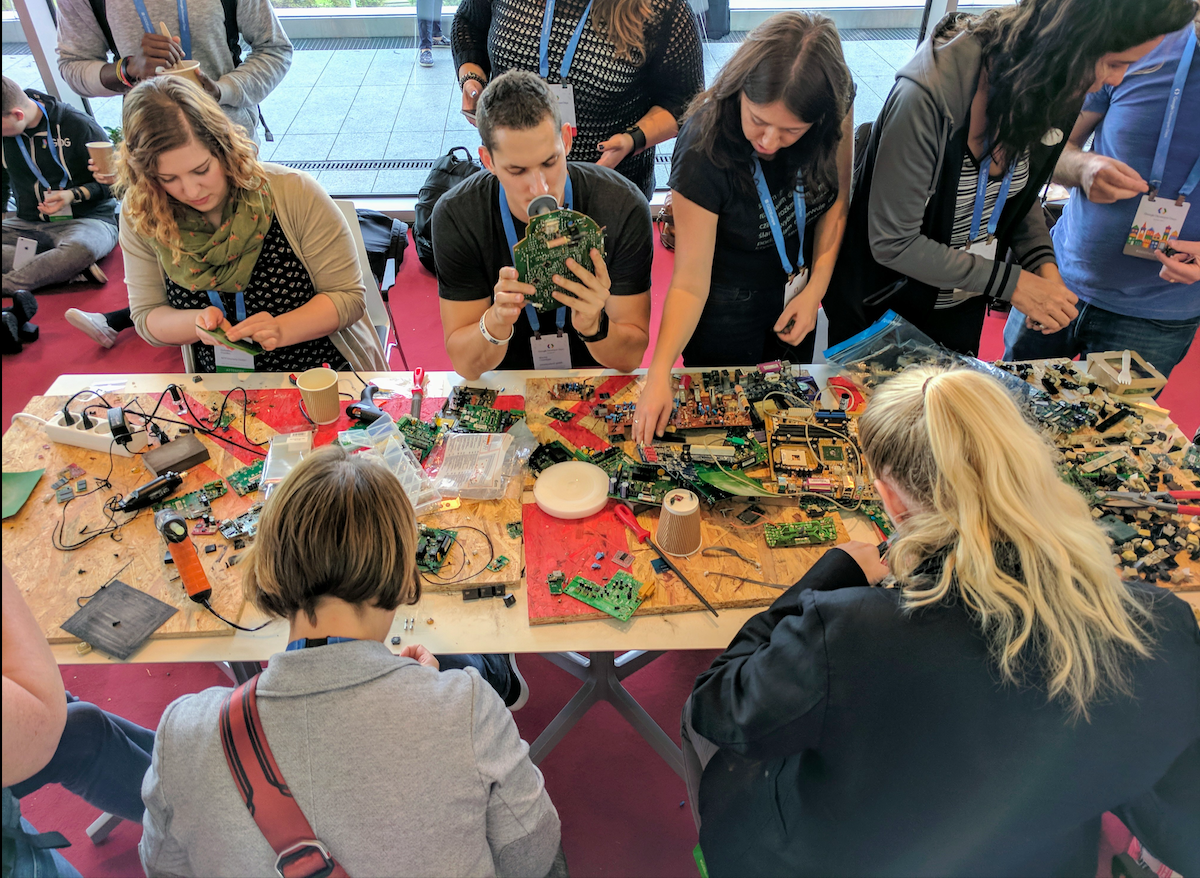
I have been interested in the topic of IoT and Android Things for a long time, so I went to the conference on reports on this topic. From the reports, it became clear that Google continues to develop the Android Things platform and related infrastructure for it. Such steps have a positive effect on reducing the threshold for entering the topic of developing devices based on microcontrollers. A pleasant surprise was the box with the NXP Pico Pro Maket Kit , which was received by the conference participants. This gesture inspired people who did not touch the world of iron to try themselves in this area.
Separately, it is worth noting the ML direction of the company. As they said on Google I / O 2017, the company took the AI-first course and encourages others to do the same. Appeals are backed up by appropriate tools that are designed for developers and analysts. In addition to the already familiarTensorflow and the Cloud ML API (Vision, NLP, etc.), I learned about the existence of Machine Learning Nanodegree 's Udacity course , which uses Tensorflow . The conference showed the current level of interest in ML from the community. Most of the people I saw were right next to the booth where googlers answered questions about ML.
Well, the presentation of ARCore became a cherry on the cake, for me personally . A decent response from "some other company" and its ARKit;) It's nice that now it works not on one specific device as before, but on quite ordinary Pixel & Nexus. For inexperienced in graphic modeling introduced a set of tools Blockswhich helps to create 3D models. The sophisticated were offered the Rajawali rendering engine , and for the full Jedi they left raw OpenGL ES .

Timoshilov Dmitry ( @HellBurund ), lead Android developer of Redmadrobot
Sundar Pichai believes that in the coming years, Mobile-first will be replaced by AI-fst. Google Assistant, a personal assistant, is one of Google’s key products in this area. It was presented at Google I / O 2017, and now it is clear that Assistant is actively developing. During the demo, the Google Assistant looked amazing. The developers are going to make it possible to speak with the device in the same way as with a person: in long or short phrases, without selecting words, to conduct a full-fledged conversation. Long colloquial phrases like:
“can you please tell me how is the weather going to be tomorrow in Krakow” are already being processed correctly .
In this case, the Assistant takes into account the context of the conversation. For example, if you ask:
“tell me about Spartak football team”
Assistant will talk about the team and its players. To find out any details, you do not need to mention Spartak again. Just ask:
“what is the stadium”
and the assistant will tell about the Opening Arena, the team’s stadium.
Context is also taken into account for correct speech recognition. Of the several hearing-like words, the system will choose the one that is more suitable for the topic of conversation.
In this Assistant is embedded in the application. If you say:
“OK Google, talk to ...”
and name the application, control will be transferred to him. You can learn more about how this works from the video from the conference .
Unfortunately, Assistant does not yet support the Russian language. But, as they managed to find out from the googlers, support is planned. It is hoped that she will appear within a year.
Another of the high-profile topics of Google I / O 2017 is Instant Apps , applications launched immediately from Google Play, without installing on the device. For a long time, the technology was in closed beta, but now googlers are ready to tell the details.
The essence of the technology is that when the user wants to use some function of the application, it does not load and is not installed on the device as a whole. Google Play downloads the module that contains the new feature, and it happens faster.
The main thing that should change is to replace the monolithic apk file comes a zip archive containing several apk: one basic and one for each feature. To do this, the application will have to be divided into modules by features.
There is an important limitation. The total volume of the base apk and any of the apk with features should not exceed 4 MB. For example, if the size of the base apk is 3 MB, then the rest should be no more than 1 MB each.
There are open questions about Instant Apps. How to make friends such an architecture with Dagger ? How comfortable is it for the user to switch from the functionality of the already loaded module to the functionality of the not yet loaded? How to combine the modularity of Instant Apps with the modularity of Clean Architecture ?
Learn more about implementing Instant Apps.here .
In general, the conference was well organized and each participant could find something interesting for himself. Each participant received an IoT kit as a gift.

The conference lasted 2 days and was held in 5 tracks: 2 tracks with reports, 2 with workshops and 1 community. The reports partially overlapped with the past I / O, for some of them it became clear how much Google has advanced in each of the disciplines.
Blinov Alexander ( @Xanderblinov ), Lead Android Developer at Redmadrobot
The main task that I set for myself was communicating with googlers and GDE. I was wondering how, from the point of view of Google engineers, to correctly solve certain problems and compare their opinion with our vision of the approach. For example, Google engineers and I reached a consensus on the architecture of Android applications - for large applications, you need to use Clean Architecture with MVP / MVVM and routing. Unfortunately, Ben Weiss and Florina Muntenescu did not know about Moxy or Cicerone , but we corrected this annoying misunderstanding;)
Google pays great attention to computing in the cloud and Firebase- This technological stack flashed in a significant part of the reports and codelabs. In addition to active promotion, Firebase provides excellent support. If you have any questions about this technology stack, feel free to write them to the relevant Firebase Community on Slack channel . If you haven’t received an answer in the channel, you can even ask questions in PM to GDE and Google engineers.
In general, Google and GDE engineers turned out to be very sociable and friendly guys who use Clean, Rx, Dagger, Kotlin and drink smoothies!
Artem Kulakov ( @ Fi5t ), Redmadrobot lead Android developer
I have been interested in the topic of IoT and Android Things for a long time, so I went to the conference on reports on this topic. From the reports, it became clear that Google continues to develop the Android Things platform and related infrastructure for it. Such steps have a positive effect on reducing the threshold for entering the topic of developing devices based on microcontrollers. A pleasant surprise was the box with the NXP Pico Pro Maket Kit , which was received by the conference participants. This gesture inspired people who did not touch the world of iron to try themselves in this area.
Separately, it is worth noting the ML direction of the company. As they said on Google I / O 2017, the company took the AI-first course and encourages others to do the same. Appeals are backed up by appropriate tools that are designed for developers and analysts. In addition to the already familiarTensorflow and the Cloud ML API (Vision, NLP, etc.), I learned about the existence of Machine Learning Nanodegree 's Udacity course , which uses Tensorflow . The conference showed the current level of interest in ML from the community. Most of the people I saw were right next to the booth where googlers answered questions about ML.
Well, the presentation of ARCore became a cherry on the cake, for me personally . A decent response from "some other company" and its ARKit;) It's nice that now it works not on one specific device as before, but on quite ordinary Pixel & Nexus. For inexperienced in graphic modeling introduced a set of tools Blockswhich helps to create 3D models. The sophisticated were offered the Rajawali rendering engine , and for the full Jedi they left raw OpenGL ES .
Timoshilov Dmitry ( @HellBurund ), lead Android developer of Redmadrobot
Sundar Pichai believes that in the coming years, Mobile-first will be replaced by AI-fst. Google Assistant, a personal assistant, is one of Google’s key products in this area. It was presented at Google I / O 2017, and now it is clear that Assistant is actively developing. During the demo, the Google Assistant looked amazing. The developers are going to make it possible to speak with the device in the same way as with a person: in long or short phrases, without selecting words, to conduct a full-fledged conversation. Long colloquial phrases like:
“can you please tell me how is the weather going to be tomorrow in Krakow” are already being processed correctly .
In this case, the Assistant takes into account the context of the conversation. For example, if you ask:
“tell me about Spartak football team”
Assistant will talk about the team and its players. To find out any details, you do not need to mention Spartak again. Just ask:
“what is the stadium”
and the assistant will tell about the Opening Arena, the team’s stadium.
Context is also taken into account for correct speech recognition. Of the several hearing-like words, the system will choose the one that is more suitable for the topic of conversation.
In this Assistant is embedded in the application. If you say:
“OK Google, talk to ...”
and name the application, control will be transferred to him. You can learn more about how this works from the video from the conference .
Unfortunately, Assistant does not yet support the Russian language. But, as they managed to find out from the googlers, support is planned. It is hoped that she will appear within a year.
Another of the high-profile topics of Google I / O 2017 is Instant Apps , applications launched immediately from Google Play, without installing on the device. For a long time, the technology was in closed beta, but now googlers are ready to tell the details.
The essence of the technology is that when the user wants to use some function of the application, it does not load and is not installed on the device as a whole. Google Play downloads the module that contains the new feature, and it happens faster.
The main thing that should change is to replace the monolithic apk file comes a zip archive containing several apk: one basic and one for each feature. To do this, the application will have to be divided into modules by features.
There is an important limitation. The total volume of the base apk and any of the apk with features should not exceed 4 MB. For example, if the size of the base apk is 3 MB, then the rest should be no more than 1 MB each.
There are open questions about Instant Apps. How to make friends such an architecture with Dagger ? How comfortable is it for the user to switch from the functionality of the already loaded module to the functionality of the not yet loaded? How to combine the modularity of Instant Apps with the modularity of Clean Architecture ?
Learn more about implementing Instant Apps.here .
In general, the conference was well organized and each participant could find something interesting for himself. Each participant received an IoT kit as a gift.