
 August 31, 2017 at 09:25
XBRL: Just About the Complex - Chapter 6. Diving into XBRL - Part 6. Multidimensionality
- Transfer
6.6. Multidimensionality
Hypercubes with one dimension are no problem, are they? In this final chapter, let's see what the dimension taxonomy and report will look like if we combine the two dimensions into one hypercube.
This will lead to changes in all parts of the taxonomy - basically, discarding elements that are no longer needed, and replacing several elements with one combined one:
- Basic concepts
Now we do not need to distinguish between the two dimensions, so we can get rid of the concepts of nr_employees_by_age and nr_employees_by_gender . - Dimension Taxonomy
Since we can use the gender element to denote “all gender groups”, similarly add the all element to the age_group_type type .
- Template Taxonomy
We can replace the hc_age_group and hc_gender hypercubes with one common hc_gender_x_age_group hypercube .
6.6.1. Definition Link Base
Looking at the reference database of definitions becomes interesting. First of all, definitionLinkgender-related relationships between basic concepts and a hypercube, as well as between a hypercube and a dimension, are removed, only the relationship between the dimension and its elements remains.
Age groups definitionLinkcan be completely removed by replacing it with a definitionLinknew hypercube.
Notice that the arcs are hypercube-dimensionordered. Also, note that the attribute targetRolein the arc to the gender dimension indicates the role with which the dimension elements were defined. This allows you to switch from one basic set to another, forming DRS .
6.6.2. Report
Report contexts must be changed to provide all values for both dimensions. The following example shows some of the possible contexts (if you give a complete list, you get tired of scrolling).
12-34567 2005-01-01 sd:male all 12-34567 2005-12-31 sd:female .. - 20 The first context can be used to convey facts about the number of male employees at the beginning of the reporting period, regardless of their age. The second context is for facts about the number of female employees under the age of 20 at the end of the reporting period.
Please note that the order of measurements should be the same as in the definition reference database.
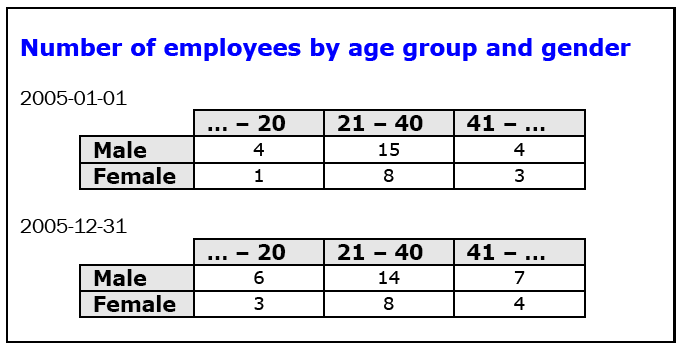
The visualization of such a report may look different, not necessarily as in our application that displays it in such a tabular form (and loses the final values somewhere):
6.6.3. If in doubt, use the default value.
Let's see if we can somehow make life easier for the drafters of the report who want to convey facts by age groups regardless of gender groups. As you recall, you can use the domain_gender domain element to indicate all genders . We can help by making it the default dimension member.
Now the context may look like this:
12-34567 2005-01-01 .. - 20 The XBRL report creation software will automatically substitute the value of domain_gender .
6.6.4 Never Ask a Lady About Her Age
The final touch in our taxonomy of dimensions is the exclusion of certain combinations of elements. Let's assume that we are real gentlemen who do not ask a woman about her age. Define the role and hypercube:
A gentlemen never asks a lady about her age link:definitionLink The female gender and all age groups are included in the hypercube, using the gentleman role to keep it separate from other hypercubes.
Create the necessary locators:
The hypercube fem_x_age_group includes the same two dimensions as gender_x_age_group .
But the domain of elements of the gender dimension includes only female .
Finally, we create a relationship notAllbetween the basic concept of nr_employees and our new hypercube, which prohibits the use of the combinations of elements indicated in it. This very effectively deprives us of the opportunity to convey the fact of women of any age group.
Conclusion
This concludes our work with XBRL. As shown in this chapter, you can do a lot with it, but you should carefully study how to create a taxonomy and its reference database, while remaining within the boundaries indicated by the XBRL Specification.
PS from the translator
I hope this translation helped you understand the basics of XBRL a bit and, perhaps, even put the new knowledge into practice.
If you are interested in the topic of XBRL, send me your questions, ideas for new articles and suggestions for translating materials that you think are useful from English.
I invite you to participate in the survey and thank you all for your attention and your comments!
Chapter navigation
Only registered users can participate in the survey. Please come in.
What connects you to XBRL?
- 14.2% Curiosity, I just walked past 2
- 0% I purposefully study to broaden my horizons 0
- 71.4% Need for work - now or in the near future 10
- 14.2% I am a member of the pilot group of the XBRL project of the Bank of Russia, I participate in working meetings 2