April 1, 2017 at 14:10
Intel processors will become ternary

For many decades, the increase in processor performance driven by Moore’s law was achieved through improved process technology. However, the end of this race is just around the corner: we have come close to the limit dictated by the laws of physics. How will we “cheer up” the processors further? Intel strategists two years ago came to the conclusion that one of the solutions to this problem could be the transition from binary to ternary number system. A number of steps in this direction have already been taken, and now we can say with certainty: the next generation of Intel Core processors, followed by Intel Xeon, will be ternary.
The binary number system and binary logic used now in the computer are familiar and seem to be optimal, in fact this is just one of the options, not without its drawbacks. The numbering system 0/1 is simple, but the binary digit is small, and the yes / no logic is in some cases too crude and inflexible. Since the time of Aristotle, scientists have identified ternary logic, where in addition to “yes” and “no” there is a third indefinite meaning, as the most natural for the process of cognition. In terms of arithmetic, the ternary count also has a gain over the binary.
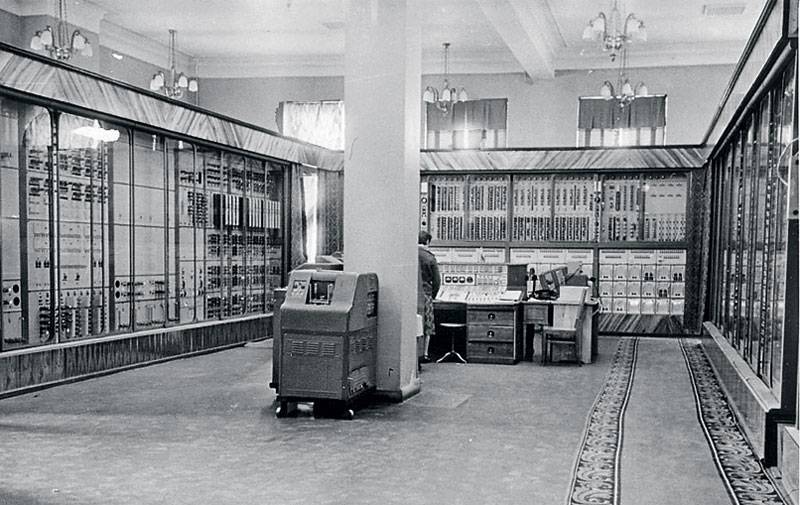
Trinity computer "Setun"
Guided by just such considerations, in the 60s of the last century a group of scientists from Moscow University, under the leadership of Nikolai Petrovich Brusentsov, developed and manufactured the triple Setun computer, which was then mass-produced. Later, the same team created an improved Setun-70 model. After that, the ternary computers were forgotten for more than 40 years, until then, until they were given a rebirth by Intel engineers.
One bit of the ternary record - trit - may contain the value "+", "-", "0". The ternary system is most optimal from the point of view of the digit capacity of the number, since the triple is the closest integer to the Euler number - e. 6 trits are combined into a trait - it is easy to calculate that the information capacity of a trait is almost three times more than a byte. The rate of addition of ternary numbers is one and a half times greater than binary numbers, if we add here the savings in data transfer, reading / writing, etc., we get a twofold increase in computer performance without any technological tricks.
“The game is worth the candle” - Intel decided and in 2015 launched the Dallas program. To date, much has been prepared:
- the two-step tick-tock cycle of the processor release has been replaced by a three-step, ternary;
- changes were made to the processor architecture, detailed information on this should appear on the spring IDF;
- specifications of hardware components were prepared for transfer to third-party manufacturers of PC components;
- optimized core software tools and libraries of Intel, especially compilers.
Note that the ternary set is natively compatible with the binary, since the latter is a subset of the former. However, to achieve maximum performance, optimization of all software will be required, which will be gradually implemented.
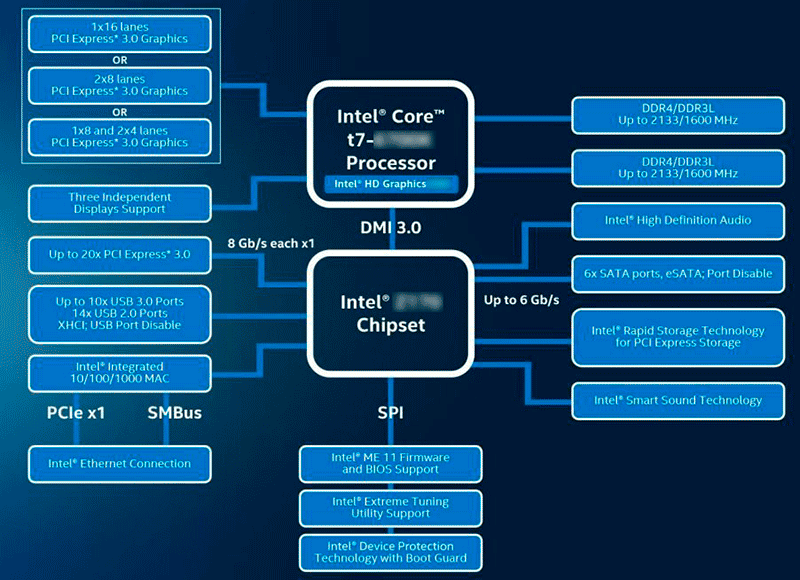
The schematic diagram of the ternary processor is almost no different from the binary.
The first models of ternary processors Intel Core (they will have an index t instead of i, for example, Core t3) will appear next year, then the chipset for them will be ready. The news seems sensational, but this is a necessary and timely step, which you just need to decide. We have no doubt that ternary processors have a great future.
Upd. When reading, please pay close attention to the date this post was created.