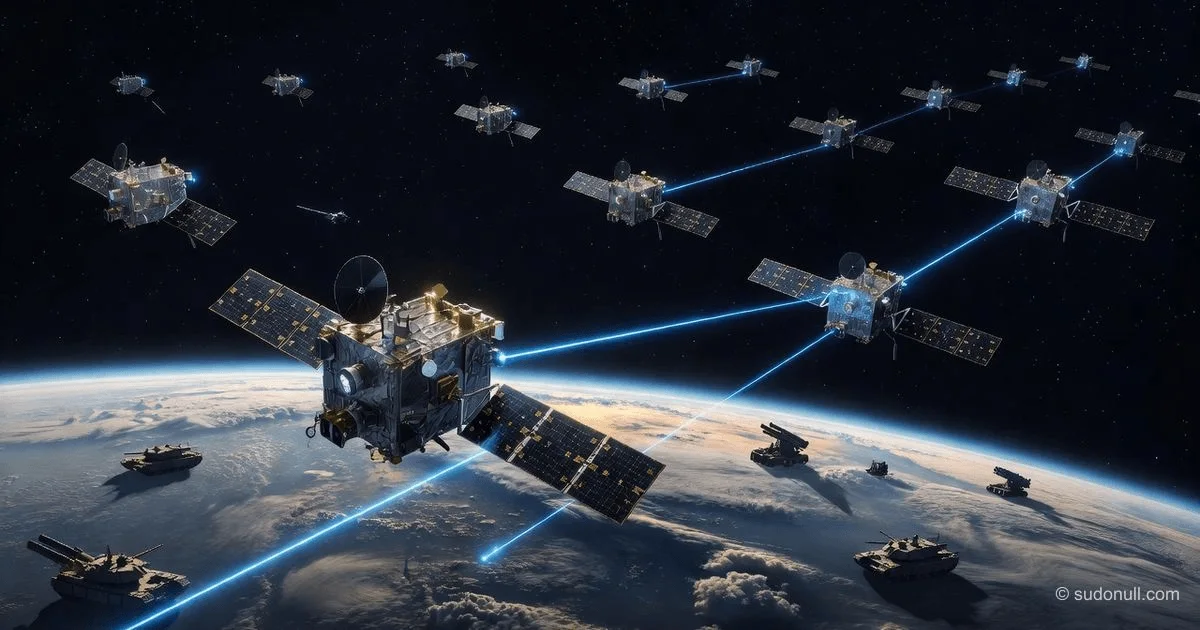
U.S. Space Force Awards SpaceX $4.16 Billion Contract for Tracking System
Elon Musk's company will provide satellite technology for the Space-Based Airborne Moving Target Indicator program. The system is designed to detect and track moving ground targets.
Analytical article: $4.16 billion from the U.S. Space Force — SpaceX breaks Lockheed Martin's monopoly on military intelligence
[The Gist]: What's Really Happening
The official wording about a "system for detecting moving ground targets" is just a cover for a much more fundamental shift. The U.S. Space Force has awarded SpaceX a $4.16 billion contract to build the Space-Based Airborne Moving Target Indicator (SB-AMTI) satellite constellation. Essentially, this is an attempt to replace aging JSTARS radar aircraft (whose total support costs have reached $13 billion) with an "eye from space" that cannot be shot down.
The real essence of the deal lies not in technology, but in politics. SpaceX won the competition, beating out the traditional "monopolist" of military space intelligence — Lockheed Martin together with Northrop Grumman. This is an unprecedented case where a commercial company, rather than the "old guard" of defense, gets a key role in Architecture 2 — the Pentagon's tactical troop control system.
And here lies the main paradox: Elon Musk, on one hand, negotiates with China on technology transfer through commercial projects, and on the other, receives billions to create a system that will monitor Chinese army movements in real time. This conflict of interest remains behind the scenes, but it defines all the risks of this grand deal.
Timeline and Context
The contract culminated years of struggle within the Pentagon between supporters of traditional expensive satellites (Lockheed Martin) and supporters of "distributed constellations" (SpaceX). In 2025, the U.S. Space Development Agency (SDA) launched the Tranche 1 program, laying the foundations for the network. Now it's about expanding this network to a "carpet" capability — where no tank or missile launcher can hide from the gaze of hundreds of low-orbit satellites.
Insider info that didn't make it into press releases: the contract was signed under intense pressure from the White House. The presidential administration, faced with the need to contain China in the Indo-Pacific region, ordered the acceleration of SB-AMTI deployment. Lockheed Martin could not guarantee speed because their production lines at the Sunnyvale plant are busy assembling secret satellites for the National Reconnaissance Office (NRO).
At the same time, SpaceX promised to launch the entire constellation into orbit by the end of 2027. Typically, military projects of this scale stretch over 7-10 years. But Musk is willing to take risks, using Starshield technology — a secure version of Starlink. If he succeeds, it will be the biggest humiliation for "Old Space" since the advent of the Falcon 9.
Who Wins and Who Loses
The main beneficiary is SpaceX. Musk gets more than just money. He gets access to the most secret military algorithms. Synthetic aperture radar (SAR) requires computing power comparable to managing nuclear forces. By controlling both satellites and ground stations, SpaceX becomes a key link in the "decision-strike" chain.
The SDA (Space Development Agency) wins. This young organization has fought for decades for funding against the "heavy" satellites of the U.S. Air Force. SB-AMTI's success will prove that hundreds of cheap satellites are more effective than a dozen expensive ones. This will upend the military space market — Lockheed and Boeing will have to urgently switch to assembly-line production instead of bespoke "exclusives."
Lockheed Martin and Northrop Grumman lose. This is not just a loss of $4 billion. It's a loss of reputation as "indispensable guardians." Analysts are already calculating: if SpaceX successfully launches SB-AMTI, the next contract for the Next-Generation Overhead Persistent Infrared (Next-Gen OPIR) missile defense system could also go to Musk. Lockheed's stock could drop 5-7% in the long term if they don't present an urgent counter-prototype.
China loses. Beijing is actively developing its "Thousand Sails" system (an analog of Starlink), but their technology for tracking ground targets from low orbit still lags by 2-3 years. SB-AMTI will make the U.S. Navy and Air Force "invisible" to Chinese missiles, allowing them to strike from areas where Chinese radars cannot reach due to the curvature of the Earth.
What the Media Isn't Saying
First and most dangerous insight: The SB-AMTI network may be vulnerable to jamming "in its own way." Starlink technology uses laser inter-satellite links (OISL). But if an enemy disables key satellites, the entire network will break into clusters. SpaceX has an automatic recovery protocol, but whether it can work in an active war is a big question. Starlink has never been tested under direct state-level cyberattacks.
Second hidden detail: Elon Musk's role as an intermediary. Musk publicly advocates for peace and free trade, including technology with China. This creates a unique situation: the man who owns the "eyes" of the Pentagon has business interests (Tesla) in China. This causes concern in U.S. intelligence. It's possible that the SB-AMTI satellites have hardware backdoors controlled by a third party (e.g., Space Force command), to which Musk and his team have no access. But perfect separation doesn't exist.
Third omission: SB-AMTI cannot see through clouds and forests. This is not advertised in press releases, but any synthetic aperture radar (SAR) has limitations. It works well for columns of vehicles in deserts or steppes. But it is nearly useless in the dense jungles of Vietnam or in heavy cloud cover over the North Atlantic. The system is being built for a war with China in the Pacific, where there are many clouds. This means the Pentagon will still have to keep expensive reconnaissance aircraft (like the E-7 Wedgetail) in the air as a backup. So the "revolution" of canceling JSTARS may be premature.
Forecast: Next 30 Days and 90 Days
Next 30 days (until early July 2026). We will see a wave of lawsuits and appeals from Lockheed Martin. Defense contractors will argue that SpaceX underbid, not accounting for cybersecurity costs. Lockheed has hired former Senate Antitrust Committee staff to prove that "Musk's monopoly" harms national security. However, the chances of canceling the contract are near zero — too many geopolitical commitments to AUKUS allies (Australia, U.K., U.S.) are at stake.
Next 90 days (until September 2026). Watch SpaceX's factory in Redmond, Washington. That's where the first antennas for SAR satellites will be cast. By September, data will leak on whether SpaceX stayed within budget. The margin on military contracts for SpaceX is usually lower than on commercial launches. If Musk starts delaying commercial Starlink deliveries for SB-AMTI, we'll see investor discontent.
On a parallel track: expect a response from China. Beijing will likely accelerate the launch of its Yaogan-30 constellation and announce the creation of a similar system, "Oko-2." But the main event won't be in space, but in politics: Musk may be called to closed hearings before U.S. intelligence agencies to testify about the nature of his ties with Chinese leadership. This will be the most nerve-wracking moment for Tesla — shares could dip if investors fear that SpaceX's "weapons" status will harm Tesla's consumer brand in the Chinese market.
If SB-AMTI is ready by 2027, it will radically change the balance of power in the Pacific. The U.S. will be able to track the movement of every aircraft carrier and air defense division without entering China's air defense zone. This is called a "revolution in military affairs," and it happened before the eyes of journalists who thought they were just writing about a contract.
— Editorial Team








No comments yet.