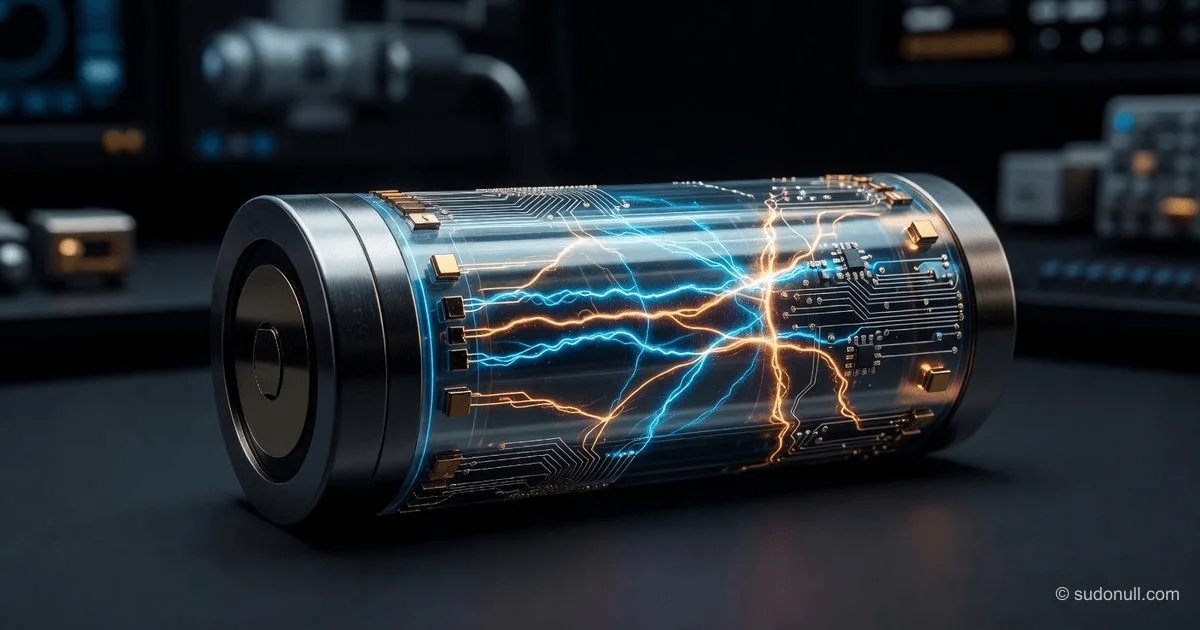
GM invests $900 million in revolutionary LMR battery development
The company is betting on next-generation lithium-manganese batteries in a new cell development center. The new chemistry will reduce the cost of the Chevrolet Silverado EV by $6,000 while maintaining range.
Analytical article: GM's $900 million on LMR batteries is not a technological breakthrough, but a desperate attempt to catch up with China
The gist: what's really happening
The official story about "revolutionary lithium-manganese batteries" and reducing the cost of the Chevrolet Silverado EV by $6,000 is a pretty wrapper for a much more alarming reality. General Motors has found itself in a technological trap: its proprietary Ultium platform with nickel-manganese-cobalt-aluminum (NMCA) cells turned out to be too expensive for the mass market. Competitors from China, primarily BYD and CATL, have long been using LFP chemistry in budget models, and GM is only now, two years after starting mass production of Ultium, admitting that its "premium" strategy was a mistake.
Behind these investments is Kurt Kelty, who joined GM from Tesla in 2024 and essentially took on the mission of saving the company's battery division. Kelty is the person who was responsible for battery technology at Tesla during the Model S and Model 3 era. He knows what production scaling is, and his experience is now critical for GM. But the problem is that GM spent $900 million not on a new lab—that was its Wallace Battery Cell Innovation Center, opened in 2022. The new Battery Cell Development Center (BCDC) is a bridge between R&D and production. The bridge that GM has lacked for the past three years, and whose absence has cost the company billions.
The real gist: GM is not making a technological breakthrough. It is catching up. LMR chemistry is known in academic circles as Li₁.₂Ni₀.₁₃Mn₀.₅₄Co₀.₁₃O₂, and it has been worked on at Argonne National Laboratory since the 2010s. CATL has already commercialized LMR-like materials for the energy storage market in China. Ford announced LMR back in April 2025, albeit without specific timelines. GM is trying to pass off as its own discovery what is actually the result of 10 years of research in collaboration with LG Energy Solution. And $900 million is not so much an investment in new technology as it is a payment for management mistakes and lost time.
Timeline and context
The roots of this story go back to the 2010s, when GM and LG began joint research on battery chemistries. By 2020, LMR development accelerated—GM saw it as a way to bypass high cobalt and nickel prices. In 2022, GM opened the Wallace Battery Cell Innovation Center, an R&D center for small-volume cell development. Around the same time, the first Ultium gigafactory in Lordstown, Ohio, began operations. But there was nothing between Wallace and the gigafactory—no way to test new chemistries at near-industrial scale.
Problems with Ultium began to surface in 2024. Module assembly was so complex that GM delayed the launch of several models by 12-18 months. The high nickel content (about 85%) made the batteries expensive. In mid-2025, GM announced its decision to switch to LMR for pickups and full-size SUVs. And in June 2026, TechCrunch published a report from the new BCDC—the missing link.
A key detail that most missed: in May 2026, BloombergNEF published a battery supply chain ranking in which China regained first place. This was a cold shower for the American industry. GM, which prided itself on "American" Ultium batteries, realized that without LFP or LMR on price, it could not compete with BYD.
Another important chronological detail: the BCDC will produce only 2,500 cells per day—about 0.5 gigawatt-hours per year. For comparison, the Ultium gigafactory in Tennessee produces 300,000 cells per year—45 gigawatt-hours. The BCDC is a small fraction of capacity. But its task is not volume, but iteration speed. Each test run costs about $200,000, while launching a full line at a gigafactory costs tens of millions.
Who wins and who loses
Kurt Kelty and his team win. For Kelty, who came from Tesla, LMR is his "product footprint" at GM. If the technology takes off, his name will be associated with it. If it fails, he becomes the scapegoat. The risk is high, but so is the reward. Kelty has already reshaped GM's battery strategy, betting on three chemistries instead of one: NMC for premium, LMR for mass long-range, and LFP for the cheapest models.
LG Energy Solution wins. The South Korean partner gets an exclusive contract to commercialize LMR in the US. The Ultium Cells joint venture, created by GM and LG, will produce LMR at LG's plant in Tennessee, starting with pre-series production in late 2027. LG Energy Solution also gains access to data and patents that can be used in other projects.
Argonne National Laboratory wins. The basic principles of LMR chemistry were developed there. GM and LG are commercializing the result of decades of government investment in fundamental science. Argonne will receive royalties—standard practice for national labs. But more importantly, LMR becomes a "success story" that justifies further funding.
Element 25 wins. GM invested $85 million in this Australian manganese supplier in 2023. Now that LMR is 60-70% manganese, that investment looks like a genius move. Element 25 will become a key link in GM's supply chain, which is critical in the global competition for resources.
GM itself loses—in the short term. $1.6 billion in write-downs in 2025, thousands of job cuts, a freeze on full-size EV pickup updates. Investors are tired of promises. GM needs to show results. But LMR won't appear in production vehicles until at least 2028. That's almost two years during which GM will sell expensive Ultium models and lose market share.
The US market as a whole loses. While GM spends $900 million on catch-up technology, CATL and BYD are already building plants in Europe and Southeast Asia. American automakers compete not only with Chinese companies but also with European ones that have access to Chinese batteries without tariffs. Trump's tariffs on Chinese cells are 73.4%, but that doesn't solve the problem—it only postpones it.
What the media isn't telling you
First and most important non-obvious insight: LMR batteries could be a "firework." And I don't mean that figuratively. Academic literature and industry research directly indicate: LMR materials have fundamental problems with oxygen release at high voltages. When oxygen leaves the crystal lattice, it can lead to thermal runaway—the very fire that all EV manufacturers fear. CATL's patents describe stabilization methods through doping and coatings, but these methods have not yet proven effective at gigawatt-hour scale.
GM may limit voltage below 4.6 V to avoid degradation—but then LMR loses its energy density advantage. Playing with chemistry is always a balance between risk and performance. And GM is betting that its 10 years of research (including the equivalent of 1.5 million miles of lab testing) have found that balance. But real-world road operation is not a lab.
Second hidden detail: LMR could be stillborn because of LFP. Let me explain. LFP batteries (lithium iron phosphate) are a direct competing technology. LFP has lower energy density (about 400 Wh/L vs. 700 for LMR), but they are much safer and cheaper. China owns virtually all intellectual property on LFP. But American companies cannot use Chinese LFP cells due to tariffs, and building their own LFP production from scratch requires $5-10 billion in investment and 5-7 years.
So GM chooses LMR—because this technology can be produced without Chinese patents. But if China dumps LFP on the global market (and it is—LFP cell prices have fallen 30% in the last two years), LMR could become uncompetitive. GM has bet on a technology that "might be" cheaper than LFP at the same energy density. "Might be" is the key phrase.
Third omission: Boeing 787 and lithium-ion battery—a historical analogy. When Boeing developed the Dreamliner, it bet on new lithium-ion batteries to reduce weight. In 2013, batteries caught fire on two aircraft, the entire fleet was grounded for three months, and Boeing lost $600 million. The problem was not the chemistry itself, but unproven scaling and production control. GM's BCDC now produces 2,500 cells per day. But the gigafactory will produce 100 times more. Will GM repeat Boeing's fate? The question is not whether a defect is possible. The question is how quickly GM will detect and fix it.
Forecast: next 30 days and 90 days
Next 30 days (through early July 2026). The first LMR cells should pass through the BCDC in 2026—Gallegos expects the first batches to appear "later this year." This means the process is already underway, and in the coming weeks we should see either an announcement of a successful test batch or silence. Silence would be a bad sign—it could mean that the yield is below 85%, which, according to McKinsey, makes the technology non-commercial.
Also in the next 30 days, I expect a reaction from Ford. Ford already announced LMR in a LinkedIn post in April 2025, but without specific timelines. GM has now named 2028. Ford must either confirm that it has a roadmap or admit that GM has overtaken it in this race. If Ford announces its own LMR project in the coming weeks, it means the battery chemistry war is entering a new phase.
Next 90 days (through September 2026). By then, the first digital simulation results should appear. GM has already used AI models for simulation—150 million CPU hours for LMR. That's more than for some aircraft engines. The BCDC's digital twin allows testing recipe changes without physical costs. Within 90 days, GM may publish LMR performance data in various operating modes—from city cycles to towing a Silverado trailer. If the data shows LMR energy density is 30% higher than LFP (as promised), GM's stock could rise. If the difference is less than 20%, it will be a disappointment.
Also within 90 days, we will see how the market reacts to GM's claim of reducing the Silverado's cost by $6,000. That's a powerful promise. But it is based on the assumption that LMR cells will be produced at the same cost as LFP. If the cost turns out higher, the price reduction will be smaller. Competitors—primarily Tesla with the Cybertruck and Ford with the F-150 Lightning—are closely watching the numbers. If GM cannot deliver on its promise, the reputational hit will be severe.
Separately, watch NASA's position. Lunar Outpost won a NASA contract for the Pegasus lunar rover, and GM Defense supplies batteries for it. If GM can claim that LMR is used in the space program—even in modified form—it will be a powerful signal of trust in the technology. The extreme temperature conditions of the Moon, from -180°C to +120°C, are an excellent proving ground for LMR stability. If the batteries hold up, GM will get not only PR but also engineering data that is hard to obtain on Earth.
— Editorial Team







No comments yet.