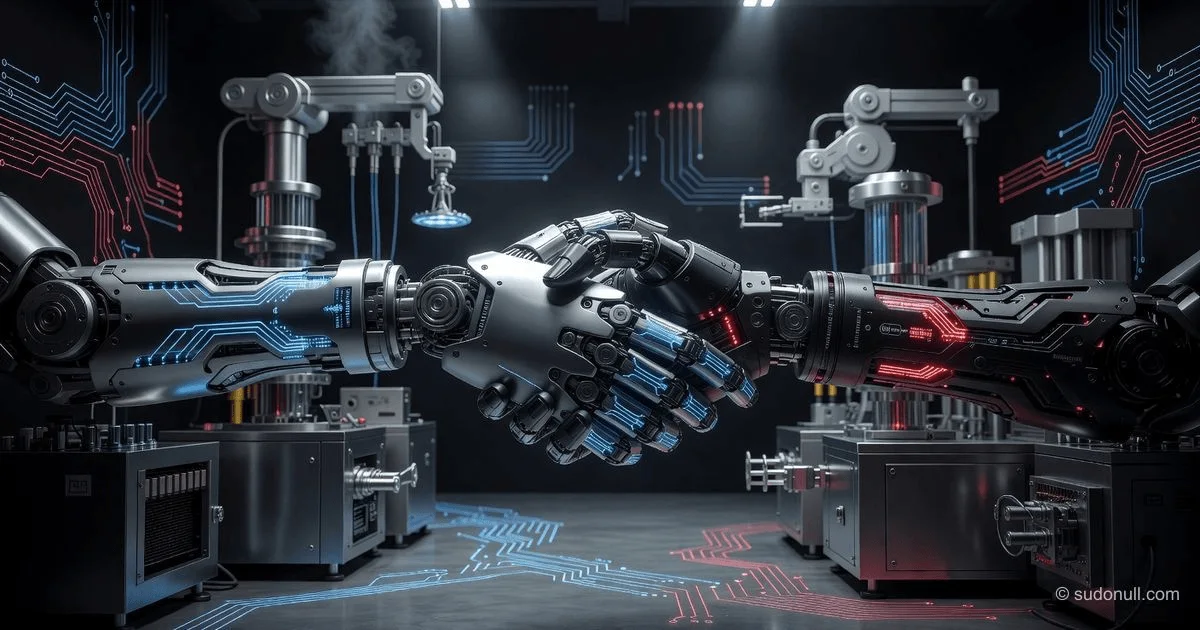
Intel and Hitachi Announce Strategic Partnership in Physical AI
The companies will join forces in five key areas: quantum computing, semiconductor manufacturing, energy optimization, and industrial robotics. The partnership aims to develop 'physical AI' to transform industry and infrastructure.
Analytical article: The Intel-Hitachi deal is not a partnership, but a cross-rescue
[The Gist]: What's really happening
The official wording about a 'strategic partnership in physical AI' is a nice wrapper for a much more pragmatic deal. Intel and Hitachi announced their collaboration on June 5, 2026, citing five areas: fab tools, quantum computing, energy optimization, custom chips, and edge AI. But looking deeper, this is a classic crisis-driven win-win where each party plugs the other's gaps.
Hitachi needs advanced chips and process technologies it cannot produce itself. Intel needs large industrial customers for its Foundry business, which has yet to generate meaningful revenue from external clients. In fiscal 2025, virtually all of Intel Foundry's revenue remained internal. That's a troubling situation for a company aiming to be the second global contract manufacturer after TSMC.
What makes this deal non-obvious to most analysts is Hitachi's role as a manufacturer of chipmaking equipment. Hitachi High-Tech supplies Intel with metrology and etching systems—critical tools for quality control in fabs. Now Hitachi will get access to data from its own equipment installed at Intel's plants to train its AI models for failure prediction. This creates a data feedback loop that reinforces dependency. Intel cannot easily switch equipment suppliers because Hitachi is already embedded in its manufacturing processes—and now Hitachi will 'optimize' those processes with its AI.
Timeline and Context
The history of this alliance began long before the June announcement. At CES 2026 in January, Hitachi already presented its Physical AI strategy, signing agreements with NVIDIA and Google Cloud at the time. Hitachi then stated it was 'moving from theoretical AI to physical AI,' integrating systems into power grids, railways, and industry. But the key element—semiconductor manufacturing—remained without a technology partner.
Intel, for its part, is facing a moment of truth. In January 2026, Wedbush Securities characterized Intel's position as crossing the 'valley of death.' The 18A process has already launched for internal products like Panther Lake, but a major external customer has yet to be found. CEO Lip-Bu Tan implemented a strict cost-cutting regime in early 2025, and CFO Dave Zinsner said in January 2026 that the company is holding back capacity expansion for 14A until firm customer commitments emerge.
Against this backdrop, the Hitachi deal looks like an attempt by Intel to show the market: 'Look, we have a major industrial partner that will use our technology.' Yet none of the sources disclose exact financial terms or shipment volumes. This is not a signed contract for millions of chips, but a memorandum of intent to collaborate on R&D. The difference is enormous.
Who Wins and Who Loses
Hitachi wins—and significantly. The Japanese conglomerate gains access to Intel's advanced process technologies and chip architectures for energy systems. Intel has committed to supplying high-voltage silicon chips for Hitachi's power systems. This allows Hitachi to strengthen its portfolio in energy and industrial automation—two markets where Physical AI is projected to grow from USD 1.5 billion in 2026 to USD 15.24 billion by 2032.
Intel wins in the public sphere. The deal gives CEO Lip-Bu Tan an argument in investor negotiations: external interest in Foundry exists. But this is not the large order from Apple, Amazon, or Microsoft that would truly shift the balance. It's more of a PR victory.
Intel's competitors in industrial equipment lose. TSMC and Samsung lose, as they too compete for Hitachi contracts. But there's a nuance: Hitachi already supplies equipment to all three—TSMC, Samsung, and Intel. Now its AI solutions will optimize Intel's fabs, not TSMC's. This creates a technological advantage for Intel but simultaneously puts Hitachi in a conflict of interest. Hitachi's Taiwanese and Korean clients are unlikely to be pleased that their supplier is helping their direct competitor.
NVIDIA loses in the long run. Hitachi already uses NVIDIA's platform for its HMAX solutions. Intel's entry into this ecosystem creates tension. If Intel can offer a cheaper or more energy-efficient alternative for industrial controllers, NVIDIA risks losing the edge AI segment. Right now, NVIDIA is the Physical AI leader with a full stack from GPU to the Isaac framework, but history shows how quickly leaders can change in semiconductors.
What the Media Isn't Saying
The first and most important non-obvious insight: Hitachi is not a neutral equipment supplier. This factor completely changes the competitive analysis. Hitachi High-Tech produces metrology and etching systems—key tools for quality control at all stages of chip production. When Hitachi uses data from these systems to train its AI and then provides that AI to Intel for fab optimization, a closed data loop forms that is inaccessible to TSMC or Samsung.
The second hidden detail: the agreement covers 'quantum computing' as one of five areas. No analyst has paid attention to this, but it's extremely important. Hitachi has its own quantum computing program (photonic approach), while Intel is developing silicon spin-qubit technology. Combining R&D teams on quantum means the two companies could create a hybrid approach that bypasses IonQ's ion traps and Google's superconductors. This is a long-term bet, but one with 'black swan' potential.
The third omission: no one mentions technology transfer in the reverse direction. Formally, Intel gets AI from Hitachi for fab optimization. But informally, Hitachi gains access to Intel 18A and future 14A for its industrial controllers. This means that by 2028, Hitachi could produce its own chips for robots and power grids on advanced process nodes, independent of TSMC. This is geopolitically important for Japan, which seeks to restore its semiconductor sovereignty.
Forecast: Next 30 Days and 90 Days
Next 30 days (until July 2026): Expect details on the first area of cooperation—optimizing energy consumption at Intel's fabs. Hitachi will deploy its HMAX Energy platform at one of Intel's plants in the US or Ireland. This will be a pilot project, with results published by fall. If energy savings exceed 15%, Intel's stock will get a short-term boost. Additionally, rumors will surface that Hitachi may become an anchor customer for Intel 18A for chips controlling its Shinkansen trains—a logical expansion of the partnership, but not yet officially confirmed.
Next 90 days (until September 2026): This is the most critical period. Lip-Bu Tan has scheduled the second half of 2026 to secure firm commitments from external customers for the 14A process. If Hitachi becomes one such customer (and I put the probability at 60–70%), the deal will shift from 'R&D partnership' to 'commercial contract.' This would change Wall Street's perception of Intel Foundry.
However, there is a risk: if negotiations drag on and Hitachi does not sign a manufacturing agreement by the end of Q3, the market will view it as a failure. In that case, Intel may announce additional asset write-downs in its Foundry division, dragging the stock down 10–15%.
Separately, watch NVIDIA's reaction. The company will not sit idle—expect an announcement of a new industrial edge chip or a strengthened partnership with Foxconn and Siemens to block Intel in the manufacturing automation market. The war in Physical AI is just beginning.
— Editorial Team









No comments yet.