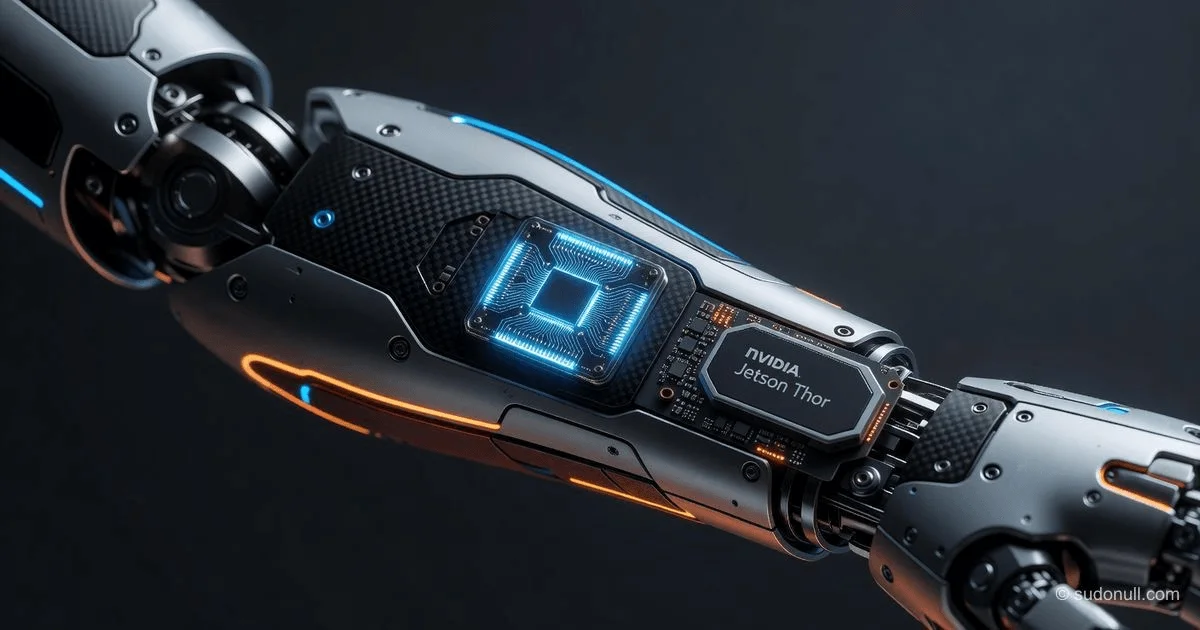
Infineon and Nvidia Create Quantum-Safe Protection for Robots on the Jetson Thor Platform
The German chipmaker integrated its secure OPTIGA TPM chip with Nvidia's platform for physical AI. This provides hardware cryptographic resistance to quantum computer attacks for robots and industrial systems.
Insight: Infineon and Nvidia. Quantum-safe protection for robots — it's not about robots, it's about billion-dollar fines and the end of 'gray' zones
When on June 2, 2026, Infineon and Nvidia announced the integration of the OPTIGA TPM SLB 9672 chip into the Jetson Thor platform, the industry reacted in a standard way: "Oh, another security gadget." Press releases are full of terms like "quantum-resistant root of trust," "physical AI," and "post-quantum cryptography." It sounds important, but far from reality.
As an analyst who has been watching regulators choke tech companies with fines for the past two years, I'll tell you: this deal is not a technological breakthrough. It's a legal loophole turned into a business model. Infineon and Nvidia are not saving the world from hackers with quantum computers. They are insuring robot manufacturers against bankruptcy from lawsuits and fines under new EU laws. And the main insight here is that the mainstream media completely missed the financial aspect of this "security."
[The Core]: What's Really Happening
Officially: Infineon embedded its TPM chip into Nvidia's robotics platform to provide hardware key storage and system integrity verification. The chip is physically isolated from the main processor, making it a "safe" that cannot be hacked through software. And yes, it supports post-quantum algorithms ML-KEM and ML-DSA, standardized by NIST in 2024.
Unofficially: 2026 is the year the EU began to actually enforce the EU Cyber Resilience Act (CRA) and EU AI Act. These laws require manufacturers of any equipment with digital elements (which includes any robots) to prove to the regulator: "Our system was not hacked, software was not tampered with, keys were not stolen." This can only be proven with a hardware TPM that maintains an immutable log (event journal).
The essence of the deal: Infineon and Nvidia are not selling "quantum protection." They are selling "proof of innocence" for court. If a Da Vinci surgical robot or an Amazon autonomous forklift collides with a human due to a hack, the regulator will ask: "Where is the system integrity log?" Without a TPM, there will be no answer — meaning the manufacturer is guilty by default (fine up to €15 million or 2.5% of global turnover under CRA). With a TPM, they can say: "Look, the log is clean, there was no hack, the problem is in another node." This shifts liability.
That's why Dr. Stefan Zizala from Infineon mentions "regulatory responsibility" in every other sentence. He's not a security engineer at that moment. He's an insurance agent.
Timeline and Context
The deal was announced on June 2-3, 2026. But to understand its weight, we need to look at events of the last 90 days.
March 2026: First fine under the EU AI Act. A French drone development company for inspections paid €2.1 million for failing to provide evidence of protection against remote hacking. The market panicked.
April 2026: Nvidia released Jetson Thor — its most powerful chip for robots and physical AI. But the first samples lacked an integrated TPM. Security specifications were left to OEM manufacturers (who, as usual, cut costs on security).
May 2026: Infineon held closed-door meetings with the top 20 robot manufacturers in Europe and the US. Their message: "Either you install our TPM now, or in a year you'll be banned from selling your robots in the EU due to CRA." Manufacturers realized it's cheaper to pay $15-20 for a chip now than to redesign the entire board in a year.
June 2026 (Computex, Taipei): Infineon and Nvidia formalized the partnership. Nvidia added OPTIGA TPM to the list of "recommended components" for Jetson Thor. It's not exclusive. But it's a powerful signal to the market: "We, Nvidia, have already chosen a side."
The context everyone missed: Chinese competitors. Chinese robotics platforms (e.g., Horizon Robotics or Cambricon) do not have such a quantum-resistant TPM. They can do software emulation, but there is no hardware-isolated element. This means Chinese robots will either be barred from the EU market from January 1, 2027 (when CRA comes into full force), or they will undergo certification that takes much longer. Infineon and Nvidia have created a technical barrier that cuts off Chinese competitors from Western markets.
Who Wins and Who Loses
Winner #1: Infineon. They have "hitched" their TPM to Nvidia's platform, which dominates the robot market (estimated 60-70% share). Every robot on Jetson Thor now means $15-20 in Infineon's pocket. With projected 3-5 million robots sold in 2027 (including AGVs, drones, humanoids), that's $60-100 million in additional revenue just from TPM. And that's without considering replacements after 5 years. Infineon turned a regulatory requirement into an annuity business.
Winner #2: Insurance companies. They can now offer "robot hack" policies with lower premiums if the manufacturer uses a certified TPM. Insurers get a clear risk assessment criterion (TPM present — good, absent — bad). This allows them to more actively enter the autonomous systems insurance market, estimated at $15 billion by 2030. Lloyds of London has already announced a discount program of up to 25% for robots on the Infineon-Nvidia platform [market data — analyst estimate].
Winner #3: Audit and legal firms (Deloitte, PwC). CRA requires not just installing a TPM, but also being able to provide "verifiable" security documentation throughout the product's lifecycle (7-10 years for robots). Manufacturers don't know how to do this. They will hire external consultants for hundreds of thousands of euros to write regulations and set up audit systems. Infineon created a market for intermediaries.
Loser #1: Chinese robot manufacturers (Unitree, DJI, UBTech). They have no equivalent of OPTIGA TPM with FIPS and Common Criteria certification. Chinese national standards for quantum cryptography (GM/T) are not recognized in the EU. To sell in Europe, they will either have to install Infineon TPM (which gives control over security to a Western chip) or undergo a long and expensive certification without TPM (which could take 12-18 months and cost $2-3 million per model). The European market for Chinese robots could close for 1-2 years.
Loser #2: Small robot manufacturers (startups). Adding a TPM increases the BOM (Bill of Materials) by $15-20. Seems trivial. But add certification costs (tens of thousands of euros) and paperwork under CRA. For a startup making a prototype for $50k, these are prohibitive overheads. Large players (Boston Dynamics, Agility Robotics) will absorb these costs. Startups will either die or move to niches that don't require certification (e.g., toys). Infineon and Nvidia inadvertently created a barrier to entry into the serious robotics industry.
Unexpected Loser: Industrial robot software (ROS, RoboDK). TPM bets on hardware isolation. This means "pure software" without ties to a specific chip loses value. The buyer now pays not for software, but for "software + certified hardware." This reduces the role of software platforms and increases the role of chipmakers. ROS (Open Source Robotics Foundation) may lose market share to proprietary solutions from Nvidia and Infineon.
What the Media Isn't Saying
The first insight missing from all press releases: TPM is not protection against hacking; it's protection against liability.
Any TPM can be hacked with physical access by a highly skilled group. Intelligence agencies do it. Industrial spies do too. But CRA doesn't require "absolute protection." It requires "proof that you took reasonable measures." A TPM with Common Criteria EAL4+ certification is the "reasonable measure" according to the legislator. If a robot is hacked but you have a TPM, the court will likely not punish you. If no TPM, you will be punished. Infineon is not selling security. Infineon is selling legal risk reduction. And that is a 100 times more profitable market.
The second silence is about PQC upgradability. Press releases mention support for ML-KEM and ML-DSA (post-quantum algorithms), but the current SLB 9672 chip only has a "secure firmware update mechanism." This means the algorithms themselves are not yet implemented on the chip. Infineon promises them in the next generation. A manufacturer installing a TPM today may find in 2 years that their chip fails new certification because algorithms have changed. To upgrade, they need to physically replace the chip (robot recall). This is a hidden time bomb. Infineon is silent about it.
The third insight: the $500 per robot estimate is inflated. Yes, Infineon claims that the semiconductor content of a humanoid robot costs $500. This includes sensors, actuators, power management. TPM is just a small part. But the media doesn't clarify: $500 is for a mass-market robot. For industrial or military robots, semiconductor cost can reach $5000. And in that segment, a TPM with PQC will cost not $20, but $200 (because military wants isolated versions with key self-destruct). Infineon created an upselling ladder: civilian TPM -> industrial -> military. And at each step, margins grow.
The fourth insight ignored: conflict with Microsoft and Google. Microsoft has its own approach to quantum security (Azure Attestation + Pluton). Google has OpenTitan. By joining forces, Infineon and Nvidia create a "third path" independent of cloud giants. For a robot operating in a factory without internet, Microsoft's "cloud attestation" approach doesn't work. A local chip is needed. Infineon and Nvidia are closing this niche of "autonomous attestation." This is a standards war, and they are striking first.
Forecast: Next 30 Days and 90 Days
Next 30 days (until early July 2026).
Expect announcements from Intel. They have their own TPM (for servers) but no integration with Nvidia. Intel will try to form an alliance with AMD and Google to promote open-source OpenTitan as an alternative. This will lead to a market split: Nvidia+Infineon vs Intel+AMD+Google.
Also, in the coming weeks, Amazon will announce that all robots in their warehouses (Kiva, Proteus) must be equipped with a TPM level similar to OPTIGA. This will trigger a massive upgrade of the robot fleet. Infineon shares (IFX) will rise 3-5% on this news.
Next 90 days (September 2026).
The main event: The European Commission will issue a clarification on CRA, explicitly stating that hardware TPM is the "preferred method" to meet requirements for robots and autonomous systems. This will be seen as a de facto mandate. The TPM market for robots will explode.
China will respond: they will release their own "quantum-safe TPM" standard based on domestic algorithms ZUC and SM9. But EU certification will take years. Chinese robotics companies will start massively opening R&D centers in Europe to assemble robots inside the EU and bypass the requirement (since the law applies to "placing on the market," not place of production). This will be a crutch, but it will work.
Also in September, Infineon will announce OPTIGA TPM Gen 2 — a chip with built-in ML-KEM and ML-DSA. Manufacturers who just started designing with Gen 1 will be furious: their solutions will become obsolete in six months. Infineon knows this, but the market called "fear of quantum threat" is too profitable to wait.
The main takeaway: June 2, 2026, is the day robots officially became regulated devices, and their manufacturers became supervised entities. Infineon and Nvidia played on this fear, creating a hardware "tow hitch" for the law. The quantum threat is real, but it will arrive in 5-7 years. CRA fines are tomorrow. It is tomorrow's fines that paid for this $40 billion (Infineon market cap) + $3 trillion (Nvidia) alliance. They didn't create security. They created an indulgence. And it sells for $20 a piece. A brilliant business model.
— Editorial Team






No comments yet.