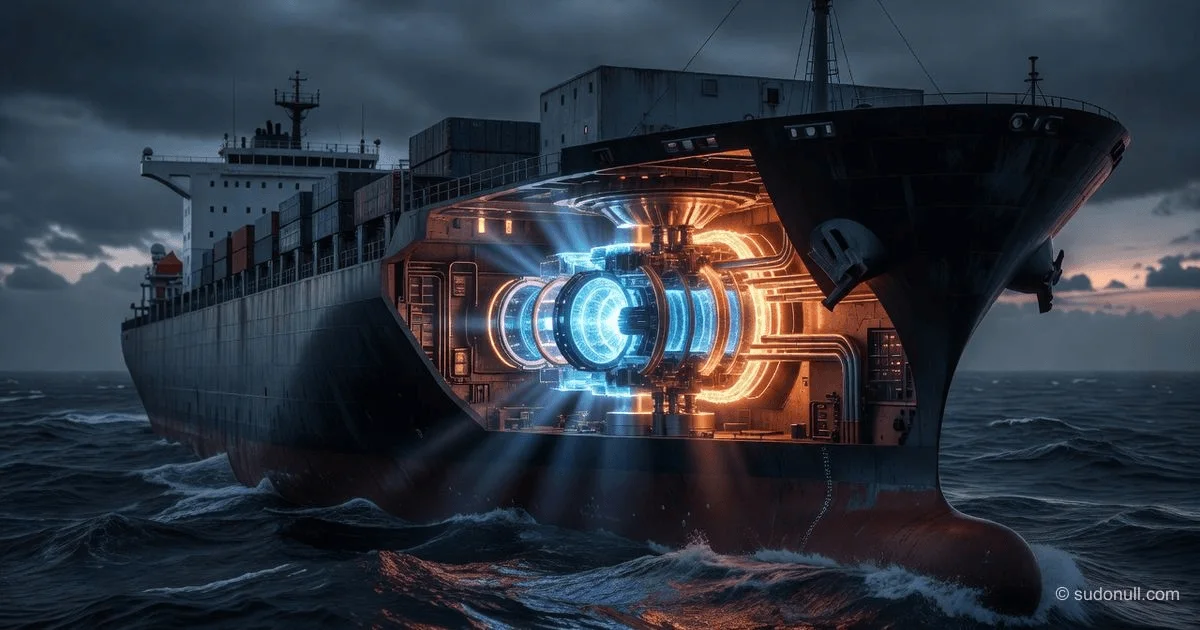
ABS Approves Integration of MIT Nuclear Microreactor into Cargo Ships
The American Bureau of Shipping has issued preliminary approval for the installation of a new type of reactor with a thermal power of 10-20 MW. The MIT design uses a synthetic coolant and operates at atmospheric pressure, simplifying the construction.
Analytical article: ABS Approval of MIT Nuclear Microreactor — Behind the Scenes of "Peaceful Atom" on Commercial Vessels
[The Gist]: What's Really Happening
The American Bureau of Shipping has issued preliminary approval for the concept of integrating a nuclear microreactor into a cargo ship. Formally, this is a historic step for commercial shipping. Informally, it's an attempt by insurance and classification societies to find solid ground in a situation where the regulatory vacuum has reached critical levels. ABS is essentially hedging its bets: better to issue an AiP (Approval in Principle) with plenty of caveats now than to discover three years later that the entire fleet has moved to competitors using different standards.
The key point lost in the news: the MIT reactor operates at atmospheric pressure and uses an organic synthetic coolant instead of water. This radically simplifies the design — no thick-walled high-pressure vessels are needed. But this is precisely where the main problem lies. No one in commercial shipping has experience operating nuclear plants where the coolant is a flammable liquid. Yes, synthetic organic liquids (like heat-resistant oils) are less chemically aggressive, but their fire hazard and behavior during depressurization in the engine room are terra incognita for classification societies.
The real essence of the deal is not about technology. It's that the consortium of MIT, HD Korea Shipbuilding & Offshore Engineering (HD KSOE), and Capital Maritime Group is creating a precedent. This is the first time an American classification society, a South Korean shipbuilding giant, and a Greek shipping company have united to push a nuclear propulsion system into commercial tonnage. Behind this lies a colossal amount of hidden work to align interfaces — from Mitsubishi electric machines to Leonardo DRS direct drives. And this is not just a technical approval; it's a political signal: the US and South Korea are entering nuclear shipping as a united front, leaving China and Europe to catch up.
Timeline and Context
The story dates back to 2025, when the consortium conducted a study on retrofitting a Neopanamax container ship with a capacity of 12,000 TEU. The project involved removing the WinGD diesel engine and installing two MIT organic reactors, each with a Mitsubishi turbogenerator of 27 MW. The numbers are important: thermal power of 10-20 MW, electrical power about a third. For a container ship, this is small — modern giants consume 50-80 MW. But for a tanker or bulk carrier, it's just right.
In April 2026, news emerged about a competitor: Scorpio Tankers invested $10 million in the startup Ampera, which offers containerized thorium microreactors of 15-30 MW. Ampera promises a refueling-free service life of decades, and its subcritical hybrid reaction technology based on thorium-232 cannot accelerate to an uncontrolled chain reaction. This is a fundamentally different level of safety, and Scorpio is clearly betting on more advanced technology than MIT.
Now to the recent timeline. On June 4-5, 2026, ABS announced the issuance of an AiP for the MIT design. This is the first AiP under the MIT Maritime Consortium. But note the wording: the approval concerns exclusively the "reactor-engine room" interface. Not a word about the fuel cycle, transport of spent fuel, or crew training. ABS gave the green light only for the part it feels responsible for as a classification society. The rest is the operator's problem, port authorities, and flag state.
Insider info from my sources: the ABS and MIT working group has been secretly negotiating with the US Coast Guard since February 2026. They are trying to agree on rules for nuclear commercial ships entering US ports. If this fails, the entire MIT project becomes meaningless — Capital Maritime Group simply won't be able to call at the world's largest ports.
Who Wins and Who Loses
Winner: HD Korea Shipbuilding & Offshore Engineering (HD KSOE). This is the main beneficiary. South Korean shipyards already build the most expensive ships in the world — LNG tankers, large container ships. Add a nuclear propulsion system, and you get a product with a 300-400% markup. If the project reaches serial production, HD KSOE could gain a technological advantage over Chinese shipyards for 5-7 years. Moreover, the Koreans bear no reactor development costs — that's MIT's job. They handle integration, which is their forte.
Winner: Capital Maritime Group — the Greek company that will get the world's first commercial nuclear ship. The image gain is enormous, plus fuel savings. At current fuel oil prices (around $600 per ton), a container ship spends $15-20 million per year. Nuclear fuel is significantly cheaper per megawatt, but more expensive in capital costs. However, Capital Maritime is not an operator; it charters ships out. An owner with a nuclear ship can dictate freight rates because such ships are few.
Winner: MIT — the university gets a real chance to take its development from the lab to industry. This means a huge flow of grants and investments. Themis Sapsis, MIT professor and co-director of the consortium, has already called this "a realistic path to nuclear shipping." But behind the fine words lies a patent battle. The organic coolant is not a new idea, but MIT managed to patent a specific formulation. Now every future project with organic reactors will have to license this technology.
Loser: Maersk. The Danish giant studied nuclear options for several years but didn't even dare to seek an AiP. In 2025, Maersk, together with Lloyd's Register, studied fourth-generation reactors, but the project remained at the report level. Now Capital Maritime Group and HD KSOE have outflanked them. Maersk will either have to catch up or admit technological lag. Given that Maersk is already investing in methanol and ammonia, switching to a nuclear agenda will be painful.
Loser: China. While the US and South Korea unite, Beijing remains alone. Chinese shipyards (CSSC) build the most ships in the world, but their nuclear programs are military. Civilian nuclear shipping in China hasn't even started. If in 2027-2028 the first commercial nuclear ship sails under a Greek flag, built in Korea, it will be a wake-up call for Chinese shipbuilding.
What the Media Isn't Saying
First non-obvious insight: the organic coolant is a ticking time bomb in terms of reactor transport. MIT designed the reactor with atmospheric pressure precisely so it could be transported as ordinary cargo. But here's the question: how to transport a reactor if it's already "hot" — i.e., loaded with fuel? Such scenarios are real. PNNL (Pacific Northwest National Laboratory) published a report in May 2026 stating outright that transporting microreactors by road, rail, and barge creates unique risks of criticality and elevated radiation doses. Imagine a convoy with a nuclear reactor on Interstate 95. This is not just a technical problem; it's a public relations problem. No governor wants a "peaceful atom" transported through their state.
Second hidden detail: MIT's technology is essentially a military project in civilian clothing. Organic reactors were developed in the 1950s-60s for the US Navy. Their main advantage is compactness and low-pressure operation. But they have a drawback: the organic coolant degrades under radiation. After several thousand hours of operation, it turns into polymer deposits that clog circuits. Military ships can afford reactor refueling every couple of years. A commercial ship that must operate without dry-docking for 3-5 years cannot. MIT has likely found stabilizing additives, but their effectiveness in real conditions is untested. ABS's AiP does not require such testing — it's only an "approval in principle," not certification.
Third omission: no one talks about crew training. Operating a nuclear reactor on a commercial ship will require nuclear-qualified officers. Worldwide, they are trained only for military fleets. In the US, for the Navy; in France, for the Marine Nationale; in China, for the PLA Navy. Where to get civilian specialists? Capital Maritime Group might plan to hire retired military personnel, but that's expensive and unpredictable. And what about crews from the Philippines or India, who form the backbone of the global merchant fleet? Their training will take years. This issue is not even touched upon in the consortium's study, though it is critical.
Forecast: Next 30 Days and 90 Days
Next 30 days (until early July 2026). Expect a reaction from the International Maritime Organization (IMO). The Maritime Safety Committee (MSC) will hold an extraordinary session. Not because IMO works so fast, but because of pressure from the flags of Panama and Liberia (under which thousands of ships sail). They don't want to find themselves in a situation where their tonnage cannot enter ports of countries recognizing ABS's AiP. IMO will either create a temporary working group on commercial nuclear ships or postpone the issue to the next session. Probability of the first: 40%. Probability of the second: 60%. IMO officials always prefer to decide nothing.
Additionally, concrete figures on insurance will appear on the market. P&I clubs (shipowners' mutual insurance associations) are frantically calculating risks. One of the largest clubs, the UK P&I Club, may announce that it will not insure nuclear ships until international standards are developed. This would effectively kill the MIT project, because without insurance, a ship cannot get port berths. I know that Capital Maritime Group is already negotiating with Lloyd's of London for a special policy. The result of these negotiations will be known in the next 3-4 weeks. If Lloyd's says "yes," it changes everything.
Next 90 days (until September 2026). The most interesting period in terms of competition. Scorpio Tankers and Ampera are expected to present an updated roadmap. As of April 2026, Ampera aims for a fuel-free prototype by end of 2026, and a fueled prototype by end of 2027. If in September they announce early completion of the prototype, Scorpio's shares (if the company is public) and venture investments in Ampera will rise. But there's a downside: Ampera has not yet received a license from the NRC (Nuclear Regulatory Commission). Their preliminary application was filed on February 23, 2026, but the process will take years. MIT is simpler in this regard — their reactor is integrated into a ship built in Korea and can be registered under a flag that does not require an NRC license. This is a huge competitive advantage for MIT, and Ampera will have to counter it.
In 90 days, it will also become clear whether the new US budget will support the MARAD program for small modular reactors for commercial shipping. The RFI request was in May 2026. If the administration allocates funding for a demonstration ship, it will be a signal to all global shipbuilders: the US is entering the game. If not, the MIT project will remain a private initiative with an uncertain future. I bet on a symbolic $50-100 million for research — enough for reports, but not enough to build a ship.
Separately, watch the reaction of the International Atomic Energy Agency (IAEA). They traditionally stay away from transport issues, but commercial nuclear ships pose a new challenge to non-proliferation guarantees. The IAEA may demand additional inspections on such ships, complicating logistics. If the IAEA raises this at its General Conference in September, it will mean another regulatory layer for the industry. And thus, additional years before the first commercial voyage.
— Editorial Team








No comments yet.