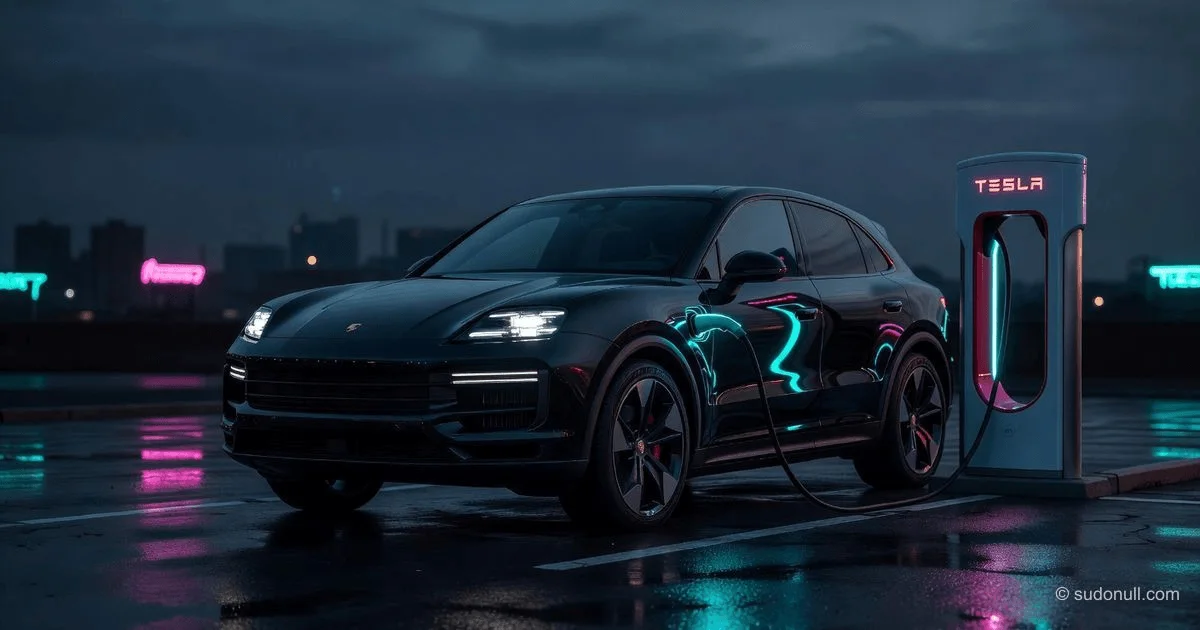
Porsche Unveils Most Powerful Cayenne Coupe Turbo with Range Up to 416 Miles
The electric SUV delivers 1,139 hp and accelerates to 60 mph in 2.4 seconds. It features 400 kW charging, inductive charging, and Porsche's first NACS connector.
Analytical Article: Porsche Cayenne Turbo Electric — 400 kW, NACS, and the Hidden War Over Standards
[The Core]: What's Really Happening
The official story about the "most powerful Cayenne in history" with 1,139 horsepower and a 0-60 mph time of 2.4 seconds is just the tip of the iceberg. Beneath it lies a much more significant shift: the Porsche Cayenne Turbo Electric is the first vehicle from the German premium brand to come factory-equipped with the NACS connector (North American Charging Standard). And this is not just a technical detail. It's a political and industrial statement.
Let me recap the timeline: in May 2023, Tesla opened its standard, and within 18 months, virtually the entire industry — Ford, GM, Rivian, Hyundai, the entire Volkswagen Group (including Audi, Porsche, Scout, VW) — announced a switch to NACS. But promising is one thing. Actually producing a production vehicle with a built-in NACS connector, without an adapter, is another. The Cayenne Turbo Electric is the first non-Tesla vehicle from a major European manufacturer to do this. And the timing is no coincidence: the 2026 model year in the US starts in summer 2026, exactly when Cayenne deliveries begin.
The real essence: Porsche isn't making a "charging revolution." It's making a forced transition under regulatory pressure. In January 2024, a coalition of automakers led by the Alliance for Automotive Innovation wrote a letter to the California Air Resources Board (CARB) demanding changes to the Advanced Clean Cars II rules. The demand was simple: remove the mandatory CCS connector requirement for model year 2026 and replace it with permission to use NACS. If CARB had not agreed, 99% of the market (including Porsche) would have been forced to install CCS or supply expensive adapters. CARB agreed. And now Porsche is one of the first to take advantage of this.
Timeline and Context
The story began long before the Cayenne's premiere. In November 2025, Porsche officially introduced the Cayenne Electric as a 2026 model, announcing 850 kW (1,139 hp), 0-60 in 2.4 seconds, 400 kW charging, and inductive charging (a first for Porsche). At the same time, it was announced that the vehicle would feature the NACS connector.
Then, on May 9, 2025, Porsche announced that owners of the Taycan and Macan Electric would gain access to the Tesla Supercharger network (23,500 stations in North America) via an adapter. Free for 2025-2026 models, $185 for older ones. This was a "soft launch" — through the Tesla app. Full integration with plug-and-charge via My Porsche was promised later.
And now, on June 7, 2026 — the official premiere of the Cayenne Turbo Coupe Electric at an event in Munich, where journalists from Ars Technica were the first to ride in the most powerful Porsche in history. Details that didn't make the headlines:
- Two charging ports: NACS DC-only on the left rear fender and J1772 AC-only on the right. This setup allows AC charging at home via a standard J1772 outlet and fast charging via NACS.
- 400 kW charging: 10-80% in 16 minutes under ideal conditions (station >390 kW, >850 V, >520 A, battery temperature 15°C).
- 11 kW inductive charging: an option available from the second half of 2026. Porsche is betting on wireless home charging — convenient but expensive.
It's important to understand the difference between WLTP (European cycle) and EPA (American). On WLTP, the Cayenne Turbo Coupe covers 628 km (390 miles), and the base version 661 km (411 miles). In the US, EPA will be around 350 miles (560 km) — less, but still impressive.
Who Wins and Who Loses
Porsche wins — and it's the main beneficiary in the short term. It becomes the first European premium brand with native NACS support. For the American buyer, this means: "I can buy a Porsche and charge it at 23,500 Tesla stations without an adapter." This removes the main barrier to switching from Tesla to another brand. Additionally, Porsche showcases technological leadership: 400 kW charging, inductive charging, Formula E technologies with direct oil cooling for the rear motor — all positioning the Cayenne as a technology flagship.
Tesla wins. Every vehicle with NACS is another customer for the Supercharger network. Supercharger is not just a charging network; it's a high-margin business. Tesla earns money on every non-Tesla vehicle charge. And the more such vehicles, the higher the return on already built infrastructure. Tesla didn't invest additional billions in expansion — it simply opened its standard and got the entire industry as customers.
LG Energy Solution wins (battery supplier for the Cayenne). The 113 kWh battery with bidirectional cooling is an engineering masterpiece. Charging 70% of the battery (from 10 to 80%) in 16 minutes at 400 kW requires excellent thermal management. LG Energy Solution provided the technology that allows the Cayenne to do what many competitors cannot.
The North American buyer wins — finally, no need to carry two adapters (CCS→NACS and NACS→CCS). Connector unification is like the transition from micro-USB to USB-C in smartphones. Finally, you can pull up to any fast charger and plug in without hassle.
Electrify America and other CCS networks lose. They invested billions in CCS infrastructure, and now their connector is becoming second-class. Yes, they will have adapters, but native NACS support signals that the future is NACS. Electrify America has already announced it will install NACS cables at new stations, but old stations will remain CCS. This will create fragmentation.
Europe loses. NACS is a North American standard. In Europe, CCS Type 2 remains mandatory. Porsche now has to produce two versions of the Cayenne: one for the US with NACS and one for Europe with CCS. This increases development and logistics costs. The EU, which always prided itself on its standards, now finds itself isolated: its automakers must support two standards to sell in the US.
What the Media Isn't Saying
First and most important non-obvious insight: Porsche does not support Autocharge on NACS. And this is a huge problem that no one is talking about. In Porsche's specifications, it states that to initiate charging at a Tesla Supercharger, you must use the Tesla app at the start. Full plug-and-charge (where you simply plug in the cable and the car automatically authorizes and starts charging) is expected "in the coming months." At the time of the Cayenne's release (late summer 2026), this feature may not be ready yet.
Why is this important? Imagine: you buy a Cayenne for $168,000, pull up to a Supercharger, take out your phone, open the Tesla app, select the station number, confirm payment, and only then plug in the cable. Meanwhile, a Tesla owner at the next stall just plugs in and walks away. It's not fatal, but it's annoying. And it shows that Porsche's integration with the Tesla ecosystem is not yet complete. Full plug-and-charge is not just a convenience; it's an indicator that Porsche has become "native" to the Supercharger network. Apparently, that's still a long way off.
Second hidden detail: inductive charging is an option that will only appear in the second half of 2026, and it's not certain it will work with NACS. Technically, inductive charging (Porsche Wireless Charging at 9.6 kW or optionally 19.2 kW) is AC charging via a magnetic field. It doesn't depend on the connector — you just park over a pad. But the problem is that inductive charging requires the vehicle to have a receiving coil. The Cayenne has one. However, there is still no standard for inductive charging for electric vehicles. Porsche uses its own protocol. This means you cannot go to a public inductive station (there are almost none) and charge. Only at home, with Porsche's proprietary pad. And that costs additional thousands of dollars.
Third omission: competitive dynamics with the Tesla Model X Plaid. The Model X Plaid has 1,020 hp, 0-60 in 2.5 seconds, a range of about 330 miles (EPA), and a price around $95,000. The Cayenne Turbo Coupe Electric has 1,139 hp, 0-60 in 2.4 seconds, an estimated range of about 350 miles, and a starting price of $168,000. The Cayenne is faster and has more range, but costs $73,000 more. It's a different segment. Porsche positions the Cayenne not as a competitor to the Model X, but as a competitor to the Lamborghini Urus and Aston Martin DBX. But here's the catch: the Urus and DBX are not electric. Porsche is creating a new segment: the electric super-SUV. And the question is whether there is demand for a $168,000 electric SUV when you can buy both a Urus (gasoline) and a Model X (and save money) for that price. The market will tell.
Forecast: Next 30 Days and 90 Days
Next 30 days (through early July 2026). First deliveries of the Cayenne Electric will begin in late summer 2026, so we won't see mass reviews in the next 30 days. But we will see a wave of test drives and first impressions. Journalists who already rode in the Cayenne Turbo in Munich will publish full video reviews. The key question they will answer: how quickly does charging power drop after 50%? Porsche promises 400 kW "under ideal conditions." In reality, the battery heats up, and charging may drop to 250 kW after 50%. If the drop is too sharp, it will be a major disappointment.
Also, in the next 30 days, expect a reaction from Tesla. Elon Musk will likely post on X (formerly Twitter) something like "Porsche uses our standard, but their software stack isn't ready for our hardware." It will be a provocation, but technically accurate — plug-and-charge on Porsche indeed doesn't work yet. Porsche's response will be diplomatic but tense.
Next 90 days (through September 2026). The main event: will Porsche achieve the promised 16-minute 10-80% charge in real-world conditions, not just in the lab? By September, the first vehicles will reach real customers (not journalists). Data from actual charges at Supercharger V3 and V4 stations will be published. If real-world time turns out to be 20-25 minutes, it will be a failure. If 16-18 minutes, a success.
Second important event: a firmware update with plug-and-charge support at Tesla Superchargers. Porsche promised this "in the coming months" after the soft launch in May 2025. A year has passed. If by September 2026 plug-and-charge still doesn't work, it will become a scandal. Owners of a $168,000 Cayenne will be justifiably outraged that their car requires manual authorization via an app, like a cheap Chinese EV.
Separately, watch competitors. BMW, Mercedes, and Volkswagen Group (including Audi and Porsche) have announced a switch to NACS. But the Cayenne is the first real production vehicle with NACS from the VW Group. The success or failure of this integration will determine how quickly other brands (Audi Q6 e-tron, Porsche Macan Electric, VW ID. Buzz) transition to NACS. If the Cayenne has charging issues, it will delay the entire group's transition to NACS by 6-12 months. If everything goes smoothly, by the end of 2026, all new VW Group EVs in the US will have NACS. The stakes are high.
— Editorial Team







No comments yet.