January 31, 2017 at 15:16
Get out of the splinters from the brain. 15 stereotypes about CRM systems
We all know how many troubles a very small problem can cause: a splinter has hit, and now the pain, inflammation, work is becoming more difficult ... So it is in business. Every action of the company - from hiring employees to buying software - is associated with money, namely expenses and income. So, you need to approach the issue carefully and make an informed decision. You go on the Internet to read what people say, and there is a lot of mixed information, which in fact does not always turn out to be reliable. As a result, stereotypes develop. The same thing happens with CRMs.
 Source: Yandex.Pictures of
CRM systems have taken root in Russia and are in demand by business. However, it is difficult to imagine software around which there would be the same number of misconceptions that alarm the future user. We, as a vendor, often have to deal with each of them individually and with several at once. We have selected the 15 most common stereotypes about CRM systems. Let's analyze them in detail.
There are cases when top management is involved in working with CRM after it is installed and run in, but this is a disastrous practice. First of all, the company's management determines the strategic goals and plans for the achievement of which operational activities are carried out - and in the process of implementing CRM these plans must be taken into account. For example, the head of the company decided that it was necessary to change the process of coordination of documents and logistics. Due to poor information flow, only two top managers knew about it. At this time, CRM is being introduced in parallel for the sales, warehouse and logistics departments, taking into account the requirements within the old strategy. At the first acquaintance of the boss with the program, it will have to be finalized. The worst case scenario is when the manager simply washes his hands and does not deliberately participate in the process of business automation.
If the head cares about his business, then the CRM-system as the main tool for automating this business should also be concerned. Some popular foreign and domestic systems have outgrown the stage of the “program for maintaining customers and sales”: now CRM is a comprehensive automation that affects most of the processes in the company. Accordingly, the leader should not only show interest in the program or work in it - he must become the evangelist of the system in order to broadcast its usefulness to subordinates.
In fact, the requirements of the various departments are quite homogeneous, if you look at them from the point of view of the CRM system: reports, filters, funnels, etc. Each user can customize the system for himself, assigning custom values of stages, statuses in the directory, saving filters, etc. Therefore, more often than not, scattered requirements simply come down to initial configuration.
Five lines of advertising. We are a Russian company that makes RegionSoft CRM and a bunch of corporate software for business of any scale. Regionsoft CRM is a powerful desktop system that has several versions with a different set of functions. Telephony, KPI, business processes, mailings, reports, transactions and everything else is available.
Write, call, all our consultations and presentations are free. You don’t even have to leave your PC.
If the specifics of the business involves customization for each unit, it is better to dwell on those points that definitely require automation. As a rule, these are multi-level complex processes (orders, purchases, long sales, production tasks), routine repetitive tasks (approval of documents, handling of calls, standard selling, purchasing goods for office needs), working with a warehouse, setting and controlling tasks, KPI . And some processes can’t be automated at all. These are strategies for communicating with VIP clients (not scripted), processes for creating marketing activities, one-time events, etc. All of them fall into CRM in one form or another, accumulate data, but are not automatic processes.
If you have more than one client in your company and you do not plan to stop there, CRM should be used. Because sooner or later you will encounter problems:
Consider the listed options in a table and evaluate their advantages and disadvantages:
There are two ways of development - extensive (when you increase sales, for example, by increasing the number of salespeople or the number of cold calls, that is, developing due to quantity) and intensive (when you use modern technologies, new algorithms and focus on expanding your client base and increased loyalty, that is, improving the quality of your customers). Without a CRM system, an intensive development path is almost impossible. It is worth stopping to keep contacts and data in a table with infinitely growing columns, choose a CRM-ku and you will never look back.
Here is a simple practical example. There is a company that offers brigade services and sells building materials. There were three sales people and a sales volume of 150,000 per month. We hired two more, it became 250,000. Managers recorded clients in files - that is, they simply kept records of sales. They gave ads, while it was spinning, another 70,000 customers arrived, after the advertising was turned off, sales returned by 250,000. As you can see, the growth is extensive (flat schedule). We installed a CRM system, entered data and began making resales to those who had already contacted, introduced household chemicals and curtains into the assortment, and initiated sending out SMS and e-mails. Three months later, sales steadily exceeded 550,000 and growth continued already from this new point. Growth is intense.
If the implementation of the CRM-system is not accompanied by comprehensive internal training, consider that the project failed. Training must be, and in several stages: primary from the vendor and secondary, continuous within the company. If you train once, inspired employees will return to their work computers with a new CRM, they will use it for a few days ... and forget it. One of the right decisions is to require all work reports, hold meetings, prepare business proposals based on data from CRM. Someone will gamify the use of a CRM system, this is not the best option, since gamification will penetrate into all areas of the company’s activity, this is not serious - people go to work and it should be work. Gamification is justified only on the corporate portal in establishing relationships or in the formation of a corporate culture.
Salesmen are another story. CRM is their main working tool in which they hold contacts, conduct transactions, write out documents, prepare contracts, call, count sales, build funnels, write reminders and do mailings. In general, all that is possible. Accordingly, training is mandatory, and the time spent on it will more than pay off when you start working in the program.
No, CRM by itself does not bring profit, does not ring, and, no matter how our competitors convince users, it does nothing unnoticed - all actions of the CRM system are initiated by a person (who, from a technical point of view, is an operator in relation to it). Correspondingly, a CRM-system brings a result when an employee focused on this result works for it. Indeed, as you can see in the example above, CRM contributes to sales and profit growth, but it is still (and I am sure it will be for a long time) indirectly. Due to what? (Using RegionSoft CRM as an example , the solutions on the market are very different).
 Again this robot became an employee of the month!
All employees should be interested in working with the CRM system, this is their time, their calm activity in the company and honest relations with the employer. Then the effect of the implementation of the program will become noticeable.
When you choose a CRM system, the first mistake is to choose it for the price: there is a lot of money, I'll take the most expensive and tricked out. Expensive software is not necessarily good software. The CRM system must be selected based on the requirements and the compliance of the program with them. Like any investment, the new system should be cost-effective - that is, bring measurable and measurable results.
Return on investment in CRM implementation can be measured using a set of indicators that will reflect the effectiveness of the acquired software.
Ultimately, within a few months you will feel the effect of the introduction on the dynamics of financial indicators. If the indicators worsened or did not change, look for the reasons within the team (sabotage of new software), study the profile of interaction with the system and take measures.
Not really. From a technical point of view, yes, CRM is an application software, a set of algorithms described in a programming language, just like everyone else. Differences occur at the level of user interaction. In the case of Office or Photoshop, the interaction takes place according to a simple scheme: you want something from the program, enter information into it through the interface, get the result, close the program. The manager interacts with the CRM system continuously, he uses it as:
Thus, the CRM-system is a comprehensive multi-functional software with which the user continuously interacts within the workflow, that is, actually receives an electronic assistant.
 Well, actually, that's why we need a computer
With this approach, it’s better not to implement a CRM system, it just won’t pay off. It’s common for a person to be afraid of everything new, especially if he suspects control of this new by the management (which, in fact, does not exist - through CRM you cannot spy on an employee, his actions on a PC, etc.). In fact, to master CRM and start working in it is simple, since its structure and functionality repeat the work of a manager. Automation frees up working time, human resources and saves the company from the vicissitudes of paperwork and the war for customers between managers.
If the resistance of employees is difficult to overcome, it should be explained that the CRM system has no way to monitor something other than the dynamics of the execution of work and time, to motivate employees, but it is advisable not materially, so that they do not later turn the use of CRM into blackmail. For example, you can spend part of the free time on staff development.
Despite the fact that this idea is fundamentally wrong and completely unethical, some vendors in the process of promoting their systems continue to use it as an argument. We have already discussed above that CRM without a user is just a shortcut on the PC desktop. But the growth of labor productivity should not lead to reductions if your company is adequate and is not going to curtail its activities. Consider that with the advent of CRM, your staff at the same wage has increased one and a half times due to increased efficiency. And you do not need to spend money on recruitment, adaptation and training. Your employees are well aware of the company's processes, understand its specifics and the market in which it is necessary to work. Such reinforcement is an occasion to master new niches, sales channels, develop new ways of promotion, and finally take care of service and customer support.
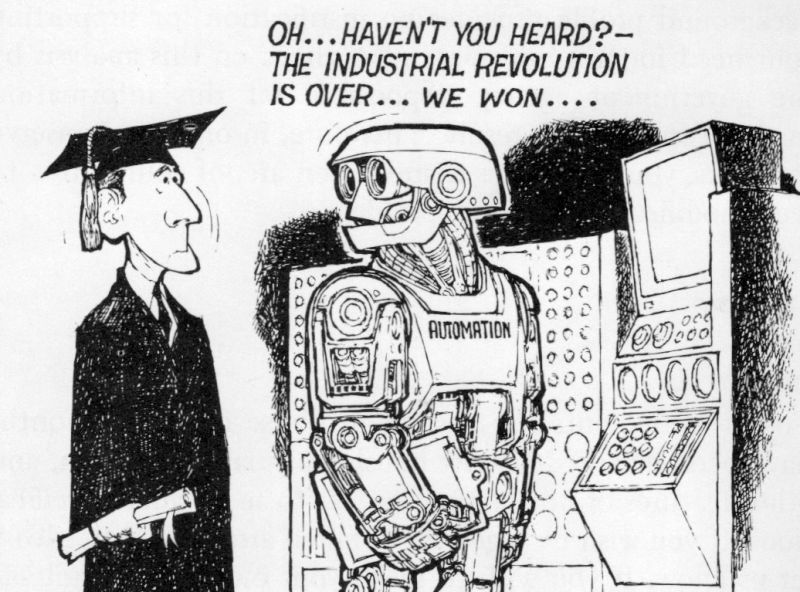 Oh ... Have you not heard? The industrial revolution is over ... We won ...
A CRM system is a valuable tool for service, sales, advertising and marketing, top management, logistics, etc., but the main thing is that people who extract and analyze data, communicate with customers, develop creative concepts, create and sell product. CRM displays market conditions, provides data for understanding successes and failures, reflects trends, shortens the sales cycle, but only the user responds to these indicators and takes measures. Accordingly, the tool requires human intervention to obtain results and the company to a new level of development. If you are reducing staff in proportion to the effect of CRM, then purely mathematically and in fact you will stagnate instead of growing. Money saved on salaries is a drop in the bucket next to the income you can get by saving people and entrusting them with new tasks.
A very common misconception. It is better to implement a CRM system after you formulate the requirements within the working group and determine which processes need to be automated. The CRM system does not work for you, its purpose is to collect, process and store data, as well as automate routine and repetitive actions. It is thanks to this state of information in your company that you can work quickly, without any hesitations and memory lows about transactions and contacts with customers - this is the first brick in relations with them.
Some CRM-systems (including RegionSoft CRM) automate business processes: in fact, you introduce an algorithm into the system that indicates how an action is performed after an action inside the process and you get a scheme according to which the usual task is “run” without errors and delays.
For example, earlier, the purchase of a consignment of consumables in a printing house looked like this: in the middle of an urgent order, the Oracal film ended, the producers wrote to the manager, the manager urgently dragged the necessary volume through their channels, then asked the buyer to order the lot, the buyer made a request, the general forgot to sign, after three days of searching for an order, a new one was printed out, the manager signed, the accounting department lost track, requested again, the storekeeper lost five rolls of film, found it, transferred it to production - uhhhh!
With CRM, it looks like this: there is the process “Purchase of Oracal film consumables”, the steps and the responsible ones are prescribed in it. When the film runs out of stock, the storekeeper creates an order, sends it to CRM for approval, the order goes to the buyer there, the accounting department receives a notification asking to pay the bill, the buyer receives a reminder that the shipment is the day after tomorrow, the storekeeper receives a shipment, scans the barcodes in CRM, and the manager and the production see that there are enough films. No fuss or panic. And all in electronic form without pieces of paper, in one process.
As you can see from the example, most departments are involved in business processes, which means that only sales will not be automated and marketing will not work. It is necessary to understand the processes, examine them, find problem points (delays, irresponsibility, etc.) and automate the business already with the correction of problems. For some reason, many companies think that the examination of processes and interactions is something very complex, they hire consultants and voluntarily pay money for their inability to get together, discuss and agree. As a rule, a working group within the company and the support of an actively participating leader is enough to develop requirements, outline the main points of the technical task and contact the vendor.
It is worth mentioning separately about the interaction of departments when using CRM. Centralizing data for all commercial departments saves a lot of money and time that is required for data entry and analysis, facilitates company management and allows you to get full-fledged customer stories that can underlie promising developments. And the trick here is that the units are interconnected and each of them pursues the same goal: to increase the profitability of the business, and to increase their well-being based on the results of excellent work. Everything is linear.
But no. There are situations when sales and promotion do not just conflict, but fight in a big way, plotting and closing data. As a result, everyone works as in a black box. The service department and the entire front office in such situations are generally extreme because they suffer from a lack of information.
 Friends, to start selling normally, you should at least start talking to each other
The real story about such a problem, however, is not about our CRM, but about the well-known import, but in Russia. In a company with 2 million customers, they bought and implemented CRM for commercial service. The marketing department demanded that only they work in the system. The old sales department, consisting of a logistician and a manager, was not opposed. New advanced sales team protested. While there were disputes and approvals, the help desk was not informed about the current action, customer complaints rained down. CRM was open to all businesses, but marketing closed access to its data and all analytics. After a year of pulling the blanket, CRM remained out of work, because it turned out to be ineffective (if only when nobody worked fully in it). A project worth more than 20 million rubles turned out to be useless to anyone.
 Get down! Marketing and sales are fighting!
Inside the organization, all data should be used in a complex, analytical information should be available to everyone who makes decisions based on it. End-to-end automation is much better and more productive than patchwork automation.
In principle, there is nothing criminal in this situation, and theoretically it is possible to collect all the data from one person. But then the whole meaning of CRM as a teamwork tool for managing customer relationships is lost and there will still be information loss. In addition, in this situation, the manager will spend all the time on entering data received from employees.
The logic of the CRM system is as follows: employees enter customer information each in its own place, it is aggregated and stored in a single database, the accesses are divided in accordance with security policies, and the manager can analyze information and make decisions based on the results. Automation of each workplace has a positive effect, but one for all does not.
The only situation in which it is possible to purchase one license is to work alone: a beginner IP-employee or a freelancer.
In 2015-2016, CRM vendor releases related to integration with social networks flooded the Runet. Abroad, social CRM became popular much earlier since users actively communicate with brands in public, ask questions, write reviews, and comment. A CRM system for such purposes should not only pick up messages from group accounts via the API, but also save user profiles, accumulate their interests, etc. Thus, the company receives not abstract registrations, but warm leads. In Russia, the majority of CRM, integrated with social networks, perform far from all tasks.
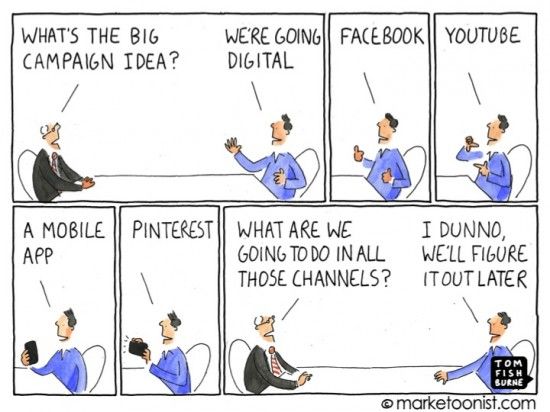 “Well, what's the big idea of this new campaign?”
- We will become digital (digital). Facebook Youtube. Mobile app. Interest
“And what are we going to do in all these channels?”
- I don’t know, we'll figure it out later.
Not every business needs to work with social networks. As a rule, B2C sector companies that sell directly through pages on social networks (hand-made goods, flower shops, jewelry, some services) have this need. They tend to rarely access CRM services. The B2B sphere, with rare exceptions, has nothing to catch on social networks. You can twist advertising for brand recognition, maintain a blog, but get a client - from the category of casuistry. It is possible that further transformation of digital channels will lead to the need for new integrations, but so far the needs of B2B sector users are approaching zero.
Go boldly: a pack of pentalgin - at our expense. But seriously, the CRM system that does not suit you needs to be changed. How to understand that the current CRM system is no longer working:
The vendor will help you transfer the database, solve issues related to integrations. Indeed, migration from one CRM system to another is a complex process with pitfalls and surprises. However, it is better to come to changes, to start the process, efforts and nerves will pay off handsomely. You will receive a new wave of automation, especially since you already have a huge advantage - experience in implementing, training and working in a CRM system, which means, at least, save your nerves and money on typical growth diseases.
I need it.
 No thanks! We are too busy.
Why is it important to deal with stereotypes? Until the splinter is removed, you will experience unpleasant sensations, the work will move slowly, all thoughts where it becomes inflamed and hurts. While you are thinking about reviews and opinions, your competitors are already automating the business and ahead of you. In our society, information both helps and slows down the decision-making process. Of course, nothing arises out of the blue, and under each of the judgments there was once (or maybe even now) soil, but this applies to systems that are not developing, a business that did not want or could not overcome the implementation project. Therefore, the most correct thing is to keep questions in mind, ask their vendor and start automating now, so as not to regret missed opportunities in the near future.
If you have questions, concerns, worries, write them in the comments or on any of the contacts on the RegionSoft CRM website . We will tell and show, not a question.
Slides, slides. Comics and pictures are found on Pinterest and on the sites specified in copyright.
CRM systems have taken root in Russia and are in demand by business. However, it is difficult to imagine software around which there would be the same number of misconceptions that alarm the future user. We, as a vendor, often have to deal with each of them individually and with several at once. We have selected the 15 most common stereotypes about CRM systems. Let's analyze them in detail.
Top managers should not participate in the implementation, it is enough to install software for them and show where to look at the final signs
There are cases when top management is involved in working with CRM after it is installed and run in, but this is a disastrous practice. First of all, the company's management determines the strategic goals and plans for the achievement of which operational activities are carried out - and in the process of implementing CRM these plans must be taken into account. For example, the head of the company decided that it was necessary to change the process of coordination of documents and logistics. Due to poor information flow, only two top managers knew about it. At this time, CRM is being introduced in parallel for the sales, warehouse and logistics departments, taking into account the requirements within the old strategy. At the first acquaintance of the boss with the program, it will have to be finalized. The worst case scenario is when the manager simply washes his hands and does not deliberately participate in the process of business automation.
- CRM provides information on a business strategy: provides actual data on sales, marketing, warehouse, etc .;
- CRM system helps to improve the results and impact on customer loyalty based on analysis;
- in general, the CRM system makes it possible to reduce costs in certain areas, for example, sales and warehouse management, due to automation of routine tasks, transparency of the manager’s actions and process control.
If the head cares about his business, then the CRM-system as the main tool for automating this business should also be concerned. Some popular foreign and domestic systems have outgrown the stage of the “program for maintaining customers and sales”: now CRM is a comprehensive automation that affects most of the processes in the company. Accordingly, the leader should not only show interest in the program or work in it - he must become the evangelist of the system in order to broadcast its usefulness to subordinates.
We implement CRM only if it suits 100% of users in the company
In fact, the requirements of the various departments are quite homogeneous, if you look at them from the point of view of the CRM system: reports, filters, funnels, etc. Each user can customize the system for himself, assigning custom values of stages, statuses in the directory, saving filters, etc. Therefore, more often than not, scattered requirements simply come down to initial configuration.
Five lines of advertising. We are a Russian company that makes RegionSoft CRM and a bunch of corporate software for business of any scale. Regionsoft CRM is a powerful desktop system that has several versions with a different set of functions. Telephony, KPI, business processes, mailings, reports, transactions and everything else is available.
Write, call, all our consultations and presentations are free. You don’t even have to leave your PC.
If the specifics of the business involves customization for each unit, it is better to dwell on those points that definitely require automation. As a rule, these are multi-level complex processes (orders, purchases, long sales, production tasks), routine repetitive tasks (approval of documents, handling of calls, standard selling, purchasing goods for office needs), working with a warehouse, setting and controlling tasks, KPI . And some processes can’t be automated at all. These are strategies for communicating with VIP clients (not scripted), processes for creating marketing activities, one-time events, etc. All of them fall into CRM in one form or another, accumulate data, but are not automatic processes.
We will install the free version, and we will do the rest in Excel and on paper. The demo version is enough for us, after all. Yes, and just in Excel, in principle, it will do
If you have more than one client in your company and you do not plan to stop there, CRM should be used. Because sooner or later you will encounter problems:
- scaling - as the business grows and the customer base accumulates, it will be necessary to store data, unify it and process it;
- security - contacts and transactions is your expensive asset, and it must be protected primarily from outgoing and unscrupulous employees;
- safety - the data should be in your undamaged form;
- continuity - in the case of transfer of authority from manager to manager or joining a team of new employees, clients and tasks must be transferred quickly and in full.
Consider the listed options in a table and evaluate their advantages and disadvantages:
| Sign | MS Excel | Free CRM | Demo CRM | The combination of Excel and free CRM |
|---|---|---|---|---|
| Scaling | Filling with data is possible, if necessary, add new parameters - complexity. | Filling with data is possible up to a certain amount. Functions are usually truncated or deprecated. | Filling with data is possible up to a certain amount. | Scaling leads to confusion and data loss. |
| Security | There are certain levels of protection for a sheet and a book, but are easily bypassed. An inexperienced employee can incorrectly sort and re-save, old versions are not always successful. | In the demo version - no guarantees of data protection and security from the vendor - it all depends on you. In the free version - basic data protection. As a rule, you cannot set permissions. | Data is fragmented and protected at the application level in which it resides. | |
| Safety | The data is easy to copy, everyone sees the clients of everyone in a common file on the server, collisions and conflicts are possible. | Data safety at the level of the flagship CRM system: if in the cloud - everything is in the cloud, if on the server - on the server. However, it is not possible to give access rights and share security policies. | Initially, the data is in two places - this is the main threat to safety. | |
| Continuity | You can transfer (or not transfer) a file in which the devil will break his leg. You can allow a novice to a file on the server - but you risk data safety. | Transfer a login / password from cloud-based CRM or put an employee behind the outgoing PC - as a rule, free single-user CRMs. But there are exceptions, but their functionality is more than modest. | See option 1 + option 2 | |
| Usability | The familiar interface, with large amounts of information and the need for processing - problems and errors. | As a rule, a truncated or outdated version is inferior to the flagship CRM. | The same as in the flagship CRM, however, there are restrictions on individual functions or the number of entries. | No convenience - data loss and switching between windows in search of the necessary information. |
| Data unification | In general use, data formats get confused, if conditional formatting is prescribed, formulas break down, because there are still few advanced Excel users. | Unification of data at the level of the "main" CRM-system, all data is entered with an input mask, a drop-down list or prompts. | No unification - total fragmentation and confusion. | |
| Exchange between departments | Send the file by e-mail, share on the local network, use Excel Online. | There is no networking capability or it is limited. | By email. | |
| Data control | Weak control | If there is no network work, there is no control; all managers work in their versions. If there is, it is possible to control the data. | There is no way to control anything, data both there and there. | |
Here is a simple practical example. There is a company that offers brigade services and sells building materials. There were three sales people and a sales volume of 150,000 per month. We hired two more, it became 250,000. Managers recorded clients in files - that is, they simply kept records of sales. They gave ads, while it was spinning, another 70,000 customers arrived, after the advertising was turned off, sales returned by 250,000. As you can see, the growth is extensive (flat schedule). We installed a CRM system, entered data and began making resales to those who had already contacted, introduced household chemicals and curtains into the assortment, and initiated sending out SMS and e-mails. Three months later, sales steadily exceeded 550,000 and growth continued already from this new point. Growth is intense.
We will not train salespeople why distract them from work
If the implementation of the CRM-system is not accompanied by comprehensive internal training, consider that the project failed. Training must be, and in several stages: primary from the vendor and secondary, continuous within the company. If you train once, inspired employees will return to their work computers with a new CRM, they will use it for a few days ... and forget it. One of the right decisions is to require all work reports, hold meetings, prepare business proposals based on data from CRM. Someone will gamify the use of a CRM system, this is not the best option, since gamification will penetrate into all areas of the company’s activity, this is not serious - people go to work and it should be work. Gamification is justified only on the corporate portal in establishing relationships or in the formation of a corporate culture.
Salesmen are another story. CRM is their main working tool in which they hold contacts, conduct transactions, write out documents, prepare contracts, call, count sales, build funnels, write reminders and do mailings. In general, all that is possible. Accordingly, training is mandatory, and the time spent on it will more than pay off when you start working in the program.
CRM works and makes profit from the first day: set and forget
No, CRM by itself does not bring profit, does not ring, and, no matter how our competitors convince users, it does nothing unnoticed - all actions of the CRM system are initiated by a person (who, from a technical point of view, is an operator in relation to it). Correspondingly, a CRM-system brings a result when an employee focused on this result works for it. Indeed, as you can see in the example above, CRM contributes to sales and profit growth, but it is still (and I am sure it will be for a long time) indirectly. Due to what? (Using RegionSoft CRM as an example , the solutions on the market are very different).
- By streamlining the process of communication with customers. You do not need to search for contacts and transactions, everything is tied to a single entity - a customer’s card, in which all documents are attached, accounts and transactions are kept, contacts are indicated, correspondence and generally all the smallest subtleties are preserved, including the security of relations with the customer and his profiles.
- Due to the formalization and automation of business processes. All routine actions are described by schemes that are launched at the start of the procedure and automatically notify those responsible and take into account intermediate results.
- Due to the growth of customer loyalty and personalization. Even minimal “recognition” of the client by the manager and call routing give a positive effect, not to mention the additional sales, repeat sales and discount programs.
- Due to the transparency of management processes. Each manager controls his tasks and monitors the progress of his KPIs.
- Due to the transparency of relations between employees. Access rights to CRM, personal workspace and private clients do not leave managers any chances to withdraw customers from each other, conflicts are settled as quickly as possible.
All employees should be interested in working with the CRM system, this is their time, their calm activity in the company and honest relations with the employer. Then the effect of the implementation of the program will become noticeable.
Cannot determine CRM profitability
When you choose a CRM system, the first mistake is to choose it for the price: there is a lot of money, I'll take the most expensive and tricked out. Expensive software is not necessarily good software. The CRM system must be selected based on the requirements and the compliance of the program with them. Like any investment, the new system should be cost-effective - that is, bring measurable and measurable results.
Return on investment in CRM implementation can be measured using a set of indicators that will reflect the effectiveness of the acquired software.
- Estimate the dynamics of sales. If you see quantitative sales growth and growth in monetary terms, this is the main indicator of the effectiveness of using a CRM system. Track that the trend did not fall sharply and failed. If this happens, look for reasons.
- Estimate the length of the sales cycle. One of the key tasks of the CRM system is to shorten the sales cycle by automating processes and communicating with the client. If this does not happen, conduct additional training for managers, demonstrate successful examples.
- Count the number of calls and leads processed. The new system should facilitate the speed of processing calls. If the indicators do not satisfy you, try to give recommendations on the duration of the conversation with customers and put a call plan.
- Evaluate changes in the client base - the company should have more potential customers. CRM-system helps to maintain and not lose contacts, which means that there should be more records about leads and potential customers than in the period without CRM.
Ultimately, within a few months you will feel the effect of the introduction on the dynamics of financial indicators. If the indicators worsened or did not change, look for the reasons within the team (sabotage of new software), study the profile of interaction with the system and take measures.
CRM is just a program. Like MS Office or Photoshop
Not really. From a technical point of view, yes, CRM is an application software, a set of algorithms described in a programming language, just like everyone else. Differences occur at the level of user interaction. In the case of Office or Photoshop, the interaction takes place according to a simple scheme: you want something from the program, enter information into it through the interface, get the result, close the program. The manager interacts with the CRM system continuously, he uses it as:
- data warehouse - introduces, accumulates and stores information;
- operational work tool - all calls go through CRM, contracts and primary documentation are formed in it, work with mailing lists, etc .;
- analytics tool - interprets data, builds reports, allows you to manage the sales funnel, do ABC analysis, adjust the assortment policy;
- self-control tool - the manager sees his targets, monitors their progress;
- task management system - all tasks are set and controlled within schedulers and calendars with reminders, projects can be managed inside CRM;
- a key element of a CRM strategy is customer relationship management, understanding the customer profile, his portrait and needs.
Thus, the CRM-system is a comprehensive multi-functional software with which the user continuously interacts within the workflow, that is, actually receives an electronic assistant.
CRM - it’s very difficult to understand, I’ll introduce only contacts
With this approach, it’s better not to implement a CRM system, it just won’t pay off. It’s common for a person to be afraid of everything new, especially if he suspects control of this new by the management (which, in fact, does not exist - through CRM you cannot spy on an employee, his actions on a PC, etc.). In fact, to master CRM and start working in it is simple, since its structure and functionality repeat the work of a manager. Automation frees up working time, human resources and saves the company from the vicissitudes of paperwork and the war for customers between managers.
If the resistance of employees is difficult to overcome, it should be explained that the CRM system has no way to monitor something other than the dynamics of the execution of work and time, to motivate employees, but it is advisable not materially, so that they do not later turn the use of CRM into blackmail. For example, you can spend part of the free time on staff development.
Hooray, CRM! Now you can fire a couple of salespeople and a secretary. Smarter people algorithm
Despite the fact that this idea is fundamentally wrong and completely unethical, some vendors in the process of promoting their systems continue to use it as an argument. We have already discussed above that CRM without a user is just a shortcut on the PC desktop. But the growth of labor productivity should not lead to reductions if your company is adequate and is not going to curtail its activities. Consider that with the advent of CRM, your staff at the same wage has increased one and a half times due to increased efficiency. And you do not need to spend money on recruitment, adaptation and training. Your employees are well aware of the company's processes, understand its specifics and the market in which it is necessary to work. Such reinforcement is an occasion to master new niches, sales channels, develop new ways of promotion, and finally take care of service and customer support.
A CRM system is a valuable tool for service, sales, advertising and marketing, top management, logistics, etc., but the main thing is that people who extract and analyze data, communicate with customers, develop creative concepts, create and sell product. CRM displays market conditions, provides data for understanding successes and failures, reflects trends, shortens the sales cycle, but only the user responds to these indicators and takes measures. Accordingly, the tool requires human intervention to obtain results and the company to a new level of development. If you are reducing staff in proportion to the effect of CRM, then purely mathematically and in fact you will stagnate instead of growing. Money saved on salaries is a drop in the bucket next to the income you can get by saving people and entrusting them with new tasks.
CRM can be implemented without prior business analysis in the company - the main thing is to automate sales and marketing
A very common misconception. It is better to implement a CRM system after you formulate the requirements within the working group and determine which processes need to be automated. The CRM system does not work for you, its purpose is to collect, process and store data, as well as automate routine and repetitive actions. It is thanks to this state of information in your company that you can work quickly, without any hesitations and memory lows about transactions and contacts with customers - this is the first brick in relations with them.
Some CRM-systems (including RegionSoft CRM) automate business processes: in fact, you introduce an algorithm into the system that indicates how an action is performed after an action inside the process and you get a scheme according to which the usual task is “run” without errors and delays.
For example, earlier, the purchase of a consignment of consumables in a printing house looked like this: in the middle of an urgent order, the Oracal film ended, the producers wrote to the manager, the manager urgently dragged the necessary volume through their channels, then asked the buyer to order the lot, the buyer made a request, the general forgot to sign, after three days of searching for an order, a new one was printed out, the manager signed, the accounting department lost track, requested again, the storekeeper lost five rolls of film, found it, transferred it to production - uhhhh!
With CRM, it looks like this: there is the process “Purchase of Oracal film consumables”, the steps and the responsible ones are prescribed in it. When the film runs out of stock, the storekeeper creates an order, sends it to CRM for approval, the order goes to the buyer there, the accounting department receives a notification asking to pay the bill, the buyer receives a reminder that the shipment is the day after tomorrow, the storekeeper receives a shipment, scans the barcodes in CRM, and the manager and the production see that there are enough films. No fuss or panic. And all in electronic form without pieces of paper, in one process.
As you can see from the example, most departments are involved in business processes, which means that only sales will not be automated and marketing will not work. It is necessary to understand the processes, examine them, find problem points (delays, irresponsibility, etc.) and automate the business already with the correction of problems. For some reason, many companies think that the examination of processes and interactions is something very complex, they hire consultants and voluntarily pay money for their inability to get together, discuss and agree. As a rule, a working group within the company and the support of an actively participating leader is enough to develop requirements, outline the main points of the technical task and contact the vendor.
No data exchange - each department has closed information with limited access, let sales and marketing fight further
It is worth mentioning separately about the interaction of departments when using CRM. Centralizing data for all commercial departments saves a lot of money and time that is required for data entry and analysis, facilitates company management and allows you to get full-fledged customer stories that can underlie promising developments. And the trick here is that the units are interconnected and each of them pursues the same goal: to increase the profitability of the business, and to increase their well-being based on the results of excellent work. Everything is linear.
But no. There are situations when sales and promotion do not just conflict, but fight in a big way, plotting and closing data. As a result, everyone works as in a black box. The service department and the entire front office in such situations are generally extreme because they suffer from a lack of information.
The real story about such a problem, however, is not about our CRM, but about the well-known import, but in Russia. In a company with 2 million customers, they bought and implemented CRM for commercial service. The marketing department demanded that only they work in the system. The old sales department, consisting of a logistician and a manager, was not opposed. New advanced sales team protested. While there were disputes and approvals, the help desk was not informed about the current action, customer complaints rained down. CRM was open to all businesses, but marketing closed access to its data and all analytics. After a year of pulling the blanket, CRM remained out of work, because it turned out to be ineffective (if only when nobody worked fully in it). A project worth more than 20 million rubles turned out to be useless to anyone.
Inside the organization, all data should be used in a complex, analytical information should be available to everyone who makes decisions based on it. End-to-end automation is much better and more productive than patchwork automation.
Let the sales manager use CRM, buy him one license, so be it
In principle, there is nothing criminal in this situation, and theoretically it is possible to collect all the data from one person. But then the whole meaning of CRM as a teamwork tool for managing customer relationships is lost and there will still be information loss. In addition, in this situation, the manager will spend all the time on entering data received from employees.
The logic of the CRM system is as follows: employees enter customer information each in its own place, it is aggregated and stored in a single database, the accesses are divided in accordance with security policies, and the manager can analyze information and make decisions based on the results. Automation of each workplace has a positive effect, but one for all does not.
The only situation in which it is possible to purchase one license is to work alone: a beginner IP-employee or a freelancer.
CRM without integration with social networks? No and no, only with VKontakte, otherwise how our metallurgists will collect orders
In 2015-2016, CRM vendor releases related to integration with social networks flooded the Runet. Abroad, social CRM became popular much earlier since users actively communicate with brands in public, ask questions, write reviews, and comment. A CRM system for such purposes should not only pick up messages from group accounts via the API, but also save user profiles, accumulate their interests, etc. Thus, the company receives not abstract registrations, but warm leads. In Russia, the majority of CRM, integrated with social networks, perform far from all tasks.
- We will become digital (digital). Facebook Youtube. Mobile app. Interest
“And what are we going to do in all these channels?”
- I don’t know, we'll figure it out later.
Not every business needs to work with social networks. As a rule, B2C sector companies that sell directly through pages on social networks (hand-made goods, flower shops, jewelry, some services) have this need. They tend to rarely access CRM services. The B2B sphere, with rare exceptions, has nothing to catch on social networks. You can twist advertising for brand recognition, maintain a blog, but get a client - from the category of casuistry. It is possible that further transformation of digital channels will lead to the need for new integrations, but so far the needs of B2B sector users are approaching zero.
Our CRM is outdated, expensive, dislike, out of service, but I won’t switch to a new one. I don’t need such a headache!
Go boldly: a pack of pentalgin - at our expense. But seriously, the CRM system that does not suit you needs to be changed. How to understand that the current CRM system is no longer working:
- it is not supported - the vendor has stopped servicing or its existence, and you have more and more technical problems;
- it does not meet the needs of the business - you have to integrate or just use separately more and more solutions (project management system, warehouse system, telephony with built-in CRM functions, etc.);
- she does not like it, because it does not include modern functions, for example, automation of business processes, mailing lists and telephony;
- employees do not understand the logic of the system, the interface is uncomfortable, they constantly objectively complain about data loss, problems of unification of input values, malfunctions in the operation of basic capabilities.
The vendor will help you transfer the database, solve issues related to integrations. Indeed, migration from one CRM system to another is a complex process with pitfalls and surprises. However, it is better to come to changes, to start the process, efforts and nerves will pay off handsomely. You will receive a new wave of automation, especially since you already have a huge advantage - experience in implementing, training and working in a CRM system, which means, at least, save your nerves and money on typical growth diseases.
CRM is not needed, it's a waste of money
I need it.
Why is it important to deal with stereotypes? Until the splinter is removed, you will experience unpleasant sensations, the work will move slowly, all thoughts where it becomes inflamed and hurts. While you are thinking about reviews and opinions, your competitors are already automating the business and ahead of you. In our society, information both helps and slows down the decision-making process. Of course, nothing arises out of the blue, and under each of the judgments there was once (or maybe even now) soil, but this applies to systems that are not developing, a business that did not want or could not overcome the implementation project. Therefore, the most correct thing is to keep questions in mind, ask their vendor and start automating now, so as not to regret missed opportunities in the near future.
If you have questions, concerns, worries, write them in the comments or on any of the contacts on the RegionSoft CRM website . We will tell and show, not a question.
Slides, slides. Comics and pictures are found on Pinterest and on the sites specified in copyright.