November 10, 2016 at 21:53
Donald Knuth about his happy life, his death and the last two projects
- Transfer
“I realized that I was ready to die as soon as I finished the book.”
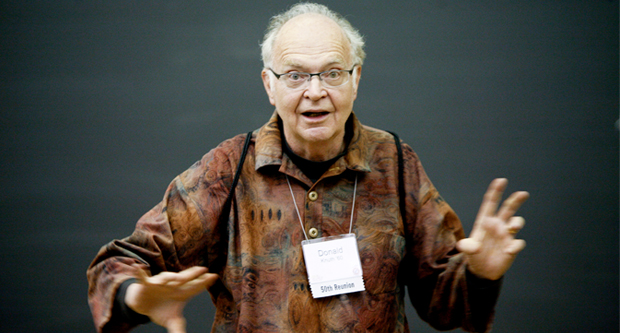
I am still working on the “Art of Programming,” but I found the time to work on two large projects. I worked on one in the late 80s, and on another in the early 90s. These were monographs.
The first project was called Axioms and Shells, I studied interesting problems in geometry — convex geometry — and I continued to work on it while I was in Singapore, releasing “3:16” in print. It was a small book, about 100 pages.
Then I began to study random graphs - an amazing phenomenon when something like the Big Bang occurs: start with points that are not connected by anything, then select 2 random points and connect them, and so on; as soon as you cross the number of connections, about half the points, suddenly almost all points always turn out to be connected. It is called "giant component . "
Publication support is provided by Edison , which has developed a system for calculating road traffic at intersections and a taxi order exchange application .
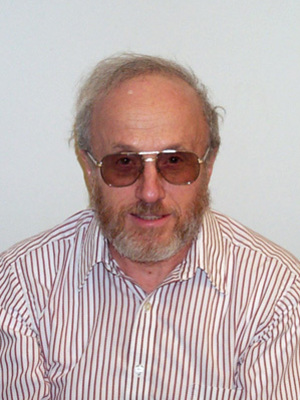
I studied this problem with Boris Pittel, who visited me in the late 80s, and we got some preliminary results that are interesting from a mathematical point of view. I wrote an article and realized that even more results can be obtained from these experiments: the deeper I studied this topic, the more interesting the system appeared. And it all turned out to be ... this system developed into the fact that I began to study not only the giant component, but wrote a research article, a huge article. She took a whole magazine.
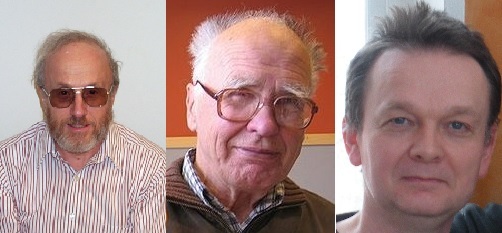
I also had three co-authors: Boris Pittel, whom I already mentioned, Svante Johnson and Thomas Luchak from Poland. We all continued to find more facts, and pushed each other to the next step in the study of this phenomenon. And it was like writing two doctoral dissertations at the end of my career, two monographs, one on the topic of Axioms and Shells, and the other on a gigantic component. It was my swan song, after which I said: “Okay, well, I have already done a lot here, and I will leave all other topics to other people, if I can not solve the problem in a day. Or in an hour. "
But sometimes after an hour of work, I understand that maybe in an hour I can solve the problem. And so, now, if I don’t know how to solve a new problem, I pass it on to someone else, saying: “Don't you think this is a cool thing?”, And just let me have fun with the solution to the problem.
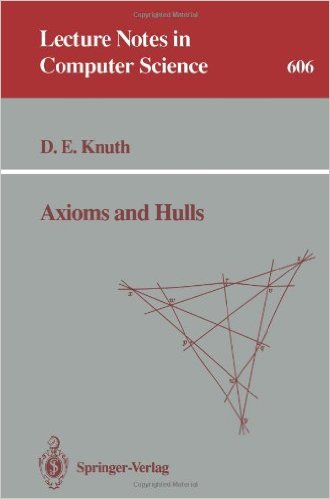
Axioms and hulls
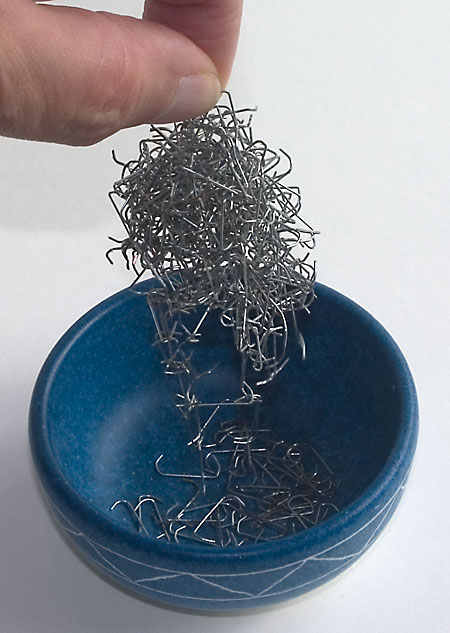
The birth of the giant component
As you understand from my story, I am passionate about writing books. I like to share ideas with other people. I think that the books I wrote are about those amazing things that are too good not to share them, and I wanted other people to share my joy when reading books. And it just so happened that I now have more than 20 published books, and there are so many that I doubt whether there is such a person in the world who would read more than half.
And sometimes I think it would be terrible if there were 10 people on earth who looked like me, because we simply did not have time to read each other's books. And still I ... you know, behind every written book, there is a story, behind every written article.
I don’t understand this “publish or die”, because I never wrote all these articles just because I needed it for a career or something. I wrote because I wanted to, you know, I thought it was a cool idea that others should learn. One guy asked me two or three weeks ago, he was doing a project for school, he needed to shoot a video with several people whom he barely knew and ask them the following question: “If you could change only one thing in your life and do “to another, what would you choose?”
And, you know, I was never asked such a question, and after 5 minutes of thought I gave up. I mean, yes, maybe I am becoming forgetful with age, but I could not think of any moment in my life that I would regret. I'm just too lucky, I was constantly on the crest of a wave. I mean, I was born at the right time, computers just started to appear, and I had skills that helped me get comfortable with computers, write programs. And if I were born 10 years earlier or 10 years later, then everything would be different.
I started working with computers when they began to appear, and the problems were much simpler. I could easily solve them. The easiest ones fell on us, but now we have to solve those that remained - the most difficult ones - or look at problems from completely different angles, they are, of course, very exciting, for example, robotics and other areas that were open, because fundamental , the simplest problems have given a new level of discovery, unresolved issues. But I can’t even imagine that I could be even happier or, although many of the things that I did throughout my life were not popular, I just can’t think of anything that I would like to do differently. So, it was very difficult for me to answer that guy’s question.
Last year, I found out that I had cancer and, fortunately, it was found out at an early stage, so that could not stop me from writing "The Art of Programming." But at the end of last year, I did not know how bad everything was. I just want to tell you a little about this, because it can happen to everyone ... sooner or later everyone dies, but we never know what will happen and everyone will have to face such a situation someday.
I just want to share how it affected me last year. I understand that I am now at such an age when I have to attend the funeral of people whom I knew well, for example, my colleague Bob Floyd died a couple of years ago and I, you know, then thought about how to cope with death. After all, this is inevitable, and I realized that I was ready to die as soon as I finished the book, but not a week earlier. It would be terrible if I could not finish the project. And then, when I finished the book, that's all, I again reconciled with this thought.
After the death of my father in the 70s, I first encountered this and had to decide how I should relate to death. I remember that it took me about a month before I could again not think about death literally every hour and stop asking questions. I thought a lot about it at that time, and it helped to get used to this idea. And now, I know many cases when someone dies, and we say: “Oh, how so?”, But this is a good end, because a week ago they could meet with their children or friends, put things in order, and, well, they had time to take stock, and everything was so good that one can only dream of it.
The reason I'm talking about this is prostate cancer, which I discovered last year, and the operation was scheduled for December. At the same time, I was invited to make an important presentation at a conference in Europe dedicated to the 150th anniversary of the founding of the Swiss Higher Technical School in Zurich, this is like the Massachusetts Institute of Technology, but in Europe. And I was the keynote speaker, and all the reporters interviewed, etc., of course, I didn’t say anything about the upcoming operation, and, you know, the presentation went well, everyone was passionate about the same as me, I have there were no enemies, I was on top.
Even if I died then in December during that operation, it would be that happy ending that I knew from others. Moreover, several essays were written in my speech, in Zurich I received an honorary doctorate, it was already 31, even more than that of Ronald Reagan, well, of course, still not as much as Bob Hope, but for such a direction as programming is incredible.
I achieved everything I dreamed about, but did not finish the “Art of Programming”. And then, after Switzerland, I flew back, spent a week with my children and grandchildren, you know, we had a wonderful time together, and even if I had died then, that would also be the perfect end. I considered it as, “I had a full life, and if I die during the operation, then okay, it will just be a little unexpected, but not something that is worth upsetting about; and if everything goes well, then I’ll have another chance to do something useful, but it’s more likely to be a gift, and you should not take it for granted. ” Do you understand what I mean?
And I'm not just talking about it now, I really thought so then. When I was in the hospital, I did not think about what I would do when I got home, I thought: “Well, if I get home, then I’ll think about business.” And I was in the operating room for 4 or 5 hours, unconscious, and then suddenly I heard happy voices and people who said that everything went well. “So, wonderful, I'm still alive, and maybe I can move forward a little more.”
It is not so easy to recover from the operation, but everything went well, and here I am. Next month I will also start radiotherapy as a precaution, but the prognosis is pretty good. Every day, when I feel good, I perceive it as a gift that allows me to do what I can - to collect all the facts related to computers, and write a book that people who are far from science could understand.
I am still working on the “Art of Programming,” but I found the time to work on two large projects. I worked on one in the late 80s, and on another in the early 90s. These were monographs.
The first project was called Axioms and Shells, I studied interesting problems in geometry — convex geometry — and I continued to work on it while I was in Singapore, releasing “3:16” in print. It was a small book, about 100 pages.
Then I began to study random graphs - an amazing phenomenon when something like the Big Bang occurs: start with points that are not connected by anything, then select 2 random points and connect them, and so on; as soon as you cross the number of connections, about half the points, suddenly almost all points always turn out to be connected. It is called "giant component . "
Publication support is provided by Edison , which has developed a system for calculating road traffic at intersections and a taxi order exchange application .
Two final major research projects (83/97)
I studied this problem with Boris Pittel, who visited me in the late 80s, and we got some preliminary results that are interesting from a mathematical point of view. I wrote an article and realized that even more results can be obtained from these experiments: the deeper I studied this topic, the more interesting the system appeared. And it all turned out to be ... this system developed into the fact that I began to study not only the giant component, but wrote a research article, a huge article. She took a whole magazine.
I also had three co-authors: Boris Pittel, whom I already mentioned, Svante Johnson and Thomas Luchak from Poland. We all continued to find more facts, and pushed each other to the next step in the study of this phenomenon. And it was like writing two doctoral dissertations at the end of my career, two monographs, one on the topic of Axioms and Shells, and the other on a gigantic component. It was my swan song, after which I said: “Okay, well, I have already done a lot here, and I will leave all other topics to other people, if I can not solve the problem in a day. Or in an hour. "
But sometimes after an hour of work, I understand that maybe in an hour I can solve the problem. And so, now, if I don’t know how to solve a new problem, I pass it on to someone else, saying: “Don't you think this is a cool thing?”, And just let me have fun with the solution to the problem.
Axioms and hulls
The birth of the giant component
My love of writing and a lucky life (84/97)
As you understand from my story, I am passionate about writing books. I like to share ideas with other people. I think that the books I wrote are about those amazing things that are too good not to share them, and I wanted other people to share my joy when reading books. And it just so happened that I now have more than 20 published books, and there are so many that I doubt whether there is such a person in the world who would read more than half.
And sometimes I think it would be terrible if there were 10 people on earth who looked like me, because we simply did not have time to read each other's books. And still I ... you know, behind every written book, there is a story, behind every written article.
I don’t understand this “publish or die”, because I never wrote all these articles just because I needed it for a career or something. I wrote because I wanted to, you know, I thought it was a cool idea that others should learn. One guy asked me two or three weeks ago, he was doing a project for school, he needed to shoot a video with several people whom he barely knew and ask them the following question: “If you could change only one thing in your life and do “to another, what would you choose?”
And, you know, I was never asked such a question, and after 5 minutes of thought I gave up. I mean, yes, maybe I am becoming forgetful with age, but I could not think of any moment in my life that I would regret. I'm just too lucky, I was constantly on the crest of a wave. I mean, I was born at the right time, computers just started to appear, and I had skills that helped me get comfortable with computers, write programs. And if I were born 10 years earlier or 10 years later, then everything would be different.
I started working with computers when they began to appear, and the problems were much simpler. I could easily solve them. The easiest ones fell on us, but now we have to solve those that remained - the most difficult ones - or look at problems from completely different angles, they are, of course, very exciting, for example, robotics and other areas that were open, because fundamental , the simplest problems have given a new level of discovery, unresolved issues. But I can’t even imagine that I could be even happier or, although many of the things that I did throughout my life were not popular, I just can’t think of anything that I would like to do differently. So, it was very difficult for me to answer that guy’s question.
Coping with cancer (85/97)
Last year, I found out that I had cancer and, fortunately, it was found out at an early stage, so that could not stop me from writing "The Art of Programming." But at the end of last year, I did not know how bad everything was. I just want to tell you a little about this, because it can happen to everyone ... sooner or later everyone dies, but we never know what will happen and everyone will have to face such a situation someday.
I just want to share how it affected me last year. I understand that I am now at such an age when I have to attend the funeral of people whom I knew well, for example, my colleague Bob Floyd died a couple of years ago and I, you know, then thought about how to cope with death. After all, this is inevitable, and I realized that I was ready to die as soon as I finished the book, but not a week earlier. It would be terrible if I could not finish the project. And then, when I finished the book, that's all, I again reconciled with this thought.
After the death of my father in the 70s, I first encountered this and had to decide how I should relate to death. I remember that it took me about a month before I could again not think about death literally every hour and stop asking questions. I thought a lot about it at that time, and it helped to get used to this idea. And now, I know many cases when someone dies, and we say: “Oh, how so?”, But this is a good end, because a week ago they could meet with their children or friends, put things in order, and, well, they had time to take stock, and everything was so good that one can only dream of it.
The reason I'm talking about this is prostate cancer, which I discovered last year, and the operation was scheduled for December. At the same time, I was invited to make an important presentation at a conference in Europe dedicated to the 150th anniversary of the founding of the Swiss Higher Technical School in Zurich, this is like the Massachusetts Institute of Technology, but in Europe. And I was the keynote speaker, and all the reporters interviewed, etc., of course, I didn’t say anything about the upcoming operation, and, you know, the presentation went well, everyone was passionate about the same as me, I have there were no enemies, I was on top.
Even if I died then in December during that operation, it would be that happy ending that I knew from others. Moreover, several essays were written in my speech, in Zurich I received an honorary doctorate, it was already 31, even more than that of Ronald Reagan, well, of course, still not as much as Bob Hope, but for such a direction as programming is incredible.
I achieved everything I dreamed about, but did not finish the “Art of Programming”. And then, after Switzerland, I flew back, spent a week with my children and grandchildren, you know, we had a wonderful time together, and even if I had died then, that would also be the perfect end. I considered it as, “I had a full life, and if I die during the operation, then okay, it will just be a little unexpected, but not something that is worth upsetting about; and if everything goes well, then I’ll have another chance to do something useful, but it’s more likely to be a gift, and you should not take it for granted. ” Do you understand what I mean?
And I'm not just talking about it now, I really thought so then. When I was in the hospital, I did not think about what I would do when I got home, I thought: “Well, if I get home, then I’ll think about business.” And I was in the operating room for 4 or 5 hours, unconscious, and then suddenly I heard happy voices and people who said that everything went well. “So, wonderful, I'm still alive, and maybe I can move forward a little more.”
It is not so easy to recover from the operation, but everything went well, and here I am. Next month I will also start radiotherapy as a precaution, but the prognosis is pretty good. Every day, when I feel good, I perceive it as a gift that allows me to do what I can - to collect all the facts related to computers, and write a book that people who are far from science could understand.
Read more
- Donald Knuth: I sat on the back desks and bullied jokes, and the teachers humbled themselves and didn’t beat their asses often (1,2,3,7 / 97)
- Donald Knuth: “My Advice to the Young” (93/97) and “Feeling the need to assert oneself” (9/97)
- “Surreal numbers”: I worked for six days, and rested on the seventh (40,41,42 / 97)
- Donald Knuth: How The Art of Programming Was Created (33.38.39 / 97)
- Donald Knuth: about his wife, kisses, “Specific Mathematics” and a look at teaching at the university
- Donald Knuth: When will the fourth volume finally be released
- Donald Knuth: How I spent the summer with a computer, not with girls (19,20,21,22 / 97)
- Donald Knuth: about assembler, translator and competent programming
List of 97 Donald Knuth videos
Youtube playlist
1. Family history
2. Learning to read and school
3. My mother
4. My parents' finances
5. Interests in high school
6. Being a nerd of nerds at high school
7. My sense of humor
8. The Potrzebie System of Weights and Measures
9. Feeling the need to prove myself
11. University life: my basketball management system
12. University life: the fraternity system
13. Meeting my wife Jill
14. Bible study at university and a time of personal challenge
15. Extra-curricular activities at Case
16. Taking graduate classes at Case
17. Physics, welding, astronomy and mathematics
18. My maths teacher at Case and a difficult problem
19. My interest in graphs and my first experience of a computer
20. How I got interested in programming
21. Learning how to program on the IBM 650
22. Writing a tic-tac-toe program
23. Learning about Symbolic Optimum Assembly programs
24. The Internal Translator
25. Adding more features to RUNCIBLE
26. Wanting to be a teacher and why I chose to go to Caltech
27. Writing a compiler for the Burroughs Corporation
28. Working for the Burroughs Corporation
29. Burroughs Corporation
30. My interest in context-free languages
31. Getting my PhD and the problem of symmetric block designs with ...
32. Finding a solution to an open problem about projective planes
33. Inception of The Art of Computer Programming
34. 1967: a turbulent year
35. Work on attribute grammars and the Knuth-Bendix Algorithm
36. Being creative in the forest
37. A new field: analysis of algorithms
38. The Art of Computer Programming: underestimating the size of the ...
39. The successful first release of The Art of Computer Programming
40. Inspiration to write Surreal Numbers
41.Writing Surreal Numbers in a hotel room in Oslo
42. Finishing the Surreal Numbers
43. The emergence of computer science as an academic subject
44. I want to do computer science instead of arguing for it
45. A year doing National Service in Princeton
46. Moving to Stanford and wondering whether I'd made the right choice
47. Designing the house in Stanford
48. Volume Three of The Art of Computer Programming
49. Working on Volume Four of The Art of Computer Programming
50. Poor quality typesetting on the second edition of my book
51. Deciding to make my own typesetting program
52. Working on my typesetting program
53. Mathematical formula for letter shapes
54. Research into the history of typography
55. Working on my letters and problems with the S
56. Figuring out how to typeset and the problem with specifications
57. Working on TeX
58. Why the designer and the implementer of a program should be the ...
59. Converting Volume Two to TeX
60. Writing a users' manual for TeX
61. Giving the Gibbs lecture on my typography work
62. Developing Metafont and TeX
63. Why I chose not to retain any rights to TeX and transcribed it to ...
64. Tuning up my fonts and getting funding for TeX
65. Problems with Volume Two
66. Literate programming
67. Re-writing TeX using the feedback I received
68. The importance of stability for TeX
69. LaTeX and ConTeXt
70. A summary of the TeX project
71. A year in Boston
72. Writing a book about the Bible
73. The most beautiful 3:16 in the world
74. Chess master playing at Adobe Systems
75. Giving a lecture series on science and religion at MIT
76. Back to work at Stanford and taking early retirement
77. Taking up swimming to help me cope with stress
78 My graduate students and my 64th birthday
79. My class on Concrete Mathematics
80. Writing a book on my Concrete Mathematics class
81.Updating Volumes One to Three of The Art of Computer Programming
82. Getting started on Volume Four of “The Art of Computer ...
83. Two final major research projects
84. My love of writing and a lucky life
85. Coping with cancer
86 Honorary doctorates
87. The importance of awards and the Kyoto Prize
88. Pipe organ music is one of the great pleasures of life
89. The pipe organ in my living room
90. Playing the organs
91. An international symposium on algorithms in the Soviet Union
92. The Knuth-Morris-Pratt algorithm
93. My advice to young people
94. My children: John
95. My children: Jenny
96. Working on a series of books of my collected papers
97. Why I chose analysis of algorithms as a subject
1. Family history
2. Learning to read and school
3. My mother
4. My parents' finances
5. Interests in high school
6. Being a nerd of nerds at high school
7. My sense of humor
8. The Potrzebie System of Weights and Measures
9. Feeling the need to prove myself
11. University life: my basketball management system
12. University life: the fraternity system
13. Meeting my wife Jill
14. Bible study at university and a time of personal challenge
15. Extra-curricular activities at Case
16. Taking graduate classes at Case
17. Physics, welding, astronomy and mathematics
18. My maths teacher at Case and a difficult problem
19. My interest in graphs and my first experience of a computer
20. How I got interested in programming
21. Learning how to program on the IBM 650
22. Writing a tic-tac-toe program
23. Learning about Symbolic Optimum Assembly programs
24. The Internal Translator
25. Adding more features to RUNCIBLE
26. Wanting to be a teacher and why I chose to go to Caltech
27. Writing a compiler for the Burroughs Corporation
28. Working for the Burroughs Corporation
29. Burroughs Corporation
30. My interest in context-free languages
31. Getting my PhD and the problem of symmetric block designs with ...
32. Finding a solution to an open problem about projective planes
33. Inception of The Art of Computer Programming
34. 1967: a turbulent year
35. Work on attribute grammars and the Knuth-Bendix Algorithm
36. Being creative in the forest
37. A new field: analysis of algorithms
38. The Art of Computer Programming: underestimating the size of the ...
39. The successful first release of The Art of Computer Programming
40. Inspiration to write Surreal Numbers
41.Writing Surreal Numbers in a hotel room in Oslo
42. Finishing the Surreal Numbers
43. The emergence of computer science as an academic subject
44. I want to do computer science instead of arguing for it
45. A year doing National Service in Princeton
46. Moving to Stanford and wondering whether I'd made the right choice
47. Designing the house in Stanford
48. Volume Three of The Art of Computer Programming
49. Working on Volume Four of The Art of Computer Programming
50. Poor quality typesetting on the second edition of my book
51. Deciding to make my own typesetting program
52. Working on my typesetting program
53. Mathematical formula for letter shapes
54. Research into the history of typography
55. Working on my letters and problems with the S
56. Figuring out how to typeset and the problem with specifications
57. Working on TeX
58. Why the designer and the implementer of a program should be the ...
59. Converting Volume Two to TeX
60. Writing a users' manual for TeX
61. Giving the Gibbs lecture on my typography work
62. Developing Metafont and TeX
63. Why I chose not to retain any rights to TeX and transcribed it to ...
64. Tuning up my fonts and getting funding for TeX
65. Problems with Volume Two
66. Literate programming
67. Re-writing TeX using the feedback I received
68. The importance of stability for TeX
69. LaTeX and ConTeXt
70. A summary of the TeX project
71. A year in Boston
72. Writing a book about the Bible
73. The most beautiful 3:16 in the world
74. Chess master playing at Adobe Systems
75. Giving a lecture series on science and religion at MIT
76. Back to work at Stanford and taking early retirement
77. Taking up swimming to help me cope with stress
78 My graduate students and my 64th birthday
79. My class on Concrete Mathematics
80. Writing a book on my Concrete Mathematics class
81.Updating Volumes One to Three of The Art of Computer Programming
82. Getting started on Volume Four of “The Art of Computer ...
83. Two final major research projects
84. My love of writing and a lucky life
85. Coping with cancer
86 Honorary doctorates
87. The importance of awards and the Kyoto Prize
88. Pipe organ music is one of the great pleasures of life
89. The pipe organ in my living room
90. Playing the organs
91. An international symposium on algorithms in the Soviet Union
92. The Knuth-Morris-Pratt algorithm
93. My advice to young people
94. My children: John
95. My children: Jenny
96. Working on a series of books of my collected papers
97. Why I chose analysis of algorithms as a subject