October 25, 2016 at 14:24
Cloud Applications
Software usage patterns are changing rapidly. “The cloudy future has already come. By 2025, 95% of IT costs will go from office to cloud. ” “The traditional model of using IT (directly at the company’s offices) has exhausted its capabilities, and in the next 10 years, the bulk of IT operations will be transferred to the clouds.” Such forecasts have been voiced over the past couple of years at industry conferences.
According to Gartner, in 2016 the global market for public cloud services will reach $ 204 billion, an increase of 16.5% compared to the previous year. At the same time, revenues from cloud applications, or SaaS services, will amount to 18.5% of this volume ($ 37.7 billion), which corresponds to an increase of 20.3% compared to last year.
The SaaS segment is best known in the cloud computing market, in part because the largest number of users deal with it: many have experience working directly with cloud applications. Today, every Internet user deals with SaaS quite regularly: all online mail services, Google Docs, Microsoft Live, Office 365 and much more - all these are SaaS. A similar model applies to business applications.

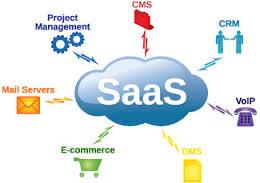
SaaS (Software-as-a-Service) or “software as a service” means that the manufacturer of the software (software) allows you to use your application and charges a monthly fee. That is, the customer (user) does not buy the software, but rents it for a certain period of time. The SaaS model now offers a wide variety of software solutions, ranging from ordinary text editors to CRM and ERP systems and cloud exchanges. Corporate mail on Gmail, Yandex or other clients is the most popular example of SaaS. At the same time, SaaS does not limit the capabilities of the software, but simply uses a different economic model.

SaaS is one of the three main types of cloud services.
Today, to conduct a business with minimal initial investment, you can organize an “office in the cloud” and choose the optimal set of services. Using cloud resources allows you to reduce investment costs for the purchase of software, server or telecommunications equipment, and even completely abandon your own IT department and the costs of its maintenance, shifting the worries about supporting employee jobs and updating corporate software to the provider.

IT industry giants are changing the business model.
Focusing on the needs of the market, software manufacturers are gradually changing their business models and moving from selling stand-alone licensed software to leasing public cloud services.
How is the SaaS application different from the “usual” one and what are its advantages and benefits for the buyer? First of all, the payment mechanism. Such software is paid monthly in the form of a monthly fee, or according to other criteria. In the case of SaaS, customers do not pay for a license, but for a software rental, which eliminates the need to immediately invest heavily in the purchase of applications - the payment is time-consuming. The monthly subscription model allows not only to reduce initial investments, but also to flexibly and effectively use IT budgets in the future. If the need to use the software is temporarily gone, then you can stop using it and no longer pay the developer or application provider.
For example, in a few months the business results will disappoint you, or if you find the best application, then you simply stop renting the software, saving on the fact that you did not pay its full price. However, if it suits you, then over time, rental costs may exceed the cost of buying a software license.

Sales of SaaS applications and traditional software in the world in recent years. SaaS share is still small, but gradually growing.
The main difference between SaaS and application hosting is the initial focus of the software on the use of this particular model. In most cases, application hosting is a special case of traditional software when the server part of the application is deployed at the site of the hosting provider. At the same time, each customer is provided with a dedicated copy of the software in the provider's data center.
SaaS, however, involves the use of a multi-tenant (multitenant) architecture, which requires a single software environment and a common hardware platform. Such an architecture implies other technical approaches to solving the issues of scaling and optimizing system performance.
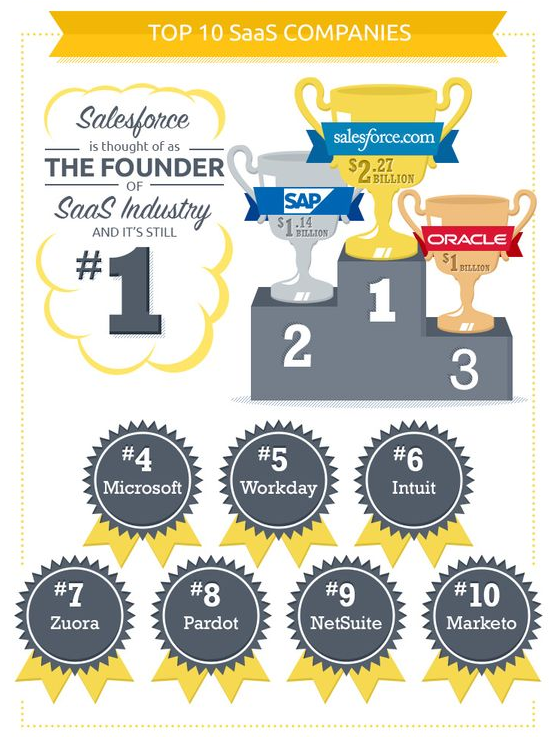
TOP-10 companies in the global SaaS market.
In addition, the SaaS application was originally designed for remote work and sharing, and software support is already included in the board. One of the most significant advantages of the “software as a service” model is that there is no need for the cost of installing, updating and maintaining the health of the servers and the software running on them. Using SaaS allows an employee not to become attached to a workplace or a computer: access to the application is possible from anywhere with Internet access. This model is often called the "virtual office." In case of SaaS, you can get the hardware base (virtual server) and software from the hosting provider.

The growth of the global SaaS market in billions of dollars.
SaaS applications are affordable, they can be quickly put into operation and mastered, they are focused on solving specific problems and allow you to quickly get results. An important factor in favor of SaaS is the growth of confidence in cloud solutions in general.

Leaders in the global SaaS enterprise application market in terms of growth in Q2 2016 (according to IDC).
With SaaS, there is no need to install software on employees' workplaces, since access to it is carried out via the Internet - through a regular browser. Software update is transparent for users - the provider is responsible for this. There is no need to spend money on security administration.
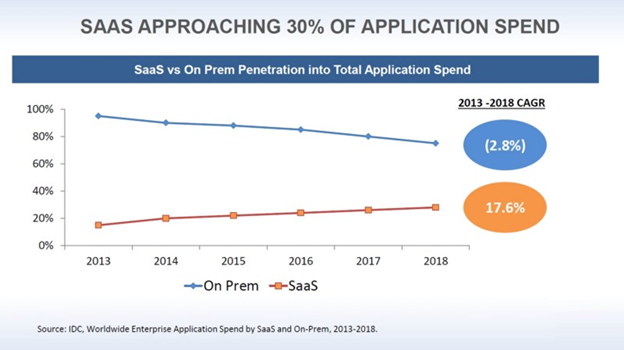 The share of expenses on SaaS applications in the world is approaching 30% (according to IDC).
The majority of SaaS users are small and medium-sized businesses, for whom purchasing a software product and its subsequent support is quite expensive, so renting it is preferable. In addition, such a system will be beneficial for geographically distributed companies with a wide network of offices or branches, between which a constant exchange of data should be carried out, so SaaS may be of interest to large companies. However, everything has its drawbacks.
What are the disadvantages and problems, what are the negative factors of “software as a service”? In Russia, doubts about the safety and confidentiality of data are not uncommon. It is worth saying that cloud storage and applications are much more secure than the IT infrastructure of the companies themselves. However, the need to transfer commercial data to a third-party service provider is considered a negative factor in using SaaS.
SaaS (software as a service) is a software delivery model in which the platform developer provides all the technical support and daily functioning of the service that customers use.
Features:
- Internet access
- Central management of the entire system
- One application - many users
Benefits:
- Accessibility from anywhere with Internet access
- Quick start
- Technical support - vendor task
- Lower cost
Disadvantages:
- Less flexibility and personalization
- Network only
One of the main conditions for using SaaS is a constant and stable connection to a data source and software , that is, a reliable Internet channel. In the regions of Russia, this problem is often not resolved. “Bad Internet” is not a very high speed system or application, possible interruptions in access to software, and, as a result, interruptions in work. The speed of the system depends on the speed of the Internet connection.
However, all these problems are gradually fading into the background, as modern technologies allow you to have stable and fast access to the Internet, and data encryption technologies - it is quite reliable to exchange commercial information. Therefore, SaaS systems are becoming more widespread.
SaaS is a key segment of the cloud market. According to IDC forecasts, by 2018, 27.8% of the global market for enterprise applications will be based on the SaaS model.
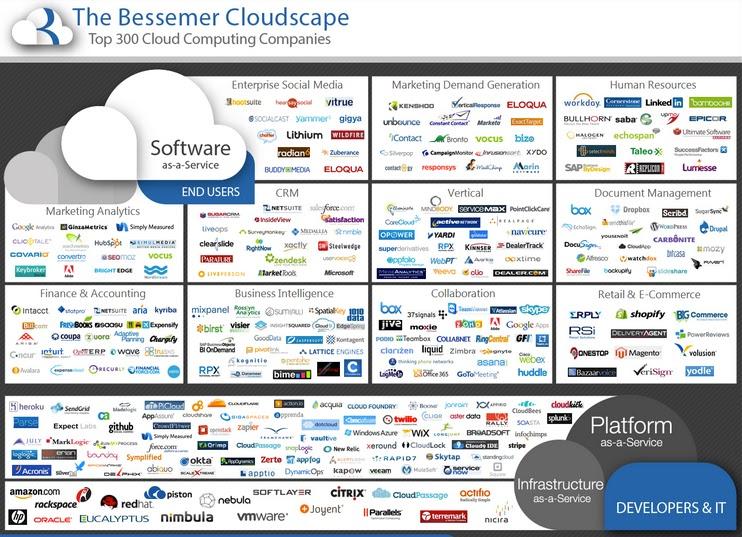
Cloud Atlas: leading vendors of different segments of the global cloud market.
The SaaS model is gradually becoming quite widespread in Russia. According to the estimates of various analytical agencies, currently the growth of the Russian market of services offered by the SaaS model is ahead of the global one. According to Parallels forecast, in 2016 the Russian market for services provided under the SaaS model in the segment of small and medium-sized businesses will reach 28 billion rubles.
In general, SaaS services have already become an everyday offer on the market and are quite familiar to users. According to a survey conducted by Naumen among Russian customers, 64% of respondents successfully work with a number of SaaS solutions, 19% plan to use SaaS, and 2% even transferred almost all corporate systems to the SaaS model, although 15% are still categorically against SaaS.
The growth in annual revenue of the largest SaaS suppliers in Russia is expressed in double digits. According to forecasts, by 2018, the growth rate of the SaaS market in the Russian Federation will be about 25%. The main reason - migration to SaaS allows you to optimize costs, which is especially true in a crisis.
Among the cloud services market in general, the SaaS market remains the largest segment. SaaS share in Russia in sales of “cloud solutions” is approaching 70%, and in the segment of small and medium-sized businesses is 90%. Parallels experts have provided such estimates over the past few years. According to SaaS market participants, it presents about two hundred high-quality services for business, and about 30 IT companies form the main proposals.
When using public cloud services, including SaaS, many companies and organizations choose local providers rather than a global provider. The reasons are different - this is the requirements of regulators, and the willingness of a local provider to tailor services to customer requirements, and sometimes the best fit of the services offered to market realities and the consideration of regional features. In addition, the products in the Russian data centers are predictable pricing, independent of the exchange rate, a higher speed of access to data in the cloud compared to foreign services.
In Russia, cloud providers are actively offering analytical, financial and accounting applications, collaboration applications, CRM, e-commerce systems, as well as other solutions for the B2B segment.
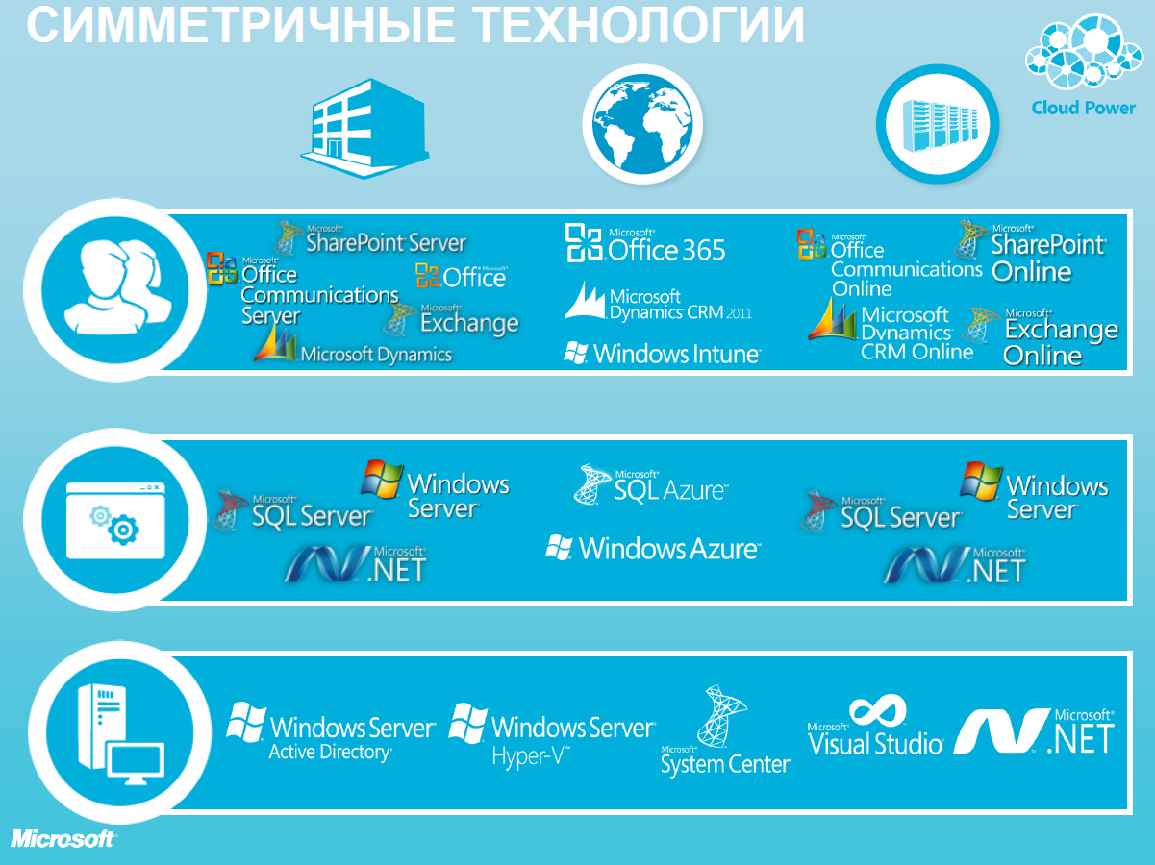 Microsoft offers both cloud and local versions of its software, developing both directions .
A popular offer is MS Office 365: office applications, business-class email, communications and file management, corporate social network. It is found in many Russian cloud providers - Microsoft partners in the sale of cloud solutions.
Microsoft Office 365 makes it easier for enterprises to move to the cloud by enabling IT leaders to combine cloud and traditional technology. To make this integration easier, Microsoft is investing huge amounts of money. Office 365 competes with Google Apps, although these are fairly different products. Office 365 is a more functional, but also more complex solution, which is more suitable for medium-sized and even large companies that are accustomed to working in a Microsoft-oriented environment and have an administrator who is versed in Active Directory, the intricacies of setting up Exchange and Sharepoint.
Russian SaaS solution providers offer their customers Microsoft cloud products under the Services Provider License Agreement (SPLA). This license agreement allows service providers and third-party software developers to license Microsoft products and provide them to their customers as services.
This program is used by organizations whose activities are related to web hosting, rental (hosting) of applications on the Microsoft platform, system integration, outsourcing of IT infrastructure and business processes, etc.
It provides for several licensing options. A Subscriber Access License (SAL) is required for each user or device. At the same time, in this licensing option, a separate server license is not required, and the subscriber can access any number of servers. A license such as a Processor License (PL) allows an unlimited number of users to access a product running on this processor.
The SPLA program allows a partner to pay only for the software that was actually used by the end user at one time or another. In this way, SPLA helps the partner earn money and save the end user.
By entering into an SPLA agreement, a partner company has the right to deploy the necessary Microsoft software and provide services to its customers on its basis. Paid on a monthly basis. The advantages of the SPLA program are the absence of initial investments in software, a flexible cost structure, stable prices, worldwide sales, etc.

SPLA program.
The hosting provider RUVDS, as part of an affiliate program, offers the opportunity to use “software as a service” for some software products, the list of which is constantly updated. The company is an official Microsoft partner in the SPLA program. It rents out dedicated virtual servers ( VPS / VDS) running modern licensed versions of Windows Server. The price of each VDS / VPS server already includes an operating system license. A range of related products are also available for rent.

RUVDS offers related software for rent.
For example, renting a package of Microsoft Office editors - gives access to all employees working on the server, the ability to use a licensed package of office applications without the extra cost of buying. Such a product is licensed by the number of users.
If a team of employees is working on a virtual server and you need to have more than two simultaneous connections to VDS , you can use the RDS CAL service.
RDS CAL (Remote Desktop Services Client Access License) is a license that gives a user the right to access server services.
There are two types of Windows Server 2012 Remote Desktop Services CALs: Device CAL and User CAL. You can use both types of client licenses to access server software at the same time.
The Windows Server 2012 Remote Desktop Services External Connector license allows you to provide an unlimited number of external users (partners and customers) with access to Windows Server 2012-based remote desktop services.
One example of using MS SharePoint Server - Creation of a site that gives users the opportunity for teamwork. Sites created on the SharePoint platform can be used as a data warehouse and can also be used to execute web-based applications that facilitate interaction, such as wikis and blogs.
There are also various rental options for MS SQL Server . You can purchase a license for one user, or license the server core, without limiting the number of users.
According to Gartner, in 2016 the global market for public cloud services will reach $ 204 billion, an increase of 16.5% compared to the previous year. At the same time, revenues from cloud applications, or SaaS services, will amount to 18.5% of this volume ($ 37.7 billion), which corresponds to an increase of 20.3% compared to last year.
The SaaS segment is best known in the cloud computing market, in part because the largest number of users deal with it: many have experience working directly with cloud applications. Today, every Internet user deals with SaaS quite regularly: all online mail services, Google Docs, Microsoft Live, Office 365 and much more - all these are SaaS. A similar model applies to business applications.
SaaS (Software-as-a-Service) or “software as a service” means that the manufacturer of the software (software) allows you to use your application and charges a monthly fee. That is, the customer (user) does not buy the software, but rents it for a certain period of time. The SaaS model now offers a wide variety of software solutions, ranging from ordinary text editors to CRM and ERP systems and cloud exchanges. Corporate mail on Gmail, Yandex or other clients is the most popular example of SaaS. At the same time, SaaS does not limit the capabilities of the software, but simply uses a different economic model.
SaaS is one of the three main types of cloud services.
Today, to conduct a business with minimal initial investment, you can organize an “office in the cloud” and choose the optimal set of services. Using cloud resources allows you to reduce investment costs for the purchase of software, server or telecommunications equipment, and even completely abandon your own IT department and the costs of its maintenance, shifting the worries about supporting employee jobs and updating corporate software to the provider.
IT industry giants are changing the business model.
Focusing on the needs of the market, software manufacturers are gradually changing their business models and moving from selling stand-alone licensed software to leasing public cloud services.
RuVDS Differences between the SaaS model and the conventional software model
How is the SaaS application different from the “usual” one and what are its advantages and benefits for the buyer? First of all, the payment mechanism. Such software is paid monthly in the form of a monthly fee, or according to other criteria. In the case of SaaS, customers do not pay for a license, but for a software rental, which eliminates the need to immediately invest heavily in the purchase of applications - the payment is time-consuming. The monthly subscription model allows not only to reduce initial investments, but also to flexibly and effectively use IT budgets in the future. If the need to use the software is temporarily gone, then you can stop using it and no longer pay the developer or application provider.
For example, in a few months the business results will disappoint you, or if you find the best application, then you simply stop renting the software, saving on the fact that you did not pay its full price. However, if it suits you, then over time, rental costs may exceed the cost of buying a software license.
Sales of SaaS applications and traditional software in the world in recent years. SaaS share is still small, but gradually growing.
The main difference between SaaS and application hosting is the initial focus of the software on the use of this particular model. In most cases, application hosting is a special case of traditional software when the server part of the application is deployed at the site of the hosting provider. At the same time, each customer is provided with a dedicated copy of the software in the provider's data center.
| Key benefits of SaaS over traditional software: 1. Lower cost of ownership. 2. Shorter implementation times. 3. Low entry threshold (you can quickly and free to test). 4. The tasks of maintaining and updating the system are entirely the responsibility of the provider. 5. User mobility, limited only by Internet access. 6. Support for geographically distributed companies and remote employees. 7. Low power requirements for the user's computer. 8. Cross-platform. |
SaaS, however, involves the use of a multi-tenant (multitenant) architecture, which requires a single software environment and a common hardware platform. Such an architecture implies other technical approaches to solving the issues of scaling and optimizing system performance.
TOP-10 companies in the global SaaS market.
In addition, the SaaS application was originally designed for remote work and sharing, and software support is already included in the board. One of the most significant advantages of the “software as a service” model is that there is no need for the cost of installing, updating and maintaining the health of the servers and the software running on them. Using SaaS allows an employee not to become attached to a workplace or a computer: access to the application is possible from anywhere with Internet access. This model is often called the "virtual office." In case of SaaS, you can get the hardware base (virtual server) and software from the hosting provider.
The growth of the global SaaS market in billions of dollars.
SaaS applications are affordable, they can be quickly put into operation and mastered, they are focused on solving specific problems and allow you to quickly get results. An important factor in favor of SaaS is the growth of confidence in cloud solutions in general.
Leaders in the global SaaS enterprise application market in terms of growth in Q2 2016 (according to IDC).
With SaaS, there is no need to install software on employees' workplaces, since access to it is carried out via the Internet - through a regular browser. Software update is transparent for users - the provider is responsible for this. There is no need to spend money on security administration.
The majority of SaaS users are small and medium-sized businesses, for whom purchasing a software product and its subsequent support is quite expensive, so renting it is preferable. In addition, such a system will be beneficial for geographically distributed companies with a wide network of offices or branches, between which a constant exchange of data should be carried out, so SaaS may be of interest to large companies. However, everything has its drawbacks.
RuVDS Cons SaaS
What are the disadvantages and problems, what are the negative factors of “software as a service”? In Russia, doubts about the safety and confidentiality of data are not uncommon. It is worth saying that cloud storage and applications are much more secure than the IT infrastructure of the companies themselves. However, the need to transfer commercial data to a third-party service provider is considered a negative factor in using SaaS.
SaaS (software as a service) is a software delivery model in which the platform developer provides all the technical support and daily functioning of the service that customers use.
Features:
- Internet access
- Central management of the entire system
- One application - many users
Benefits:
- Accessibility from anywhere with Internet access
- Quick start
- Technical support - vendor task
- Lower cost
Disadvantages:
- Less flexibility and personalization
- Network only
One of the main conditions for using SaaS is a constant and stable connection to a data source and software , that is, a reliable Internet channel. In the regions of Russia, this problem is often not resolved. “Bad Internet” is not a very high speed system or application, possible interruptions in access to software, and, as a result, interruptions in work. The speed of the system depends on the speed of the Internet connection.
However, all these problems are gradually fading into the background, as modern technologies allow you to have stable and fast access to the Internet, and data encryption technologies - it is quite reliable to exchange commercial information. Therefore, SaaS systems are becoming more widespread.
RuVDSSaaS in Russia
SaaS is a key segment of the cloud market. According to IDC forecasts, by 2018, 27.8% of the global market for enterprise applications will be based on the SaaS model.
Cloud Atlas: leading vendors of different segments of the global cloud market.
The SaaS model is gradually becoming quite widespread in Russia. According to the estimates of various analytical agencies, currently the growth of the Russian market of services offered by the SaaS model is ahead of the global one. According to Parallels forecast, in 2016 the Russian market for services provided under the SaaS model in the segment of small and medium-sized businesses will reach 28 billion rubles.
In general, SaaS services have already become an everyday offer on the market and are quite familiar to users. According to a survey conducted by Naumen among Russian customers, 64% of respondents successfully work with a number of SaaS solutions, 19% plan to use SaaS, and 2% even transferred almost all corporate systems to the SaaS model, although 15% are still categorically against SaaS.
The growth in annual revenue of the largest SaaS suppliers in Russia is expressed in double digits. According to forecasts, by 2018, the growth rate of the SaaS market in the Russian Federation will be about 25%. The main reason - migration to SaaS allows you to optimize costs, which is especially true in a crisis.
Among the cloud services market in general, the SaaS market remains the largest segment. SaaS share in Russia in sales of “cloud solutions” is approaching 70%, and in the segment of small and medium-sized businesses is 90%. Parallels experts have provided such estimates over the past few years. According to SaaS market participants, it presents about two hundred high-quality services for business, and about 30 IT companies form the main proposals.
RuVDS SPLA Program
When using public cloud services, including SaaS, many companies and organizations choose local providers rather than a global provider. The reasons are different - this is the requirements of regulators, and the willingness of a local provider to tailor services to customer requirements, and sometimes the best fit of the services offered to market realities and the consideration of regional features. In addition, the products in the Russian data centers are predictable pricing, independent of the exchange rate, a higher speed of access to data in the cloud compared to foreign services.
In Russia, cloud providers are actively offering analytical, financial and accounting applications, collaboration applications, CRM, e-commerce systems, as well as other solutions for the B2B segment.
A popular offer is MS Office 365: office applications, business-class email, communications and file management, corporate social network. It is found in many Russian cloud providers - Microsoft partners in the sale of cloud solutions.
Microsoft Office 365 makes it easier for enterprises to move to the cloud by enabling IT leaders to combine cloud and traditional technology. To make this integration easier, Microsoft is investing huge amounts of money. Office 365 competes with Google Apps, although these are fairly different products. Office 365 is a more functional, but also more complex solution, which is more suitable for medium-sized and even large companies that are accustomed to working in a Microsoft-oriented environment and have an administrator who is versed in Active Directory, the intricacies of setting up Exchange and Sharepoint.
Russian SaaS solution providers offer their customers Microsoft cloud products under the Services Provider License Agreement (SPLA). This license agreement allows service providers and third-party software developers to license Microsoft products and provide them to their customers as services.
This program is used by organizations whose activities are related to web hosting, rental (hosting) of applications on the Microsoft platform, system integration, outsourcing of IT infrastructure and business processes, etc.
It provides for several licensing options. A Subscriber Access License (SAL) is required for each user or device. At the same time, in this licensing option, a separate server license is not required, and the subscriber can access any number of servers. A license such as a Processor License (PL) allows an unlimited number of users to access a product running on this processor.
The SPLA program allows a partner to pay only for the software that was actually used by the end user at one time or another. In this way, SPLA helps the partner earn money and save the end user.
By entering into an SPLA agreement, a partner company has the right to deploy the necessary Microsoft software and provide services to its customers on its basis. Paid on a monthly basis. The advantages of the SPLA program are the absence of initial investments in software, a flexible cost structure, stable prices, worldwide sales, etc.
SPLA program.
The hosting provider RUVDS, as part of an affiliate program, offers the opportunity to use “software as a service” for some software products, the list of which is constantly updated. The company is an official Microsoft partner in the SPLA program. It rents out dedicated virtual servers ( VPS / VDS) running modern licensed versions of Windows Server. The price of each VDS / VPS server already includes an operating system license. A range of related products are also available for rent.
RUVDS offers related software for rent.
For example, renting a package of Microsoft Office editors - gives access to all employees working on the server, the ability to use a licensed package of office applications without the extra cost of buying. Such a product is licensed by the number of users.
If a team of employees is working on a virtual server and you need to have more than two simultaneous connections to VDS , you can use the RDS CAL service.
RDS CAL (Remote Desktop Services Client Access License) is a license that gives a user the right to access server services.
There are two types of Windows Server 2012 Remote Desktop Services CALs: Device CAL and User CAL. You can use both types of client licenses to access server software at the same time.
The Windows Server 2012 Remote Desktop Services External Connector license allows you to provide an unlimited number of external users (partners and customers) with access to Windows Server 2012-based remote desktop services.
One example of using MS SharePoint Server - Creation of a site that gives users the opportunity for teamwork. Sites created on the SharePoint platform can be used as a data warehouse and can also be used to execute web-based applications that facilitate interaction, such as wikis and blogs.
There are also various rental options for MS SQL Server . You can purchase a license for one user, or license the server core, without limiting the number of users.