How to stop worrying about inefficient employees once again
Epigraph. “Criticism is not accepted at all, only an alternative construction is accepted. If it is better than mine, then I will accept it as more correct. ”
The article was inspired by the article Karate motivation: how to stop worrying about inefficient employees? .
The article provides an alternative opinion on how to build a bonus system. Partially, the technique has been tested on its own skin and has shown its high efficiency in the applied field (not software development).
a picture to attract attention
Disclaimer: No matter how bonuses are awarded, there will always be those who consider this to be unfair. I just propose another way how this can be done.
Each task has a value for the business (as an expense) and has a benefit for the business (as an estimate of the profit that the company will receive if the task is completed). Typically, tasks that increase profits are non-standard, because if there were standard ones, then everyone would do standard tasks and everyone would have a good time with business in IT. Empirically, this is not so, many startups and even mature companies simply fail.
But even for typical tasks, such a reward system will work poorly. A few thoughts from an adjacent area. I went to school and received money from my parents for grades. Homework is a typical subject of a spherical task in terms of human hours. You take the condition, apply the rules, get the result. (Important historical note. The system does not work at the institute at all)
Let us compare the methods for me and the one that was in the article.
Adapting the methodology for the team is not so trivial, but let's try to figure something out.
First, we will collect information about what we have, what we want to build and what to avoid:
Now try to assemble.
Note. Here I will mix lead and PM to one role - the "boss".
A few words in the end. Unlike the author of the original article, this technique in its entirety was not used anywhere else in software development. This article can be considered as a detailed commentary on the original article.
The article was inspired by the article Karate motivation: how to stop worrying about inefficient employees? .
The article provides an alternative opinion on how to build a bonus system. Partially, the technique has been tested on its own skin and has shown its high efficiency in the applied field (not software development).
a picture to attract attention
Disclaimer: No matter how bonuses are awarded, there will always be those who consider this to be unfair. I just propose another way how this can be done.
Each task has a value for the business (as an expense) and has a benefit for the business (as an estimate of the profit that the company will receive if the task is completed). Typically, tasks that increase profits are non-standard, because if there were standard ones, then everyone would do standard tasks and everyone would have a good time with business in IT. Empirically, this is not so, many startups and even mature companies simply fail.
But even for typical tasks, such a reward system will work poorly. A few thoughts from an adjacent area. I went to school and received money from my parents for grades. Homework is a typical subject of a spherical task in terms of human hours. You take the condition, apply the rules, get the result. (Important historical note. The system does not work at the institute at all)
Let us compare the methods for me and the one that was in the article.
- There is a specific lesson for which the task is given. It will be checked and rated. For 5 I will get a lot. For 4, little or nothing. For 3 and 2 there will be a penalty. What motivation do I have? There is motivation to do best. There is motivation to do it fastest, because the rest of the time I can play on my computer.
And what motivation is there with your system? Firstly, because obviously wrong leverage was introduced into the system, I will try as much as possible to increase the estimated deadlines. Secondly, there is an implicit opportunity to deflect from the task. She is always at work and at school. To indicate to the authorities that there is a higher priority task that you specially came up with. It is both easier and faster to do, and you can not do any garbage. Even worse! I can add a bug to the repository. Get him on the tracker, assign him time, make him and get points. - There are priorities between subjects. For technical subjects they give more, for humanitarian less. Business (in this case, parents) very clearly set priorities in monetary terms. Therefore, I will try more on technical subjects - there is always the possibility that if I have not learned something, they will ask me this. Therefore, I will spend more time on re-reading the book on mathematics, and I will not read “War and Peace”. If I do not get 5 in mathematics, but get 4, then the lost profit will be big, and if in literature, then the situation is more indifferent. Yes, I will strive to get 5, but if I get 4, I’m not very upset.
In the methodology of the article, the connection with business is, to put it mildly, strange. There are specific tasks that will increase the company's profits. Some more, some less. You have a team. It does not matter who does the task - the main thing is that it is done and the profit has grown. Your monthly expenses for a team are approximately fixed, as opposed to profit. How to fix this, see clause 3. - There is a final score in the report card for the period. I can cheat endlessly with estimates in the process, but if I fill up a couple of important control points, then I will lose ~ 50% of the profit. somewhere I get half the money for current grades, and half just for one number in the report card. Therefore, I am very motivated to get the final result, not an intermediate one. Needless to say, you simply do not have this part. Bonuses at the end of the year are not about that at all.
There is one antipattern to be avoided.
A professor of economics at Texas Tech University said he had never failed students one at a time, but once failed a whole group. The group insisted that socialism “works” and that no one will be poor and no one will be rich. Great alignment! The professor said that well, we put in this class an experiment on the subject of socialism. All grades will be averaged and everyone will get the same grade, so no one will fail and no one will get “excellent”. After the first control assessment, they were averaged and everyone got “good”. Students who studied stubbornly were upset, while students who studied little were happy. But by the time of the second control, students who studied a little, studied even less, and those who studied hard, decided that they also want freebies, therefore, they did a little ... The second control on average gave "satisfactory". No one was happy. When the third control passed, on average it turned out “bad”. The result did not improve, because quarrels, reproaches, and abuse led to hostile relations and no one was going to study for others.
Adapting the methodology for the team is not so trivial, but let's try to figure something out.
First, we will collect information about what we have, what we want to build and what to avoid:
- It would be nice if the developers instead of “oooh, another task” or “how good that I have no tasks, I’m not doing anything, but the money is dripping”, they said “here’s the result, let’s continue”, “let’s go we’ll make the product better ”,“ but I used our site and found such a bug ”(disclaimer: deliberate introducing bugs by the staff is very difficult to stop if it is systemic, but very easy if it is marginal).
- We have a specific lead that is responsible for the direction. He has some information about what the business needs and there is a team as a means of achieving the goals of the business.
- Is it important how many people do the job? If 2 people do 2 tasks, then it takes 1 hour. If at first 2 people do one task together, and then another, then it will also be 1 hour. But there is some difference. The more people will do the task (to a certain limit), the more inaccuracies can be noticed.
- Nobody likes when they lower their salaries, but everyone loves when they pay extra.
- Each system may be perfect on paper, but there may be no way to build it.
Now try to assemble.
Note. Here I will mix lead and PM to one role - the "boss".
- There is a specific period. Let the quarter go. There is a quarterly earnings report. This is an assessment of the work of the entire company and IT team in particular. For an increase in the company's profits, a bonus is due. To everyone involved. But you can share the bonus in proportion to how each participant invested in the result. OK. Business gives 10% of the increase in revenue for the quarter as a bonus.
- Let us have one lead. How much lead should be obtained from this is a separate difficult question, one needs to think. But somewhere around 90% of the money should be received by the team that did everything. Lead directly affects how he distributes tasks and, as a result, how much each will receive. Its tasks: to distribute assignments relatively evenly so that more can be done, distribute assignments so that they are done as efficiently as possible, to occupy loafers (in the good sense of the word, the fact is that different employees are idle at different stages of the company’s work, this is normal and it’s right not to fight this, but to eliminate a narrow link (see Goldratt - Goal 1)).
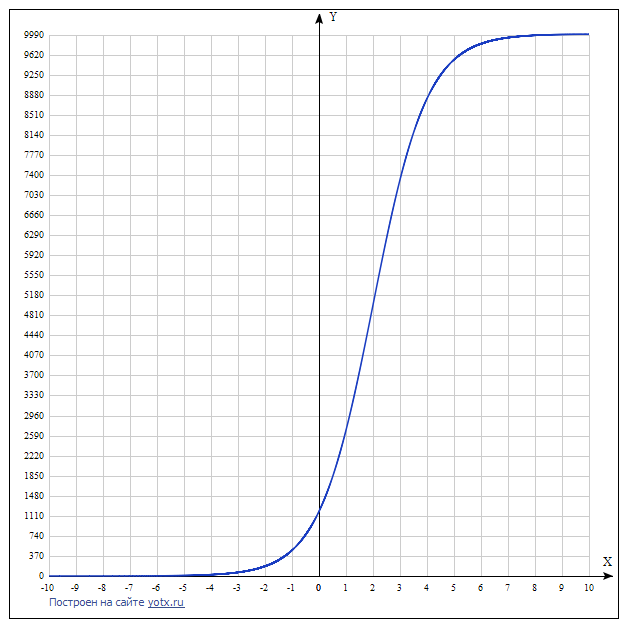
- And here we need metrics to share this bonus. During this period of time there were tasks that needed to be done. There were people who participated in these assignments. It is logical that the more people participated, the more they should receive. But here IMHO you need to make one small detail that no one does. Add something like a sigmoid function to the part that corresponds to too much reward. Why is it important. Firstly, the problem is to determine how much lead gets. It becomes clear that he simply won’t get more than a certain amount according to the formula, because the point of pulling a blanket over yourself is less and less, the more you pull it over yourself, and not proportionally. Secondly, there is risk management, if the team has one knight on a white horse, the bus factor will tend to 1, and this should be avoided. Understanding the asymptotes improves the atmosphere. You are not trying to get out of your skin and jump over your head to get another reward, so you burn out less. In the end, it’s better for both the employee and the lead.
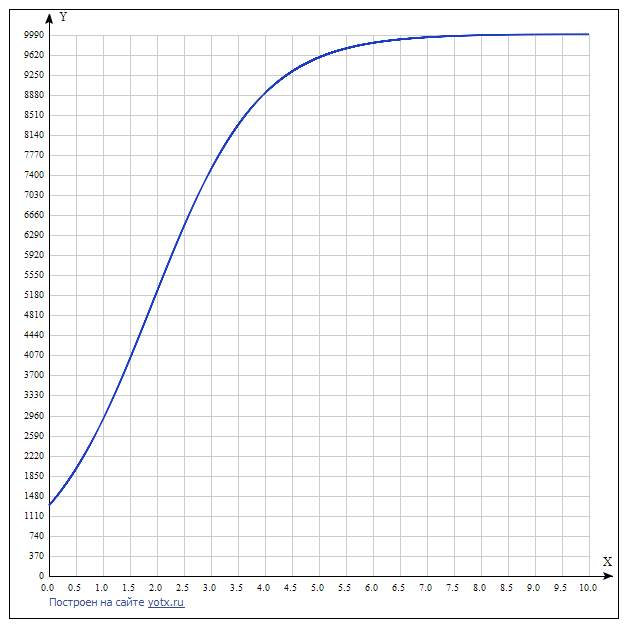
An example of a salary in $, as a function of the work done. - In addition to the bonus from increasing profits, you need to add a bonus from current profits. This is important because if the company is stable, then the system simply will not work. There are no examples of positive reinforcement.
- Some fixed part of the bonus is vital to make subjective. This part should reflect the manager’s attitude to how this particular employee works.
- It will be difficult to hire a new employee. If you offer him a rate lower than the market + bonus, then everyone will say “we know, swam”, and if you give him 4k $ + bonus right away, then the bosses will doubt “but should we take a more effective manager”. Therefore, there should be a smooth integration of the new employee into the company's culture. The first 3 months is a conditional probationary period. There is only a fixed rate. Further, the next 3 months bonuses are distributed to the employee as well as to all. But truncated 2 times. Here an employee can feel the power of motivation bonuses. After receiving bonuses for the first time, the employee is informed that, in fact, now he can switch from a large fixed rate and a small bonus spread to a lower fixed rate and a larger bonus spread. Several options are possible, discussed with the business.
- Cunning gouging will not work. If you constantly do the minimum “just to get a fixed rate”, then this will not last long. At the moment when they propose to switch from a safe fixed rate, the cunning gouging will remain on the old terms, but this automatically attracts the attention of the immediate boss. Here is such a feedback.
- By construction, personal inefficiency is suppressed weakly. Those. if you do less than everything - ok, at this stage you are a loafer, but then you may have the opportunity to prove yourself on another task. If you can’t prove yourself in any way - bye. If personal inefficiency grows into something more and already prevents part of the team from working normally (which affects their bonuses), then “goodbye” may come much earlier.
- A slave may well receive more than his immediate superior. This is normal, moreover, it allows career growth without changing the office or moving to the level of incompetence (see Peter Principle )
A few words in the end. Unlike the author of the original article, this technique in its entirety was not used anywhere else in software development. This article can be considered as a detailed commentary on the original article.
Only registered users can participate in the survey. Please come in.
Would you work on such a system?
- 8.8% I am the boss, and I would work on such a system 10
- 16.8% I am an employee and I would work on such a system 19
- 5.3% I am the boss, and I would not work on such a system 6
- 18.5% I am an employee, and I would not work on such a system 21
- 50.4% I am tomato 57