August 29, 2016 at 18:15
The future of computer technology: an overview of current trends
- Transfer
The field of information technology develops in two mainly independent cycles: grocery and financial. In recent years, disputes about what stage of the financial cycle we are in have not ceased; a lot of attention is paid to financial markets, which sometimes behave unpredictably and fluctuate greatly. On the other hand, product cycles receive relatively little attention, although they are the ones that move information technology forward. But, analyzing the experience of the past, you can try to understand the current product cycle and predict the further development of technology.

The development of product cycles in the field of high technology is due to the interaction of platforms and applications: new platforms allow you to create new applications, which, in turn, add value to these platforms, thus closing the chain of positive feedback.

Small product cycles are constantly repeated, but historically, once every 10-15 years, the next large cycle begins - an era that completely changes the face of IT.
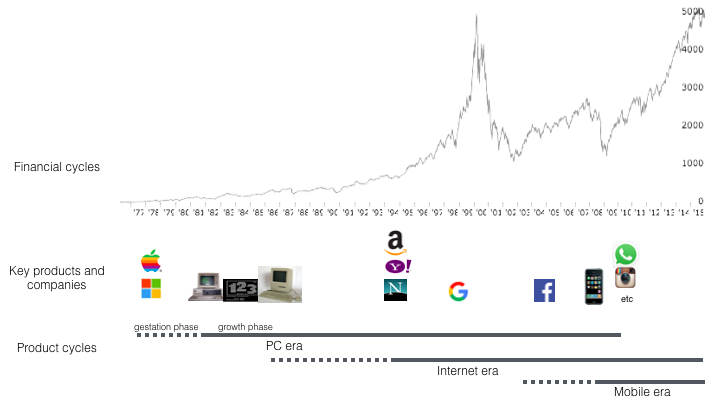
Financial and product cycles evolve mainly independently of one another.
Once the advent of computers prompted entrepreneurs to create the first text editors, spreadsheets and many other PC applications. With the advent of the Internet, the world saw search engines, online commerce, email, social networks, SaaS business applications and many other services. Smartphones have given impetus to the development of mobile social networks and instant messengers, as well as the emergence of new types of services like carpooling. We live in the midst of a mobile era, and, apparently, there are still many interesting innovations awaiting us.
Each epoch can be conditionally divided into 2 phases: 1) the formation phase - when the platform first appears on the market, but is expensive, crude and / or difficult to use; 2) the active phase - when a new product solves the mentioned disadvantages of the platform, thereby beginning the period of its rapid development.
The Apple II computer was released in 1977, and the Altair 8800 in 1975, but the active phase of the PC era began with the release of the IBM PC in 1981.
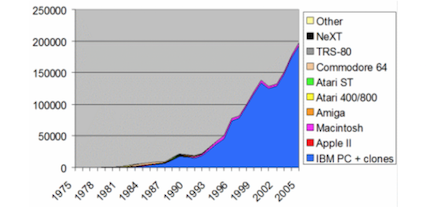
PC sales per year (thousand)
The phase of Internet formation began in the 80s and early 90s , when, in fact, it was a text data exchange tool used by scientists and the government. The launch of the first browser, NCSA Mosaic, in 1993 marked the beginning of a phase of intensive development of the Internet, which has not ended to this day.
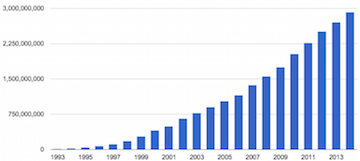
Number of Internet users around the world
In the 90s mobile phones already existed, and the first smartphones appeared at the dawn of the zero, but the widespread production of smartphones began in 2007-2008 with the release of the first iPhone, and then with the advent of the Android platform. Since then, the number of smartphone users has skyrocketed, and now their number has already reached about two billion. And by 2020, 80% of the world's population will have smartphones .

Worldwide smartphone sales (million)
If the duration of each cycle is indeed 10-15 years, in just a few years the active phase of the new computer era will begin. It turns out that the new technology is already in the formation phase. Today, there are several main trends in the areas of hardware and software that allow us to partially shed light on the next era. In this article, I want to discuss these trends and make some suggestions about how our future might look.
In the mainframe era, only large organizations could afford a computer. Mini-computers were available for smaller organizations, and computers for homes and offices.
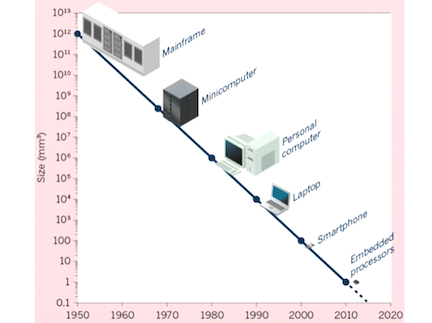
The size of computers is decreasing at a constant speed.
We are now on the verge of a new era in which processors and sensors are becoming so cheap and compact that there will soon be more computers than people.
Two factors contribute to this. First, the steady progress in semiconductor manufacturing over the past 50 years ( Moore's Law ). Secondly, what Chris Anderson calls “peaceful dividends from the smartphone war”: the dizzying success of smartphones has contributed to a large investment in the development of processors and sensors. Take a look inside a modern quadrocopter, virtual reality glasses or any device of the Internet of things - what will you see? That's right - mostly smartphone components.
But in the modern era of semiconductors, all attention has shifted from individual processors to entire nodes of special microcircuits, known as single-chip systems.
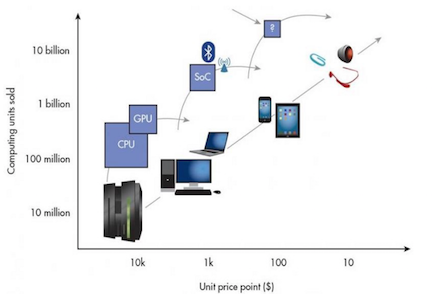
Prices for computers are steadily declining
An ordinary single-chip system combines an energy-efficient ARM processor and a special graphics processor, as well as information exchange, power management, video signal processing, and so on.
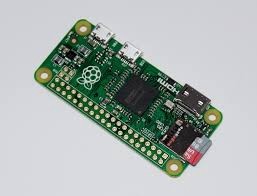
Raspberry Pi Zero: A $ 5 Linux Computer with a 1 GHz Processor
This innovative architecture has reduced the minimum cost of basic computing systems from $ 100 to $ 10 per unit. A great example is the Raspberry Pi Zero , the first $ 5 Linux computer with a frequency of 1 GHz. For the same money, you can purchase a Wi-Fi microcontroller that supports one of the versions of Python. Very soon, these microprocessors will cost less than a dollar, and we can easily integrate them almost everywhere.
But more serious achievements are taking place today in the world of high-quality microprocessors. Graphic processors deserve special attention ., the best of which are produced by NVIDIA. GPUs are useful not only for processing graphics, but also when working with machine learning algorithms, as well as with virtual and augmented reality devices. However, representatives from NVIDIA promise more significant GPU performance improvements in the near future.
The trump card of the entire sphere of information technology is still quantum computers, which so far exist mainly in laboratories. But it is worth making them commercially attractive, and this will lead to a tremendous increase in productivity, primarily in the field of biology and artificial intelligence.

Google Quantum Computer
There are many interesting things happening in the software world today. A good example is distributed systems. Their appearance is due to a multiple increase in the number of devices in recent years, which necessitated parallelizing tasks on several machines, establishing data exchange between devices and coordinating their work. Special attention should be paid to such technologies of distributed systems as Hadoop or Spark , designed to work with large data arrays. It is also worth mentioning the blockchain technology that ensures the security of data and resources and was first implemented in the Bitcoin cryptocurrency.
But perhaps the most exciting discoveries are being made today in the field of artificial intelligence (AI), which has a long history of ups and downs. Alan Turing himself also predicted that by 2000, cars would be able to mimic people. Although this prediction has not yet been realized, there are good reasons to believe that AI is finally entering the golden age of its development.
The greatest excitement in the field of AI is concentrated around the so-called deep learning - a method that has been widely covered in the framework of one well-known Google project launched in 2012. A high-performance network of computers was involved in this project, the purpose of which was to learn to recognize cats in YouTube videos. The deep learning method is based on artificial neural networks - a technology that originated in the 40s of the last century. Recently, this technology has again become relevant due to many factors : the emergence of new algorithms, lower cost of parallel computing and the widespread dissemination of large data sets.
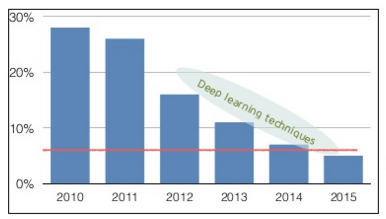
Percentage of errors in the ImageNet contest (red line corresponds to human performance)
It is hoped that in-depth training will not be just another fashionable term of Silicon Valley. However, interest in this teaching method is supported by impressive theoretical and practical results. For example, before the introduction of in-depth training, the permissible error rate of ImageNet winners , the well-known machine vision contest, was 20–30%. But after its application, the correctness of the algorithms grew steadily, and already in 2015, the performance of machines exceeded the performance of a person.
Many documents, data packages and software tools,associated with in-depth training, are in the public domain, which allowed individuals and small organizations to create their own highly effective applications. WhatsApp Inc. it took only 50 developers to create a popular messenger for 900 million users . For comparison, the creation of instant messengers of previous generations required the involvement of more than a thousand (and sometimes several thousand) developers. Something similar is now happening in the field of AI: software tools like Theano and TensorFlow , combined with cloud-based data centers for training and low-cost graphics cards for computing, allow small teams of developers to create innovative AI systems.
For example, below is a small project by one programmer using TensorFlow to convert black and white photos to color:

From left to right: black and white photo, converted photo, color original photo. ( Source )
And here is a small startup application for classifying objects in real time:

The Teradeep application identifies objects in real time
Hmm, but somewhere I already saw it:

A fragment from the movie Terminator 2: Doomsday (1991)
One of the first applications with the deep learning method released by a large company was an amazingly smart application for searching for images Google Photos:

Searching for photographs (without metadata) with the keyword “big ben”
Soon, we will expect a significant increase in AI performance in all areas of software and hardware: voice assistants, search engines, chat bots , 3D scanners , language translators, cars, drones diagnostic imaging systems and much, much more.
Startups creating AI-focused products should remain extremely focused on specific applications in order to compete with large companies for which AI is a top priority. AI systems become more efficient as the amount of data collected for them increases. It turns out something like a flywheel, constantly rotating due to the so-called data network effect (more users → more data → better products → more users). For example, the Wase mapping service team used the effect of a data network to make the quality of the provided maps better than that of their more venerable competitors. Everyone who intends to use AI for their startup should follow a similar strategy.
Now at the stage of formation is a whole series of promising platforms, which may soon go to the development stage, since they combine the latest developments from the areas of software and hardware. And although these platforms may look different or have different bundles, they have one thing in common: using the latest advanced features of smart virtualization. Consider some of these platforms:
Cars.Large IT companies like Google, Apple, Uber and Tesla are investing heavily in the development of autonomous or unmanned vehicles. Semi-autonomous Tesla Model S cars are already on the market, and updated and more advanced models are expected soon. Creating a fully autonomous car will take some time, but there is reason to believe that no more than five years are left to wait. In fact, there are already developments of fully autonomous cars that drive no worse than under human control. However, due to many aspects of a cultural and regulatory nature, such cars must drive much better than human-driven vehicles in order to be eligible for widespread use.
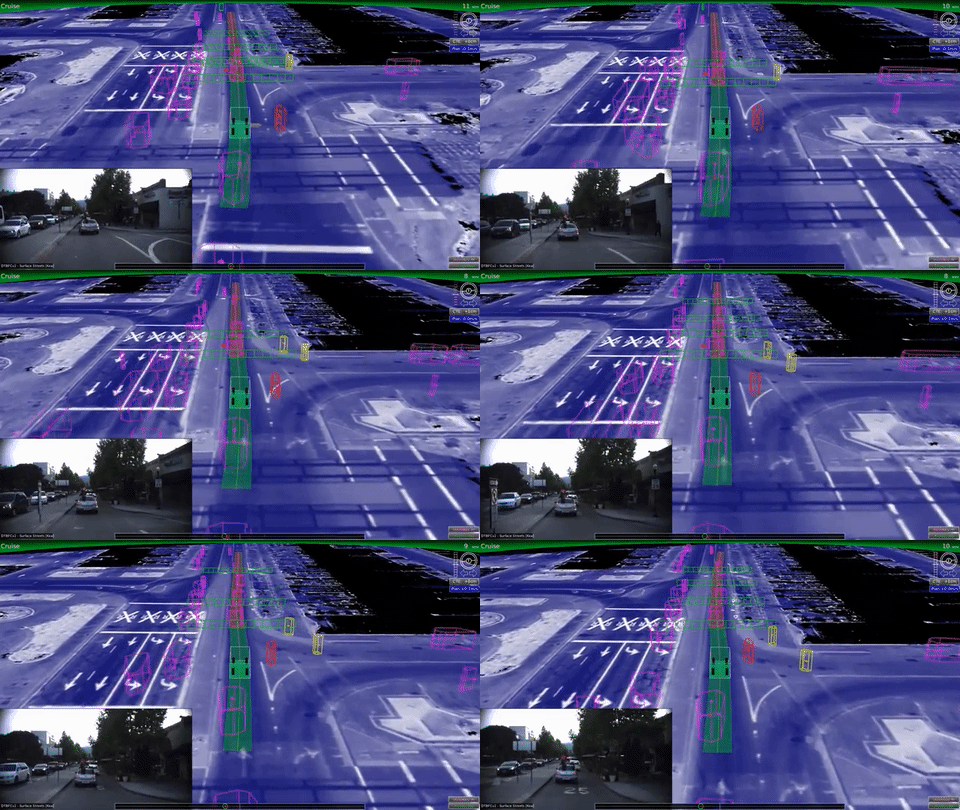
An unmanned vehicle draws up a diagram of its environment.
Undoubtedly, the volume of investment in unmanned vehicles will only grow. In addition to information technology companies, major car manufacturers have also begun to think about autonomy. We are waiting for many more interesting startup products. Deep learning software has become so effective that today , with a single developer , you can make a semi-autonomous car.
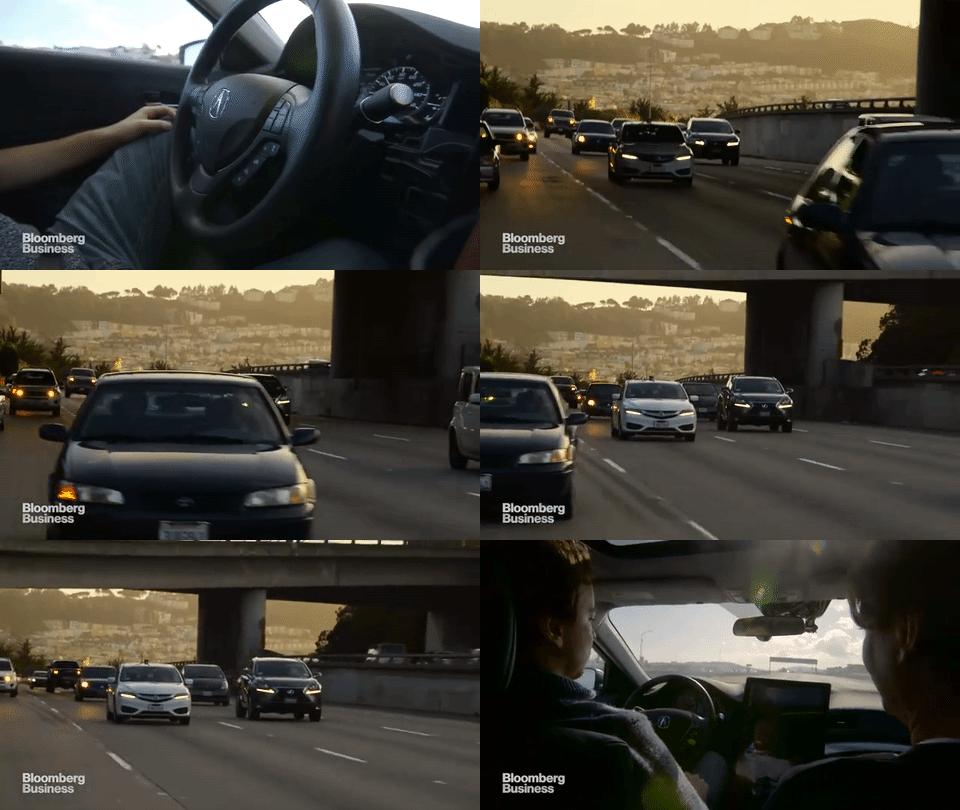
Home-made unmanned vehicle
Drones. Modern drones are equipped with the latest technology (mainly smartphone components and mechanical parts), but have relatively simple software. Soon, there will be improved models equipped with computer vision and other types of AI, which will make them safer, easier to manage and useful. Photography and video shooting from drones will be popular not only among amateurs, but, more importantly, will find commercial application. In addition, there are many dangerous types of work, including high-altitude, for which it would be much safer to use drones.

Fully autonomous drone flight
Internet of things. The most basic advantages of IoT devices are their energy efficiency, safety and convenience. Good examples of the first two features are Nest and Dropcam . As for convenience, it is worth paying attention to the Amazon Echo device .
Most people believe that Echo is another marketing ploy, but, having used it at least once, they are surprised how convenient this device turns out to be. It shows brilliantlythe effectiveness of voice control as the basis of the user interface. Of course, we will not soon see robots with universal intelligence that can support a full conversation. But, as Echo shows, computers are already capable of handling more or less complex voice commands. As the deep learning method improves, computers will learn to better understand the language.

3 main advantages: energy efficiency, safety, convenience.
Internet of things devices will also find application in the business segment. For example, devices with sensors and network connectivity are widely used for operational control of industrial equipment.
Wearable technology.Today, the functionality of wearable computers varies depending on a number of factors: battery capacity, communications and data processing. The most successful devices usually have a very narrow scope: for example, fitness tracking. As hardware components improve, wearable devices, like smartphones, will expand their functionality, opening up opportunities for new applications. As with the Internet of things, it is assumed that voice will become the main user interface for managing wearable devices.

A miniature headphone with artificial intelligence, an excerpt from the movie "She"
Virtual Reality. 2016 will be very interesting for the development of VR tools: the release of Oculus Rift and HTC Vive virtual reality glasses (and, possibly, PlayStation VR) means that convenient and immersive VR systems will finally become publicly available. VR device developers will have to work hard to prevent users from creating the so-called “sinister valley” effect , in which the excessive credibility of a robot or other artificial object causes hostility among human observers.
Creating high-quality VR systems requires high-quality screens (with high resolution, high refresh rate and low inertia), powerful video cards and the ability to track the exact position of the user (previous generations of VR systems could only track the rotation of the user's head). This year, thanks to new devices, users will be able to experience the full-fledged presence effect for the first time : all feelings are so “deceived” that the user feels a complete immersion in the virtual world.
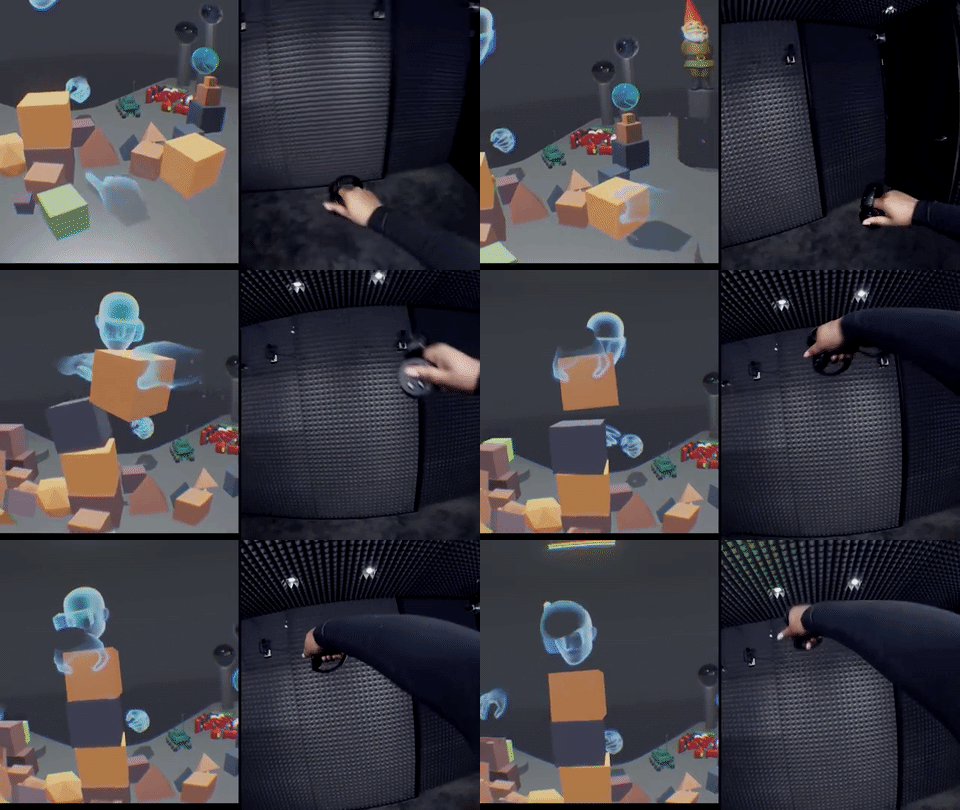
Demonstration of Oculus Rift Toybox
Undoubtedly, VR glasses will continue to evolve and will become more accessible over time. Developers still have a lot of work to do on such aspects as new tools for presenting generated and / or captured VR content , improving machine vision to track the user's position and obtain data about him directly from the phone or virtual reality glasses, as well as distributed server systems for hosting large-scale virtual surroundings.
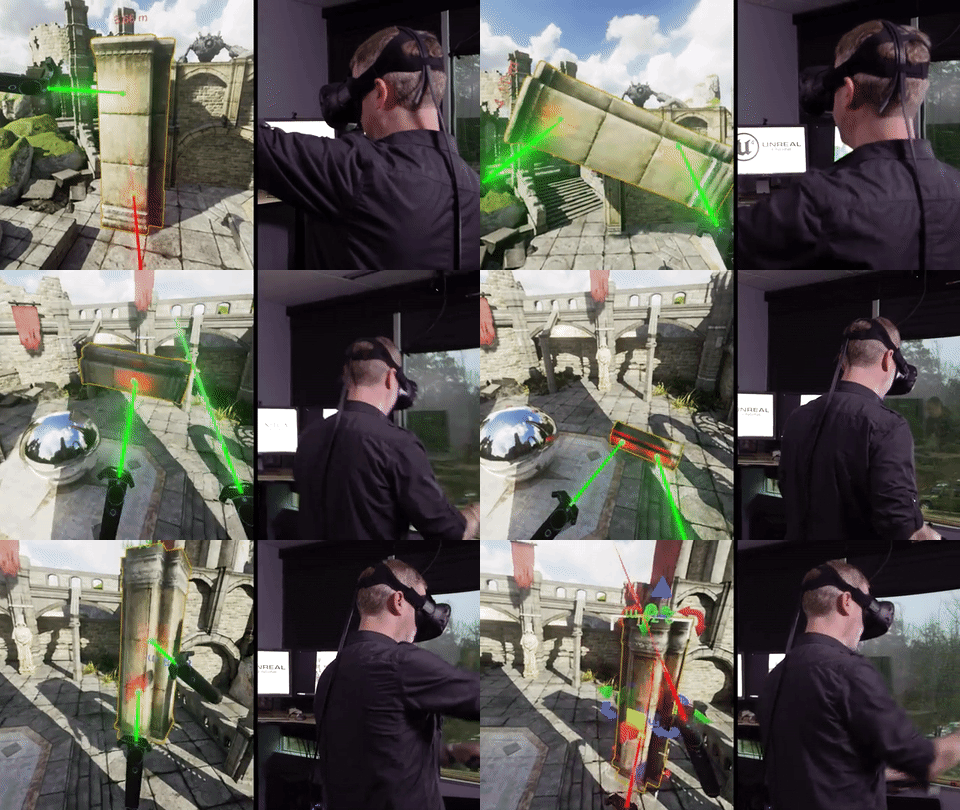
Create a virtual world in 3D format with VR glasses
Augmented reality. Most likely, AR will only develop after VR, because for the full use of augmented reality, you will need all the capabilities of a virtual one along with additional new technologies. For example, to fully integrate real and virtual objects in one interactive scene, AR tools will require advanced low-latency machine vision technologies.

Augmented reality device, an excerpt from the movie “Kingsman: Secret Service”
But, most likely, the era of augmented reality will come faster than you think. This demo was shot directly through the AR Magic Leap device:
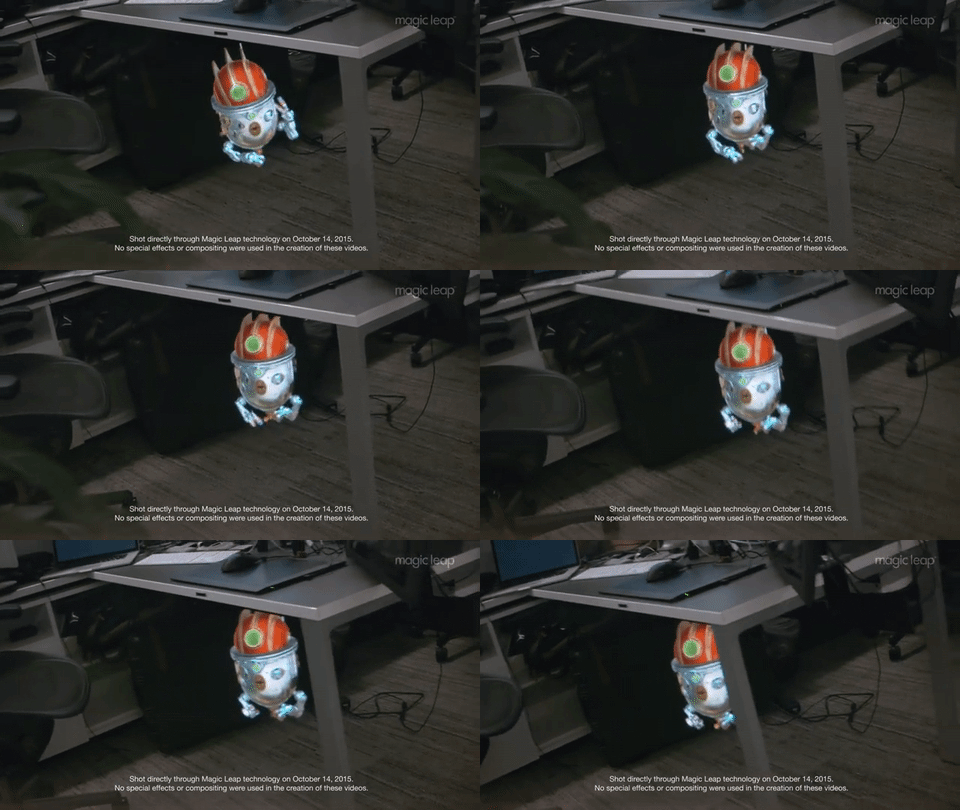
Demo of Magic Leap: a virtual character in a real environment
This demo was shot directly through the Magic Leap device on October 14, 2015. When it was created, neither special effects nor compositing were used.
Perhaps cycles of 10-15 years will no longer repeat, and the mobile era will be the last of them. Or maybe the next era will be shorter, or just a single subspecies of the technologies discussed above will become really important subsequently.
I prefer to think that we are now at the intersection of several eras. “Peaceful dividends from the war of smartphones” was the rapid emergence of new devices and developments in the field of software, especially artificial intelligence, which can make these devices even more intelligent and useful.
Some researchers note that most of the new devices are still in the "puberty": they can be imperfect and somewhat ridiculous, and all because they have not yet entered the phase of development. As in the case of personal computers in the 70s, the Internet in the 80s and smartphones at the dawn of the zero, we do not see the full picture, but only fragments of what current technologies have to turn into. One way or another, the future is near: markets are fluctuating, fashion is coming and going, but progress, as before, is confidently moving forward.
The development of product cycles in the field of high technology is due to the interaction of platforms and applications: new platforms allow you to create new applications, which, in turn, add value to these platforms, thus closing the chain of positive feedback.
Small product cycles are constantly repeated, but historically, once every 10-15 years, the next large cycle begins - an era that completely changes the face of IT.
Financial and product cycles evolve mainly independently of one another.
Once the advent of computers prompted entrepreneurs to create the first text editors, spreadsheets and many other PC applications. With the advent of the Internet, the world saw search engines, online commerce, email, social networks, SaaS business applications and many other services. Smartphones have given impetus to the development of mobile social networks and instant messengers, as well as the emergence of new types of services like carpooling. We live in the midst of a mobile era, and, apparently, there are still many interesting innovations awaiting us.
Each epoch can be conditionally divided into 2 phases: 1) the formation phase - when the platform first appears on the market, but is expensive, crude and / or difficult to use; 2) the active phase - when a new product solves the mentioned disadvantages of the platform, thereby beginning the period of its rapid development.
The Apple II computer was released in 1977, and the Altair 8800 in 1975, but the active phase of the PC era began with the release of the IBM PC in 1981.
PC sales per year (thousand)
The phase of Internet formation began in the 80s and early 90s , when, in fact, it was a text data exchange tool used by scientists and the government. The launch of the first browser, NCSA Mosaic, in 1993 marked the beginning of a phase of intensive development of the Internet, which has not ended to this day.
Number of Internet users around the world
In the 90s mobile phones already existed, and the first smartphones appeared at the dawn of the zero, but the widespread production of smartphones began in 2007-2008 with the release of the first iPhone, and then with the advent of the Android platform. Since then, the number of smartphone users has skyrocketed, and now their number has already reached about two billion. And by 2020, 80% of the world's population will have smartphones .
Worldwide smartphone sales (million)
If the duration of each cycle is indeed 10-15 years, in just a few years the active phase of the new computer era will begin. It turns out that the new technology is already in the formation phase. Today, there are several main trends in the areas of hardware and software that allow us to partially shed light on the next era. In this article, I want to discuss these trends and make some suggestions about how our future might look.
Hardware: compact, cheap and versatile
In the mainframe era, only large organizations could afford a computer. Mini-computers were available for smaller organizations, and computers for homes and offices.
The size of computers is decreasing at a constant speed.
We are now on the verge of a new era in which processors and sensors are becoming so cheap and compact that there will soon be more computers than people.
Two factors contribute to this. First, the steady progress in semiconductor manufacturing over the past 50 years ( Moore's Law ). Secondly, what Chris Anderson calls “peaceful dividends from the smartphone war”: the dizzying success of smartphones has contributed to a large investment in the development of processors and sensors. Take a look inside a modern quadrocopter, virtual reality glasses or any device of the Internet of things - what will you see? That's right - mostly smartphone components.
But in the modern era of semiconductors, all attention has shifted from individual processors to entire nodes of special microcircuits, known as single-chip systems.
Prices for computers are steadily declining
An ordinary single-chip system combines an energy-efficient ARM processor and a special graphics processor, as well as information exchange, power management, video signal processing, and so on.
Raspberry Pi Zero: A $ 5 Linux Computer with a 1 GHz Processor
This innovative architecture has reduced the minimum cost of basic computing systems from $ 100 to $ 10 per unit. A great example is the Raspberry Pi Zero , the first $ 5 Linux computer with a frequency of 1 GHz. For the same money, you can purchase a Wi-Fi microcontroller that supports one of the versions of Python. Very soon, these microprocessors will cost less than a dollar, and we can easily integrate them almost everywhere.
But more serious achievements are taking place today in the world of high-quality microprocessors. Graphic processors deserve special attention ., the best of which are produced by NVIDIA. GPUs are useful not only for processing graphics, but also when working with machine learning algorithms, as well as with virtual and augmented reality devices. However, representatives from NVIDIA promise more significant GPU performance improvements in the near future.
The trump card of the entire sphere of information technology is still quantum computers, which so far exist mainly in laboratories. But it is worth making them commercially attractive, and this will lead to a tremendous increase in productivity, primarily in the field of biology and artificial intelligence.
Google Quantum Computer
Software: The Golden Age of Artificial Intelligence
There are many interesting things happening in the software world today. A good example is distributed systems. Their appearance is due to a multiple increase in the number of devices in recent years, which necessitated parallelizing tasks on several machines, establishing data exchange between devices and coordinating their work. Special attention should be paid to such technologies of distributed systems as Hadoop or Spark , designed to work with large data arrays. It is also worth mentioning the blockchain technology that ensures the security of data and resources and was first implemented in the Bitcoin cryptocurrency.
But perhaps the most exciting discoveries are being made today in the field of artificial intelligence (AI), which has a long history of ups and downs. Alan Turing himself also predicted that by 2000, cars would be able to mimic people. Although this prediction has not yet been realized, there are good reasons to believe that AI is finally entering the golden age of its development.
“Machine learning is a key, revolutionary way to rethink everything we do,” said Google CEO Sundar Pichai .
The greatest excitement in the field of AI is concentrated around the so-called deep learning - a method that has been widely covered in the framework of one well-known Google project launched in 2012. A high-performance network of computers was involved in this project, the purpose of which was to learn to recognize cats in YouTube videos. The deep learning method is based on artificial neural networks - a technology that originated in the 40s of the last century. Recently, this technology has again become relevant due to many factors : the emergence of new algorithms, lower cost of parallel computing and the widespread dissemination of large data sets.
Percentage of errors in the ImageNet contest (red line corresponds to human performance)
It is hoped that in-depth training will not be just another fashionable term of Silicon Valley. However, interest in this teaching method is supported by impressive theoretical and practical results. For example, before the introduction of in-depth training, the permissible error rate of ImageNet winners , the well-known machine vision contest, was 20–30%. But after its application, the correctness of the algorithms grew steadily, and already in 2015, the performance of machines exceeded the performance of a person.
Many documents, data packages and software tools,associated with in-depth training, are in the public domain, which allowed individuals and small organizations to create their own highly effective applications. WhatsApp Inc. it took only 50 developers to create a popular messenger for 900 million users . For comparison, the creation of instant messengers of previous generations required the involvement of more than a thousand (and sometimes several thousand) developers. Something similar is now happening in the field of AI: software tools like Theano and TensorFlow , combined with cloud-based data centers for training and low-cost graphics cards for computing, allow small teams of developers to create innovative AI systems.
For example, below is a small project by one programmer using TensorFlow to convert black and white photos to color:
From left to right: black and white photo, converted photo, color original photo. ( Source )
And here is a small startup application for classifying objects in real time:
The Teradeep application identifies objects in real time
Hmm, but somewhere I already saw it:
A fragment from the movie Terminator 2: Doomsday (1991)
One of the first applications with the deep learning method released by a large company was an amazingly smart application for searching for images Google Photos:
Searching for photographs (without metadata) with the keyword “big ben”
Soon, we will expect a significant increase in AI performance in all areas of software and hardware: voice assistants, search engines, chat bots , 3D scanners , language translators, cars, drones diagnostic imaging systems and much, much more.
“It's easy to predict the ideas of the next 10,000 startups: take X and add artificial intelligence,” - Kevin Kelly .
Startups creating AI-focused products should remain extremely focused on specific applications in order to compete with large companies for which AI is a top priority. AI systems become more efficient as the amount of data collected for them increases. It turns out something like a flywheel, constantly rotating due to the so-called data network effect (more users → more data → better products → more users). For example, the Wase mapping service team used the effect of a data network to make the quality of the provided maps better than that of their more venerable competitors. Everyone who intends to use AI for their startup should follow a similar strategy.
Software + Hardware: New Computers
Now at the stage of formation is a whole series of promising platforms, which may soon go to the development stage, since they combine the latest developments from the areas of software and hardware. And although these platforms may look different or have different bundles, they have one thing in common: using the latest advanced features of smart virtualization. Consider some of these platforms:
Cars.Large IT companies like Google, Apple, Uber and Tesla are investing heavily in the development of autonomous or unmanned vehicles. Semi-autonomous Tesla Model S cars are already on the market, and updated and more advanced models are expected soon. Creating a fully autonomous car will take some time, but there is reason to believe that no more than five years are left to wait. In fact, there are already developments of fully autonomous cars that drive no worse than under human control. However, due to many aspects of a cultural and regulatory nature, such cars must drive much better than human-driven vehicles in order to be eligible for widespread use.
An unmanned vehicle draws up a diagram of its environment.
Undoubtedly, the volume of investment in unmanned vehicles will only grow. In addition to information technology companies, major car manufacturers have also begun to think about autonomy. We are waiting for many more interesting startup products. Deep learning software has become so effective that today , with a single developer , you can make a semi-autonomous car.
Home-made unmanned vehicle
Drones. Modern drones are equipped with the latest technology (mainly smartphone components and mechanical parts), but have relatively simple software. Soon, there will be improved models equipped with computer vision and other types of AI, which will make them safer, easier to manage and useful. Photography and video shooting from drones will be popular not only among amateurs, but, more importantly, will find commercial application. In addition, there are many dangerous types of work, including high-altitude, for which it would be much safer to use drones.
Fully autonomous drone flight
Internet of things. The most basic advantages of IoT devices are their energy efficiency, safety and convenience. Good examples of the first two features are Nest and Dropcam . As for convenience, it is worth paying attention to the Amazon Echo device .
Most people believe that Echo is another marketing ploy, but, having used it at least once, they are surprised how convenient this device turns out to be. It shows brilliantlythe effectiveness of voice control as the basis of the user interface. Of course, we will not soon see robots with universal intelligence that can support a full conversation. But, as Echo shows, computers are already capable of handling more or less complex voice commands. As the deep learning method improves, computers will learn to better understand the language.
3 main advantages: energy efficiency, safety, convenience.
Internet of things devices will also find application in the business segment. For example, devices with sensors and network connectivity are widely used for operational control of industrial equipment.
Wearable technology.Today, the functionality of wearable computers varies depending on a number of factors: battery capacity, communications and data processing. The most successful devices usually have a very narrow scope: for example, fitness tracking. As hardware components improve, wearable devices, like smartphones, will expand their functionality, opening up opportunities for new applications. As with the Internet of things, it is assumed that voice will become the main user interface for managing wearable devices.
A miniature headphone with artificial intelligence, an excerpt from the movie "She"
Virtual Reality. 2016 will be very interesting for the development of VR tools: the release of Oculus Rift and HTC Vive virtual reality glasses (and, possibly, PlayStation VR) means that convenient and immersive VR systems will finally become publicly available. VR device developers will have to work hard to prevent users from creating the so-called “sinister valley” effect , in which the excessive credibility of a robot or other artificial object causes hostility among human observers.
Creating high-quality VR systems requires high-quality screens (with high resolution, high refresh rate and low inertia), powerful video cards and the ability to track the exact position of the user (previous generations of VR systems could only track the rotation of the user's head). This year, thanks to new devices, users will be able to experience the full-fledged presence effect for the first time : all feelings are so “deceived” that the user feels a complete immersion in the virtual world.
Demonstration of Oculus Rift Toybox
Undoubtedly, VR glasses will continue to evolve and will become more accessible over time. Developers still have a lot of work to do on such aspects as new tools for presenting generated and / or captured VR content , improving machine vision to track the user's position and obtain data about him directly from the phone or virtual reality glasses, as well as distributed server systems for hosting large-scale virtual surroundings.
Create a virtual world in 3D format with VR glasses
Augmented reality. Most likely, AR will only develop after VR, because for the full use of augmented reality, you will need all the capabilities of a virtual one along with additional new technologies. For example, to fully integrate real and virtual objects in one interactive scene, AR tools will require advanced low-latency machine vision technologies.
Augmented reality device, an excerpt from the movie “Kingsman: Secret Service”
But, most likely, the era of augmented reality will come faster than you think. This demo was shot directly through the AR Magic Leap device:
Demo of Magic Leap: a virtual character in a real environment
This demo was shot directly through the Magic Leap device on October 14, 2015. When it was created, neither special effects nor compositing were used.
What's next?
Perhaps cycles of 10-15 years will no longer repeat, and the mobile era will be the last of them. Or maybe the next era will be shorter, or just a single subspecies of the technologies discussed above will become really important subsequently.
I prefer to think that we are now at the intersection of several eras. “Peaceful dividends from the war of smartphones” was the rapid emergence of new devices and developments in the field of software, especially artificial intelligence, which can make these devices even more intelligent and useful.
Some researchers note that most of the new devices are still in the "puberty": they can be imperfect and somewhat ridiculous, and all because they have not yet entered the phase of development. As in the case of personal computers in the 70s, the Internet in the 80s and smartphones at the dawn of the zero, we do not see the full picture, but only fragments of what current technologies have to turn into. One way or another, the future is near: markets are fluctuating, fashion is coming and going, but progress, as before, is confidently moving forward.