August 28, 2016 at 19:23
Why do companies so persistently want to have Fullstack developers?
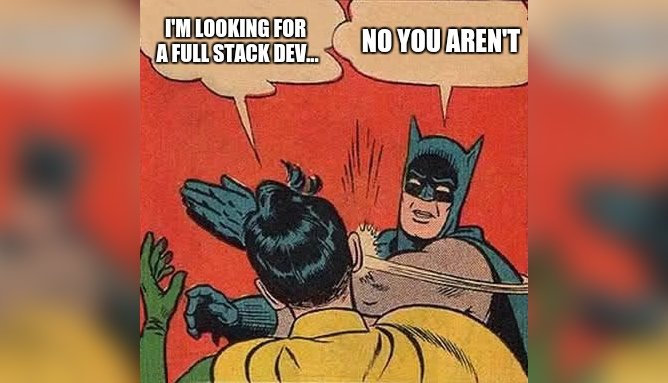
Many articles have already been written here about who Fullstack is, what its pros and cons are, in which projects it makes sense to hire such developers, and where not. I will proceed from the idea that you understand what Fullstack is and what it is eaten with.
The thought that I would like to express is as follows - “Why, even large outsourcing and food companies, want to hire Fullstack and / or develop their employees in this direction?”.
The question, in the context of the article, is interesting, but I do not want to answer it, I only want to speculate on this topic.
Take the manager of a large company, say, more than 500 people who received the following summary from the management: “We need to recruit 20 developers for our future products / orders.”
The management does not care whether it will be BE or FE or Fullstack - they need to submit an order on time or release a product. The manager, having read many articles about Fullstack, thinks: “Here it is - the Solution!” And starts typing Fullstack, on the basis that it’s possible to recruit 15 such developers and close all vacancies and save money, because the salaries of such developers rarely exceed salaries more specialized developers.
But, after some time, problems begin, not in a month, but in a year. It turns out that the product / application is not able to withstand the load or the addition of new features has become time-consuming and inefficient.
This does not always happen and not with everyone, but it happens more often. Why is that? Because, the first thing to do after the approval of MVP (minimum working product) is to make sure that everything falls into place and further development of the product will go as predictably as possible with the minimum possible number of errors. And, as a rule, only a qualified specialist can predict the future path of the application / product.
I am by no means against Fullstack as a phenomenon, because the effectiveness of such developers has been proven in certain cases, but I am very concerned about the emerging trends in the development of current specialized specialists in Fullstack for any products, regardless of whether this is necessary or not.
This is one of the oldest disputes: "Wide from narrow?"
We all know very well that now, hiring an intelligent specialist is a big job and sometimes an impossible task.
Judging by the personal experience of conducting more than a hundred interviews, mainly with guys from the EU and the CIS, I often have to make concessions to the leadership and hire at least a little person who reaches the level of expertise in the fire in my eyes, in the hope that he will still be useful and will become Rock Star. " Increasingly, you see “Senior Dev / Senior Fullstack Dev”, with a billion years of experience that FizzBuzz cannot solve, calculate the sum of Fibonacci numbers, or write an example of recursion.
Now it’s difficult to be in the top, at least in one direction, be it FE in Web, Android, iOs, game development or BE in
the same game development, Data Science, Big Query, DB analyst, etc. To be really useful, it is necessary that not only the “kettle cooks”, but also know all the trends and have a wealth of practical experience, and this can be achieved only by learning something new daily.
I agree that any developer should know the basics of programming, have algorithmic training, know and understand the difference in patterns, and understand, in general terms, how FE and BE work. But, as before, I think that an intelligent specialist in their specific field will do everything faster and better than a general specialist.
Yes, and think for yourself, with whom would you like to work and study - with Fullstack or wise gray hair, FE, BE, GameDev, DevOps guru?
PS There are a certain number of gifted guys who can work and keep up with everything they do, be it FE, BE, etc. But they are even fewer than intelligent narrow specialists, and, alas, they will not be able to close all the necessary vacancies and needs in the market. I am only glad if a person changed his occupation and moved to another area, but, as before, he will be occupied in one area, and not in a dozen areas.