LLVM-based C / C ++ compiler for multicellular processors: to be or not to be?
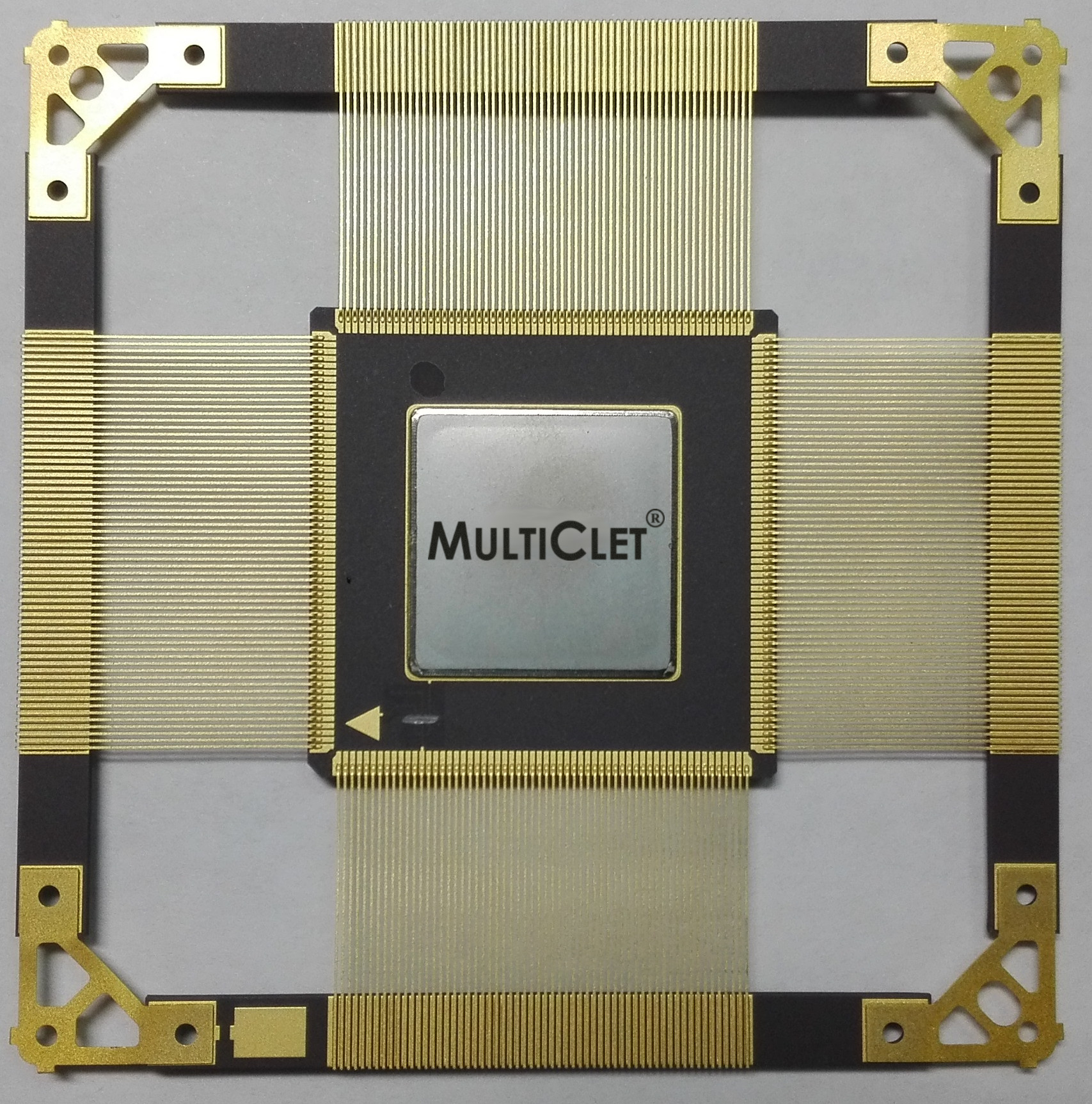
An inquisitive reader is probably already familiar with the fundamentally new architecture of processors - multicellular; and if he doesn’t know, he will be able to quickly familiarize himself with our article . The architecture is so unlike traditional that creating a compiler of familiar programming languages becomes a problem that developersto no avail have been fighting for many years.
A bit of history
Since the foundation of the Multiclet company in 2010, several types of compilers for multicellular architecture have been developed:
- Since the first processor Multiclet P1 in 2012, was developed as part of the compiler software S89 on the basis of the LCC . At the same time, the development of the first version of our own compiler was underway, suspended due to the initially complex unrealizable idea.
As has been repeatedly pointed out in many articles on this topic, as well as recognized by the developers of the company themselves, the LCC-based compiler has a number of significant drawbacks: support only for the C89 language, the absence of any optimizations.
Subsequently, this compiler was adapted to support the new Multiclet R1 processor (2015), the command system of which was significantly expanded, but the compiler did not take this into account.
Taking into account these shortcomings, the company management in 2012 assembled a group of programmers who were tasked with developing a new C99 compiler, devoid of these shortcomings. - After examining the available open source compilers (frameworks for developing compilers) (GCC and LLVM), a controversial and categorical decision was made: none of the existing ones for multicell architecture is suitable and it is necessary to develop the second version of your compiler from scratch.
 And three years of development began, which ended in the fall of 2015 with the fact that the development of our own compiler was again postponed for financial reasons. The required resources exceeded financial capabilities, which in the absence of any grant or budget support did not allow diverting resources to theoretical work.
 - In the same fall of 2015, it was decided to try to develop a compiler for the Multiclet R1 processor based on the LLVM framework. And so the development team has moved along this interesting and exciting path.
Some details
The main job was to write a compiler backend that
converts the intermediate LLVM representation into assembler code for the
multicell processor Multiclet R1. This means that you can already try to compile programs written in any LLVM language, you just need to specify that their compilers output LLVM IR bitcode or assembler. Then submit the resulting file to the input of this backend.
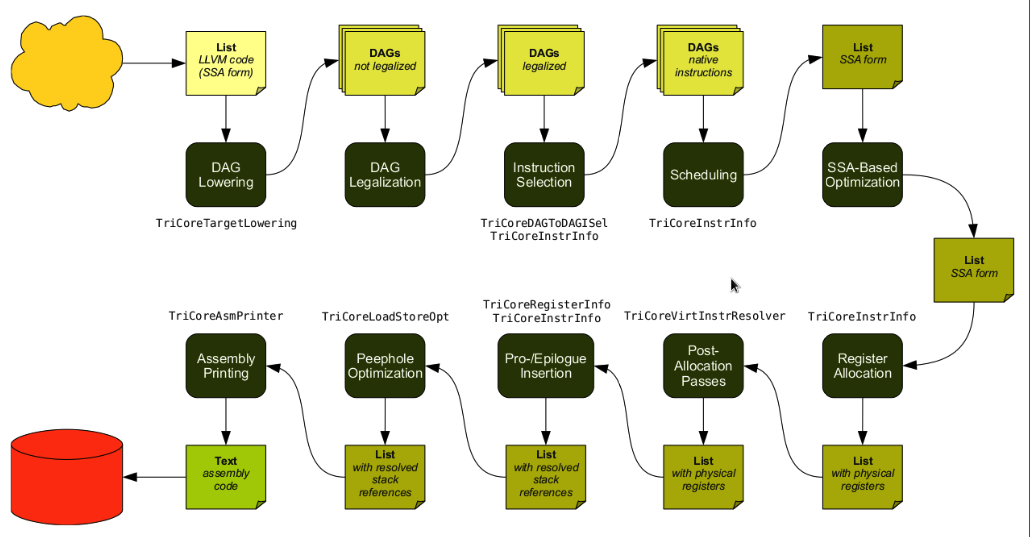
In general terms, during the development of the backend, the following actions were performed:
- Description of the target architecture using abstract interfaces, as well as the specialized language TableGen, designed to describe the general information used in LLVM at different stages of compilation (* .td files)
1.1. Description of the characteristics of the target machine (derived class from TargetMachine, DataLayout, Multiclet.td)
1.2. Description of the set of registers of the target machine, (derived from TargetRegisterInfo, MulticletRegisterInfo.td). At this stage, the LLVM framework was immediately oriented towards code generation for register machines, which in fact are not multicellular processors. The question arose of how to describe the switch used to exchange results between instructions. After some deliberation, it was decided to consider the switch cells as registers with a limited lifetime, that is, the values of such registers are relevant only within one base unit, which in turn is a paragraph, and, moreover, their relevance within one base unit depends from the scope of the results provided by the switch. Looking ahead, you can immediately say
1.3. Description of the set of instructions supported by the target machine (derived class from TargetInstrInfo, MulticletTargetInstrFormats.td, MulticletTargetInstrInfo.td) - A description of the process of selecting and converting LLVM IR intermediate representation instructions, represented as a directed acyclic graph (DAG), into the corresponding instructions explicitly supported by the target machine (derived class from TargetLowering, derived class from SelectionDAGISel). During the implementation of this stage, the need for special processing of instructions that appear in the setXX instructions of the target machine was revealed. The fact is that the setXX instructions for setting the register value (NOT the switch cells) are actually executed at the end of the paragraph, i.e., under the assumption that the paragraph is the base block, at the end of the base block, therefore, these instructions must split the base block. This behavior was implemented using special handlers (Instruction Emitting Hooks),
- Further, just before the allocation of the registers, two passes were added that reflect the specifics of the multicellular architecture:
3.1. Analysis and modification of control transfer instructions. The fact is that in a multicellular architecture there are actually only instructions for setting the address of the next paragraph to be executed (although they are named, very unsuccessfully, jmp and jXX), and the transfer of control is carried out at the end of the current paragraph. Therefore, in this passage, firstly, in the base unit, in which there is no control transfer instruction (in this case, it is assumed that the next base unit located in memory is executed), the instruction for unconditional control transfer to the next base unit is added, and secondly, in the base unit, in which there is one conditional control transfer instruction, immediately followed by one unconditional control transfer instruction,
3.2. Analysis of instructions for reading from memory and writing to memory. Since the execution of instructions in a multicellular architecture is disordered, it is generally unacceptable in one base unit to execute two write instructions at the same address, as well as to execute a read instruction at the address at which it might have been (or might not have been) before the write instruction is completed. - The LLVM framework provides the following set of register allocators: fast, basic, greedy, pbqp. In view of the features (availability of a switch) of a multicellular architecture, the correct assembler code can be generated from the allocators presented above only by using a fast allocator, which distributes the registers at the level of base blocks, which is necessary within the framework of the accepted concept of “base block”. Since fast allocator is the default allocator for assemblies with debugging support, it does not perform any optimizations. To eliminate this fact, we developed our own multiclet allocator, which also contains some additional architecture-dependent optimizations.
- Implementation of the prolog / epilogue insert function (derived from TargetFrameLowering).
- Further, just before the output of the assembler code, two passes were added that reflect the specifics of the multicellular architecture:
6.1. Optimization of the location of control transfer instructions. Since, in a multicellular architecture, control transfer instructions are actually instructions for setting the address to which control should be transferred at the end of the base unit (paragraph), in this passage we move such instructions (if possible) as close to the beginning of the base unit as possible.
6.2. Eliminating references to the results of previously executed instructions that go beyond the scope of the results provided by the switch.
To date, this passage performs very simple processing of such links, which consists in adding the move instruction to the desired position in the sequence of instructions. In some cases, such trivial processing may fail, which will lead to an abnormal termination of the program (compiler). - Implementation of the code emission pass (assembly code output).
The set of changes made to the frontend was much smaller: a multicellular architecture was added as a supported target machine.
As a result of this work, a good foundation was laid for the development of a compiler for multicell processors based on LLVM. In other words, the development of this compiler is a bit further than the initial stage, as evidenced by the following incomplete list of flaws in the current version of the compiler:
- There is no full support for 64-bit integer arithmetic.
- there is no support for vector instructions, which in a limited set are supported by the Multiclet R1 processor.
- Architecture-dependent optimizations on the backend side are in their infancy (only obvious optimizations are implemented).
- The compiler does not take into account all possible hardware errors of the Multiclet R1 processor (in general, I would like to take into account and circumvent such errors on the assembler side so that the top-level compiler is, if possible, freed from solving this problem, and also not to repeat the same code in different compilers top level, if there are several (we have a C89 compiler based on lcc)).
- There is no standard C language library, math library, etc.
- There is no possibility of generating position-independent code (-fPIC), all generated code is static.
- There is no generation of debugging information.
- The compiler’s reaction to the use of attributes and assembler inserts in the program’s source code is not known, since tests of such code were not carried out (the compiler may crash in some cases).
The presented compiler can be downloaded on the official website of the company here .
You can ask all questions on the forum .
About current results
Using the current version of the compiler, various short C programs were compiled, which were mainly used for testing, A Lightweight TCP / IP stack version 1.4.1 , Coremark test .
The Coremark benchmark for the Multiclet R1 is 0.56 Coremark / MHz, which is almost twice as good as the Coremark benchmark, which was compiled
using the LCC-based C89 compiler .
Of course, the result of 0.56 Coremark / MHz is still far from the desired 2-3 units. Firstly, this is due to the lack of good architecture-dependent optimizations in the presented version of the compiler, and, secondly, to the non-optimality of some
hardware blocks of this particular implementation of the Multiclet R1 processor, which are poorly adapted to execute sequential (poorly parallelized) algorithms, which Coremark is not so small.
CoreMark Scorecard
| Multiclet P1 (lcc compiler) | Multiclet R1 (lcc compiler) | Multiclet R1 (llvm compiler) | 985BE91T Milander ARM Cortex-M3 | STM32F4x ARM Cortex-M4 | RX62N Renesas | WIPS proAptive RTL FPGA prototype | Intel Core i7-2760QM [email protected] | |
|---|---|---|---|---|---|---|---|---|
| Clock frequency, MHz | 80 | 100 | 100 | 80 | 168 | 100 | 31 | 2400 |
| CoreMark overall score | 24.49 | 24.95 | 56.45 | 117.6 | 501.85 | 311.54 | 137.10 | 85151.68 |
| Coremark / MHz | 0.31 | 0.25 | 0.56 | 1.47 | 2.98 | 3.12 | 4.42 | 35.48 |
To evaluate the architectures of parallel processors, it is more appropriate to use assembler programs that take into account all the features of the architecture and implement parallel algorithms. Let's look at a couple of examples.
An example of an assembly-based algorithm for calculating the population of single bits in a 512-bit operand, the speed of which on the Multiclet R1 processor is comparable to that on the Intel Core i7 processor.
.data
.p2align 3
work_result:
  .space 8, 0
tmp:
  .long 0
.text
.alias value1   GPR0
.alias value2   GPR1
.alias value3   GPR2
.alias value4   GPR3
.alias value5   GPR4
.alias value6   GPR5
.alias value7   GPR6
.alias value8   GPR7
.alias result   IR0
init:
              jmp init_timer
              setl #result, 0x0
  b1       := getb 0x0
  b2       := getb @b1 + 1
  b3       := getb @b1 + 2
  b4       := getb @b1 + 3
  b5       := getb @b1 + 4
  b6       := getb @b1 + 5
  b7       := getb @b1 + 6
  b8       := getb @b1 + 7
  s2       := slll @b2, 8
  s3       := slll @b3, 16
  s4       := slll @b4, 24
  s6       := slll @b6, 8
  s7       := slll @b7, 16
  s8       := slll @b8, 24
  v1       := andl @b1, 0x000000FF
  v2       := andl @s2, 0x0000FF00
  v3       := andl @s3, 0x00FF0000
  v4       := andl @s4, 0xFF000000
  v5       := andl @b5, 0x000000FF
  v6       := andl @s6, 0x0000FF00
  v7       := andl @s7, 0x00FF0000
  v8       := andl @s8, 0xFF000000
  r1_16    := orl @v1, @v2
  r2_16    := orl @v3, @v4
  r3_16    := orl @v5, @v6
  r4_16    := orl @v7, @v8
  r1_32    := orl @r1_16, @r2_16
  r2_32    := orl @r3_16, @r4_16
  r64      := patch @r1_32, @r2_32
              setq #value1, @r64
              setq #value2, @r64
              setq #value3, @r64
              setq #value4, @r64
              setq #value5, @r64
              setq #value6, @r64
              setq #value7, @r64
              setq #value8, @r64
complete
init_timer:
              jmp init_timer_2
              wrl @0, 0xC0010018; TIM0_CR0
complete
init_timer_2:
              jmp init_timer_3
              getl 10 - 1
              getl 0xFFFFFFFF
              wrl @2, 0xC0010004; TIM0_PSCPER
              wrl @2, 0xC0010014; TIM0_CNTPER0
complete
init_timer_3:
              getl 0x03
              wrl @1, 0xC0010018; TIM0_CR0
              jmp start_popcnt512
complete
start_popcnt512:
              jmp new_popcnt512_reg
              rdl 0xC0010010; TIM0_CNTVAL0
              wrdl @1, tmp
complete
new_popcnt512_reg:
  val1     := getl #value1
  val2     := getl #value2
  val3     := getl #value3
  val4     := getl #value4
  val5     := getl #value5
  val6     := getl #value6
  val7     := getl #value7
  val8     := getl #value8
  val9     := pack @0, #value1
  val10    := pack @0, #value2
  val11    := pack @0, #value3
  val12    := pack @0, #value4
  val13    := pack @0, #value5
  val14    := pack @0, #value6
  val15    := pack @0, #value7
  val16    := pack @0, #value8
  s1_1     := slrl @val1,  1
  s1_2     := slrl @val2,  1
  s1_3     := slrl @val3,  1
  s1_4     := slrl @val4,  1
  s1_5     := slrl @val5,  1
  s1_6     := slrl @val6,  1
  s1_7     := slrl @val7,  1
  s1_8     := slrl @val8,  1
  s1_9     := slrl @val9,  1
  s1_10    := slrl @val10, 1
  s1_11    := slrl @val11, 1
  s1_12    := slrl @val12, 1
  s1_13    := slrl @val13, 1
  s1_14    := slrl @val14, 1
  s1_15    := slrl @val15, 1
  s1_16    := slrl @val16, 1
  s2_1     := andl @s1_1,  0x55555555
  s2_2     := andl @s1_2,  0x55555555
  s2_3     := andl @s1_3,  0x55555555
  s2_4     := andl @s1_4,  0x55555555
  s2_5     := andl @s1_5,  0x55555555
  s2_6     := andl @s1_6,  0x55555555
  s2_7     := andl @s1_7,  0x55555555
  s2_8     := andl @s1_8,  0x55555555
  s2_9     := andl @s1_9,  0x55555555
  s2_10    := andl @s1_10, 0x55555555
  s2_11    := andl @s1_11, 0x55555555
  s2_12    := andl @s1_12, 0x55555555
  s2_13    := andl @s1_13, 0x55555555
  s2_14    := andl @s1_14, 0x55555555
  s2_15    := andl @s1_15, 0x55555555
  s2_16    := andl @s1_16, 0x55555555
  s3_1     := subl @val1,  @s2_1
  s3_2     := subl @val2,  @s2_2
  s3_3     := subl @val3,  @s2_3
  s3_4     := subl @val4,  @s2_4
  s3_5     := subl @val5,  @s2_5
  s3_6     := subl @val6,  @s2_6
  s3_7     := subl @val7,  @s2_7
  s3_8     := subl @val8,  @s2_8
  s3_9     := subl @val9,  @s2_9
  s3_10    := subl @val10, @s2_10
  s3_11    := subl @val11, @s2_11
  s3_12    := subl @val12, @s2_12
  s3_13    := subl @val13, @s2_13
  s3_14    := subl @val14, @s2_14
  s3_15    := subl @val15, @s2_15
  s3_16    := subl @val16, @s2_16
  s4_1     := andl @s3_1,  0x33333333
  s4_2     := andl @s3_2,  0x33333333
  s4_3     := andl @s3_3,  0x33333333
  s4_4     := andl @s3_4,  0x33333333
  s4_5     := andl @s3_5,  0x33333333
  s4_6     := andl @s3_6,  0x33333333
  s4_7     := andl @s3_7,  0x33333333
  s4_8     := andl @s3_8,  0x33333333
  s4_9     := andl @s3_9,  0x33333333
  s4_10    := andl @s3_10, 0x33333333
  s4_11    := andl @s3_11, 0x33333333
  s4_12    := andl @s3_12, 0x33333333
  s4_13    := andl @s3_13, 0x33333333
  s4_14    := andl @s3_14, 0x33333333
  s4_15    := andl @s3_15, 0x33333333
  s4_16    := andl @s3_16, 0x33333333
  s5_1     := slrl @s3_1,  2
  s5_2     := slrl @s3_2,  2
  s5_3     := slrl @s3_3,  2
  s5_4     := slrl @s3_4,  2
  s5_5     := slrl @s3_5,  2
  s5_6     := slrl @s3_6,  2
  s5_7     := slrl @s3_7,  2
  s5_8     := slrl @s3_8,  2
  s5_9     := slrl @s3_9,  2
  s5_10    := slrl @s3_10, 2
  s5_11    := slrl @s3_11, 2
  s5_12    := slrl @s3_12, 2
  s5_13    := slrl @s3_13, 2
  s5_14    := slrl @s3_14, 2
  s5_15    := slrl @s3_15, 2
  s5_16    := slrl @s3_16, 2
  s6_1     := andl @s5_1,  0x33333333
  s6_2     := andl @s5_2,  0x33333333
  s6_3     := andl @s5_3,  0x33333333
  s6_4     := andl @s5_4,  0x33333333
  s6_5     := andl @s5_5,  0x33333333
  s6_6     := andl @s5_6,  0x33333333
  s6_7     := andl @s5_7,  0x33333333
  s6_8     := andl @s5_8,  0x33333333
  s6_9     := andl @s5_9,  0x33333333
  s6_10    := andl @s5_10, 0x33333333
  s6_11    := andl @s5_11, 0x33333333
  s6_12    := andl @s5_12, 0x33333333
  s6_13    := andl @s5_13, 0x33333333
  s6_14    := andl @s5_14, 0x33333333
  s6_15    := andl @s5_15, 0x33333333
  s6_16    := andl @s5_16, 0x33333333
  s7_1     := addl @s4_1,  @s6_1
  s7_2     := addl @s4_2,  @s6_2
  s7_3     := addl @s4_3,  @s6_3
  s7_4     := addl @s4_4,  @s6_4
  s7_5     := addl @s4_5,  @s6_5
  s7_6     := addl @s4_6,  @s6_6
  s7_7     := addl @s4_7,  @s6_7
  s7_8     := addl @s4_8,  @s6_8
  s7_9     := addl @s4_9,  @s6_9
  s7_10    := addl @s4_10, @s6_10
  s7_11    := addl @s4_11, @s6_11
  s7_12    := addl @s4_12, @s6_12
  s7_13    := addl @s4_13, @s6_13
  s7_14    := addl @s4_14, @s6_14
  s7_15    := addl @s4_15, @s6_15
  s7_16    := addl @s4_16, @s6_16
  s8_1     := slrl @s7_1,  4
  s8_2     := slrl @s7_2,  4
  s8_3     := slrl @s7_3,  4
  s8_4     := slrl @s7_4,  4
  s8_5     := slrl @s7_5,  4
  s8_6     := slrl @s7_6,  4
  s8_7     := slrl @s7_7,  4
  s8_8     := slrl @s7_8,  4
  s8_9     := slrl @s7_9,  4
  s8_10    := slrl @s7_10, 4
  s8_11    := slrl @s7_11, 4
  s8_12    := slrl @s7_12, 4
  s8_13    := slrl @s7_13, 4
  s8_14    := slrl @s7_14, 4
  s8_15    := slrl @s7_15, 4
  s8_16    := slrl @s7_16, 4
  s9_1     := addl @s7_1,  @s8_1
  s9_2     := addl @s7_2,  @s8_2
  s9_3     := addl @s7_3,  @s8_3
  s9_4     := addl @s7_4,  @s8_4
  s9_5     := addl @s7_5,  @s8_5
  s9_6     := addl @s7_6,  @s8_6
  s9_7     := addl @s7_7,  @s8_7
  s9_8     := addl @s7_8,  @s8_8
  s9_9     := addl @s7_9,  @s8_9
  s9_10    := addl @s7_10, @s8_10
  s9_11    := addl @s7_11, @s8_11
  s9_12    := addl @s7_12, @s8_12
  s9_13    := addl @s7_13, @s8_13
  s9_14    := addl @s7_14, @s8_14
  s9_15    := addl @s7_15, @s8_15
  s9_16    := addl @s7_16, @s8_16
  s10_1    := andl @s9_1,  0xF0F0F0F
  s10_2    := andl @s9_2,  0xF0F0F0F
  s10_3    := andl @s9_3,  0xF0F0F0F
  s10_4    := andl @s9_4,  0xF0F0F0F
  s10_5    := andl @s9_5,  0xF0F0F0F
  s10_6    := andl @s9_6,  0xF0F0F0F
  s10_7    := andl @s9_7,  0xF0F0F0F
  s10_8    := andl @s9_8,  0xF0F0F0F
  s10_9    := andl @s9_9,  0xF0F0F0F
  s10_10   := andl @s9_10, 0xF0F0F0F
  s10_11   := andl @s9_11, 0xF0F0F0F
  s10_12   := andl @s9_12, 0xF0F0F0F
  s10_13   := andl @s9_13, 0xF0F0F0F
  s10_14   := andl @s9_14, 0xF0F0F0F
  s10_15   := andl @s9_15, 0xF0F0F0F
  s10_16   := andl @s9_16, 0xF0F0F0F
  s11_1    := mull @s10_1,  0x1010101
  s11_2    := mull @s10_2,  0x1010101
  s11_3    := mull @s10_3,  0x1010101
  s11_4    := mull @s10_4,  0x1010101
  s11_5    := mull @s10_5,  0x1010101
  s11_6    := mull @s10_6,  0x1010101
  s11_7    := mull @s10_7,  0x1010101
  s11_8    := mull @s10_8,  0x1010101
  s11_9    := mull @s10_9,  0x1010101
  s11_10   := mull @s10_10, 0x1010101
  s11_11   := mull @s10_11, 0x1010101
  s11_12   := mull @s10_12, 0x1010101
  s11_13   := mull @s10_13, 0x1010101
  s11_14   := mull @s10_14, 0x1010101
  s11_15   := mull @s10_15, 0x1010101
  s11_16   := mull @s10_16, 0x1010101
  s12_1    := slrl @s11_1,  24
  s12_2    := slrl @s11_2,  24
  s12_3    := slrl @s11_3,  24
  s12_4    := slrl @s11_4,  24
  s12_5    := slrl @s11_5,  24
  s12_6    := slrl @s11_6,  24
  s12_7    := slrl @s11_7,  24
  s12_8    := slrl @s11_8,  24
  s12_9    := slrl @s11_9,  24
  s12_10   := slrl @s11_10, 24
  s12_11   := slrl @s11_11, 24
  s12_12   := slrl @s11_12, 24
  s12_13   := slrl @s11_13, 24
  s12_14   := slrl @s11_14, 24
  s12_15   := slrl @s11_15, 24
  s12_16   := slrl @s11_16, 24
  sum1     := addl @s12_1,  @s12_2
  sum2     := addl @s12_3,  @s12_4
  sum3     := addl @s12_5,  @s12_6
  sum4     := addl @s12_7,  @s12_8
  sum5     := addl @s12_9,  @s12_10
  sum6     := addl @s12_11, @s12_12
  sum7     := addl @s12_13, @s12_14
  sum8     := addl @s12_15, @s12_16
  sum9     := addl @sum1,  @sum2
  sum10    := addl @sum3,  @sum4
  sum11    := addl @sum5,  @sum6
  sum12    := addl @sum7,  @sum8
  sum13    := addl @sum9,  @sum10
  sum14    := addl @sum11, @sum12
  sum15    := addl @sum13, @sum14
              setl #result, @sum15
              jmp stop_popcnt512
complete
stop_popcnt512:
              jmp save_result
              rdl 0xC0010010; TIM0_CNTVAL0
              rdl tmp
              subl @1, @2
              wrdl @1, work_result
complete
save_result:
              jmp uart_init
              getl #result
              wrdl @1, work_result + 4
complete
uart_init:
              jmp uart_print
  altport  := getl 0xFFFFFFFF
  control  := getl 0x00000003; rx, tx enable
  bitrate  := getl 0x34;
              wrdl @control, 0xC0000108
              wrdl @altport, 0xC00F0218
              wrdl @bitrate, 0xC000010C
              setl #GPR0, 8
complete
uart_print:
  count    := getl #GPR0
              je @count, stop
              jne @count, uart_wait
              setl #GPR0, #GPR0, -1
complete
uart_wait:
  st       := rddl 0xC0000104
              andl @st, 2
              je @1, uart_wait
              jne @2, uart_print_data
complete
uart_print_data:
              jmp uart_print
  data     := rdq work_result
  n_data   := slrq @data, 8
              wrq @n_data, work_result
              wrdb @data, 0xC0000100
complete
stop:
              getl 0x0
complete
This implementation performs the specified algorithm in about 90 clock cycles.
For comparison, consider the equivalent code in C
#include "timer.h"
#include "mc-stdio.h"
#include "serial.h"
#define B1  0
#define B2  1
#define B3  2
#define B4  3
#define B5  4
#define B6  5
#define B7  6
#define B8  7
unsigned int countBits(unsigned int x)
{
  x  = x - ((x >> 1) & 0x55555555);
  x  = (x & 0x33333333) + ((x >> 2) & 0x33333333);
  x  = x + (x >> 4);
  x &= 0xF0F0F0F;
  return (x * 0x01010101) >> 24;
}
void init(unsigned int *v, int cnt)
{
  unsigned int v1 = ((B1 & 0xFF) << 0) | ((B2 & 0xFF) << 8)
                               | ((B3 & 0xFF) << 16) | ((B4 & 0xFF) << 24);
  unsigned int v2 = ((B5 & 0xFF) << 0) | ((B6 & 0xFF) << 8)
                               | ((B7 & 0xFF) << 16) | ((B8 & 0xFF) << 24);
  for (int i = 0; i < cnt; i += 2)
  {
    v[i] = v1;
    v[i+1] = v2;
  }
}
#define SIZE    16
int main(int argc, char *argv[])
{
  init_system_timer(TIM0, 0x03, 0xffffffff, 10);
  SER_init();
  unsigned int res = 0;
  unsigned int v[SIZE];
  init(v, SIZE);
  uint32_t start = get_system_ticks(TIM0);
  for (int i = 0; i < SIZE; ++i)
    res += countBits(v[i]);
  uint32_t stop = get_system_ticks(TIM0);
  mc_uprintf(0, "ticks count = 0x%X\nbits_count = %u", start - stop, res);
  return res;
}
To compile, you must run the following command:
clang -target multiclet -O2 -S test_popcnt.c -o test_popcnt.s -I
    .text
    .file   "test_popcnt.c"
    .globl  countBits
    .type   countBits,@function
countBits:
    SR2 :=  rdl #IR7, 4
    SR3 :=  rdl #IR7
            jmp @SR3
    SR4 :=  slrl @SR2, 1
    SR5 :=  andl @SR4, 1431655765
    SR4 :=  subsl @SR2, @SR5
    SR2 :=  andl @SR4, 858993459
    SR5 :=  slrl @SR4, 2
    SR4 :=  andl @SR5, 858993459
    SR5 :=  addsl @SR4, @SR2
    SR2 :=  slrl @SR5, 4
    SR4 :=  addsl @SR2, @SR5
    SR2 :=  andl @SR4, 252645135
    SR4 :=  mulsl @SR2, 16843009
    SR2 :=  slrl @SR4, 24
            setq #GPR7, @SR2
complete
.Lfunc_end0:
    .size   countBits, .Lfunc_end0-countBits
    .globl  init
    .type   init,@function
init:
            jmp LBB1_1
            setl #IR7, #IR7, -16
complete
LBB1_1:
    SR2 :=  rdl #IR7, 24
    SR3 :=  ltsl @SR2, 1
            je @SR3, LBB1_2
            jne @SR3, LBB1_3
complete
LBB1_2:
            jmp LBB1_4
    SR2 :=  rdl #IR7, 20
    SR3 :=  addsl @SR2, 4
            wrq @SR3, #IR7, 8
            wrq @0, #IR7
complete
LBB1_4:
    SR2 :=  getl 50462976
    SR3 :=  getl 117835012
    SR4 :=  rdl #IR7, 24
    SR5 :=  rdq #IR7
    SR6 :=  rdq #IR7, 8
    SR7 :=  addsl @SR6, -4
            wrl @SR3, @SR6
    SR3 :=  addsl @SR6, 8
    SR6 :=  addsl @SR5, 2
            wrl @SR2, @SR7
    SR2 :=  ltsl @SR6, @SR4
            je @SR2, LBB1_3
            jne @SR2, LBB1_4
            wrq @SR3, #IR7, 8
            wrq @SR6, #IR7
complete
LBB1_3:
    SR2 :=  rdl #IR7, 16
            jmp @SR2
            setl #IR7, #IR7, 16
complete
.Lfunc_end1:
    .size   init, .Lfunc_end1-init
    .globl  main
    .type   main,@function
main:
            jmp LBB2_1
            setl #IR7, #IR7, -128
complete
LBB2_1:
            jmp init_system_timer
    SR2 :=  getl 10
    SR3 :=  getl -1
    SR4 :=  getl 3
    SR5 :=  getl -1073676288
    SR6 :=  getl LBB2_2
            wrl @SR2, #IR7, 16
            wrl @SR3, #IR7, 12
            wrl @SR4, #IR7, 8
            wrl @SR5, #IR7, 4
            wrl @SR6, #IR7
complete
LBB2_2:
            jmp SER_init
    SR2 :=  getl LBB2_3
            wrl @SR2, #IR7
complete
LBB2_3:
            jmp get_system_ticks
    SR2 :=  getl -1073676288
    SR3 :=  getl 50462976
    SR4 :=  getl 117835012
    SR5 :=  getl LBB2_4
            wrl @SR3, #IR7, 64
            wrl @SR4, #IR7, 68
            wrl @SR3, #IR7, 72
            wrl @SR4, #IR7, 76
            wrl @SR3, #IR7, 80
            wrl @SR4, #IR7, 84
            wrl @SR3, #IR7, 88
            wrl @SR4, #IR7, 92
            wrl @SR3, #IR7, 96
            wrl @SR4, #IR7, 100
            wrl @SR3, #IR7, 104
            wrl @SR4, #IR7, 108
            wrl @SR3, #IR7, 112
            wrl @SR4, #IR7, 116
            wrl @SR3, #IR7, 120
            wrl @SR4, #IR7, 124
            wrl @SR2, #IR7, 4
            wrl @SR5, #IR7
complete
LBB2_4:
            jmp LBB2_8
    SR2 :=  getl 4
    SR3 :=  getq #GPR7
    SR4 :=  exal #IR7, 64
            wrq @SR2, #IR7, 56
            wrq @SR2, #IR7, 48
            wrq @SR3, #IR7, 40
            wrq @SR4, #IR7, 24
complete
LBB2_8:
    SR2 :=  rdq #IR7, 24
    SR3 :=  rdq #IR7, 48
    SR4 :=  rdq #IR7, 56
    SR5 :=  addsl @SR2, @SR4
    SR2 :=  addsl @SR4, 4
    SR4 :=  rdl @SR5
    SR5 :=  xorl @SR2, 64
            jne @SR5, LBB2_8
            je @SR5, LBB2_5
            wrq @SR2, #IR7, 56
    SR2 :=  slrl @SR4, 1
    SR6 :=  andl @SR2, 1431655765
    SR2 :=  subsl @SR4, @SR6
    SR4 :=  andl @SR2, 858993459
    SR6 :=  slrl @SR2, 2
    SR2 :=  andl @SR6, 858993459
    SR6 :=  addsl @SR2, @SR4
    SR2 :=  slrl @SR6, 4
    SR4 :=  addsl @SR2, @SR6
    SR2 :=  andl @SR4, 252645135
    SR4 :=  mulsl @SR2, 16843009
    SR2 :=  slrl @SR4, 24
    SR4 :=  addsl @SR2, @SR3
            wrq @SR4, #IR7, 48
            wrq @SR4, #IR7, 32
complete
LBB2_5:
            jmp get_system_ticks
    SR2 :=  getl -1073676288
    SR3 :=  getl LBB2_6
            wrl @SR2, #IR7, 4
            wrl @SR3, #IR7
complete
LBB2_6:
            jmp mc_uprintf
    SR2 :=  rdq #IR7, 40
    SR3 :=  rdq #IR7, 32
    SR4 :=  getq #GPR7
    SR5 :=  getl .L.str
            wrl @0, #IR7, 4
    SR6 :=  getl LBB2_7
    SR7 :=  subsl @SR2, @SR4
            wrl @SR5, #IR7, 8
            wrl @SR3, #IR7, 16
            wrl @SR6, #IR7
            wrl @SR7, #IR7, 12
complete
LBB2_7:
    SR2 :=  rdq #IR7, 32
            setq #GPR7, @SR2
    SR2 :=  rdl #IR7, 128
            jmp @SR2
            setl #IR7, #IR7, 128
complete
.Lfunc_end2:
    .size   main, .Lfunc_end2-main
    .type   .L.str,@object
    .section    .rodata.str1.1,"aMS",@progbits,1
.L.str:
    .asciz  "ticks count = 0x%X\nbits_count = %u"
    .size   .L.str, 35
This implementation performs the specified algorithm in about 950 clock cycles, which is more than 10 times worse than the assembler version.
Here is a summary table of results (the number of clock cycles per 32-bit calculation cycle)
| Algorithm | Multiclet R1 © | Multiclet R1 (ASM) | Pentium Dual Core 5700 3.0GHz | Intel Core i7-4700HQ @ 2400 |
|---|---|---|---|---|
| Bithacks | 59.4 | 5.0 | 9.5 | 4.7 |
One of the most representative algorithms is the FFT. At the same time, to eliminate technological factors, the assessment should be carried out in cycles spent on solving this problem, it is also necessary to take into account the number of operations performed per cycle and their features (the amount of data generated by a SIMD operation can be two or more).
.alias IRBASE 8
.alias IR0  8
.alias IR1  9
.alias IR2  10
.alias IR3  11
.alias IR4  12
.alias IRMASK01234  ((1 << (IR0 - IRBASE)) | (1 << (IR1 - IRBASE)) \
            | (1 << (IR2 - IRBASE)) | (1 << (IR3 - IRBASE)) \
            | (1 << (IR4 - IRBASE)))
.alias IRMASK04     ((1 << (IR0 - IRBASE)) | (1 << (IR4 - IRBASE)))
.syntax V1
.data
ticks:
    .long 0
.align 8
W:
;   Re(z),              Im(z)
 .float\
    0f1.000000000000000000000000,   0f-0.000000000000000000000000,\
    0f0.999698817729949951171875,   0f-0.024541229009628295898438,\
    0f0.998795449733734130859375,   0f-0.049067676067352294921875,\
    0f0.997290432453155517578125,   0f-0.073564566671848297119141,\
    0f0.995184719562530517578125,   0f-0.098017141222953796386719,\
    0f0.992479562759399414062500,   0f-0.122410677373409271240234,\
    0f0.989176511764526367187500,   0f-0.146730467677116394042969,\
    0f0.985277652740478515625000,   0f-0.170961901545524597167969,\
    0f0.980785250663757324218750,   0f-0.195090323686599731445312,\
    0f0.975702106952667236328125,   0f-0.219101235270500183105469,\
    0f0.970031261444091796875000,   0f-0.242980197072029113769531,\
    0f0.963776051998138427734375,   0f-0.266712784767150878906250,\
    0f0.956940352916717529296875,   0f-0.290284663438796997070312,\
    0f0.949528157711029052734375,   0f-0.313681751489639282226562,\
    0f0.941544055938720703125000,   0f-0.336889863014221191406250,\
    0f0.932992815971374511718750,   0f-0.359895050525665283203125,\
    0f0.923879504203796386718750,   0f-0.382683455944061279296875,\
    0f0.914209723472595214843750,   0f-0.405241340398788452148438,\
    0f0.903989315032958984375000,   0f-0.427555084228515625000000,\
    0f0.893224298954010009765625,   0f-0.449611335992813110351562,\
    0f0.881921231746673583984375,   0f-0.471396744251251220703125,\
    0f0.870086967945098876953125,   0f-0.492898225784301757812500,\
    0f0.857728600502014160156250,   0f-0.514102756977081298828125,\
    0f0.844853579998016357421875,   0f-0.534997642040252685546875,\
    0f0.831469595432281494140625,   0f-0.555570244789123535156250,\
    0f0.817584812641143798828125,   0f-0.575808227062225341796875,\
    0f0.803207516670227050781250,   0f-0.595699310302734375000000,\
    0f0.788346409797668457031250,   0f-0.615231633186340332031250,\
    0f0.773010432720184326171875,   0f-0.634393334388732910156250,\
    0f0.757208824157714843750000,   0f-0.653172850608825683593750,\
    0f0.740951120853424072265625,   0f-0.671558976173400878906250,\
    0f0.724247097969055175781250,   0f-0.689540565013885498046875,\
    0f0.707106769084930419921875,   0f-0.707106769084930419921875,\
    0f0.689540505409240722656250,   0f-0.724247097969055175781250,\
    0f0.671558916568756103515625,   0f-0.740951180458068847656250,\
    0f0.653172791004180908203125,   0f-0.757208883762359619140625,\
    0f0.634393274784088134765625,   0f-0.773010432720184326171875,\
    0f0.615231573581695556640625,   0f-0.788346409797668457031250,\
    0f0.595699310302734375000000,   0f-0.803207516670227050781250,\
    0f0.575808167457580566406250,   0f-0.817584812641143798828125,\
    0f0.555570185184478759765625,   0f-0.831469655036926269531250,\
    0f0.534997642040252685546875,   0f-0.844853579998016357421875,\
    0f0.514102697372436523437500,   0f-0.857728660106658935546875,\
    0f0.492898195981979370117188,   0f-0.870086967945098876953125,\
    0f0.471396654844284057617188,   0f-0.881921291351318359375000,\
    0f0.449611306190490722656250,   0f-0.893224298954010009765625,\
    0f0.427555114030838012695312,   0f-0.903989315032958984375000,\
    0f0.405241280794143676757812,   0f-0.914209783077239990234375,\
    0f0.382683426141738891601562,   0f-0.923879504203796386718750,\
    0f0.359894961118698120117188,   0f-0.932992815971374511718750,\
    0f0.336889833211898803710938,   0f-0.941544055938720703125000,\
    0f0.313681662082672119140625,   0f-0.949528217315673828125000,\
    0f0.290284633636474609375000,   0f-0.956940352916717529296875,\
    0f0.266712754964828491210938,   0f-0.963776051998138427734375,\
    0f0.242980122566223144531250,   0f-0.970031261444091796875000,\
    0f0.219101220369338989257812,   0f-0.975702106952667236328125,\
    0f0.195090234279632568359375,   0f-0.980785310268402099609375,\
    0f0.170961856842041015625000,   0f-0.985277652740478515625000,\
    0f0.146730497479438781738281,   0f-0.989176511764526367187500,\
    0f0.122410625219345092773438,   0f-0.992479562759399414062500,\
    0f0.098017133772373199462891,   0f-0.995184719562530517578125,\
    0f0.073564492166042327880859,   0f-0.997290432453155517578125,\
    0f0.049067649990320205688477,   0f-0.998795449733734130859375,\
    0f0.024541135877370834350586,   0f-0.999698817729949951171875,\
    0f-0.000000043711388286737929,  0f-1.000000000000000000000000,\
    0f-0.024541223421692848205566,  0f-0.999698817729949951171875,\
    0f-0.049067739397287368774414,  0f-0.998795449733734130859375,\
    0f-0.073564574122428894042969,  0f-0.997290432453155517578125,\
    0f-0.098017223179340362548828,  0f-0.995184719562530517578125,\
    0f-0.122410707175731658935547,  0f-0.992479503154754638671875,\
    0f-0.146730571985244750976562,  0f-0.989176511764526367187500,\
    0f-0.170961946249008178710938,  0f-0.985277652740478515625000,\
    0f-0.195090323686599731445312,  0f-0.980785250663757324218750,\
    0f-0.219101309776306152343750,  0f-0.975702106952667236328125,\
    0f-0.242980197072029113769531,  0f-0.970031261444091796875000,\
    0f-0.266712844371795654296875,  0f-0.963776051998138427734375,\
    0f-0.290284723043441772460938,  0f-0.956940293312072753906250,\
    0f-0.313681721687316894531250,  0f-0.949528157711029052734375,\
    0f-0.336889922618865966796875,  0f-0.941544055938720703125000,\
    0f-0.359895050525665283203125,  0f-0.932992815971374511718750,\
    0f-0.382683515548706054687500,  0f-0.923879504203796386718750,\
    0f-0.405241340398788452148438,  0f-0.914209723472595214843750,\
    0f-0.427555084228515625000000,  0f-0.903989315032958984375000,\
    0f-0.449611365795135498046875,  0f-0.893224298954010009765625,\
    0f-0.471396833658218383789062,  0f-0.881921231746673583984375,\
    0f-0.492898166179656982421875,  0f-0.870087027549743652343750,\
    0f-0.514102756977081298828125,  0f-0.857728600502014160156250,\
    0f-0.534997701644897460937500,  0f-0.844853520393371582031250,\
    0f-0.555570363998413085937500,  0f-0.831469535827636718750000,\
    0f-0.575808167457580566406250,  0f-0.817584812641143798828125,\
    0f-0.595699369907379150390625,  0f-0.803207516670227050781250,\
    0f-0.615231692790985107421875,  0f-0.788346350193023681640625,\
    0f-0.634393274784088134765625,  0f-0.773010492324829101562500,\
    0f-0.653172850608825683593750,  0f-0.757208824157714843750000,\
    0f-0.671559035778045654296875,  0f-0.740951061248779296875000,\
    0f-0.689540684223175048828125,  0f-0.724246978759765625000000,\
    0f-0.707106769084930419921875,  0f-0.707106769084930419921875,\
    0f-0.724247157573699951171875,  0f-0.689540505409240722656250,\
    0f-0.740951240062713623046875,  0f-0.671558856964111328125000,\
    0f-0.757208824157714843750000,  0f-0.653172850608825683593750,\
    0f-0.773010492324829101562500,  0f-0.634393274784088134765625,\
    0f-0.788346469402313232421875,  0f-0.615231513977050781250000,\
    0f-0.803207635879516601562500,  0f-0.595699131488800048828125,\
    0f-0.817584812641143798828125,  0f-0.575808167457580566406250,\
    0f-0.831469655036926269531250,  0f-0.555570185184478759765625,\
    0f-0.844853639602661132812500,  0f-0.534997463226318359375000,\
    0f-0.857728600502014160156250,  0f-0.514102756977081298828125,\
    0f-0.870087027549743652343750,  0f-0.492898136377334594726562,\
    0f-0.881921350955963134765625,  0f-0.471396625041961669921875,\
    0f-0.893224298954010009765625,  0f-0.449611365795135498046875,\
    0f-0.903989315032958984375000,  0f-0.427555054426193237304688,\
    0f-0.914209783077239990234375,  0f-0.405241221189498901367188,\
    0f-0.923879623413085937500000,  0f-0.382683277130126953125000,\
    0f-0.932992815971374511718750,  0f-0.359895050525665283203125,\
    0f-0.941544115543365478515625,  0f-0.336889803409576416015625,\
    0f-0.949528217315673828125000,  0f-0.313681602478027343750000,\
    0f-0.956940352916717529296875,  0f-0.290284723043441772460938,\
    0f-0.963776051998138427734375,  0f-0.266712725162506103515625,\
    0f-0.970031261444091796875000,  0f-0.242980077862739562988281,\
    0f-0.975702166557312011718750,  0f-0.219101071357727050781250,\
    0f-0.980785310268402099609375,  0f-0.195090308785438537597656,\
    0f-0.985277652740478515625000,  0f-0.170961812138557434082031,\
    0f-0.989176511764526367187500,  0f-0.146730333566665649414062,\
    0f-0.992479503154754638671875,  0f-0.122410699725151062011719,\
    0f-0.995184719562530517578125,  0f-0.098017096519470214843750,\
    0f-0.997290492057800292968750,  0f-0.073564447462558746337891,\
    0f-0.998795449733734130859375,  0f-0.049067486077547073364258,\
    0f-0.999698817729949951171875,  0f-0.024541210383176803588867
.text
// системный таймер
init_timer:
    setl #ST0PRDR, 0xFFFFFFFF
    setl #ST0CR, 0x1
    jmp start
complete
start:
    jmp L1;
    setl #PSW, 0x00000040; Чтение и запись идут параллельно
    getl 0x000007C0;
    patch @1, 0x00000000;
    setq #IR0, @1;
    getl 0x0001001F;
    patch @1, 0x00000000;
    setq #IR4, @1;
complete;
L1:
    irm IRMASK04
    exa #IR4;
    je @1, L2;
    jne @2, L1;
    rdc #IR0, x + 0 * 8;        x0
    rdc #IR0, x + 2 * 8;        x2
    rdc #IR0, x + 4 * 8;        x4
    rdc #IR0, x + 6 * 8;        x6
    rdc #IR0, x + 1 * 8;        x1
    rdc #IR0, x + 3 * 8;        x3
    rdc #IR0, x + 5 * 8;        x5
    rdc #IR0, x + 7 * 8;        x7
    rdc W + 64 * 8;         W4_1
    addc @9, @5;            x0=x0+x1
    subc @10, @6;           x1=x0-x1
    addc @10, @6;           x2=x2+x3
    subc @11, @7;           x3=x2-x3
    addc @11, @7;           x4=x4+x5
    subc @12, @8;           x5=x4-x5
    addc @12, @8;           x6=x6+x7
    subc @13, @9;           x7=x6-x7
    mulc @9, @5;            W4_1*x3
    mulc @10, @2;           W4_1*x7
    addc @10, @8;           x0=x0+x2
    addc @10, @3;           x1=x1+W4_1*x3
    subc @12, @10;          x2=x0-x2
    subc @12, @5;           x3=x1-W4_1*x3
    addc @10, @8;           x4=x4+x6
    addc @10, @6;           x5=x5+W4_1*x7
    subc @12, @10;          x6=x4-x6
    subc @12, @8;           x7=x5-W4_1*x7
    wrc @8, #IR0, x + 0 * 8;
    wrc @8, #IR0, x + 1 * 8;
    wrc @8, #IR0, x + 2 * 8;
    wrc @8, #IR0, x + 3 * 8;
    wrc @8, #IR0, x + 4 * 8;
    wrc @8, #IR0, x + 5 * 8;
    wrc @8, #IR0, x + 6 * 8;
    wrc @8, #IR0, x + 7 * 8;
complete
L2:
    jmp L3;
    getl 0x00000718;
    patch @1, 0x00000000;
    setq #IR0, @1;
    getl 0x00000300;
    patch @1, W;
    setq #IR1, @1;
    getl 0x00000180;
    patch @1, W;
    setq #IR2, @1;
    getl 0x000000C0;
    patch @1, W;
    setq #IR3, @1;
    getl 0x0001001F;
    patch @1, 0x00000000;
    setq #IR4, @1;
complete;
L3:
    irm IRMASK01234
    exa #IR4;
    je @1, L4;
    jne @2, L3;
    rdc #IR1;           W8_i
    rdc #IR0, x + 4 * 8;        x1
    rdc #IR0, x + 12 * 8;       x3
    rdc #IR0, x + 20 * 8;       x5
    rdc #IR0, x + 28 * 8;       x7
    mulc @5, @4;            W8_i*x1
    mulc @6, @4;            W8_i*x3
    mulc @7, @4;            W8_i*x5
    mulc @8, @4;            W8_i*x7
    rdc #IR0, x + 0 * 8;        x0
    rdc #IR0, x + 8 * 8;        x2
    rdc #IR0, x + 16 * 8;       x4
    rdc #IR0, x + 24 * 8;       x6
    addc @3, @7;            x2=x2+W8_i*x3
    subc @4, @8;            x3=x2-W8_i*x3
    addc @3, @7;            x6=x6+W8_i*x7
    subc @4, @8;            x7=x6-W8_i*x7
    addc @8, @12;           x0=x0+W8_i*x1
    subc @9, @13;           x1=x0-W8_i*x1
    addc @8, @12;           x4=x4+W8_i*x5
    subc @9, @13;           x5=x4-W8_i*x5
    rdc #IR2;           W16_i
    rdc #IR2, 0x0200;       W16_j
    mulc @2, @10;           W16_i*x2
    mulc @2, @10;           W16_j*x3
    mulc @4, @10;           W16_i*x6
    mulc @4, @10;           W16_j*x7
    addc @8, @2;            x4=x4+W16_i*x6
    addc @8, @2;            x5=x5+W16_j*x7
    subc @10, @4;           x6=x4-W16_i*x6
    subc @10, @4;           x7=x5-W16_j*x7
    addc @14, @8;           x0=x0+W16_i*x2
    addc @14, @8;           x1=x1+W16_j*x3
    subc @16, @10;          x2=x0-W16_i*x2
    subc @16, @10;          x3=x1-W16_j*x3
    mulc @8, #IR3;          W32*x4
    mulc @8, #IR3, 0x0100;      W32*x5
    mulc @8, #IR3, 0x0200;      W32*x6
    mulc @8, #IR3, 0x0300;      W32*x7
    addc @8, @4;            x0=x0+W*x4
    addc @8, @4;            x1=x1+W*x5
    addc @8, @4;            x2=x2+W*x6
    addc @8, @4;            x3=x3+W*x7
    subc @12, @8;           x4=x0-W*x4
    subc @12, @8;           x5=x1-W*x5
    subc @12, @8;           x6=x2-W*x6
    subc @12, @8;           x7=x3-W*x7
    wrc @8, #IR0, x + 0 * 8;
    wrc @8, #IR0, x + 4 * 8;
    wrc @8, #IR0, x + 8 * 8;
    wrc @8, #IR0, x + 12 * 8;
    wrc @8, #IR0, x + 16 * 8;
    wrc @8, #IR0, x + 20 * 8;
    wrc @8, #IR0, x + 24 * 8;
    wrc @8, #IR0, x + 28 * 8;
complete
L4:
    jmp L5;
    getl 0x000000F8;
    patch @1, 0x00000000;
    setq #IR0, @1;
    getl 0x000003E0;
    patch @1, W;
    setq #IR1, @1;
    getl 0x000001F0;
    patch @1, W;
    setq #IR2, @1;
    getl 0x000000F8;
    patch @1, W;
    setq #IR3, @1;
    getl 0x0001001F;
    patch @1, 0x00000000;
    setq #IR4, @1;
complete;
L5:
    irm IRMASK01234
    exa #IR4;
    je @1, stop;
    jne @2, L5;
    rdc #IR1;           W32_i
    rdc #IR0, x + 32 * 8;       x1
    rdc #IR0, x + 96 * 8;       x3
    rdc #IR0, x + 160 * 8;      x5
    rdc #IR0, x + 224 * 8;      x7
    mulc @5, @4;            W32_i*x1
    mulc @6, @4;            W32_i*x3
    mulc @7, @4;            W32_i*x5
    mulc @8, @4;            W32_i*x7
    rdc #IR0, x + 0 * 8;        x0
    rdc #IR0, x + 64 * 8;       x2
    rdc #IR0, x + 128 * 8;      x4
    rdc #IR0, x + 192 * 8;      x6
    addc @3, @7;            x2=x2+W32_i*x3
    subc @4, @8;            x3=x2-W32_i*x3
    addc @3, @7;            x6=x6+W32_i*x7
    subc @4, @8;            x7=x6-W32_i*x7
    addc @8, @12;           x0=x0+W32_i*x1
    subc @9, @13;           x1=x0-W32_i*x1
    addc @8, @12;           x4=x4+W32_i*x5
    subc @9, @13;           x5=x4-W32_i*x5
    rdc #IR2;           W64_i
    rdc #IR2, 0x0200;       W64_j
    mulc @2, @10;           W64_i*x2
    mulc @2, @10;           W64_j*x3
    mulc @4, @10;           W64_i*x6
    mulc @4, @10;           W64_j*x7
    addc @8, @2;            x4=x4+W64_i*x6
    addc @8, @2;            x5=x5+W64_j*x7
    subc @10, @4;           x6=x4-W64_i*x6
    subc @10, @4;           x7=x5-W64_j*x7
    addc @14, @8;           x0=x0+W64_i*x2
    addc @14, @8;           x1=x1+W64_j*x3
    subc @16, @10;          x2=x0-W64_i*x2
    subc @16, @10;          x3=x1-W64_j*x3
    mulc @8, #IR3;          W128_i*x4
    mulc @8, #IR3, 0x0100;      W128_j*x5
    mulc @8, #IR3, 0x0200;      W128_k*x6
    mulc @8, #IR3, 0x0300;      W128_l*x7
    addc @8, @4;            x0=x0+W128_i*x4
    addc @8, @4;            x1=x1+W128_j*x5
    addc @8, @4;            x2=x2+W128_k*x6
    addc @8, @4;            x3=x3+W128_l*x7
    subc @12, @8;           x4=x0-W128_i*x4
    subc @12, @8;           x5=x1-W128_j*x5
    subc @12, @8;           x6=x2-W128_k*x6
    subc @12, @8;           x7=x3-W128_l*x7
    wrc @8, #IR0, x + 0 * 8;
    wrc @8, #IR0, x + 32 * 8;
    wrc @8, #IR0, x + 64 * 8;
    wrc @8, #IR0, x + 96 * 8;
    wrc @8, #IR0, x + 128 * 8;
    wrc @8, #IR0, x + 160 * 8;
    wrc @8, #IR0, x + 192 * 8;
    wrc @8, #IR0, x + 224 * 8;
complete
stop:
        jmp uart_init
        getl #ST0VAL
        wrdl @1, ticks
complete
.syntax V2
uart_init:
              jmp uart_print
  altport  := getl 0xFFFFFFFF
  control  := getl 0x00000003; rx, tx enable
  bitrate  := getl 0x34;
              wrdl @control, 0xC0000108
              wrdl @altport, 0xC00F0218
              wrdl @bitrate, 0xC000010C
              setl #GPR0, 32
complete
uart_print:
  count    := getl #GPR0
              je @count, finish
              jne @count, uart_wait
              setl #GPR0, #GPR0, -8
complete
uart_wait:
  st       := rddl 0xC0000104
              andl @st, 2
              je @1, uart_wait
              jne @2, uart_print_data
complete
uart_print_data:
              jmp uart_print
  data     := rdl ticks
              slrl @data, #GPR0
              wrdb @1, 0xC0000100
complete
finish:
    getl 0;
complete
Comparison of the results of a complex single-precision floating-point FFT with 256 points:
| Number of operations | The number of measures | The number of operations per cycle | Availability of complex / SIMD operations | |
|---|---|---|---|---|
| Multiclet R1, Multiclet | 9400 | 2350 | 4 | integrated |
| 1967BH034, Milander | 10872 | 1812 | 6 | SIMD |
| Processors family C66x, TI | 14256 | 1782 | 8 | integrated |
| ADSP-TS201S, Analog Devices | 22272 | 1928 | 24 | SIMD |
The results presented show that multicellular architecture implements parallelism more efficiently. This is most clearly seen when comparing with the C66x family of processors, which, like the multicellular processor, have complex arithmetic instructions that are executed in the stream per cycle.
It can be seen from the presented examples in assembler that the multicellular architecture allows to achieve much better results, so we believe that there is the prospect of improving the compiler.
Currently, the compiler is successfully used to port the acquired software to multicellular processors under contracts with Russian and foreign customer companies.
We invite everyone, enthusiasts of multicellular architecture to take part in testing the compiler on the forum .
UPD: Fixed a typo in the FFT results table: the lost thousand cycles were returned to the number of measures of the ADSP-TS201S.