May 16, 2016 at 14:36
Fujitsu ETERNUS CS200c - Integrated Backup Solution
Perhaps, few people, especially on Habré, would have to specifically explain what value information represents in the modern world for business. Without even understanding the topic, just look at the list of the largest companies. IT industry leaders have firmly established themselves in it, crowding out companies associated with energy resources and food products. The engine of IT industry suppliers, in fact, is competition, who will offer a more efficient way to receive, process and, of course, store information. Today we’ll talk about one particular case of storage.

The answer to the tasks of consumers in storing information is the development and release, but it does not sound like a tautology - storage systems for information or data, in short - storage. In the Fujitsu package of offers, the storage line is familiar to us by the name ETERNUS. However, the storage of information is a very generalized concept, more related to theory.
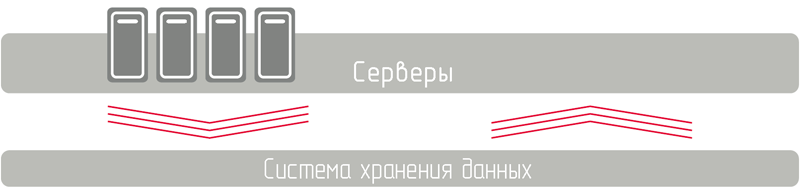
On the practical side, abstract “storage” breaks down into three main tasks - storing current data here and now; creating and storing copies of data for protection (i.e. backup) and / or for version control; and long-term storage of immutable data, i.e. archiving. However, the border between the second and third in terms of hardware implementation is rather arbitrary, the differences lie more in the approach to structuring and the scheme of access to data, so sometimes it’s quite acceptable to talk about two large scenarios, current data access and, together, about backup and prolonged storage. A typical implementation scheme for these scenarios looks something like this:
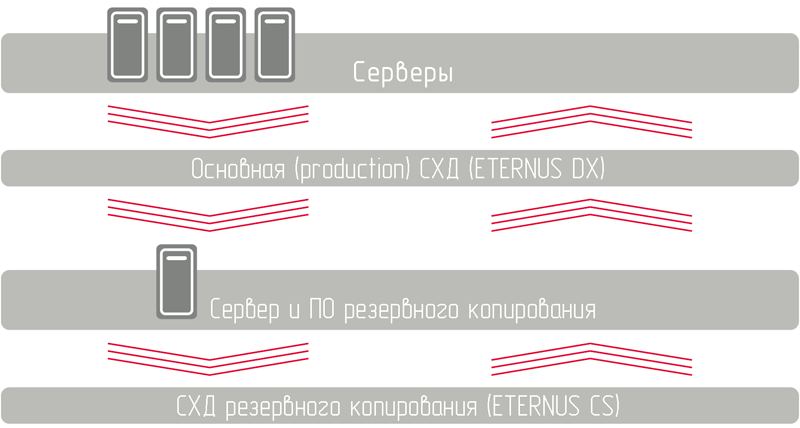
Different application scenarios cause differences in the requirements for performance and functional capabilities of storage systems. Since we are talking about Fujitsu storage systems, the diagram shows the possible areas of application for specific ETERNUS storage families, DX series as production storage, and CS (for example, ETERNUS CS800) as storage for data protection and backup storage. Of course, Fujitsu has something to offer in terms of servers, for example, from the Fujitsu PRIMERGY line , but today we are not talking about them.
To independently implement the above scenario, you must first consider the answers to many questions. Here are just a few of them:
Further steps are hardware and software selection, acquisition, deployment and configuration, verification and so on.
Fortunately, there is not always a real need to really work out everything yourself. You can simplify your task by trusting the many years of experience in the manufacturer of data storage systems. So, in the arsenal of Fujitsu there is a comprehensive solution for backup and archiving ETERNUS CS200c Powered by Commvault.

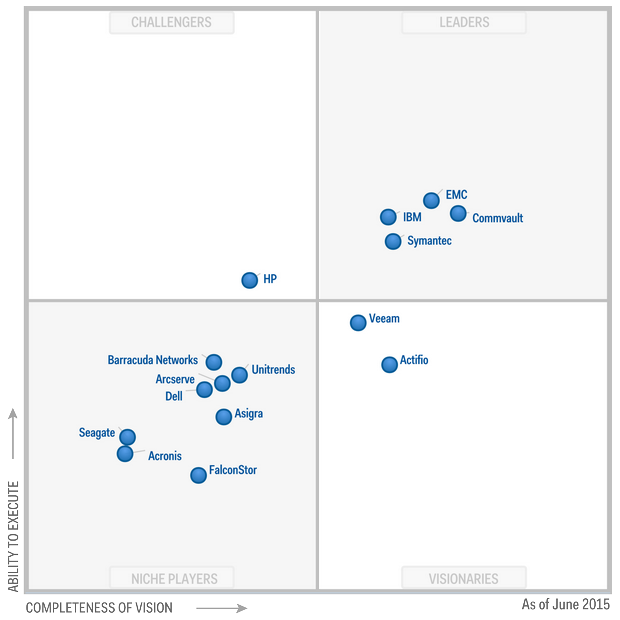
As a first approximation, the ETERNUS CS200c is a set of Fujitsu equipment and Commvault backup and archive management software. If you don’t know the Commvault brand, just take a look at one of the Gartner Magic Quadrants (Magic Quadrant for Enterprise Backup Software and Integrated Appliances, June 15, 2015, ID: G00266742):
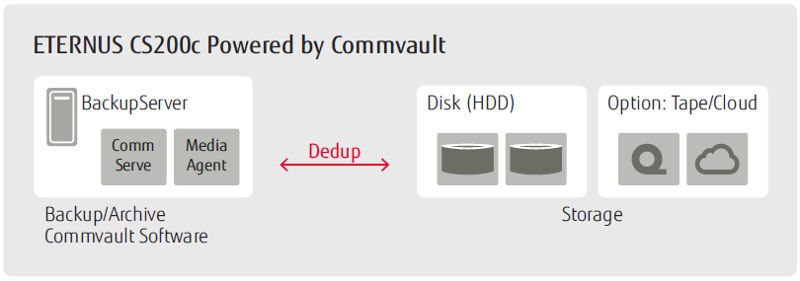
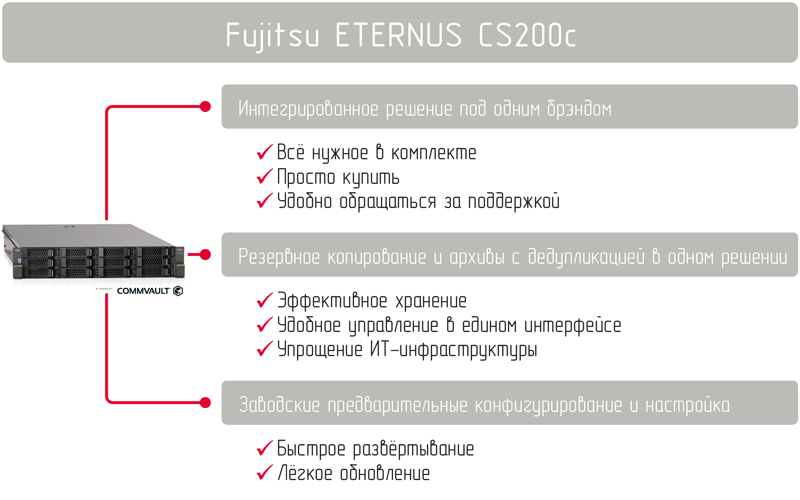
But in fact, this is not just a joint supply. Based on the extensive experience of Fujitsu in the implementation and operation of the storage systems supplied by the company, the optimal “filling” was selected. The hardware and software components of ETERNUS CS200c are already pre-configured and configured, as they say, from the factory, in order to simplify and save the customer’s time for integrating the solution into their IT environment. The kit includes a set of all necessary licenses. Some functions that are not in demand by all customers, such as connecting tape libraries, can be purchased optionally. Fujitsu will also act as a single point of contact for support and service.
It is worth mentioning separately about one, maybe not obvious, but very important detail that significantly affects economic efficiency. The fact is that although Commvault backup software is integrated into the ETERNUS CS200c solution, an exception was made by agreement with Fujitsu - the licensing scheme was changed depending on the amount of data. Commvault backup software traditionally involves licensing under the FET (Front-end Terabytes) scheme, that is, by the amount of data to back up. The licenses supplied with the ETERNUS CS200c assume the BET (Back-end Terabytes) calculation method, that is, the volume on the storage device. This is important because, in fact, with the ETERNUS CS200c storage system, the calculation of the volume of data for licensing occurs after deduplication,
ETERNUS CS200c storage is available in several versions. The youngest, the CS200c Entry S, is designed to hold 1 to 2 TB. It would seem quite a bit. But, firstly, there is built-in deduplication. Obviously, for example, for backing up several virtual machines of the same type, the deduplication coefficient will be very high, so it is quite possible to do with a small amount of storage. Secondly, ETERNUS CS200c supports replication, so using these integrated storage systems you can build a distributed system with small separate units without spending extra money by placing only one ETERNUS CS200c storage system from the top models of the series on the main site.

The most advanced of the Entry models, Entry L, supports between 6 and 36 TB. As usual for Fujitsu storage systems, we are talking about actually available space for data storage, and not about the raw volume of drives in the RAID. In a server rack or cabinet, the ETERNUS CS200c Entry model will only take up two units.

The older ETERNUS CS200c Scale comes in two flavors: Capacity and Performance, which is optimized to reduce recovery time. By installing additional disk shelves, Scale models scale to 132 and 126 TB, respectively. To maintain high performance, the deduplication database in them is located on solid-state drives (SSDs).

There are two types of licenses for Fujitsu ETERNUS CS200c storage systems. AFSW (Appliance Foundation Software) license includes backup and archiving for an unlimited number of file clients, virtual machines and storage devices, deduplication, encryption, replication and basic support for ESM snapshots (ETERNUS Snapshot Manager, actually truncated Commvault IntelliSnap, working with Fujitsu storage ) The good news is, starting with Generation S2, connecting cloud storage to the ETERNUS CS200c is also part of the standard license. Among the options for the AFSW license are support for tape libraries, full functionality for working with Commvault IntelliSnap snapshots, as well as support for three classes of agents for applications and databases. Class-1 - applications and databases for Windows, Class-2 - for Linux-based and UNIX, including Oracle, Class-3 for SAP.
The AASW (Appliance Advanced Software) license differs from AFSW in supporting applications of all three classes of agents without restrictions.
There is a third option, delivery without a license. It may be useful if the company's IT infrastructure already uses Commvault software with the appropriate licenses so as not to pay for them twice. Or if the customer chooses to license Commvault software separately for internal reasons.
As mentioned above, ETERNUS CS200c supports replication, moreover, with the DASH Copy mechanism.

DASH (Deduplication Accelerate Streaming Hash) Copy dramatically reduces the bandwidth requirements of the communication channels or the time for replication, since only changed data blocks are transferred to the storage system with the second copy. Without such a function, organizing replication to a remote site could be very expensive.
Now let's recall some of the above at the beginning, where backup and archive storage are conditionally combined into one script. Of course, a backup copy, it’s also a backup, and archive data are not the same thing. In a few words, a backup is a copy of the working data, which provides the ability to recover from a failure or return to a state at a certain point. The archive is not a copy, but the main copy, but with little demand for data, and therefore moved to the storage area with lower operating costs. The classical scheme assumes that different processes are responsible for creating backup copies and moving data to the archive. Thanks to Simpana OnePass, a component of Commvault software integrated in the ETERNUS CS200c storage system, the required operations are performed in a single pass, as a result, their execution time is reduced and management is simplified. Another bonus to an integrated approach.
The answer to the tasks of consumers in storing information is the development and release, but it does not sound like a tautology - storage systems for information or data, in short - storage. In the Fujitsu package of offers, the storage line is familiar to us by the name ETERNUS. However, the storage of information is a very generalized concept, more related to theory.
On the practical side, abstract “storage” breaks down into three main tasks - storing current data here and now; creating and storing copies of data for protection (i.e. backup) and / or for version control; and long-term storage of immutable data, i.e. archiving. However, the border between the second and third in terms of hardware implementation is rather arbitrary, the differences lie more in the approach to structuring and the scheme of access to data, so sometimes it’s quite acceptable to talk about two large scenarios, current data access and, together, about backup and prolonged storage. A typical implementation scheme for these scenarios looks something like this:
Different application scenarios cause differences in the requirements for performance and functional capabilities of storage systems. Since we are talking about Fujitsu storage systems, the diagram shows the possible areas of application for specific ETERNUS storage families, DX series as production storage, and CS (for example, ETERNUS CS800) as storage for data protection and backup storage. Of course, Fujitsu has something to offer in terms of servers, for example, from the Fujitsu PRIMERGY line , but today we are not talking about them.
To independently implement the above scenario, you must first consider the answers to many questions. Here are just a few of them:
- how much data needs to be backed up;
- backup copies of which OS and applications will be made now and which may be needed in the future;
- ultimate goal of creating backup copies, scenarios of their use;
- what the backup window and bandwidth requirements will be;
- whether archival copies of data are needed;
- ease of deployment and use of the system and whether special training is required;
- future expansion opportunities;
- selection of supported storage media and the need to place backups in the cloud storage;
- cost of implementation, support and licensing scheme.
Further steps are hardware and software selection, acquisition, deployment and configuration, verification and so on.
Fortunately, there is not always a real need to really work out everything yourself. You can simplify your task by trusting the many years of experience in the manufacturer of data storage systems. So, in the arsenal of Fujitsu there is a comprehensive solution for backup and archiving ETERNUS CS200c Powered by Commvault.
As a first approximation, the ETERNUS CS200c is a set of Fujitsu equipment and Commvault backup and archive management software. If you don’t know the Commvault brand, just take a look at one of the Gartner Magic Quadrants (Magic Quadrant for Enterprise Backup Software and Integrated Appliances, June 15, 2015, ID: G00266742):
But in fact, this is not just a joint supply. Based on the extensive experience of Fujitsu in the implementation and operation of the storage systems supplied by the company, the optimal “filling” was selected. The hardware and software components of ETERNUS CS200c are already pre-configured and configured, as they say, from the factory, in order to simplify and save the customer’s time for integrating the solution into their IT environment. The kit includes a set of all necessary licenses. Some functions that are not in demand by all customers, such as connecting tape libraries, can be purchased optionally. Fujitsu will also act as a single point of contact for support and service.
It is worth mentioning separately about one, maybe not obvious, but very important detail that significantly affects economic efficiency. The fact is that although Commvault backup software is integrated into the ETERNUS CS200c solution, an exception was made by agreement with Fujitsu - the licensing scheme was changed depending on the amount of data. Commvault backup software traditionally involves licensing under the FET (Front-end Terabytes) scheme, that is, by the amount of data to back up. The licenses supplied with the ETERNUS CS200c assume the BET (Back-end Terabytes) calculation method, that is, the volume on the storage device. This is important because, in fact, with the ETERNUS CS200c storage system, the calculation of the volume of data for licensing occurs after deduplication,
ETERNUS CS200c storage is available in several versions. The youngest, the CS200c Entry S, is designed to hold 1 to 2 TB. It would seem quite a bit. But, firstly, there is built-in deduplication. Obviously, for example, for backing up several virtual machines of the same type, the deduplication coefficient will be very high, so it is quite possible to do with a small amount of storage. Secondly, ETERNUS CS200c supports replication, so using these integrated storage systems you can build a distributed system with small separate units without spending extra money by placing only one ETERNUS CS200c storage system from the top models of the series on the main site.
The most advanced of the Entry models, Entry L, supports between 6 and 36 TB. As usual for Fujitsu storage systems, we are talking about actually available space for data storage, and not about the raw volume of drives in the RAID. In a server rack or cabinet, the ETERNUS CS200c Entry model will only take up two units.
The older ETERNUS CS200c Scale comes in two flavors: Capacity and Performance, which is optimized to reduce recovery time. By installing additional disk shelves, Scale models scale to 132 and 126 TB, respectively. To maintain high performance, the deduplication database in them is located on solid-state drives (SSDs).
There are two types of licenses for Fujitsu ETERNUS CS200c storage systems. AFSW (Appliance Foundation Software) license includes backup and archiving for an unlimited number of file clients, virtual machines and storage devices, deduplication, encryption, replication and basic support for ESM snapshots (ETERNUS Snapshot Manager, actually truncated Commvault IntelliSnap, working with Fujitsu storage ) The good news is, starting with Generation S2, connecting cloud storage to the ETERNUS CS200c is also part of the standard license. Among the options for the AFSW license are support for tape libraries, full functionality for working with Commvault IntelliSnap snapshots, as well as support for three classes of agents for applications and databases. Class-1 - applications and databases for Windows, Class-2 - for Linux-based and UNIX, including Oracle, Class-3 for SAP.
The AASW (Appliance Advanced Software) license differs from AFSW in supporting applications of all three classes of agents without restrictions.
There is a third option, delivery without a license. It may be useful if the company's IT infrastructure already uses Commvault software with the appropriate licenses so as not to pay for them twice. Or if the customer chooses to license Commvault software separately for internal reasons.
As mentioned above, ETERNUS CS200c supports replication, moreover, with the DASH Copy mechanism.
DASH (Deduplication Accelerate Streaming Hash) Copy dramatically reduces the bandwidth requirements of the communication channels or the time for replication, since only changed data blocks are transferred to the storage system with the second copy. Without such a function, organizing replication to a remote site could be very expensive.
Now let's recall some of the above at the beginning, where backup and archive storage are conditionally combined into one script. Of course, a backup copy, it’s also a backup, and archive data are not the same thing. In a few words, a backup is a copy of the working data, which provides the ability to recover from a failure or return to a state at a certain point. The archive is not a copy, but the main copy, but with little demand for data, and therefore moved to the storage area with lower operating costs. The classical scheme assumes that different processes are responsible for creating backup copies and moving data to the archive. Thanks to Simpana OnePass, a component of Commvault software integrated in the ETERNUS CS200c storage system, the required operations are performed in a single pass, as a result, their execution time is reduced and management is simplified. Another bonus to an integrated approach.