How to get maximum energy from caffeine
- Transfer

We continue to acquaint you with translations of Chris Bailey's articles, where he shares tips he learned during the “a Year of Productivity” project . Previously, we published articles by this author, they are available on our blog in the section "personal productivity" . We want to remind you that the common goal of all articles is to share the author’s experience on how to become more successful and effective everywhere: in your personal life, relationships with friends, yourself, and of course at work (whatever you do)!
So, give the floor to Chris!
Last week I watched 70 hours of TED talks as part of an experiment to increase personal effectiveness , during which I found out how caffeine affects my ability to learn.
To assess the effect of caffeine on my learning ability, I mainly watched how it affects my mindfulness and energy.
What I understood by experimenting with coffee and tea
Last week, I experimented mainly with green and black tea. I usually drink one or two cups of green tea per day and one or two cups of coffee per week.
A cup of green tea contains 25 mg of caffeine, a cup of black tea contains 42 mg, and a cup of brewed coffee contains 108 mg of caffeine. It turns out that coffee has the largest charge of power among these drinks. If you want to get the maximum charge of energy, you should drink coffee, since it is most effective in this regard (unless, of course, you do not consider energy drinks that are not consciously included in the list, as they are simply stuffed with sugar, which is extremely negative for health, although there are pleasant exceptions among them).
To understand exactly how caffeine affects my alertness and energy, I began by completely eliminating it from my diet for two days.
I think that each person has an individual level of productivity (meaning the natural level of productivity without any stimulants). There is nothing sophisticated about the “level” of productivity shown below, it is just a curve reflecting the effect of caffeine.
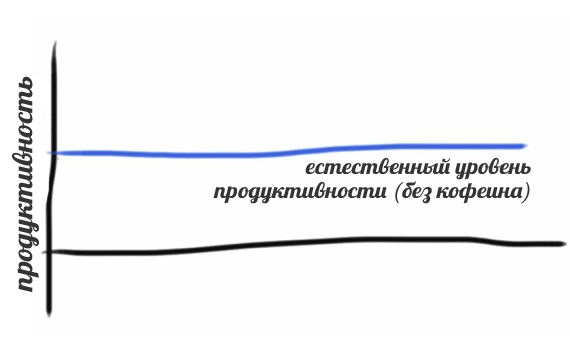
After drinking a caffeinated drink, the effect occurs immediately. Caffeine is rapidly starting to affect the central nervous system of a person, reduces physical fatigue and restores concentration. Typically, caffeine helps focus and improves coordination. All this, of course, affects productivity. Take tea, for example:

Of course, artificially high indicators should sooner or later decline. At that moment, when caffeine begins to be washed out of your body, a certain “caffeine crisis” arises. The crisis that you feel from green tea (if you feel at all) is much weaker than from coffee, but it is still present, at least for me. In the case of green tea, the loss of productivity due to the crisis is minimal (light red area) compared to the energy that you received as a result of its consumption (green area). This means that consuming green tea to increase productivity is justified. From my point of view, the same can be said about black tea.
With coffee, things are completely different. Coffee, of course, stimulates stronger, it is more pleasant to drink, it provokes an explosion of productivity (if you have not abused it and have not earned a “caffeine jammer”). But again, everything that has increased has to go down, and for me there are more unpleasant consequences from drinking coffee than there are advantages.
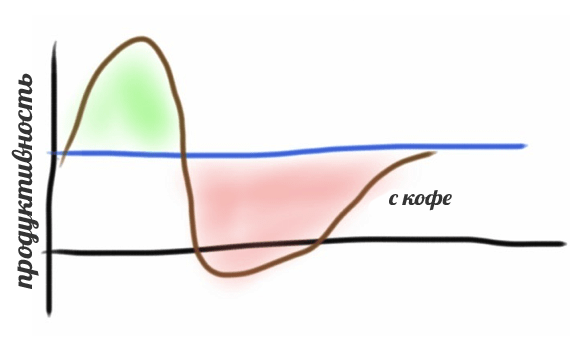
The amount of caffeine in coffee significantly exceeds my usual dose (four times, since I usually drink green tea) and since my body is not used to a lot of caffeine, its use ultimately greatly reduced my productivity. I think something similar was experienced by anyone who drank more caffeine than usual.
In fact, there are two things that I would like to explain through these graphs:
- If you have not abused caffeine, you will get a powerful boost of energy and increase your mindfulness.
- This charge of energy will have a price - you can lose a fraction of your productivity when caffeine stops working (this proportion directly depends on the amount of caffeine consumed).
Caffeine can significantly affect your productivity if you drink it too much or have no idea about the serious negative impact that caffeine washed out from the body has on your energy, motivation and attention. But, fortunately, last week I found ways to reduce these negative effects.

Six Ways to Get the Most Out of Caffeine
Caffeine can significantly affect your productivity. The list below can undoubtedly be supplemented (I'm sure there are tactics that I missed), but these 6 ways helped me maximize the positive effects of caffeine and minimize the “crisis” that ensues.
- Drink coffee / tea for a long period of time so that the body is gradually accustomed to the intake of caffeine. Do not immediately “bomb” it with shock doses. If you gradually get used to caffeine, your body will learn how to gradually “wash” it, and you will not acutely feel the “crises”.
- If you drink coffee in the morning, also drink water. Maintaining water balance, you can maintain concentration. In addition, in the mornings, when your body lacks fluid (after 8 hours of sleep), nothing will quench your thirst better than water. During my experiment, I found that drinking water in parallel with coffee helps me concentrate. It should be noted that numerous studies have shown that caffeine does not lead to dehydration.
- Stay away from sugar-containing energy drinks. Such drinks, of course, stimulate and it is pleasant to drink, but they contain a huge amount of sugar, which will certainly affect the level of insulin, making the subsequent "crisis" more noticeable. I know that there are a number of exceptions even among these tonic agents, but what is on the shelves is, by and large, garbage.
- When adapting your body to caffeine, try to eat well. When I ate slowly digestible food (for example, whole grains, vegetables and fruits), I noticed that I saved energy longer and did not feel “crises” so acutely.
- Do not consume caffeine on an empty stomach. Drinking coffee on an empty stomach means stimulating the production of hydrochloric acid, which is not very good, since hydrochloric acid should be produced exclusively for the breakdown of food. Subsequently, your body will digest food more slowly, which will lead to the formation of excess weight.
- Wait a bit before drinking a second cup of coffee / tea. Usually, after drinking a cup of coffee / tea, I am immediately drawn to drink a second. The point is probably that I am trying to get a double dose of energy. Pausing between two cups of coffee / tea, I stretch the resulting positive effect in time, which increases my productivity.
Most people prefer to notice only the pros in caffeine. It helps to concentrate, gives energy and makes you feel great. But caffeine also has a negative short-term effect on your productivity. It is expressed in the form of excessive stimulation (caffeine "jitters") and the so-called "crises" (that is, following a surge of energy, loss of strength, motivation and concentration).
Understanding the multifaceted effect of caffeine on productivity and taking the necessary measures to reduce undesirable consequences, you can increase your concentration, motivation and energy for the whole day.
PS Some time ago we published one of the most interesting articles from Chris Bailey - Why great achievements will not make you happier (and what to do about it!).
Translation by Vyacheslav Davidenko, founder of MBA Consult