April 27, 2016 at 09:45
About coordination of changes in time zones
- Transfer
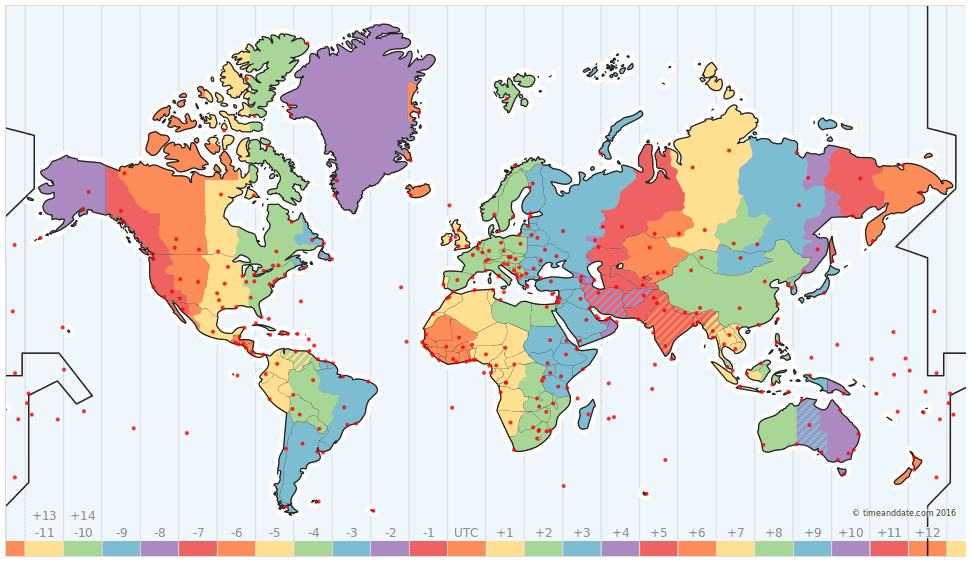
Do you know what Turkey, Chile, Russia, Venezuela, Azerbaijan, North Korea and Haiti have in common? Chaos in the management of time zones .
No, this is not a joke. In fact, this is a rather serious problem. The worst thing about time zones is not that they even exist, nor even summer time. Worst of all, they often change quite suddenly. Let me explain.
First, from a global point of view, it might seem that time zones should be managed by some relatively neutral international body, such as the ITU (International Telecommunication Union, UN) or, possibly, the IAU (International Astronomical Union). However, in reality, every time zone in the world is controlled locally.
This in itself is not a problem. I completely agree that countries within their borders should be able to do anything over time. But the fact is that again and again we are faced with the same problem: zones change without proper notice . All those countries listed earlier, along with many others, have recently done just that.
It is very important that before making changes to their time zones or the rules for switching to daylight saving time, state governments should leave enough time for updates for the IT industry. They should take into account the amount of work that people must do to check the changes, create an update, test it, and then publish and distribute it. In addition, it must be borne in mind that end users do not always update their systems immediately. The usual thing is when the user receives an update of the time zone in weeks, or even months after publication.
Case Study - Turkey
As an example, take a look at Turkey. In 2015, the government decided that it would be nice to postpone the end of daylight saving time for two weeks to give people more daylight saving time during the election period. They rescheduled the end of daylight saving time from October 25 to November 8.
The first rumors about this appeared in an unofficial news article on September 8, about 6 weeks before the proposed change. This article was not noticed by the TZ community (approx. Per .: this refers to the community involved in time zones; these are just people, volunteers, united by interest; this term will be used later, I did not come up with a different translation), until September 19th. It is difficult to build on news alone, because they often contain incorrect information or are confused in details. A few words from an official to a journalist - this is simply not enough.
On September 29, a government news agency also announced the change . This was still not completely official, for it was not accompanied by a reference to any decree or law. But that was enough to convince TZ community that this could really happen, after which a change to the IANA time zone database was initiated , and an update was released a few days later, on October 1 .
Finally, on October 4, an official announcement was issued in the government bulletin . About three weeks before the change takes effect.
Many representatives of the IT industry, including major players such as Apple, Google and Oracle, took data from IANA and published it through their own channels. For example, Apple released a zone change update for iPhone and iPad along with the iOS 9.1 update on October 21, leaving users only three days to install this update and avoid confusion over time.
For Microsoft Windows, which updates time zones in a slightly different way and requires a higher level of confirmation of changes, the announcement was made on October 9 , and an update was released on October 20 .
In some cases, the change day was skipped. For example, this happened with pytz , a popular Python timezone library whose update 2015.7 was not published until October 26th.
And what happened in the end? BBC Quote :
The bewildered Turks ask, “What time is it?” After the clock on electronic devices ignored the government’s decision to delay the seasonal time change.
Or from IBT posts :
Millions of Turks woke up in the morning in confusion, as smartphones, tablets and computers automatically switched the clock like other countries in the Eastern European time zone, despite the fact that Turkey postponed the transfer of hours by two hours an hour ago.
The effect of this, apparently, was directly opposite to what was expected. But actually, the government should know better, because almost the same nonsense happened a year earlier!
Incredible confusion for 52.9 million Turkish voters turned out to be the decision of the authorities to postpone the transfer of hours an hour forward. The reason the daylight saving time was delayed, according to Erdogan’s government, was a desire to improve the election process, but no one thought about the “new technology” factor. All smartphones of Turkish citizens automatically changed the time, and as a result, thousands of voters came to the polls too early and waited another hour to vote.
The same thing happened with computers that did not download the new version of the software. Problems also arose in the baggage delivery system at the Istanbul airport: the system automatically moved the time, ignoring the government’s plans, which ultimately led to a huge delay in baggage claim for passengers. In addition, there were problems with many flights due to the fact that passengers confused departure time.
What about the rest of the world?
Not only Turkey does not learn from its mistakes, other countries of the world have stepped on the same rake more than once. Remember the list at the beginning of the post? Let's get a little more detailed:
Chile used constant daylight saving time in 2015, but on March 13, 2016, the government announced a switch to standard time starting May 15 ( two-month notice ).
There are 11 different shifts in Russia in time zones, from UTC + 02 to UTC + 12, with their complex history of changes .
On March 27, 2016, 6 regions changed their time zones. Each of these regions has issued its own law defining this change. One of these laws was signed on December 30 ( 12 weeks notice ), which is perfectly acceptable. However, others were signed on February 15 ( six weeks notice ) or March 9 ( two weeks notice ).
Two other regions were awaiting the signing of decrees throughout this period, one of these decrees was signed only on April 5 with a transition date of April 24 (approx. Transl .: talk about the Magadan Region) ( three weeks notice )) Another is still awaiting signing by the president. It is expected that this will happen in the next few days, and the transition date will be May 29 ( notice for four weeks ) (approx. Transl .: talk about the Tomsk region; by the way, we have already rolled up the update).Venezuela has been at UTC-4: 30 since 2007, but recently authorities decided to return to UTC-4 from May 1, 2016. The transition was first announced on April 15, officially on April 18 with a publication in the government bulletin ( two-week notice ).
In 2016, Azerbaijan canceled daylight saving. The change was planned for March 27, but there were no reports of this until March 17 ( ten days notice ).
North Korea moved from UTC-9 to UTC-8: 30 August 15, 2015. This was announced on August 7 ( eight-day notice ).
- Haiti canceled daylight saving time in 2016. This was supposed to happen on March 13, but on March 12 ( a one-day notice! ) The government issued a press release announcing the change.
Other coordination issues
All of the above cases arose with a certain degree of surprise, nevertheless there are places on the planet where you don’t have to worry about the normal daylight saving timetable at all.
One such place is Fiji. Daylight saving time has been carried out there since 2009. However, each year the government announces when daylight saving time will begin and when it will end. Each year, these dates are different, and each time until the last moment it is not clear when the authorities will decide or what to do if they do not announce it. It would be much easier if they adopted a permanent schedule, and the announcement was made only in case of deviations from this schedule.
Another such place is Morocco, where the schedule for the beginning and end of daylight saving time is normally defined, but every year starting from 2012 a “daylight saving time period” is applied there, when daylight saving time ends before Ramadan begins and starts again a little later. This means not only translating the clock four times during the calendar yearbut also that no one has a clue when the second and third transitions will take place until the authorities make an announcement. This is partly due to the fact that the dates of Ramadan are tied to the observed new moon. Nevertheless, I personally think that they should fix the daylight saving time, even if it starts before Ramadan and ends after. The unpredictability of dates leads to the fact that it becomes too difficult to find out the time in Morocco, if you are not in Morocco. (By the way, Egypt practiced the same thing, but only in 2010 and 2014.)
Recommendations to national governments
First of all, I must emphasize that these are my personal recommendations. I am not speaking on behalf of my government, nor my employer, nor the TZ community. These recommendations are based on years of experience working with time zones and observing what is happening.
If you intend to make a change in your time zone or zones - whether it is a change in the offset from UTC, or the adoption or cancellation of daylight saving time, or changing the start and end dates of daylight saving time, please do the following:
- Give advance notice at least six months before the change. Even better - in a year or more.
- Issue this notice as an official government decree or law. Post the text of the law on the official government website.
- Be sure to include all details of the change, including the date and time the change took effect. For example, “April 1, 2017 at 01:00 the clock will be moved forward by 30 minutes.” Don’t just say “the time shift will take place in April.” Also, if the change affects only certain regions of the country, please indicate the exact areas.
- Notify your citizens and the whole world through a press release and the media, but do not rely solely on this method of announcement. Each such notice must be supported by an official decree or law.
- Send notice to the TZ community. To do this, just send a letter to [email protected] - the address of the discussion sheet of the time zone database . The letter should contain a link to the published announcement on the official website of the government.
- If the proposed change is canceled, also give advance notice.
Following these rules ensures that your change reaches the IT industry, including computers, mobile phones and other devices.
Recommendations for software developers
- Do not try to invent your own time zones or hardcode the list of time zones in the application.
- Allow platform or library features to perform transformations involving time zones. Do not try to invent your conversion rules.
- Do not rely solely on offsets from UTC, nor do you make any own assumptions about the summer time of any time zone.
- Keep the time zone database up to date. Check out the mechanisms in your platform or library to do this.
- Sign up for the TZ Announcements newsletter to stay updated.
- If you find out about the upcoming change in the time zone at some place, or you have other questions regarding the time zones in IT, join the TZ Discussion mailing list .
- Use timeanddate.com to check any assumptions regarding the time zones of a region. The accuracy of the data on this site has been tested by time, and its owners are members of the TZ community.
- For Windows, .NET, and other Microsoft products, follow the news feed on this site to find out when updates for the platform appear. (However, use the IANA timezone database wherever possible, even if it means using third-party libraries.)
Only registered users can participate in the survey. Please come in.
Do you experience problems (in terms of code and infrastructure support) due to changes in time zones?
- 18.6% no, never 86
- 24.3% very rarely 112
- 36.5% happens 168
- 13.2% constantly 61
- 7.1% what are these zones? 33