June 15, 2016 at 08:21
NetApp virtual storage appliance: Data ONTAP-v
Let for a long time, but somehow imperceptibly, there was news that Hyper-V and then Azure began supporting FreeBSD. Fans of the good old FreeBSD rejoiced, and many other people were perplexed: “why?”. Thanks to NetApp's efforts, FreeBSD is now supported on Hyper-V and Azure. How is NetApp interested in this? The fact is that ONTAP is based on FreeBSD. Precisely in order to have products based on Data ONTAP-v, such as Cloud ONTAP and Data ONTAP Edge. NetApp is also one of the largest modern code contributors for FreeBSD.
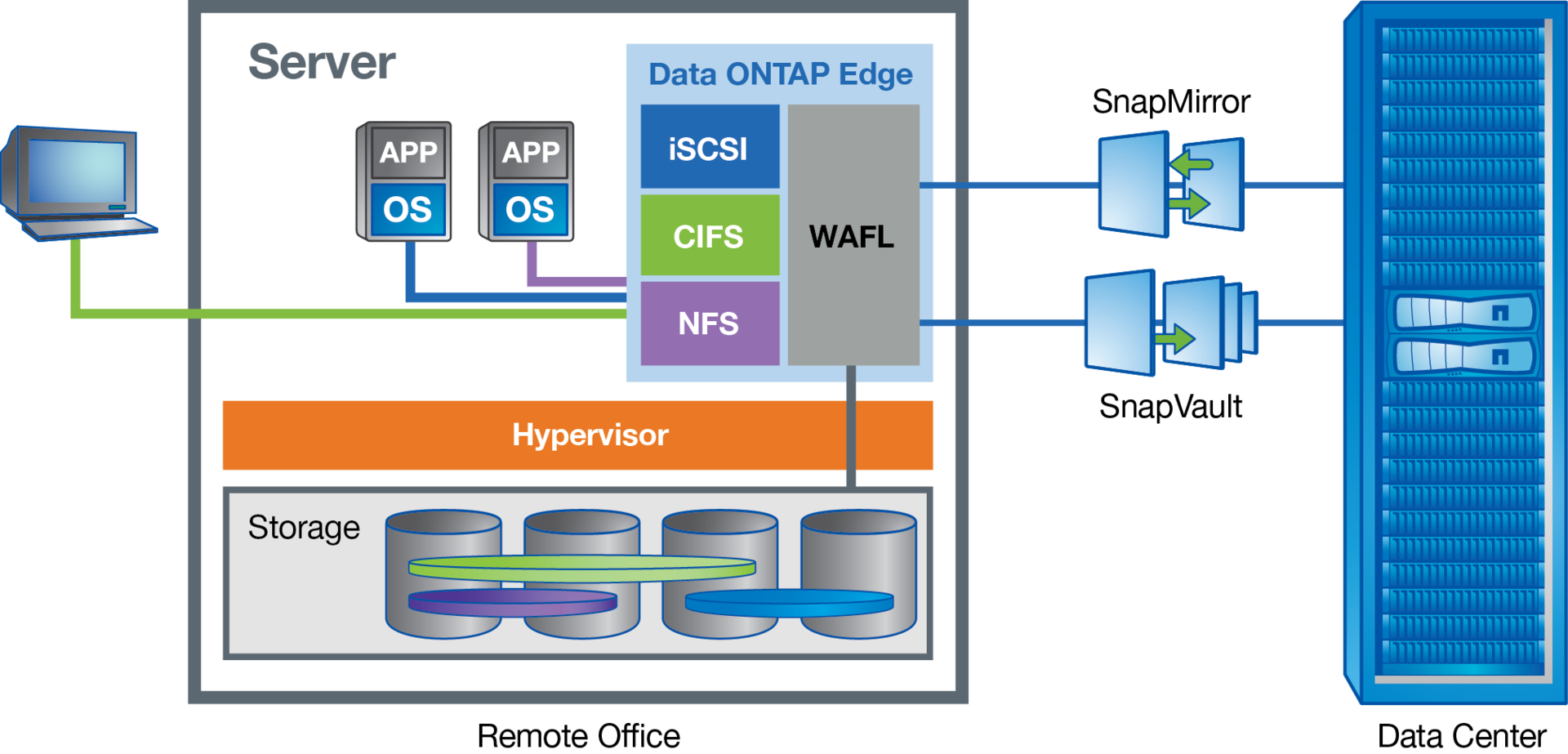
On Data ONTAP Edgein this article we will dwell in more detail. Back in 2012, the Data ONTAP Edge product appeared - a virtual appliance for Hyper-V and ESXi hypervisors. Initially, it came with DATA ONTAP 7-Mode OS (CBvM100, FDvM100), and in 2014, Data ONTAP Edge based on Clustered ONTAP (FDvM200) was released. Such solutions are designed for small offices where there is no way to install or buy a full-fledged FAS platform.
It is especially convenient to use Data ONTAP Edge for companies that have many local offices where it makes sense to build a Star topology, with a full FAS system in the center (for replicating backups to it) and Data ONTAP Edge in branches.
The difference between Data ONTAP-v and ONTAP based on the FAS platform is the complete absence of the first RAID technology. Data ONTAP-v lives and relies entirely on the traditional RAID controller installed in your server. There is also no support for FCP, which is quite logical:he’s a monument, who will plant him? it is a virtual machine. NAS (CIFS, NFS) and IP SAN (iSCSI) protocols are supported.
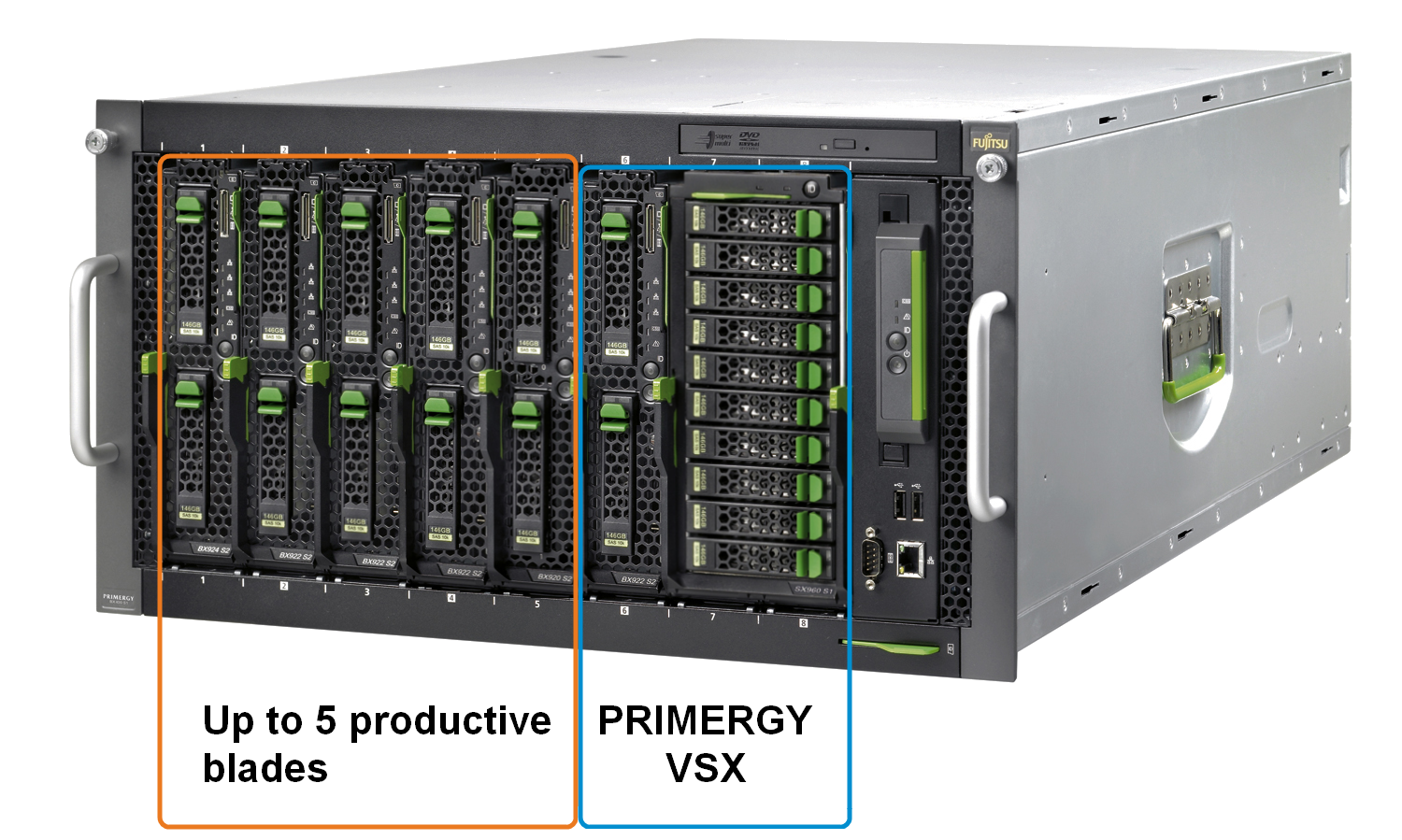
Global Partner Fujitsu Launches the Specialized VSX960 Solution with PRIMERGY BX400 Blade Servers for Use with Data ONTAP-v. VSX960 Solution supports up to 10 HDDs.
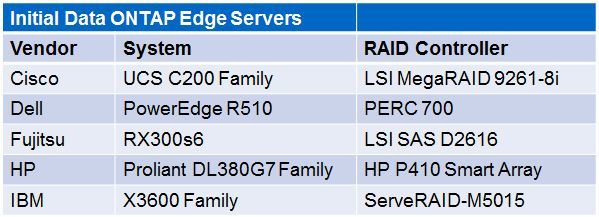
Data ONTAP Edge can also work on servers from IBM, HP, Lenovo, Cisco, Dell and others. Here is a short list of the most popular models, the key point is the availability of a supported RAID controller with a battery for the cache:
Since the system was originally designed for small offices, its limitations are higher than those of the FAS hardware platforms.
Licenses are sold for 10, 25 and 50 TB of usable space (excluding deduplication). Those. if deduplication will reap data well, then it will fit much more. The required amount of memory is 4/8 GB, 2 CPUs are required. And, as mentioned earlier, due to the lack of RAID-DP, a supported RAID controller with cache and battery is required. SnapMirror and SnapVault replication protocols, deduplication, Thing Provitioning, cloning, and SnapRestore are supported. More details on the official website . Only single-system systems that do not support High Avalability are supported.
SnapMirror comes with DataONTAP Edge. DataONTAP Edge can act as a source or as a recipient of replicas. Based on SnapMirror, you can build a DR SVM solution . If ONTAP is used only as a file storage, then for replication there is no need to ensure data consistency with third-party software. If IP SAN or virtualization applications, databases and others are used, then backup software is needed to ensure the consistency of information.
NetApp continues to develop Data ONTAP-v, which will degenerate into a full-fledged SDS . So, in the near future he will be able to cluster, receive the High Avalability function and a larger amount of information served.
Virtual applications with Data ONTAP-v are well suited for small companies and companies with a branch structure, where there is a need to keep local data and, possibly, replicate them to the central office. The server must have a supported RAID controller with a battery. Backup products that integrate ONTAP with the Hyper-V and ESXi virtual environments will be highly sought after in such schemes. So Veeam Backup & Replication allows you to perform consistent backups and manage SnapMirror replication, which makes this, and other similar products, the optimal tandem in such an infrastructure. SnapMirror for SVM technology will help build a DR solution. Separately, it is worth highlighting VMware vVOL technology, which natively provides consistent snapshots on ONTAP, which will also be very interesting for such installations.
This may contain links to Habra articles that will be published later .
Please send messages about errors in the text to the LAN .
Comments, additions and questions on the opposite article, please comment .
On Data ONTAP Edgein this article we will dwell in more detail. Back in 2012, the Data ONTAP Edge product appeared - a virtual appliance for Hyper-V and ESXi hypervisors. Initially, it came with DATA ONTAP 7-Mode OS (CBvM100, FDvM100), and in 2014, Data ONTAP Edge based on Clustered ONTAP (FDvM200) was released. Such solutions are designed for small offices where there is no way to install or buy a full-fledged FAS platform.
It is especially convenient to use Data ONTAP Edge for companies that have many local offices where it makes sense to build a Star topology, with a full FAS system in the center (for replicating backups to it) and Data ONTAP Edge in branches.
The difference between Data ONTAP-v and ONTAP based on the FAS platform is the complete absence of the first RAID technology. Data ONTAP-v lives and relies entirely on the traditional RAID controller installed in your server. There is also no support for FCP, which is quite logical:
Supported HW Hardware
Global Partner Fujitsu Launches the Specialized VSX960 Solution with PRIMERGY BX400 Blade Servers for Use with Data ONTAP-v. VSX960 Solution supports up to 10 HDDs.
Data ONTAP Edge can also work on servers from IBM, HP, Lenovo, Cisco, Dell and others. Here is a short list of the most popular models, the key point is the availability of a supported RAID controller with a battery for the cache:
Supported Server Platform RAID Controller
IBM ServerRAID M5100 SAS / SATA Controller
IBM ServerRAID M5015 SAS / SATA Controller
HP Smart Array P420 Controller
HP Smart Array P410i Controller
Fujitsu D3116 SAS / SATA Controller
Fujitsu D2616 SAS / SATA Controller
PowerEdge RAID Controller (PERC) H710
PowerEdge RAID Controller (PERC)
LSI 6G MegaRAID 9260-8i
LSI 6G MegaRAID 9265-8i
LSI 6G MegaRAID 9261-8i
Lenovo ThinkServer RAID 720ix
Lenovo ThinkServer RAID 720i
Lenovo ThinkServer RAID 710
Lenovo ThinkServer RAID 510i
Lenovo ThinkServer RAID 500
Lenovo ThinkServer RAID 110i
Lenovo ServeRAID M5210e
Lenovo SerRARA
HP Smart Array P840 Controller
HP Smart Array P830i Controller
HP Smart Array P822 Controller
HP Smart Array P440ar Controller
LSI MegaRAID SAS3108
LSI MegaRAID SAS2208
LSI MegaRAID SAS 9286CV-8e
Fujitsu PRAID EP420i
Fujitsu PRAID EP400i
Fuju2 Controller
Dfu2ge2juju
controller PERC) H730
LSI MegaRAID SAS 9361-8i
LSI MegaRAID SAS 9271-8i
LSI MegaRAID SAS 9261-8i
Cisco 9300-8E
Cisco 12G SAS
This list may be supplemented or modified, check with authorized NetApp partners and the compatibility matrix .
IBM ServerRAID M5015 SAS / SATA Controller
HP Smart Array P420 Controller
HP Smart Array P410i Controller
Fujitsu D3116 SAS / SATA Controller
Fujitsu D2616 SAS / SATA Controller
PowerEdge RAID Controller (PERC) H710
PowerEdge RAID Controller (PERC)
LSI 6G MegaRAID 9260-8i
LSI 6G MegaRAID 9265-8i
LSI 6G MegaRAID 9261-8i
Lenovo ThinkServer RAID 720ix
Lenovo ThinkServer RAID 720i
Lenovo ThinkServer RAID 710
Lenovo ThinkServer RAID 510i
Lenovo ThinkServer RAID 500
Lenovo ThinkServer RAID 110i
Lenovo ServeRAID M5210e
Lenovo SerRARA
HP Smart Array P840 Controller
HP Smart Array P830i Controller
HP Smart Array P822 Controller
HP Smart Array P440ar Controller
LSI MegaRAID SAS3108
LSI MegaRAID SAS2208
LSI MegaRAID SAS 9286CV-8e
Fujitsu PRAID EP420i
Fujitsu PRAID EP400i
Fuju2 Controller
Dfu2ge2juju
controller PERC) H730
LSI MegaRAID SAS 9361-8i
LSI MegaRAID SAS 9271-8i
LSI MegaRAID SAS 9261-8i
Cisco 9300-8E
Cisco 12G SAS
This list may be supplemented or modified, check with authorized NetApp partners and the compatibility matrix .
Limitations
Since the system was originally designed for small offices, its limitations are higher than those of the FAS hardware platforms.
Licenses are sold for 10, 25 and 50 TB of usable space (excluding deduplication). Those. if deduplication will reap data well, then it will fit much more. The required amount of memory is 4/8 GB, 2 CPUs are required. And, as mentioned earlier, due to the lack of RAID-DP, a supported RAID controller with cache and battery is required. SnapMirror and SnapVault replication protocols, deduplication, Thing Provitioning, cloning, and SnapRestore are supported. More details on the official website . Only single-system systems that do not support High Avalability are supported.
SnapMirror Replication
SnapMirror comes with DataONTAP Edge. DataONTAP Edge can act as a source or as a recipient of replicas. Based on SnapMirror, you can build a DR SVM solution . If ONTAP is used only as a file storage, then for replication there is no need to ensure data consistency with third-party software. If IP SAN or virtualization applications, databases and others are used, then backup software is needed to ensure the consistency of information.
The Future - SDS
NetApp continues to develop Data ONTAP-v, which will degenerate into a full-fledged SDS . So, in the near future he will be able to cluster, receive the High Avalability function and a larger amount of information served.
conclusions
Virtual applications with Data ONTAP-v are well suited for small companies and companies with a branch structure, where there is a need to keep local data and, possibly, replicate them to the central office. The server must have a supported RAID controller with a battery. Backup products that integrate ONTAP with the Hyper-V and ESXi virtual environments will be highly sought after in such schemes. So Veeam Backup & Replication allows you to perform consistent backups and manage SnapMirror replication, which makes this, and other similar products, the optimal tandem in such an infrastructure. SnapMirror for SVM technology will help build a DR solution. Separately, it is worth highlighting VMware vVOL technology, which natively provides consistent snapshots on ONTAP, which will also be very interesting for such installations.
This may contain links to Habra articles that will be published later .
Please send messages about errors in the text to the LAN .
Comments, additions and questions on the opposite article, please comment .