Oracle IaaS and PaaS - everything for you
Cloud computing today is extremely relevant for the entire IT market. Leading IT companies see enormous prospects in this area, and analytical agencies such as IDC and Forrester predict the growth of the cloud computing market in the areas of virtualization, platform as a service, applications as a service, etc. Both IT giants and smaller companies they are investing the most serious resources in this area, actively developing it, which means that we can very well treat cloud technologies as one of the main areas of development of IT and IT products in the foreseeable future.
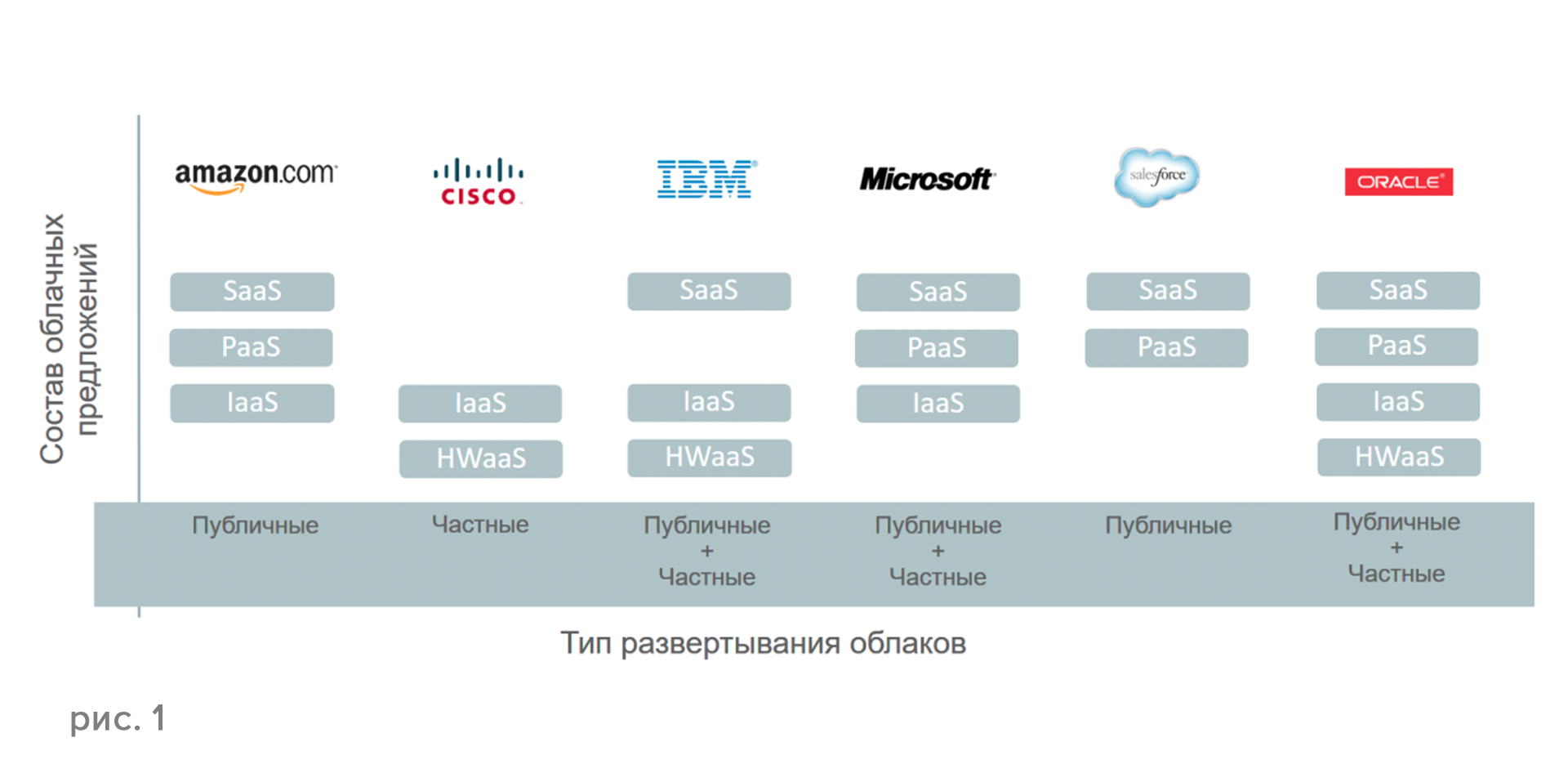
Of course, Oracle is also investing heavily in cloud automation. Moreover, if we look at the diagram of cloud solutions offered by major global suppliers (Fig. 1), it turns out that only Oracle provides a complete stack of cloud solutions, including HWaaS - equipment as a service. But how relevant are cloud computing for our country?
Our answer to this question depends on whether we believe that the list of tasks to be solved for our country, including the cloud, is relevant, namely:
It is obvious that all these tasks are relevant for Russia, and, moreover, due to the specific economic conditions of recent times, it is the cloud-based approach to solving them that is especially relevant. And if you ask a question to whom exactly in the business the use of cloud technologies is beneficial, then it turns out that it is beneficial to almost everyone. Developers who are primarily concerned about the quality of the services provided and the speed of the provision of new services, it is important that thanks to the cloud they can have quick access to the latest and constantly updated versions of technology. Heads of IT departments are interested in such organic properties of cloud platforms as quick response, quality of service, reducing risks and costs, increasing productivity. Finally, business users with high quality and speed of cloud systems provide access to new markets.
There are two main ways to deploy the cloud - a public cloud (supplying cloud services and areas for storing documents to a large number of clients - from the resources of large data centers) and a private cloud (the organization’s own cloud infrastructure). The public cloud allows you to translate all the relevant IT costs into operational costs and provides a quick and inexpensive launch of an IT solution. In the case of a private cloud, capital investments are saved - but full control of IT infrastructure is also preserved.
Oracle's approach is based on the concept of a hybrid cloud - a combination of private and public clouds, which implements cross-controlled use of data and applications between them. Hybrid cloud is very convenient for development and testing, integration of B2B solutions, implementation of products requiring IT resources, trial operation of new products.

Oracle provides its customers with a choice of all cloud models — public, private, and hybrid clouds (Figure 2). On the one hand, products are offered on the basis of which you can deploy Oracle systems in the data center, turning them into a private cloud. On the other hand, there are Oracle data centers around the world that provide public cloud services. Oracle Enterprise Manager allows you to combine both approaches, connect one cloud to another and manage them using a single interface.
It is important to recall that the cloud is not just a certain number of files on a server. The cloud is the cloud when the provision of services, their administration and payment are automated. That's why we say that the private cloud is the automation, deployment and management of IT systems. Companies with large, complex IT infrastructures understand this especially well, because managing such infrastructures without automation is impossible — that is why a private cloud is especially important for such companies.
The most popular cloud services now in the world and in Russia are Oracle infrastructure and platform services in the public cloud - a database as a service and an application server as a service.
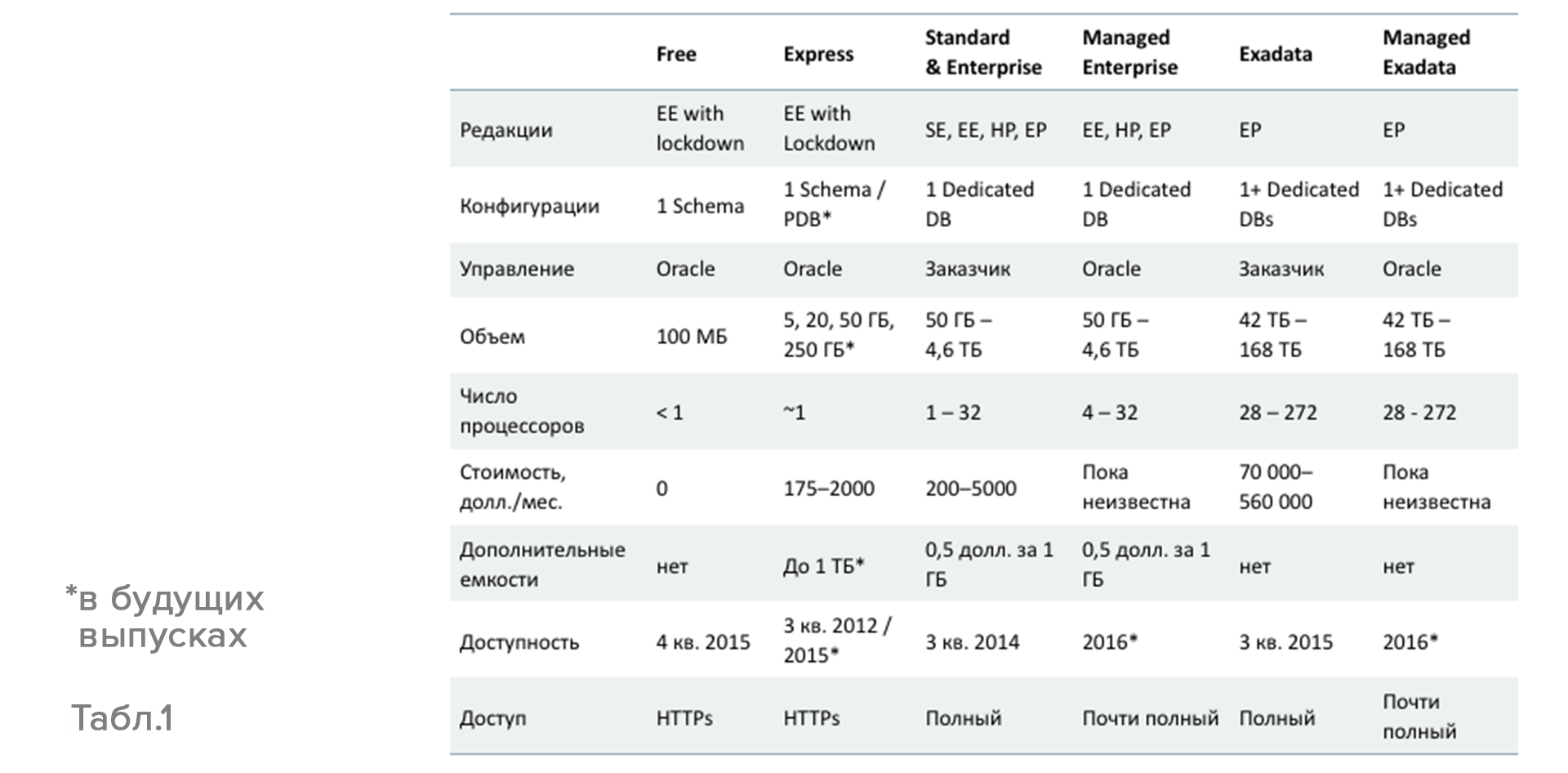
The two main ways to provide Oracle PaaS (DBaaS) services are as follows: clients work with either Oracle VMs or Exadata servers. If clients work with traditional virtual machines, there are several pre-configured sizes of virtual machines for them, which are characterized by a certain number of processors and memory size. The Exadata server-based solution is designed for customers with very high requirements for database size and performance. In addition, it makes it possible to use Exadata cells for high loads. See details in Tab. one.
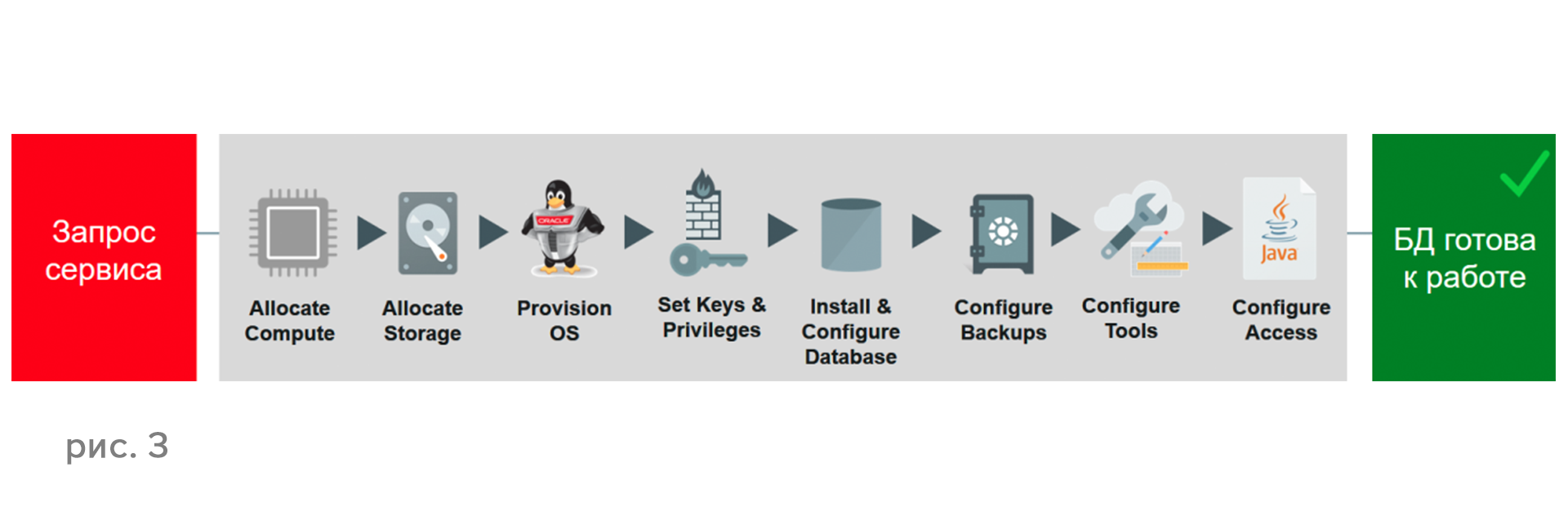
The rapid deployment of new databases is possible thanks to a convenient self-service portal, a template catalog that stores a set of deployment procedures in the form of service templates and offers different template options for different DBMS versions, configurations, etc. By clicking on the “Request Service” button in the public cloud interface There are a number of important, technologically complex processes that harmoniously and quickly lead to the availability of the service (Fig. 3). For all stages of service preparation, Oracle is responsible.
The database is provided quickly and guaranteed, there are possibilities for further automatic installation of patches and automatic backups - the service owner himself determines how often and in what area of the cloud storage the backup will be performed, Oracle is also responsible for this. Two versions of the database are available, 11 and 12; they are deployed on Linux version 6.4. All services are integrated to work with different programming languages. A whole set of tools is used to ensure security - SSH keys (access only for those systems that have a return private key), the use of a VPN channel, as well as Oracle’s own database security features.
Currently, there are two options for charging these resources - hourly or monthly payment. The hourly rate is higher, but relevant for those customers who need to save on night hours, weekends and holidays, when there is no need for system activity.
Together with the database service, several additional services work - for example, the Enterprise Manager Database Express product, which allows the administrator to manage the database through a graphical interface; service for working with APEX applications; “Light” application server GlassFish, etc.
The backup service to the cloud can be used both for backup from the cloud to the cloud, and for backing up the local database to the public Oracle cloud. It works with the traditional RMAN utility and runs for various versions of databases; Starting with Oracle Database 10, this feature is available for both Enterprise and Standart Edition. By default, backups compress and encrypt data. To increase accessibility, triple data mirroring, automatic error correction and protection against degradation are used.
Enterprise Manager 13 is a management system for both public and private cloud from a single interface. If the load when working with databases and applications exceeds the capabilities of free servers in the data center, this load can be transferred to the public cloud. Enterprise Manager performs two main functions: monitoring services wherever they are, and managing cloning (Figure 4).
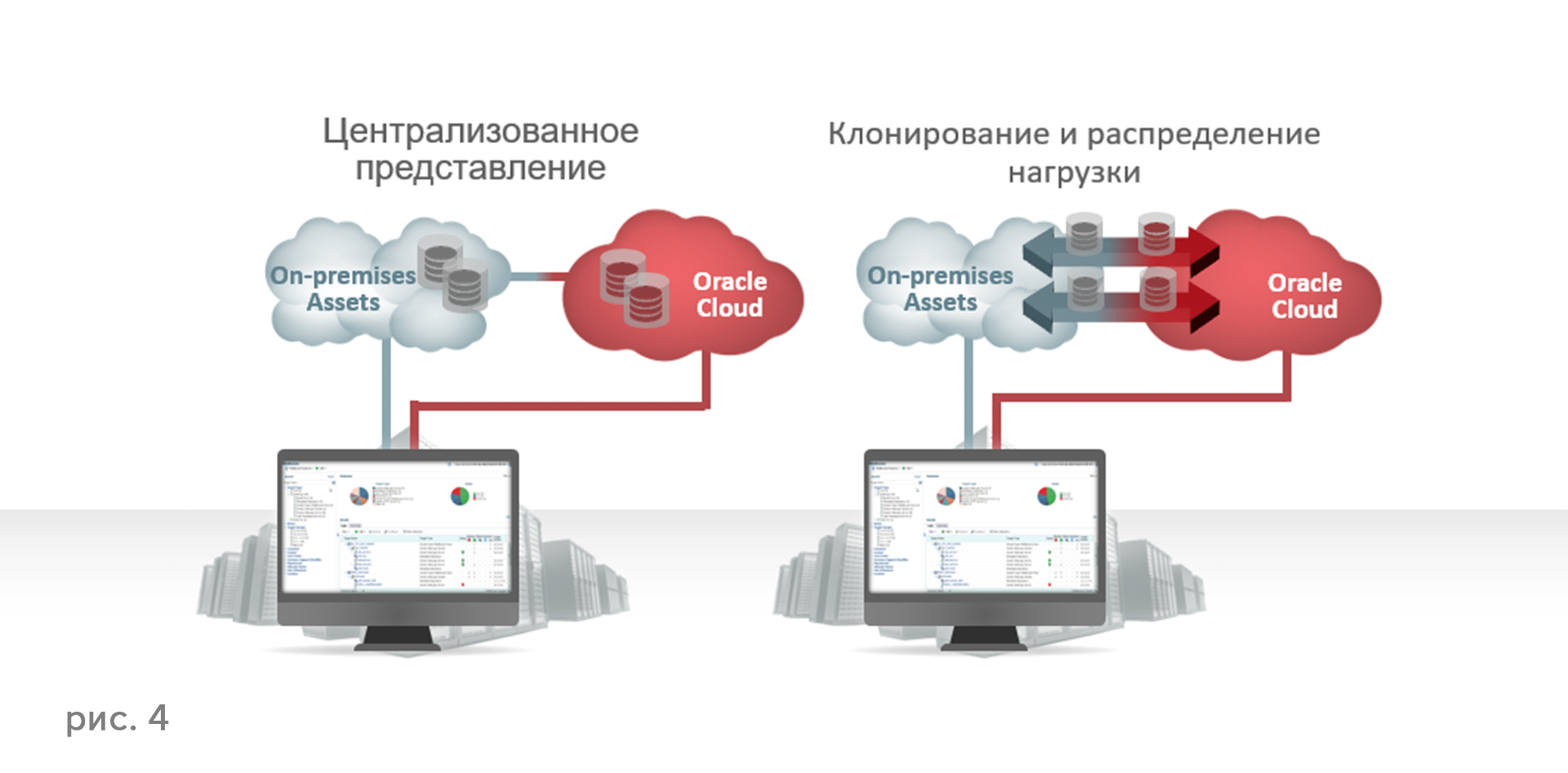
After installing Enterprise Manager, you must configure one of the Enterprise Manager agents so that it “sees” through a secure connection that it is in the public cloud, and the corresponding agent from the public cloud has communication with the local agent. When installing the agent, you choose which operating system you are installing it on. By connecting the host in the public cloud, you add the database for monitoring - Enterprise Manager will “see” this database and be able to manage it.
If you see one database in the cloud and another in the data center, you can start the cloning process. Cloning pluggable databases is fast enough. That is, in fact, the files of the connected database and the xml configuration file are copied. Cloning is possible both in and out of the cloud. This functionality is available in Oracle Enterprise Manager starting with version 12C Release 5.
Similarly, work with Java applications is implemented: by connecting a database and a WebLogic server, you can run applications in a private or public cloud.
By providing self-service, on-demand access to software and infrastructure with scalability and measurement capabilities, Enterprise Manager provides the following benefits.
In conclusion, I would like to emphasize once again that only Oracle offers a cloud with such a large selection of proprietary solutions. At the same time, Oracle’s offer is distinguished by a single architecture, standards and products for data centers and the public cloud, automation of life cycle management tasks, ready-made integration between the data center and the Oracle public cloud, as well as between PaaS and SaaS applications.
Of course, Oracle is also investing heavily in cloud automation. Moreover, if we look at the diagram of cloud solutions offered by major global suppliers (Fig. 1), it turns out that only Oracle provides a complete stack of cloud solutions, including HWaaS - equipment as a service. But how relevant are cloud computing for our country?
Our answer to this question depends on whether we believe that the list of tasks to be solved for our country, including the cloud, is relevant, namely:
- Scalability
- Cost reduction
- Improving the speed of IT services
- Service simplification
- Technology update
- Transition from capital investment to operating costs
- Security enhancement
- Standardization
It is obvious that all these tasks are relevant for Russia, and, moreover, due to the specific economic conditions of recent times, it is the cloud-based approach to solving them that is especially relevant. And if you ask a question to whom exactly in the business the use of cloud technologies is beneficial, then it turns out that it is beneficial to almost everyone. Developers who are primarily concerned about the quality of the services provided and the speed of the provision of new services, it is important that thanks to the cloud they can have quick access to the latest and constantly updated versions of technology. Heads of IT departments are interested in such organic properties of cloud platforms as quick response, quality of service, reducing risks and costs, increasing productivity. Finally, business users with high quality and speed of cloud systems provide access to new markets.
There are two main ways to deploy the cloud - a public cloud (supplying cloud services and areas for storing documents to a large number of clients - from the resources of large data centers) and a private cloud (the organization’s own cloud infrastructure). The public cloud allows you to translate all the relevant IT costs into operational costs and provides a quick and inexpensive launch of an IT solution. In the case of a private cloud, capital investments are saved - but full control of IT infrastructure is also preserved.
Oracle's approach is based on the concept of a hybrid cloud - a combination of private and public clouds, which implements cross-controlled use of data and applications between them. Hybrid cloud is very convenient for development and testing, integration of B2B solutions, implementation of products requiring IT resources, trial operation of new products.
Oracle provides its customers with a choice of all cloud models — public, private, and hybrid clouds (Figure 2). On the one hand, products are offered on the basis of which you can deploy Oracle systems in the data center, turning them into a private cloud. On the other hand, there are Oracle data centers around the world that provide public cloud services. Oracle Enterprise Manager allows you to combine both approaches, connect one cloud to another and manage them using a single interface.
It is important to recall that the cloud is not just a certain number of files on a server. The cloud is the cloud when the provision of services, their administration and payment are automated. That's why we say that the private cloud is the automation, deployment and management of IT systems. Companies with large, complex IT infrastructures understand this especially well, because managing such infrastructures without automation is impossible — that is why a private cloud is especially important for such companies.
The most popular cloud services now in the world and in Russia are Oracle infrastructure and platform services in the public cloud - a database as a service and an application server as a service.
Infrastructure Services and Platforms
The two main ways to provide Oracle PaaS (DBaaS) services are as follows: clients work with either Oracle VMs or Exadata servers. If clients work with traditional virtual machines, there are several pre-configured sizes of virtual machines for them, which are characterized by a certain number of processors and memory size. The Exadata server-based solution is designed for customers with very high requirements for database size and performance. In addition, it makes it possible to use Exadata cells for high loads. See details in Tab. one.
The rapid deployment of new databases is possible thanks to a convenient self-service portal, a template catalog that stores a set of deployment procedures in the form of service templates and offers different template options for different DBMS versions, configurations, etc. By clicking on the “Request Service” button in the public cloud interface There are a number of important, technologically complex processes that harmoniously and quickly lead to the availability of the service (Fig. 3). For all stages of service preparation, Oracle is responsible.
The database is provided quickly and guaranteed, there are possibilities for further automatic installation of patches and automatic backups - the service owner himself determines how often and in what area of the cloud storage the backup will be performed, Oracle is also responsible for this. Two versions of the database are available, 11 and 12; they are deployed on Linux version 6.4. All services are integrated to work with different programming languages. A whole set of tools is used to ensure security - SSH keys (access only for those systems that have a return private key), the use of a VPN channel, as well as Oracle’s own database security features.
Currently, there are two options for charging these resources - hourly or monthly payment. The hourly rate is higher, but relevant for those customers who need to save on night hours, weekends and holidays, when there is no need for system activity.
Together with the database service, several additional services work - for example, the Enterprise Manager Database Express product, which allows the administrator to manage the database through a graphical interface; service for working with APEX applications; “Light” application server GlassFish, etc.
The backup service to the cloud can be used both for backup from the cloud to the cloud, and for backing up the local database to the public Oracle cloud. It works with the traditional RMAN utility and runs for various versions of databases; Starting with Oracle Database 10, this feature is available for both Enterprise and Standart Edition. By default, backups compress and encrypt data. To increase accessibility, triple data mirroring, automatic error correction and protection against degradation are used.
Hybrid cloud
Enterprise Manager 13 is a management system for both public and private cloud from a single interface. If the load when working with databases and applications exceeds the capabilities of free servers in the data center, this load can be transferred to the public cloud. Enterprise Manager performs two main functions: monitoring services wherever they are, and managing cloning (Figure 4).
After installing Enterprise Manager, you must configure one of the Enterprise Manager agents so that it “sees” through a secure connection that it is in the public cloud, and the corresponding agent from the public cloud has communication with the local agent. When installing the agent, you choose which operating system you are installing it on. By connecting the host in the public cloud, you add the database for monitoring - Enterprise Manager will “see” this database and be able to manage it.
If you see one database in the cloud and another in the data center, you can start the cloning process. Cloning pluggable databases is fast enough. That is, in fact, the files of the connected database and the xml configuration file are copied. Cloning is possible both in and out of the cloud. This functionality is available in Oracle Enterprise Manager starting with version 12C Release 5.
Similarly, work with Java applications is implemented: by connecting a database and a WebLogic server, you can run applications in a private or public cloud.
By providing self-service, on-demand access to software and infrastructure with scalability and measurement capabilities, Enterprise Manager provides the following benefits.
- Improving the quality of service. IT organizations strive not only to reduce costs, but also to find solutions to improve productivity, availability and security. Cloud customers benefit from the high availability features built into the cloud.
- Flexibility in the use of resources. The ability to increase and decrease database capacity (storage size and computing power) makes applications flexible and easily adaptable to changing workloads.
- Accelerated provision of systems upon request. Databases in the cloud can be created very quickly. This reduces the overall deployment time for production applications and development platforms and speeds up the creation of debug configurations.
- Reporting - the ability to quantitatively measure the use of database resources in the cloud for budgeting, planning and distribution of administrative resources depending on the use of resources.
In conclusion, I would like to emphasize once again that only Oracle offers a cloud with such a large selection of proprietary solutions. At the same time, Oracle’s offer is distinguished by a single architecture, standards and products for data centers and the public cloud, automation of life cycle management tasks, ready-made integration between the data center and the Oracle public cloud, as well as between PaaS and SaaS applications.