
 October 21, 2015 at 09:52
Indoor Navigation: Great iBeacon Hardware Review
- Transfer
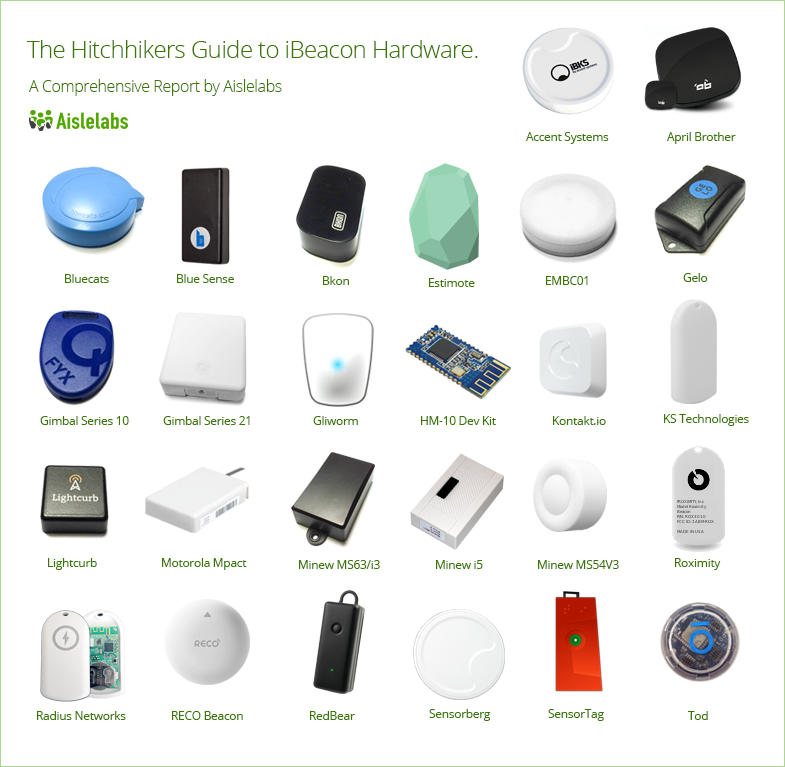
We have prepared a translation of a large overview of beacons working on iBeacon technology, which is also used in the Navigine project - indoor navigation systems. In Navigine, we use various technological solutions for indoor navigation, but iBeacon is one of the most famous and popular in the consumer sector - therefore, we will start the story from it.
In this review, we will look at 26 iBeacon beacons from different manufacturers such as Estimote, Kontakt and Gimbal. Over the past nine months, we tested the beacons in different conditions, trying to find out everything about them. This is the most comprehensive review on this topic, where all major beacon manufacturers are rated.
Introduction
Apple’s iBeacon technology helps smartphones locate in confined spaces. It is based on the BLE protocol standard ( Bluetooth Low Energy ) and is supported by all major mobile phones on the Android and iOS platforms.
iBeacon are tiny, battery-powered devices that transmit a Bluetooth signal. iBeacon (or simply beacons) repeatedly and every second transmit a signal, which, in turn, can be received by phones within a radius of several meters. The phone can accurately determine its location based on signals from nearby beacons. Imagine that the phone is a ship, and iBeacon is a lighthouse mounted on a rock; ships, seeing the light of a lighthouse, can determine their location relative to the shore.
Beacons, unlike GPS, can be used for indoor navigation. The technology has found many uses - Indoor navigation, geo-contextual advertising (services), client-selling and personalized assistance. Since the beacons use the BLE standard, they work equally well with devices based on both Android and iOS.
As the name of the protocol [Low Energy] is a standard with low energy consumption. Earlier, we investigated the effect of beacons on the battery power of iPhone and Android smartphones. As it turned out, working with nearby beacons should not spend more than 1% of the battery charge. In this review, we examine the battery life of the beacons themselves.
Beacons began to gain popularity not so long ago, but now they are installed in countless stores. Most beacons are battery powered. In this review we will make a full comparison of the various beacons available in the market. They come in different shapes and sizes, have various chipsets, firmware, and battery sizes. Over the past nine months, we have tested 26 devices from different manufacturers. In the previous review, we compared the effect of iBeacon on the battery power of the phone, and in this we will compare the beacons themselves by various parameters.
Energy consumption is a very important aspect, especially when installing beacons in a large industrial room. When there are a lot of them, it becomes very difficult to monitor the level of charge of their batteries (and also to replace them). For this reason, it is desirable that the beacon has a capacious battery.
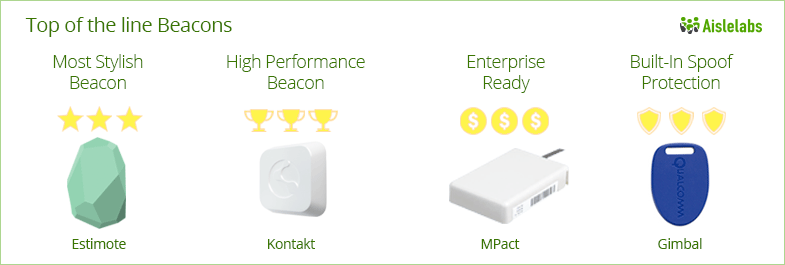
Winners:
What are beacons
Beacons are small battery powered devices. They broadcast a Bluetooth signal. The signal is received by smartphones, and also transmitted to the cloud server via the Internet. Cloud servers process information and perform further analysis, controlling the behavior of the mobile application depending on the position of the smartphone.
The beacon consists of four main components:
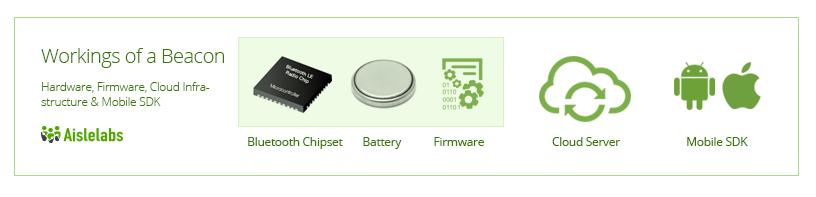
Beacon Hardware
The hardware consists of a microcontroller with a Bluetooth radio chip and a battery. The new radio chips are optimized to work with the BLE protocol, while the old ones only support classic Bluetooth, which has higher power consumption. The radio chips used in the beacons are mainly produced by two companies: Texas Instruments and Nordic Semiconductor. BlueGiga and Gimbal use radio chips from Texas Instruments (TI), but with their own firmware.
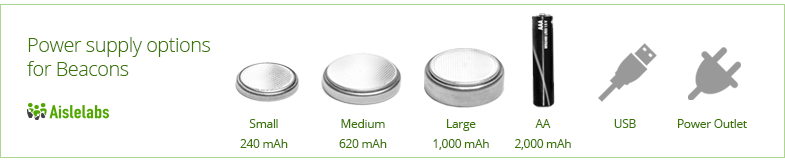
Most beacons are equipped with flat, round tablet batteries. These are lithium-ion batteries, which, despite their size, provide a capacity of up to 1000 mAh. Most common batteriesrated at 240 mAh (CR2032, small), 620 mAh (CR2450, medium size) and 1000 mAh (CR2477, large). Similar batteries are often used in key rings and digital watches.
Some beacons installed alkaline batteries type AA , which can be often found in digital cameras and TV remote. The capacity of a standard AA cell reaches 2000 mAh, but its size is larger than that of flat batteries.
Some of the beacons are connected to external power sources. They can be hooked to either a wall outlet or a USB port. Such beacons do not require battery replacement and, in certain situations, their use may be economically justified. However, it is not always easy to bring power to the place where the beacon is installed - additional wiring may be required. In this review, we will consider only battery powered beacons.
Flashing Beacons
Each beacon has its own firmware - this is the program code (logic) that controls the operation of the hardware. The firmware can control several parameters that affect the battery life.
Transmission power (Tx) - beacons transmit a signal of a certain power. The transmitted signal weakens with distance from the source. High transmit power means the signal can travel long distances. Low transmit power means low power consumption, but the signal will not propagate far.
Polling intervalIs the frequency with which iBeacon generates a signal. An interval of 100 ms means that the signal will propagate every 100 milliseconds (10 times per second). A larger value of the polling interval, equal to 500 ms, means that the signal will be broadcast only twice per second - the battery charge will be consumed less. With an increase in the polling interval, the battery life increases, but the response time of the phone decreases. There is no optimal value for the polling interval: if low latency is required, the polling interval should be chosen as little as possible, and if it is necessary to extend the battery life, then as long as possible.
In the official specification of Apple's iBeacon protocol, the polling interval is set to 100 ms, however, most beacon providers change its value upwards, while adhering to other standards. We will still call such devices the term iBeacon. In most cases, a polling interval greater than 100 ms is more than enough to provide a good user experience.
Each beacon has its own way of setting hardware operation parameters (transmit power and polling interval). Beacons such as Kontakt, Estimote, RadBeacon and BlueSense Networks use their own iPhone app to configure settings. Some beacons, such as Minew, provide an open interface through any GATT client (for example, an application for iPhone LightBlue or gattool on Linux). The main advantage of GATT clients is the ability to configure all beacons simultaneously.
Beacons of some manufacturers (for example, Gimbal) additionally support their own operating modes that are not described in Apple's iBeacon protocol. In this review, we will only cover those modes of operation that are described in the standard.
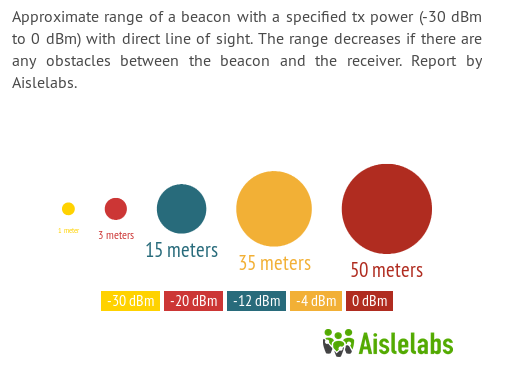
We compared the various values of the transmit power and the polling interval and looked at what this leads to. Typically, the transmit power of the beacons is -12 dBm , and the polling frequency varies from 350 ms to 900 ms. The dependence of the range of the beacon on the transmit power (in conditions of direct visibility) is shown in the diagram below:
Cloud Beacon Infrastructure
The beacons broadcast a Bluetooth signal that helps smartphones determine their location, but this signal does not mean anything by itself - an intelligent backend service is required here. Typically, cloud applications parse all received signals and make decisions, that is, they work like the brain that controls all operations.
In this review, we will not compare cloud service providers and focus only on beacon hardware.
Developer Package
Applications must be able to communicate with beacons and a cloud server in order to act in accordance with the geographical location of the smartphone. In this review, we consider beacon batteries whose lifetime does not depend on the type of development software package used.
Methodology
To accurately measure the lifetime of each battery, we placed the beacons in our laboratory, setting various settings, and tested them over the past 3-9 months. All this time, we regularly measured the battery level (initially 100% charged). We also measured current consumption (in milliamperes).
We experimented with various settings for transmit power and polling interval. Each beacon has its own standard values for these parameters, therefore, to create equal conditions, we set the transmit power to -12 dBm, and the polling interval of 645 ms is our optimal beacon settings.
Since the battery of many beacons lasted more than 9 months, we extrapolated the battery life based on the amount of current consumed. To do this, we divided the battery capacity (say, 620 mAh) by the current consumed in order to get an approximate battery discharge time.
This approach implies that the battery is ideal and the current consumption is constant, but the lithium-ion battery does not satisfy these conditions. In reality, battery performance depends on many factors. Since different beacons come with different batteries (both good and bad), it’s impossible to predict the exact time. The numbers reflecting the battery life should be regarded as a theoretical maximum.
Standardization of battery life:We calculated the battery life of each beacon with the optimal settings, using the methodology described above - this is how we standardized the battery life. This will allow us to directly compare beacons with each other.
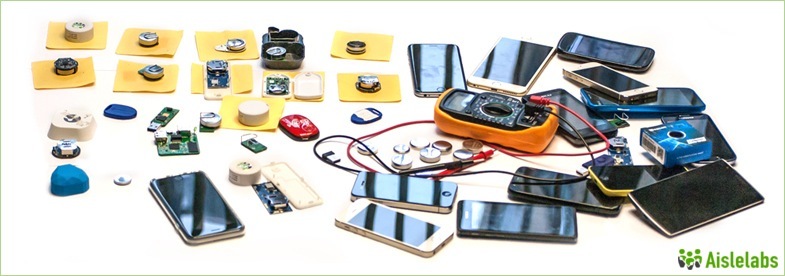
Below is a photo of our laboratory. There are several beacons and test smartphones.
Chipsets
We focused on four chipsets - Texas Instruments TI CC254x , Nordic Semiconductor nRF51822 , Bluegiga BLE112 / BLE113 and a controller from Gimbal . Although there are other chipsets on the market, this accounts for 95% of the market (at the time of writing [May 4, 2015 - approx. Trans.]).
We carefully measured the battery consumption with each of the chipsets. The chipsets from TI, Nordic and Bluegiga support various settings for transmit power and polling interval. Gimbal also provides the option of randomizing the Bluetooth MAC (this function drains the battery). Gimbal beacons support a limited set of configurations, and their polling interval cannot vary within arbitrary limits.
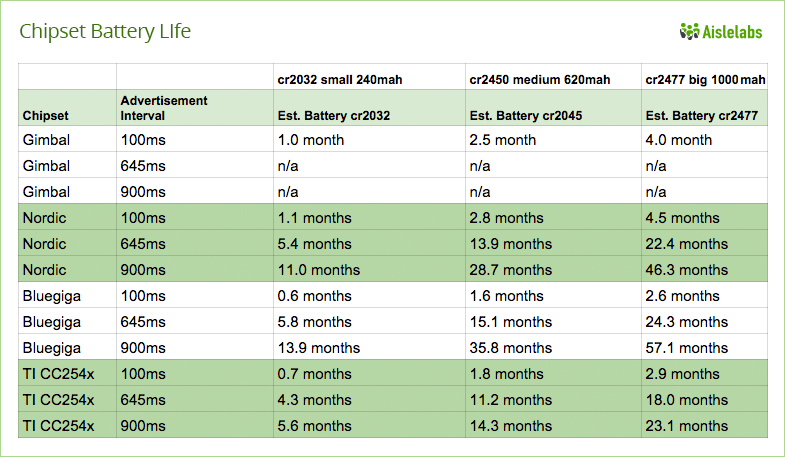
For each chipset, we calculated the battery life at the optimal beacon settings: polling interval 645 ms, transmit power -12dBm (15 meters), small CR2032 battery. Gimbal independently sets the polling interval to 100ms, so the values given for this chipset cannot be directly compared with other readings.
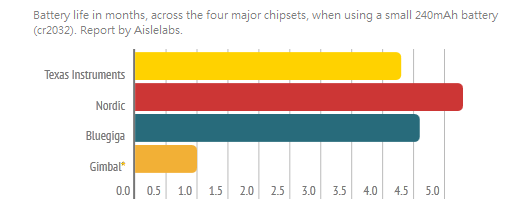
The most popular of the four chipsets are TI and Nordic. TI chipset appeared in 2009, and Nordic in 2012. In this regard, it is expected that the Nordic chipset will be more optimized for working with beacons. The Gimbal chipset additionally provides its own Beacon mode, but here we are only considering the iBeacon standard. We expect these chipsets to be equipped with more modern radio transmitters in the near future.
Beacon Suppliers
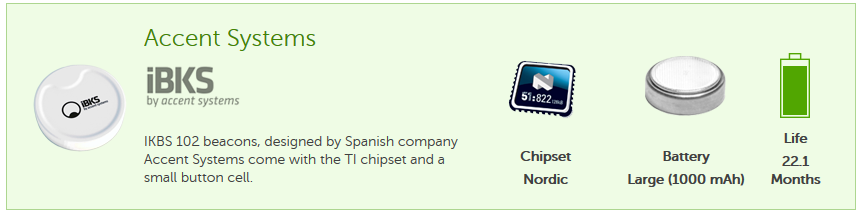
IBKS 102 beacons were developed by Accent Systems, a Spanish company. They come with a TI chipset and are powered by a 1000 mAh battery (CR2477). Technical specifications are available on the manufacturer’s website .
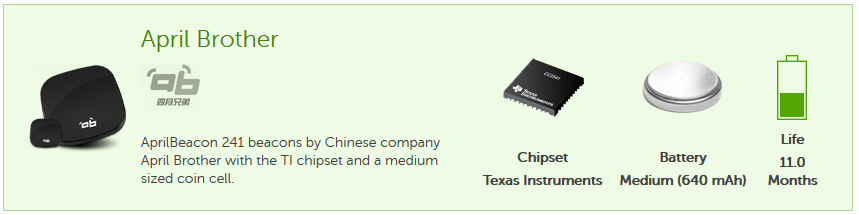
AprilBeacon 241 beacons were developed by the Chinese company April Brother. They come with a TI chipset and are powered by a 620 mAh battery (CR2450). Larger beacons powered by an AAA battery are also available, which ensure uninterrupted operation of the beacon for 32 months. Technical specifications are available on the manufacturer’s website .
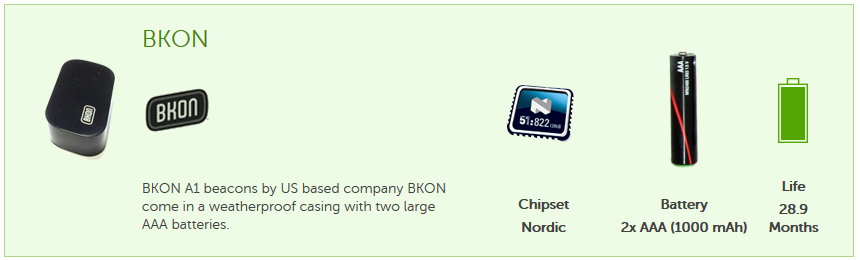
BKON, headquartered in Nashville, produces A1 beacons. They are equipped with two AAA batteries, ensuring the long life of the device. There is support for the UriBeacon protocol - an alternative to iBeacon. Technical specifications are available on the manufacturer’s website .
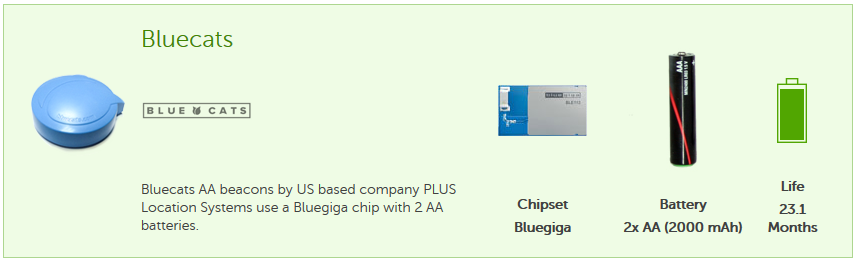
The Bluecats AA beacons used 2 AA batteries. Technical specifications are available on the manufacturer’s website .
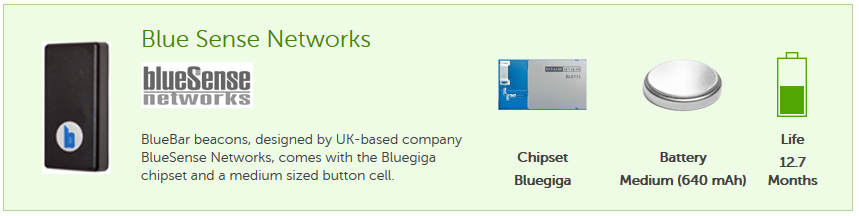
BlueBar beacons are designed by BlueSense Networks, headquartered in the UK. They come with the Bluegiga BLE113 chipset and are powered by a 620 mAh battery (CR2450). Technical specifications are available on the manufacturer’s website .
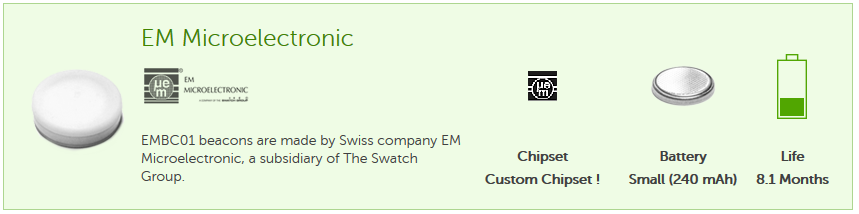
EM Microelectronic is a Swiss semiconductor microelectronics company specializing in low-power microchips for battery powered devices. The company produces EMBC01 beacons on its microcircuits. The owner of the company is the manufacturer of Swiss watches The Swatch Group. Technical specifications are available on the manufacturer’s website .
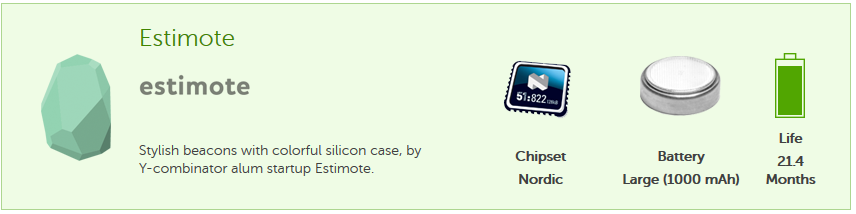
Polish startup Estimote is one of the most famous manufacturers of beacons - the company produces them in a smooth silicone case. After graduating from Y-Combinator and receiving investor money from Silicon Valley, Estimote relocated its headquarters to San Francisco. These beacons come with the Nordic Semiconductor NF51822 chipset. In one of our previous reviews, we tested the first batch of Estimote beacons, which were powered by batteries (CR2450) with a capacity of 620 mAh each. Since October 2014, the company has been producing updated beacons with batteries with a capacity of 1000 mAh. The beacon hardware is hidden in a non-separable case, so it can be installed outdoors and in places with high humidity, but this means that after discharging the battery cannot be replaced - you need to buy a new device.
With a flexible silicone shell, a rich selection of colors and a reusable adhesive base, Estimote beacons are the most stylish devices on the market. Not so long ago, the company introduced thin beacons Estimote Stickers (only 3mm thick, but with shorter battery life). Estimote also regularly releases firmware updates to further extend battery life.
Estimote beacons are configured using the iPhone app. Technical specifications are available on the manufacturer’s website .
The table below summarizes the battery life of Estimote beacons with firmware version 2.2 and a 1000 mAh battery. Note that the figures below imply the use of an ideal battery, which seems impossible in real conditions - the actual life time can be much less.
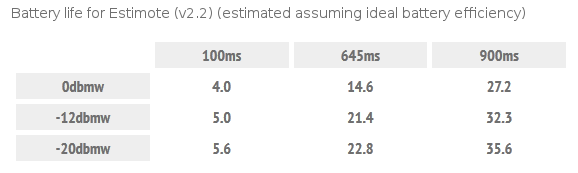
The comparison is by month (values in the table)
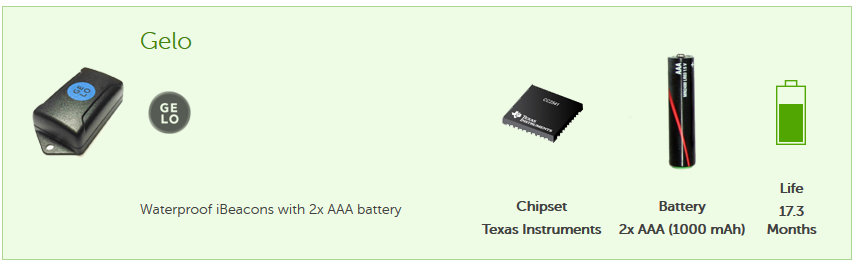
Water and weather-resistant rough beacons from a company located in Michigan. The technical specification for Gelo beacons is available on the manufacturer's website .
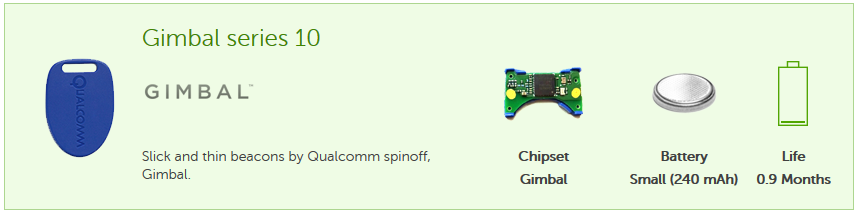
Qualcomm, the American semiconductor electronics company best known for its Snapdragon processors, opened the Gimbal beacon division earlier this year. With Qualcomm support, the new company released beacons in several form factors: the Gimbal Series 10 with a small battery and the Gimbal Series 21 with four large AA batteries.
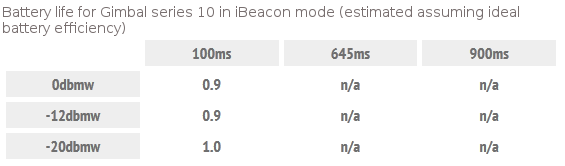
Comparison is by month (values in the table)
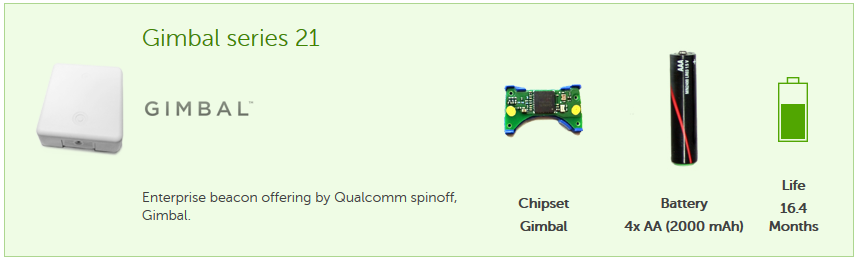
Gimbal beacons support two standards: Apple's iBeacon standard and its own. These are the only beacons that quickly change their Bluetooth address, providing protection against spoofing. Thanks to such protection, it is very difficult for an attacker to find out information about a beacon or to clone it. If such a function is not provided at the hardware level, then device protection rests with the application developer. Since Gimbal has anti-spoofing mechanisms, these beacons are a great solution when software protection is not available.
Gimbal offers high-quality beacons that generate a stable signal, but have a bulky case and short battery life. Several other manufacturers offer longer life and a smaller form factor, giving users the freedom to customize the polling interval and other parameters.
Technical specifications for Gimbal beacons are available on the manufacturer’s website .
The tables below show the battery life (in months) for Series 21 beacons while operating under the Gimbal standard (Recommended mode for Series 21) and iBeacon. Battery life is determined by the polling interval and transmit power.
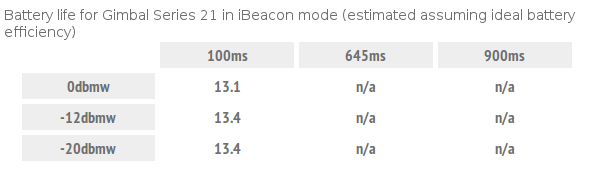
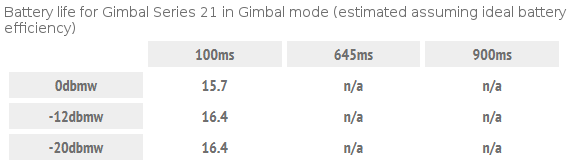
Comparison is by month (values in the table)
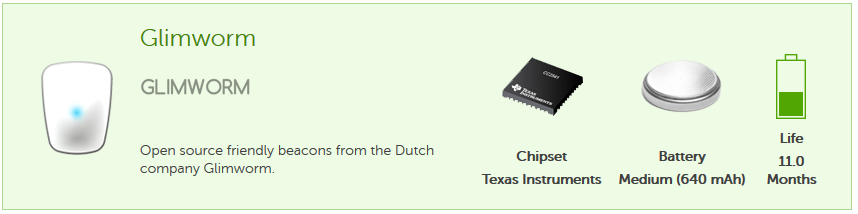
Beacons Glimworm developed by the German company of the same name. They come with a Texas Instruments chipset and a 620 mAh battery (CR2450). Technical specifications for Glimworm beacons are available on the manufacturer’s website .
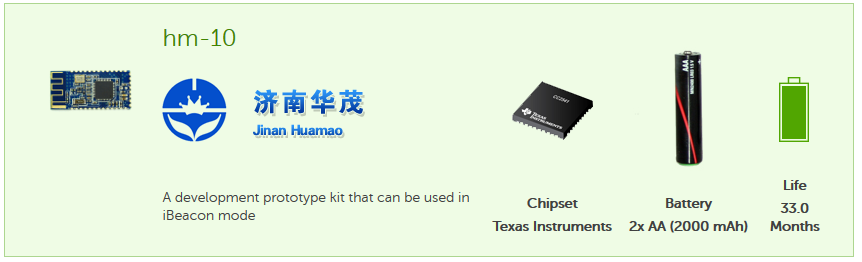
The HM-10 is a UART bridge capable of working with the iBeacon protocol. This module is made for developers as an experimental kit. Technical specification .
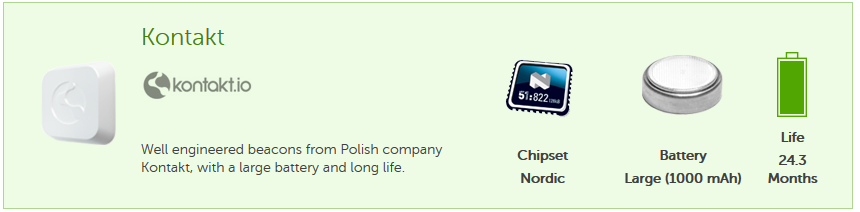
Behind the development of these beacons is the Polish company Kontakt.io. Kontakt was born as a company offering devices that help people orient in space blind and visually impaired. Today, their beacons help all segments of the population.
They come with a Nordic chipset and are powered by a 1000 mAh battery (CR2477). After conducting several tests, we found that the product architecture works perfectly with this chipset - a large signal transmission distance with relatively low power consumption.
Beacons can be configured using the Kontakt application or other applications (support for open standards). Easy setup Kontakt simplifies the installation of a large number of beacons.
Technical specification .
The table below shows the dependence of the battery life (in months) on two variables: the polling interval and transmit power. The maximum lifetime was 35.7 months (900 ms polling interval, signal power -20 dBm). When setting the most stringent settings, the battery life is reduced to 4.5 months.
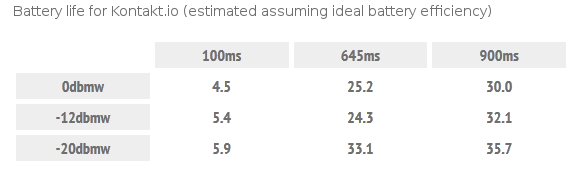
The comparison is carried out by month (values in the table)
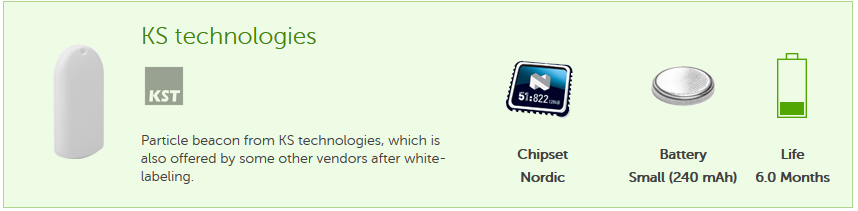
These beacons were developed by the American company KST (KS Technologies). KST sells its equipment under the Particle brand. They use a Nordic chipset and a 240 mAh battery (CR2032).
Simplicity of design makes it easy to customize beacons to the needs of the seller. KST operates under an OEM license, offering its services under the brands of other companies, and has registered its new device with FCC, IC and CE certificates.
Technicalspecification .
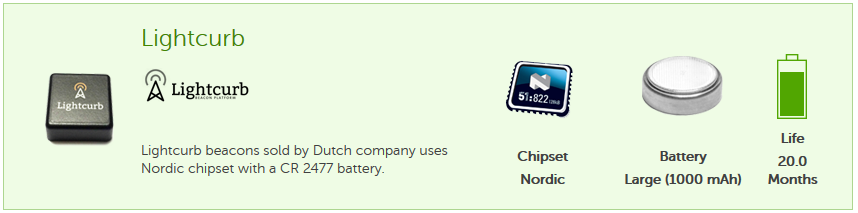
Lightcurb beacons are based on the Nordic chipset and provide a decent battery life.
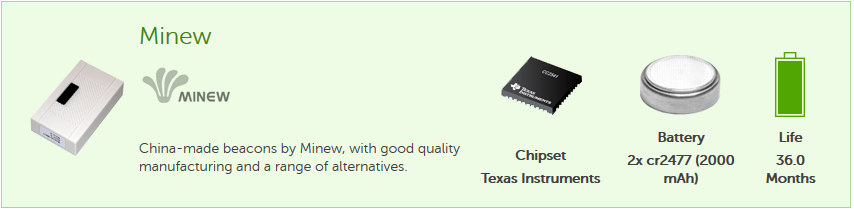
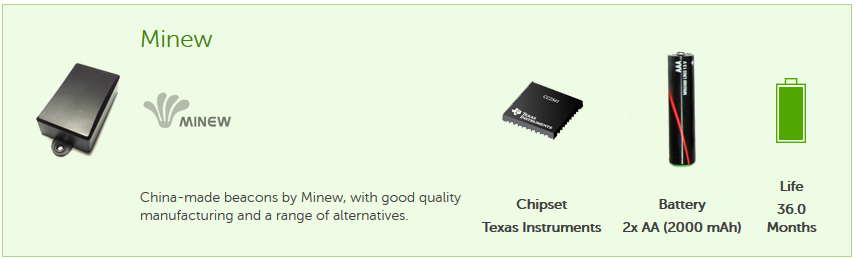
Minew beacons were developed by the Chinese company Shenzhen Minew Technologies. There are several implementations of these beacons. We tested three options: MS54V3 with a CR 2477 battery, i5 with two CR 2477 batteries and MS63 / i3 with two AA batteries. Another option is the MS56, but we have not tested it, since it is identical to the MS54V3, it only has a silicone case for outdoor use. All beacons use the same chipset from Texas Instruments with the same firmware - only the batteries differ.
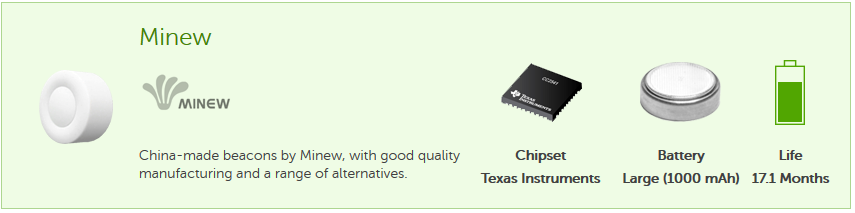
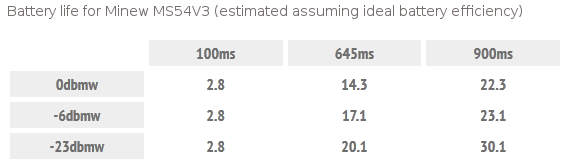
The table below shows the MS54V3 battery life at various settings. The battery life of i3 and i5 will be twice as long. The table shows the ideal battery life (in months) depending on the transmit power (in dBm) and the polling interval (in ms).
The comparison is carried out by month (values in the table).
Technical specification for Minew beacons is available on the manufacturer's website .
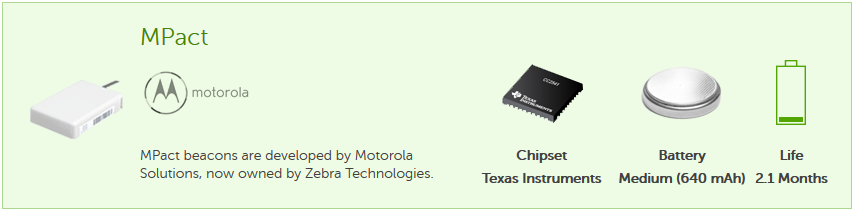
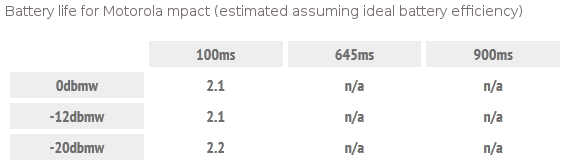
The table shows the ideal battery life (in months) depending on the transmit power (in dBm) and the polling interval (in ms). Note that at the time of testing, these beacons did not allow changing the polling interval equal to 100 ms and recommended by Apple. However, MPact beacons can now be used in iBeacon mode with a polling frequency of 600 ms, providing a battery life of up to 12 months.
MPact offers a beacon management platform. The company produces Wi-Fi access points and combines all the services related to navigation, under the auspices of MPact. Since MPact is one of the few companies that offer not only Bluetooth solutions, we have chosen this platform as ready to work in large enterprises. Other vendors, Meraki and Aruba, offering enterprise solutions, will be discussed in a future version of this review. Technical specification .
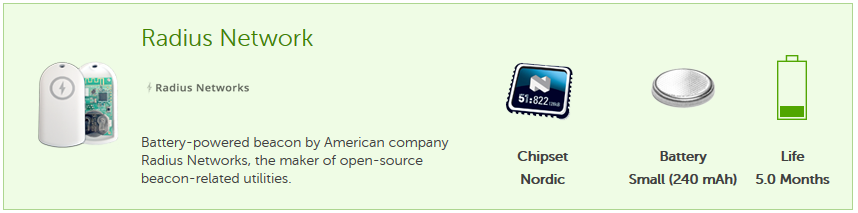
Radius Networks is an American company that owns the RadBeacon Tag brand. These beacons come with a Nordic chipset and a 240 mAh battery (CR2032).
We tested the CR2032 battery-powered version of the beacon, but Radius Networks offers yet another - USB powered and called RadBeacon USB. USB power eliminates the need for battery replacement. It is important to note that this option is more difficult to install in large rooms - you need to install outlets in exactly the places where the beacons are installed.
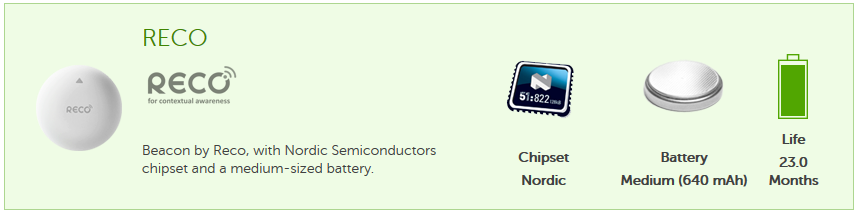
These beacons were developed by RECO (South Korea). They come with the Nordic chipset and are powered by a 620 mAh battery (CR2450). Technical specification .
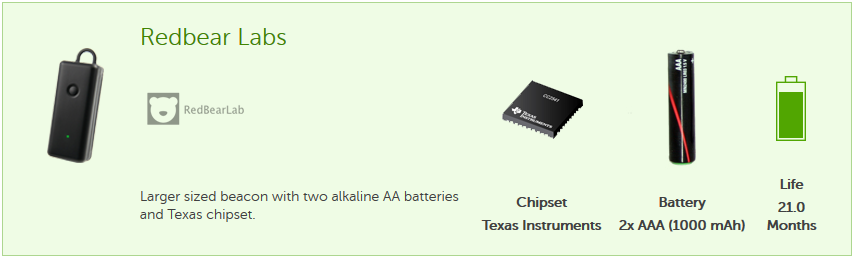
These beacons were developed by the Chinese company RedBearLab. They come with the Texas Instruments chipset and are powered by two AAA batteries with a total capacity of 2000 mAh. Technical specification .
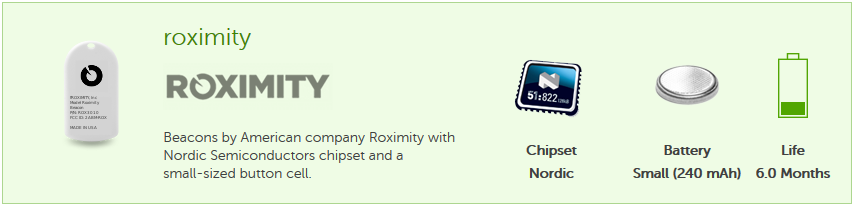
These beacons were developed by the American company Roximity. They come with the Nordic chipset and are powered by a 240 mAh battery (CR2032). Technical specification .
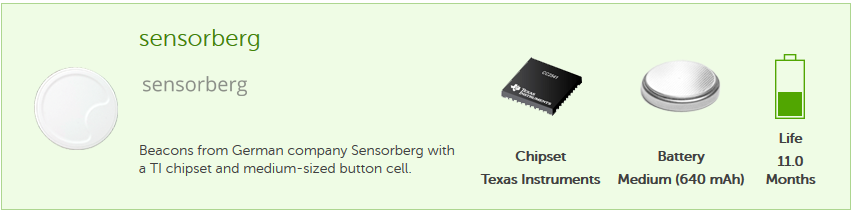
These beacons were developed by the German company Sensorberg. They come with the Texas Instruments chipset and are powered by a 620 mAh battery (CR2450) . Technical specification .
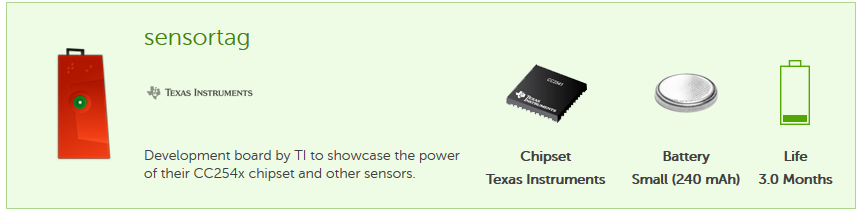
These beacons are developed by the American company Texas Instruments. They come with company chipsets and are powered by a 240 mAh battery (CR2032). Technical specification .
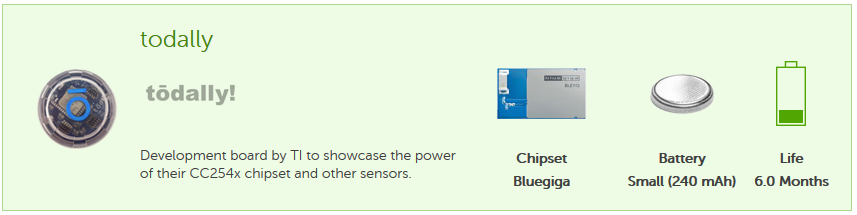
These beacons were developed by the American company tōd LLC. They come with Bluegiga chipsets and are powered by a 240 mAh battery (CR2032). Technical specification .
Conclusion
In this review, we tested the beacons of 26 of the largest manufacturers that use 5 chipset options. After nine months of long experiments with different configurations, types of batteries and settings for each beacon, we finally presented our results:
- The most stylish beacon: Estimote;
- Most productive: Kontakt;
- Ready for corporate work: MPact;
- Spoofed: Gimbal.
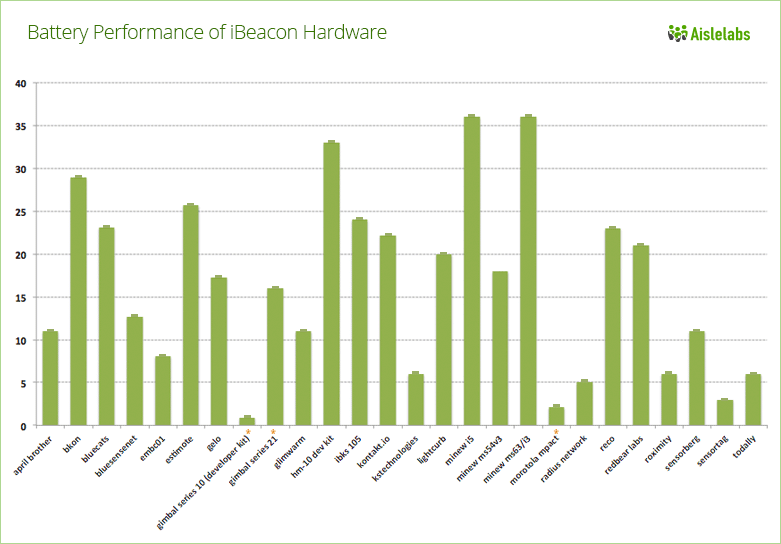
A comparison of the battery life (in months) of all beacons is shown in the graph below. Note that some beacons, such as Gimbal and MPact, did not allow changing the polling frequency, so their battery life cannot be directly compared.
It is worth emphasizing once again: despite all the popularity of Apple products and developments, indoor navigation is not limited to using iBeacon technology: there are other interesting solutions suitable for different tasks, and since we work with many of them in Navigine (our repository on GitHub ), we will definitely continue to disclose this topic in our materials and translations.