September 9, 2015 at 16:39
Intel Broadwell Xeon E3-1200 v4 - all you need to know about the new Xeon line and eDRAM
Intel recently unveiled an updated line of new quad-core Intel Broadwell Xeon E3-1200 v4 processors. A series of server processors Intel Xeon E3-1200 v3 appeared on the market in the 2nd quarter of 2013 and was quietly updated in the second quarter of 2014 on a model of type E3-1231 v3. Now announced Xeon v4. Let's figure it out: what is new from Intel?
In the terminology of the tick-to-tack strategy, Broadwell is a tick: the manufacturer used Haswell architecture in a 14-nanometer version. Tick does not imply revolutionary changes. Analysts believe that in this phase Intel completes well-known technologies, and improvements will be cosmetic. Broadwell delivers reduced power consumption and comparable performance compared to previous generation processors.
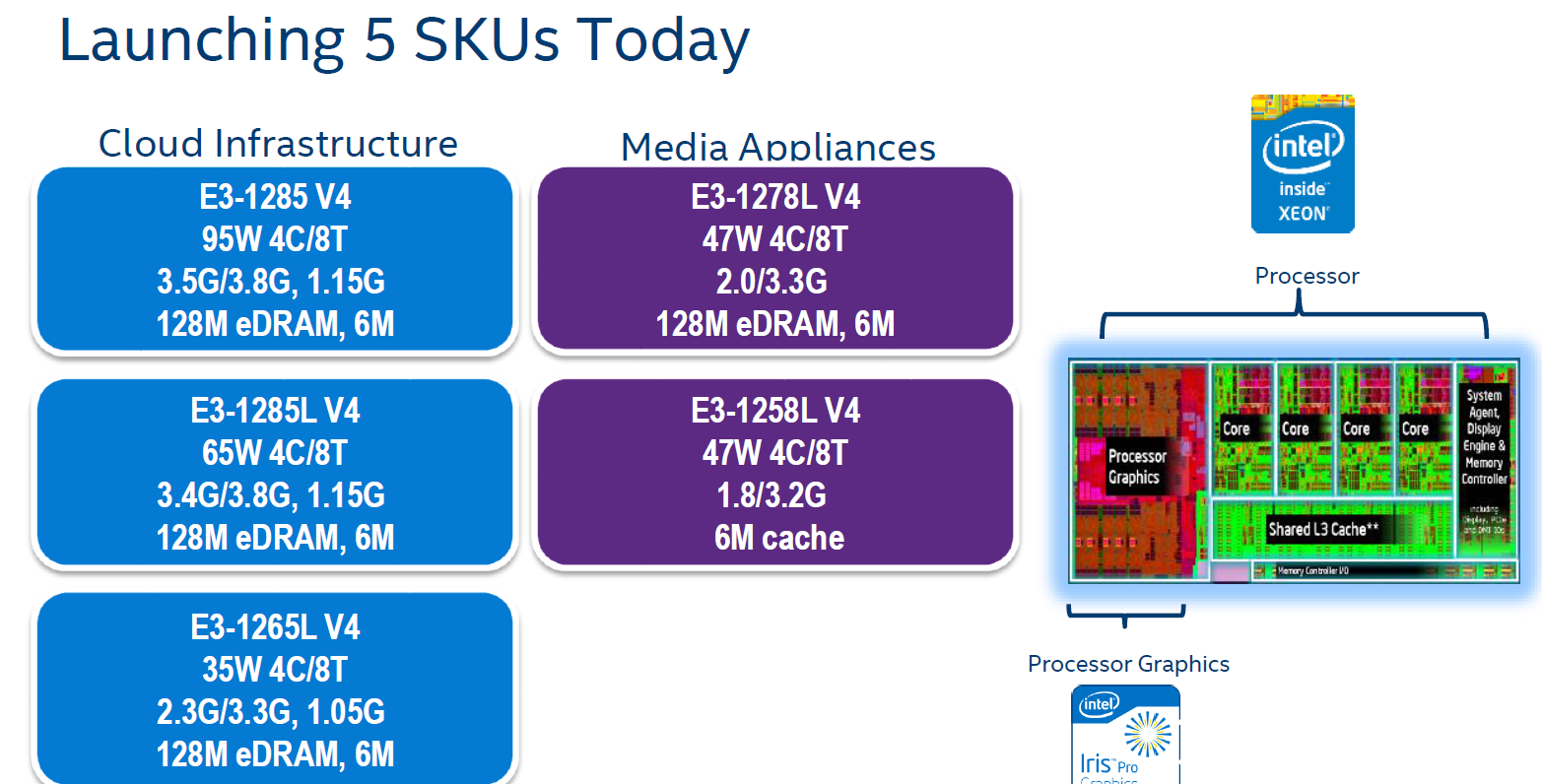
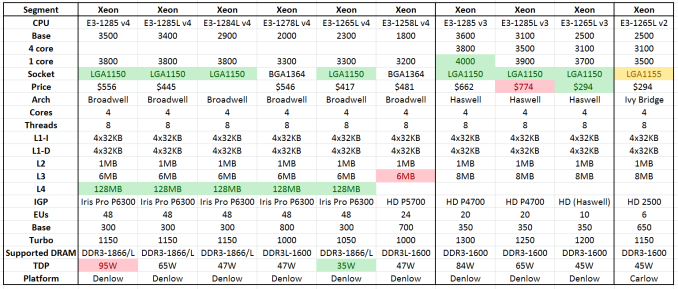
Consider three new Intel Xeon E3-1200 v4 server processors on the LGA 1150 socket.
The volume of cache in the third level is reduced by 2 MB, that is, by a quarter compared to previous Xeon models. As www.anandtech.com notes , the loss of 2 MB L3 is not significant, given the advent of eDRAM with a capacity of 128 MB in L4.
In early 2007, Intel and IBM together with AMD, Toshiba and Sony almost simultaneously announced a technology that would speed up the processors by half. To do this, it was proposed to use eDRAM (embedded DRAM), which will be used together with the technology of "silicon on the insulator" (SOI, Silicon-on-Insulator). IBM said that this will significantly accelerate the cache memory, increase its density three times and reduce power consumption by five times in idle mode of the processor. Then it was planned to use a cache of 24 MB.
Technologically, embedded DRAM is DRAM that is “embedded” in a processor, unlike SDRAM. eDRAM requires a voltage of 1 V, which is noticeably lower than the power of conventional memory. In practice, this means that eDRAM consumes less power, providing comparable performance. Smaller eDRAM cells — 0.108um² for SRAM and 0.029um² for eDRAM — will fit an order of magnitude larger than slightly slower memory cells on a chip of the same size.
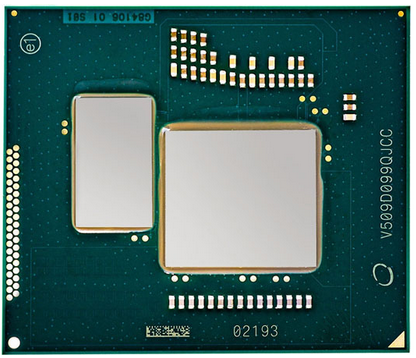
Intel has not only put the famous Haswell on 14-nanometer rails. In Broadwell processors, the manufacturer used the eDRAM capabilities as fully as possible today. The manufacturer claims a 25% improvement in parameters such as power consumption and heat dissipation.
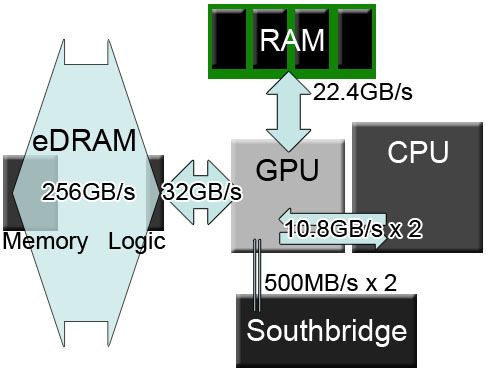
128 MB eDRAM Crystalwell acts as a fourth-level cache. Haswell had a cache of similar volume, but only in the top E7 models. At the same time, eDRAM can be used by both the graphics core and processor cores when processing large amounts of data - for example, textures. According to the manufacturer, Crystalwell provides a peak bandwidth of 51.2 GB / s in each direction (102.4 GB / s in total).
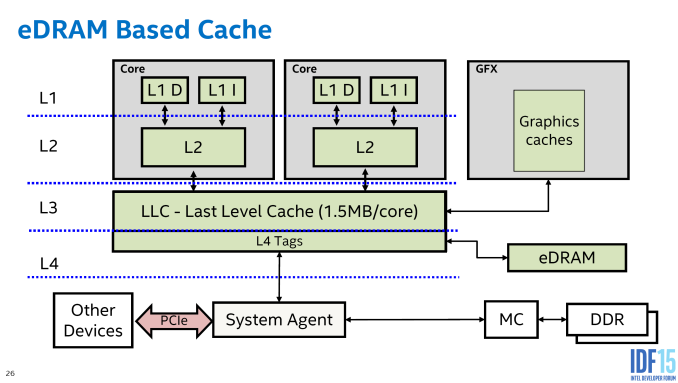
According to tests conducted by 3Dnews.ru , the latency of the eDRAM-based L4 cache is 55 cycles, and the throughput is approximately twice as high compared to the dual-channel DDR3-1866 SDRAM.
Crystalwell allows the processor to overcome the relative limitations of low system memory bandwidth and deliver better performance in HD video processing and math operations.
According to Intel's own tests (Supermicro SuperServer was used), when using Broadwell, simultaneous processing of 4368 HD video streams is possible. The same indicator when using Haswell processors is 3120. There is an increase in productivity by 40%. All S upermicro X10 series motherboards support v4 after updating the BIOS.
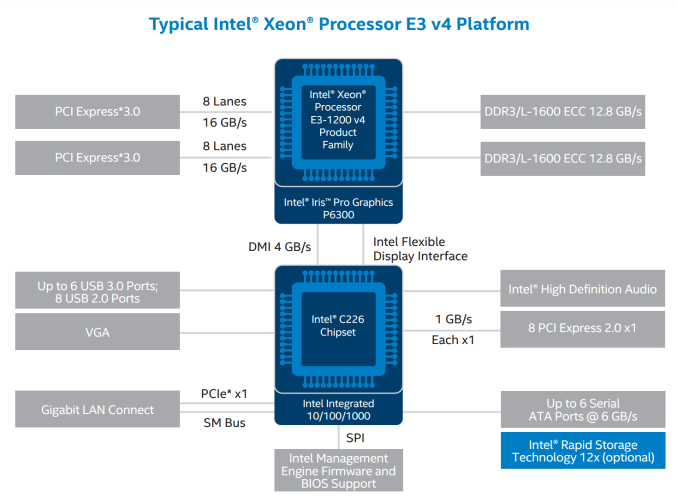
The new line of processors uses the Iris Pro Graphics graphic core , the “lite” version of which was previously only found in Haswell mobile processors. Now the Iris Pro Graphics P6300 has a GT3e configuration and 48 execution units (EU, execution units) versus 40 EU in Haswell's Iris Pro Graphics 5100 and 5200 graphics cores.
The use of Iris Pro Graphics P6300 is also a significant difference between the new Xeon and Xeon E3-1200 v3 on Broadwell: in the last line, less advanced Intel HD Graphics P4600 and Intel HD Graphics P4700 were used.
A clear advantage of the processors in question is that they are installed in the LGA1150 slot: owners of motherboards based on the Intel Z97 and Intel H97 chipset can easily upgrade the system. Formally, the new Xeon are compatible with motherboards based on the set of system logic of the eighth series on the LGA1150 socket.
Users upgrading from Haswell to Broadwell can now do this relatively cheaply. So, if the recommended Intel prices for E3-1285L v3 are $ 774, then the cost of E3-1285L v4 is $ 445.
A disadvantage for some users may be the impossibility of overclocking these processors. However, this Xeon series is a server solution, and the manufacturer offers other processors of the new line to overclocking fans.
In a series of tests conducted by www.anandtech.com , Intel Broadwell Xeon E3-1200 v4 processors showed conflicting results.
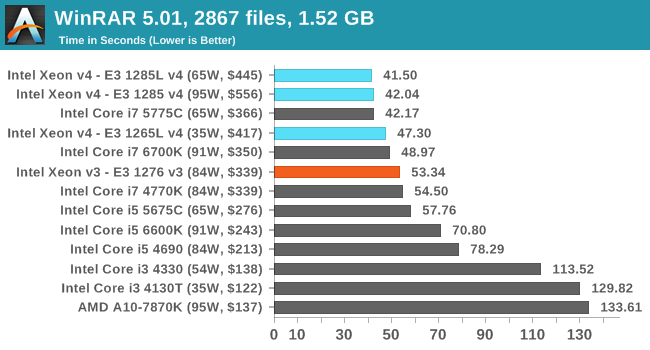
When archiving 2867 files with a total volume of 1.52 GB, the best result was shown by E3-1285L v4, overtaking even the more powerful E3-1285 v4.
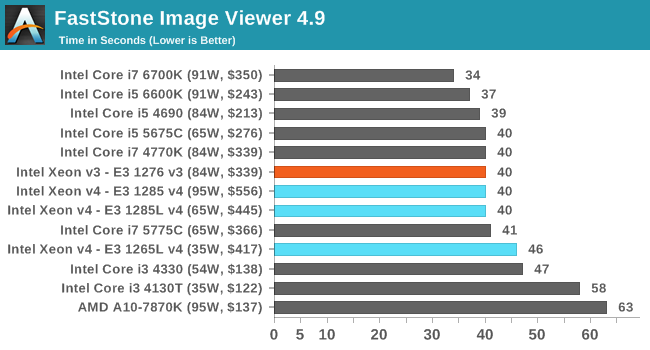
However, in other tests, Xeon lagged behind its competitors. Converting a series of 170 images using the FastStone Image Viewer v.4.9 application turned out to be a rather difficult task for the new Xeon.
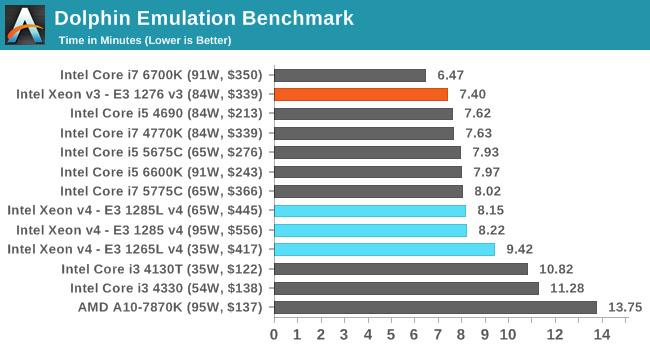
The launch of the Dolphin game console emulator showed that Intel Broadwell Xeon E3-1200 v4 is ahead of only weak processors in the development of 3D scenes.
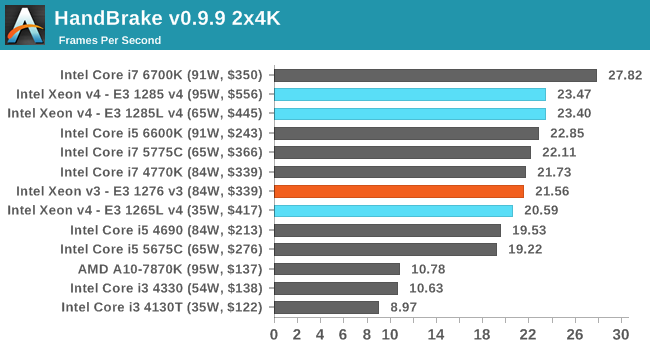
At the same time, when converting x264 video to mp4 format, Broadwell lagged behind only the Intel Core i7 6700K.
Thanks to the new eDRAM memory chip, the Intel Broadwell Xeon E3-1200 v4 line of processors outperforms older models in heavy computing tasks and HD video processing with reduced power and heat dissipation.
1) high-performance graphic stations
2) dedicated servers performing transcoding and streaming tasks without using a Tesla GPU. The new Intel processors show 40% of the performance on such tasks and can reduce the hardware overhead of transcoders. Here is a comparative performance table for Wowza online broadcast products - which processors are suitable for which tasks.
2) dedicated servers allowing virtualization of graphical applications - for this it was necessary to install Tesla or something like that before.
 We are in Hostkeywe offer dedicated servers for rent in Moscow and the Netherlands - a new type of processor for virtualizing 3D applications and streaming / video processing will appear in our country in early 2016.
For such tasks, we recommend customers to use older multi-core Xeon processors, for example, a machine in the configuration of 2 Xeon E5-2670 v2 with 20 cores at 2.5 GHz based on the T-Platform supercomputer platform and 32 GB of memory will cost 23,000 rubles per month .
Consider three new Intel Xeon E3-1200 v4 server processors on the LGA 1150 socket.
| CPU | Xeon E3-1285 v4 | Xeon E3-1285L v4 | Xeon E3-1265L v4 |
| Kernels / Threads | 4/8 | 4/8 | 4/8 |
| Hyper-Threading Technology | there is | there is | there is |
| Clock frequency | 3.5 GHz | 3.4 GHz | 2.3 GHz |
| Maximum frequency in turbo mode | 3.8 GHz | 3.8 GHz | 3.3 GHz |
| Unlocked multiplier | Not | Not | Not |
| TDP | 95 watts | 65 watts | 35 watts |
| HD Graphics | Iris Pro P6300 | Iris Pro P6300 | Iris Pro P6300 |
| GPU frequency | 1150 MHz | 1150 MHz | 1050 MHz |
| L3 cache | 6 MB | 6 MB | 6 MB |
| Integrated eDRAM | 128 MB | 128 MB | 128 MB |
| DDR3 Support | 1333/1600/1866 | 1333/1600/1866 | 1333/1600/1866 |
| VPro / TSX-NI / TXT / VT-d Technologies | there is | there is | there is |
| Instruction Set Extensions | AVX 2.0 | AVX 2.0 | AVX 2.0 |
| Socket | LGA1150 | LGA1150 | LGA1150 |
The volume of cache in the third level is reduced by 2 MB, that is, by a quarter compared to previous Xeon models. As www.anandtech.com notes , the loss of 2 MB L3 is not significant, given the advent of eDRAM with a capacity of 128 MB in L4.
What is eDRAM?
In early 2007, Intel and IBM together with AMD, Toshiba and Sony almost simultaneously announced a technology that would speed up the processors by half. To do this, it was proposed to use eDRAM (embedded DRAM), which will be used together with the technology of "silicon on the insulator" (SOI, Silicon-on-Insulator). IBM said that this will significantly accelerate the cache memory, increase its density three times and reduce power consumption by five times in idle mode of the processor. Then it was planned to use a cache of 24 MB.
Technologically, embedded DRAM is DRAM that is “embedded” in a processor, unlike SDRAM. eDRAM requires a voltage of 1 V, which is noticeably lower than the power of conventional memory. In practice, this means that eDRAM consumes less power, providing comparable performance. Smaller eDRAM cells — 0.108um² for SRAM and 0.029um² for eDRAM — will fit an order of magnitude larger than slightly slower memory cells on a chip of the same size.
Intel has not only put the famous Haswell on 14-nanometer rails. In Broadwell processors, the manufacturer used the eDRAM capabilities as fully as possible today. The manufacturer claims a 25% improvement in parameters such as power consumption and heat dissipation.
128 MB eDRAM Crystalwell acts as a fourth-level cache. Haswell had a cache of similar volume, but only in the top E7 models. At the same time, eDRAM can be used by both the graphics core and processor cores when processing large amounts of data - for example, textures. According to the manufacturer, Crystalwell provides a peak bandwidth of 51.2 GB / s in each direction (102.4 GB / s in total).
According to tests conducted by 3Dnews.ru , the latency of the eDRAM-based L4 cache is 55 cycles, and the throughput is approximately twice as high compared to the dual-channel DDR3-1866 SDRAM.
Crystalwell allows the processor to overcome the relative limitations of low system memory bandwidth and deliver better performance in HD video processing and math operations.
According to Intel's own tests (Supermicro SuperServer was used), when using Broadwell, simultaneous processing of 4368 HD video streams is possible. The same indicator when using Haswell processors is 3120. There is an increase in productivity by 40%. All S upermicro X10 series motherboards support v4 after updating the BIOS.
Video core Iris Pro Graphics
The new line of processors uses the Iris Pro Graphics graphic core , the “lite” version of which was previously only found in Haswell mobile processors. Now the Iris Pro Graphics P6300 has a GT3e configuration and 48 execution units (EU, execution units) versus 40 EU in Haswell's Iris Pro Graphics 5100 and 5200 graphics cores.
The use of Iris Pro Graphics P6300 is also a significant difference between the new Xeon and Xeon E3-1200 v3 on Broadwell: in the last line, less advanced Intel HD Graphics P4600 and Intel HD Graphics P4700 were used.
A clear advantage of the processors in question is that they are installed in the LGA1150 slot: owners of motherboards based on the Intel Z97 and Intel H97 chipset can easily upgrade the system. Formally, the new Xeon are compatible with motherboards based on the set of system logic of the eighth series on the LGA1150 socket.
Users upgrading from Haswell to Broadwell can now do this relatively cheaply. So, if the recommended Intel prices for E3-1285L v3 are $ 774, then the cost of E3-1285L v4 is $ 445.
A disadvantage for some users may be the impossibility of overclocking these processors. However, this Xeon series is a server solution, and the manufacturer offers other processors of the new line to overclocking fans.
Tests
In a series of tests conducted by www.anandtech.com , Intel Broadwell Xeon E3-1200 v4 processors showed conflicting results.
When archiving 2867 files with a total volume of 1.52 GB, the best result was shown by E3-1285L v4, overtaking even the more powerful E3-1285 v4.
However, in other tests, Xeon lagged behind its competitors. Converting a series of 170 images using the FastStone Image Viewer v.4.9 application turned out to be a rather difficult task for the new Xeon.
The launch of the Dolphin game console emulator showed that Intel Broadwell Xeon E3-1200 v4 is ahead of only weak processors in the development of 3D scenes.
At the same time, when converting x264 video to mp4 format, Broadwell lagged behind only the Intel Core i7 6700K.
To summarize
Thanks to the new eDRAM memory chip, the Intel Broadwell Xeon E3-1200 v4 line of processors outperforms older models in heavy computing tasks and HD video processing with reduced power and heat dissipation.
What are they needed for:
1) high-performance graphic stations
2) dedicated servers performing transcoding and streaming tasks without using a Tesla GPU. The new Intel processors show 40% of the performance on such tasks and can reduce the hardware overhead of transcoders. Here is a comparative performance table for Wowza online broadcast products - which processors are suitable for which tasks.
2) dedicated servers allowing virtualization of graphical applications - for this it was necessary to install Tesla or something like that before.
We are in Hostkeywe offer dedicated servers for rent in Moscow and the Netherlands - a new type of processor for virtualizing 3D applications and streaming / video processing will appear in our country in early 2016. For such tasks, we recommend customers to use older multi-core Xeon processors, for example, a machine in the configuration of 2 Xeon E5-2670 v2 with 20 cores at 2.5 GHz based on the T-Platform supercomputer platform and 32 GB of memory will cost 23,000 rubles per month .