Examples of classic code that has become Open Source

Last year, NASA published a list of software whose code they have been developing for many years. NASA has long been famous for sharing its code with the public. Other developers are not always ready to do this. At least not right away. Let's look at some examples of the classic code, which you can now see and touch.
Apollo spacecraft onboard control computer (AGC)
Apollo’s mission to the moon is rightfully considered a colossal achievement for humanity. For its implementation, no less tremendous work was done. This also applies to software developed by MIT Instrumentation Lab. AGC has been installed on both the airborne and lunar modules to provide guidance, navigation and control. In honor of the 40th anniversary of the Apollo 11 mission in 2009, the original AGC code was decrypted and scanned from old records and made publicly available.

Those who wish to familiarize themselves with the AGC code or even dig deeper into it can download it (you can also download the virtual AGC simulator) from the Google Code website: code.google.com/p/virtualagc
IBMs APLð
APL is a programming language that has inherited a mathematical notation system for manipulating arrays. It was developed by Harvard University professor Kenneth Iverson, who later influenced the development of such programming languages as J, Matlab and Mathematica. In 1962, while working for IBM, Mr. Iverson formulated and published his work in a book called A Programming Language (APL). The first implementation of APL was APLð for IBM System / 360 computers in 1966. And in 2012, IBM, together with the Museum of Computer History, released the APLð source code, containing 37,500 lines and consisting of 360 assembly languages.
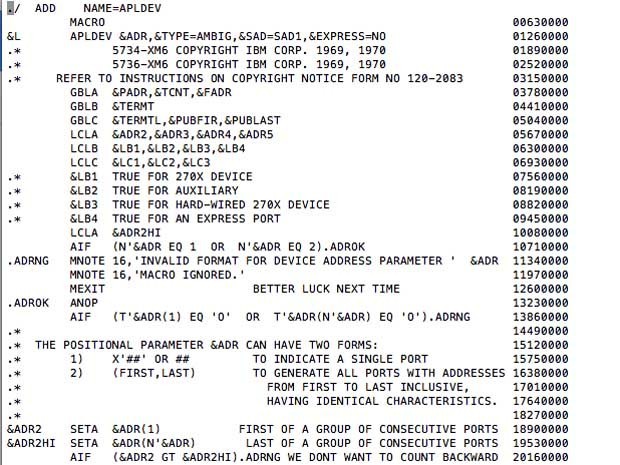
APLð source code is available for download on the Museum of Computer History website: www.computerhistory.org/atchm/apl360-software-license-agreement
Xerox Alto OS
Alto is a personal computer developed at the Palo Alto Research Center (PARC) by Xerox Corporation in 1973. He became a revolutionary invention, as he had a graphic display (black and white monitor 606x808), as well as a keyboard and mouse. An even more outstanding difference was the memory of 128 KB and the disk space of 2.5 MB, which was considered quite a lot at that time. There was also the concept of a desktop and graphical user interface. However, Alto never sold, all 1,500 copies were used exclusively within the Xerox company.

On the Museum of Computer History website you can download not only the OS, but also a lot of software and utilities developed for Alto: PUP (PARC Universal Packet) a set of inter-network protocols, Bravo is the first WYSIWYG editor and 4 programming languages (BCPL, Mesa, Smalltalk and Lisp): xeroxalto.computerhistory.org/xerox_alto_file_system_archive.html
CP / M OS
In 1979, Gary Kildall, a consultant at Intel, began developing software for floppy drive management (then still new). Soon, this development grew into a new OS for computers based on Intel's 8080 microprocessor, which he called CP / M (Control Program / Monitor, and later the Control Program for Microcomputers). Unlike other operating systems of the time, CP / M was written not in a standard programming language, but in Kildall himself. CP / M has also become the progenitor for things quite common in our time, such as 8-letter names and 3-letter file extensions. Kildall founded Digital Research, Inc. and patented its operating system, which became dominant among personal computers until the advent of DOS in the 80s.

The source code for the first 4 versions of CP / M can be downloaded from the Museum of Computer History website: www.computerhistory.org/atchm/early-digital-research-cpm-source-code
Microsoft BASIC for 6502
In 1975, MOS Technology created the 6502 microprocessor, wanting to make it a cheap alternative to other microprocessors of the time. Microsoft used the BASIC programming language, which was based on the Altair BASIC language, to run 6502. The latter was written by Bill Gates and Paul Allen in a hotel room in Albuquerque (New Mexico) for the MITS Altair 8800 microcomputer. The 6502 microprocessor was later used on many popular computers, such as Apple I and Apple II, Commodore VIC-20 and on the game console Atari 2600. Microsoft licensed BASIC for 6502 and used it to implement other systems (Commodore BASIC and Applesoft BASIC). This version of BASIC contains the famous Easter egg WAIT 6502 from Bill Gates.

You can download BASIC for 6502 from Pagetable: www.pagetable.com/?p=774
Adventure
Quest (Adventure) - a genre of video games, mostly single-player, with an interactive plot and the solution of various puzzles and tasks. One of the forefathers of this genre was the Colossal Cave Adventure (or simply Adventure), in whose honor the genre was actually named. The game was created in 1976 by William Crowther. At that time, he worked as an engineer at Bolt, Beranek & Newman. He is also one of the creators of ARPANET. Krover created a game in which the hero moved through various rooms of the cave with treasures and magic for his two daughters. The original version consisted of 700 lines of Fortran code and ran on the BB & N's PDP-10 computer. Over the years, Stanford graduate Don Woods found a copy of Adventure and, with the permission of Hoover, expanded the game to 3,000 lines of code, adding new locations and puzzles.
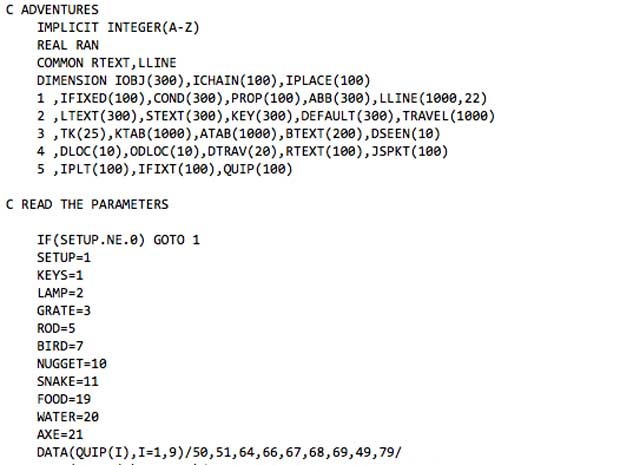
The original version of the code can be downloaded here: www.icynic.com/~don/jerz
And the version supplemented by Woods here: rickadams.org/adventure/e_downloads.html
Apple DOS 3.1
Apple II, released in 1977, used audio cassettes, not disks, for downloading additional programs and storing data. Shortly after the release of this computer, Steve Wozniak developed a controller for disks and Apple outsourced software development to Shepardson Microsystems. Developer Paul Laughton created DOS in about 35 days by writing code on punch cards. Apple DOS 3.1 was released in June 1978.

DOS 3.1 source code can be downloaded from the Museum of Computer History website: www.computerhistory.org/atchm/apple-ii-dos-source-code
MS-DOS 1.1 and 2.0
The world-famous operating system was first created for IBM's x86 personal computers. This OS was not written from scratch, but was based on previous versions, 86-DOS (written by Tim Paterson of Seattle Computer Products, after acquired by Microsoft). The first version, MS-DOS 1.1 (named after 86-DOS 1.1), was released in 1981. The source code of this OS also contains many comic words and phrases.

And you can dig into the code itself by downloading it here: www.computerhistory.org/atchm/microsoft-research-license-agreement-msdos-v1-1-v2-0
E.T. the Extra Terrestrial
ET ("Alien") became the most popular movie of the 1980s and the foundation for one of the worst games of all time. Wanting to capitalize on the popularity of the film, Atari instructed Howard Warshaw to create a game for the then popular 2600 console. The problem is that due to greed and the desire to sell as many copies of the game as possible during the Christmas holidays, Atari allocated only 5 weeks. As a result of unreasonable deadlines, the quality of the game was affected, and its sales barely exceeded 1.5 million copies, 3.5 million copies remained unrealized. In 2006, Denis Debro redesigned the game, fixing numerous bugs and adding his new components to it.

The original version of the source code can be downloaded from Pastebin: pastebin.com/AaSYZTHt
And the version modified by Debro here:www.neocomputer.org/projects/et
Wolfenstein 3D
John D. Carmack and John Romero of id Software in 1992 created a truly iconic video game that became the progenitor of many FPS - Wolfenstein 3D. Initially, the game was developed for computers based on MS-DOS, however, it reached our modern devices and was even ported to iOS. Wolfenstein 3D also gave impetus to the appearance of Doom, Duke Nukem and Quake. The Wolfenstein 3D source code along with the Spear of Destiny sequel project was published back in 1995.
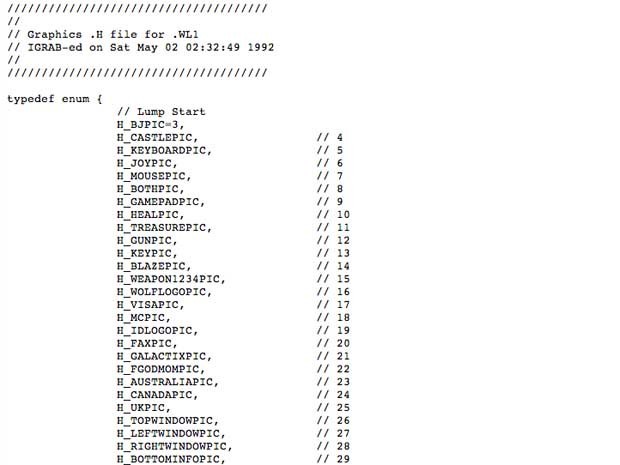
You can download it here: github.com/id-Software/wolf3d
MacPaint 1.3
MacPaint is the famous bitmap software. MacPaint was one of 2 applications available on the first Macintosh computers in January 1984 (the second is a MacWrite text application). The image editor was developed by Willy Atkinson, one of the first creators of the Macintosh, and was based on his earlier development of LisaSketch for Apple Lisa computers. MacPaint provided users with many of the functions that we already consider commonplace (fill tool, lasso image capture). In 2010, with the permission of Steve Jobs, the Museum of Computer History released the source code for MacPaint 1.3, which contains 5800 lines. Those

interested, here is the link to download this code: s3data.computerhistory.org/102658076_macpaint_acc.zip
Attention! When you click on this link, the download will start automatically.
QuickDraw
QuickDraw is a library and API for drawing raster graphics in various applications, including MacPaint. He has also been on the Macintosh from the start, from 1984. QuickDraw became obsolete only with the advent of OS X 10.4 (Tiger). And he completely resigned after the release of OS X 10.8 (Mountain Lion). Like MacPaint, it was developed by Bill Atkinson. In 2010, the source code of 17,000 lines became available to the public.
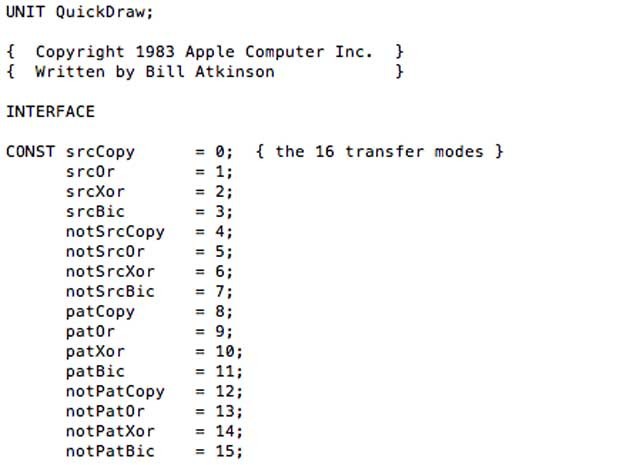
Download link: s3data.computerhistory.org/102658076_quickdraw_acc.zip
Attention! When you click on this link, the download will start automatically.
Simcity
Urban planning simulator without end, without victories and defeats - SimCity was the first of its kind. Although it was developed back in 1985 by Will Wright, the release took place only in 1989. Since the publisher was afraid that the concept of an endless and plotless game would not appeal to customers. However, we all know that they were very mistaken. SimCity became the progenitor of the genre and the inspirer of many other game projects, and was named one of the 10 most significant games in history. Don Hopkins in 2008 posted on his website the source code of SimCity, but under the name Micropolis, since the game publisher EA owns the rights to the SimCity trademark.

Download link for SimCity source code: www.donhopkins.com/home/micropolis/micropolis-activity-source.tgz
Attention! When you click on this link, the download will start automatically.
Atari 7800 ProSystem OS + games
Atari 7800 ProSystem (January 1986) became the first widely distributed game console. It was positioned as a home console, so it had the ability to connect a keyboard and other peripheral devices. As a result, less than 100 games were developed for this console. Then the port for connecting peripheral devices was removed in 1992. In 2009, the Atari Museum managed to save the source code of the operating system and several games that were flushed from floppy disks that were thrown out after the company closed in 1996.

But you can download this code here: www.atarimuseum.com/videogames/consoles/7800/games
Word for Windows 1.1a
When most people think of a text editor, they recall Microsoft Word. This software was originally developed for the DOS system in 1983 under the leadership of Charles Simoni, who also created the first Bravo WYSIWYG text processor for Xerox in 1974. Initially, Microsoft Word gave way to WordPerfect, but already in 1989, it was this text editor that appeared in Windows, which later became a monopolist on Windows OS.

The source code for Word for Windows 1.1a is available for download on the Museum of Computer History website: www.computerhistory.org/atchm/microsoft-research-license-agreement-msword-v-1-1a
Prince of Persia
Prince of Persia is a fantasy video game created under Apple II by Jordan Mekner and published in October 1989 by Brøderbund Software. The game gained its incredible popularity and commendable reviews from both critics and the players themselves due to its incredible animation. Meknerom looked through the recordings of his brother jumping and running around the parking lot, after which he transferred all these movements to the game itself. Prince of Persia has become the locomotive of many games in this series and even a full-length movie. Unfortunately, the original source code was long lost, but Metner found a pack of old floppy disks that he once decided to keep. With them, he was able to restore the code and release it in 2012.
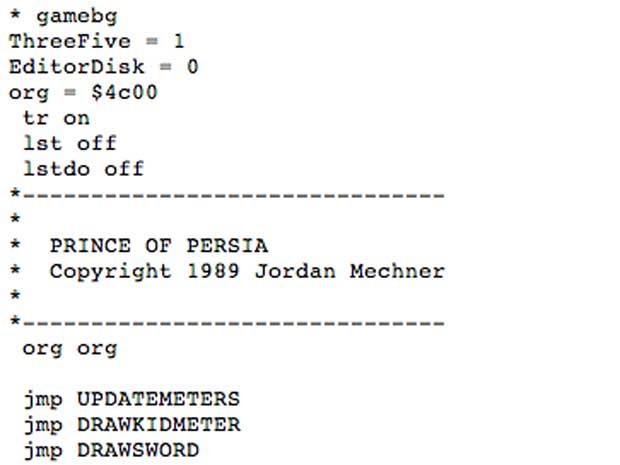
On GitHub you can download this source code: github.com/jmechner/Prince-of-Persia-Apple-II
Adobe Photoshop 1.0.1
Photoshop was developed by two brothers Thomas and John Knoll in the late 1980s. Initially, the program was simply called Display, then Image Pro. After the creators realized the full potential of their brainchild, they licensed a project called Photoshop to Adobe. Version 1.0 was released in 1990 (initially only for Mac computers). Sales totaled 3 million copies in the first 10 years. The initial version of the source code for version 1.0.1 of 128,000 lines (mostly in Pascal) became available to everyone in 2012.

Download link for Adobe Photoshop 1.0.1 source code: www.computerhistory.org/atchm/photoshop-software-license-agreement
Microsoft C # and Visual Basic
Visual Basic and Microsoft C # were developed by Microsoft in the 1991s and 2000s, respectively, as components of the .NET Framework. Wanting to share the story of its products, Microsoft provided the source code for the .NET compiler platform called Roslyn, which consisted of compilers for C # and Visual Basic.

You can download the source code from the Roslyn website: roslyn.codeplex.com/SourceControl/latest
I hope that this list was useful, because you should not forget the history (not only of civilizations, but also of programming). She can teach us a lot. It is extremely interesting to watch how this or that iconic software product was created and to dig into its “composition”.
And finally:
Always write the code as if it would be accompanied by a violent psychopath who knows where you live. (Martin Golding)