
Server Monitoring with Wiren Board NetMon-1

Hello!
We made the controller c Linux in the server rack for climate monitoring and equipment and power management and are in a hurry to share with the public.
Introduction
NetMon-1 is used for automation and monitoring tasks in racks, server and data centers. Different sensors and actuators can be connected to the controller. The controller has a built-in GSM-modem for the backup channel and SMS, and built-in batteries.
Inside the controller are Debian Linux, the mainline kernel (3.19) and our software. The platform is completely open: users have not only access to Linux, but also the source code of all the software that comes with the controller, including our own.
The wiren board NetMon-1 has been released to the open market only now, but it has been supplied to individual customers since last November. Buyers now have about 250 of these devices.
Iron
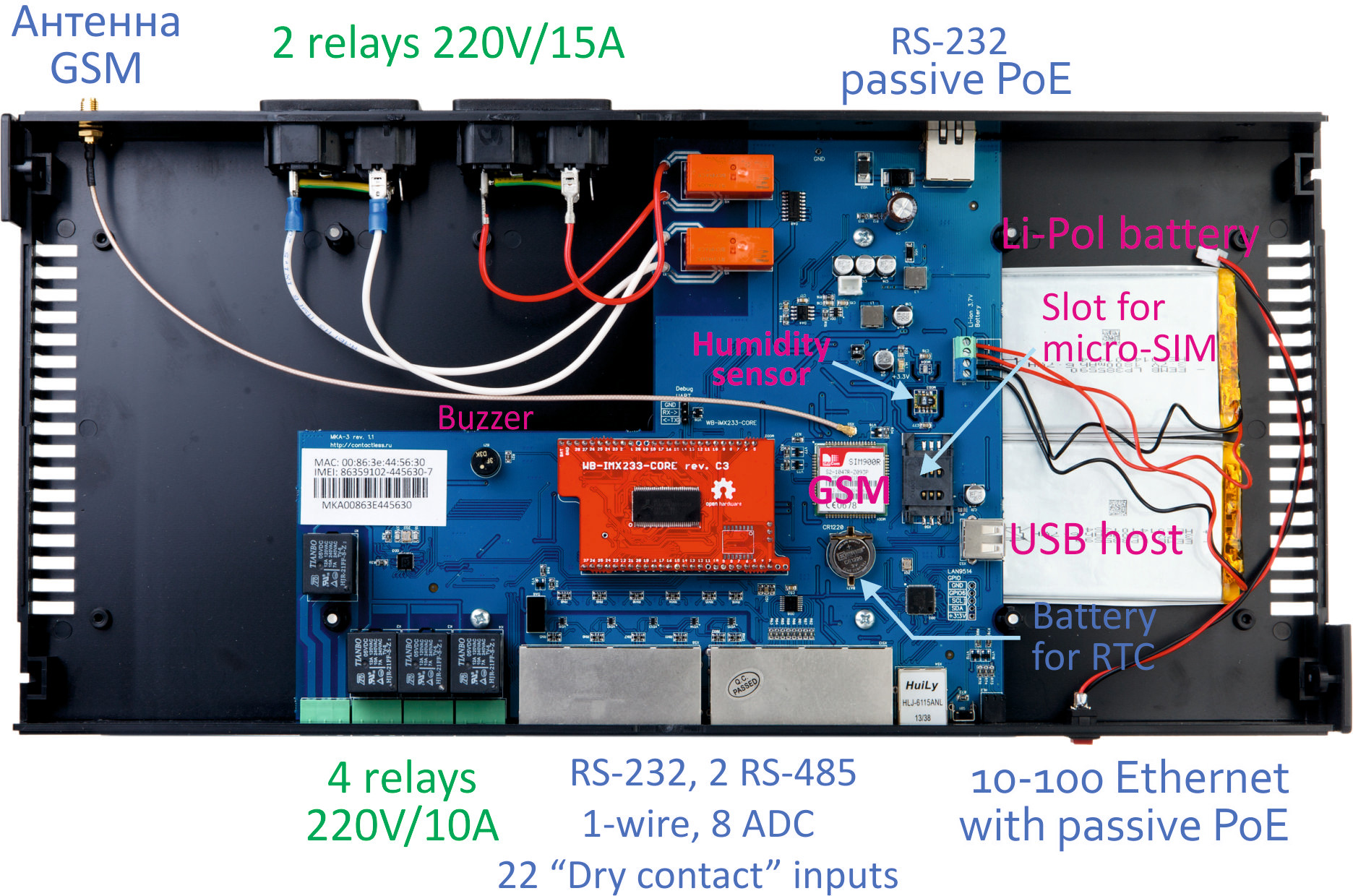
The controller is assembled in a standard 1U chassis in a 19 ”rack. The case is plastic with ventilation holes, the kit includes ears for attaching to the rack.
The hardware platform standard for Wiren Board is used: our processor module WB-IMX233-CORE with i.mx233 processor (ARM9 454MHz) and 64MB RAM. This processor is fully supported on fresh Linux and is part of the Freescale long-term availability program.
For the operating system and user data allocated 8GB flash-memory.
One Ethernet 10/100 port is displayed on the front panel of the controller, through which the controller can be powered by passive PoE (12V and 15V).
The controller is equipped with a large number of interfaces: 2 RS-485 ports, 2 RS-232 ports, 1-wire port.
To control equipment and connect sensors, there are 22 digital inputs for signals like “dry contact”, 8 analog inputs.
All interfaces and inputs are routed to 16 8P8C sockets.

The controller has a built-in GSM / GPRS modem (2G) on the SIMCOM SIM900 module. It can be used to raise a backup channel on the Internet via GPRS or to send / receive SMS.
There are outputs for switching an external load.

On the rear panel are two pairs of IEC-320-C13 / C14 connectors (plug and socket). Each pair is switched independently; up to 3 kW of load can be connected to each outlet. Upon request, a version with a common input C14 for two outputs C13 is shipped.
For switching, high-quality normally-closed relays from TE are used.
On the front panel are the outputs of four flip relays, to which you can connect up to kilowatts of load. The outputs are connected to plug-in terminal blocks.
An optional temperature and humidity sensor inside the housing is available.
In the remaining free space, lithium-ion batteries are installed. The battery life of the controller from the batteries depends on the load and capacity, and up to 7 hours on two 1800mAh banks. Batteries are charged automatically by the controller when external power is available. Additionally, protection is provided against overdischarge of cans and from charging at too high or too low a temperature.
Inside the controller there is also a USB-host port in which you can install, for example, an additional 3G modem, Wi-Fi whistle, etc. There are no restrictions on connected devices.
An important point: the controller has a hardware watchdog unit, which is independent of the main circuit and can restart the controller by power. This is a very useful feature for critical applications and use in places where machinery is difficult to travel.
Geek porn:
Supported Hardware
Due to the large number of interfaces and support in our software, many different devices can be connected to Wiren Board NetMon-1.
In general, the list almost completely coincides with the equipment supported by our controller on the DIN - Wiren Board 4. Recently, we wrote about this review article on Habr.
Below is a short list of what can be connected and what * is supported in our software * i.e. integrated with web interface, rules system, etc.
In short, you can connect:
- To digital inputs (“dry contact"):
- Equipment Status Outputs
- Water, gas, electricity meters with pulse outputs
- Reed switches, opening sensors, tamper sensors, motion sensors

- Buttons and switches
- 220V Availability Sensors
- Smoke sensors, other sensors with digital output
- To analog inputs (ADC):
- Sensors with analog voltage output
- Sensors with analog current output (with external resistor). Some 8P8C sockets immediately contain the necessary voltage source for convenience.
- Sensors with resistive output (with external resistor): electrochemical sensors of gas, smoke and air quality, thermistors
- External powered analog sensors. For example, moisture sensors on Honeywell chips from different manufacturers.
- To 1-Wire ports (you can connect many devices in parallel)
- Temperature Sensors on DS18B20 Chips
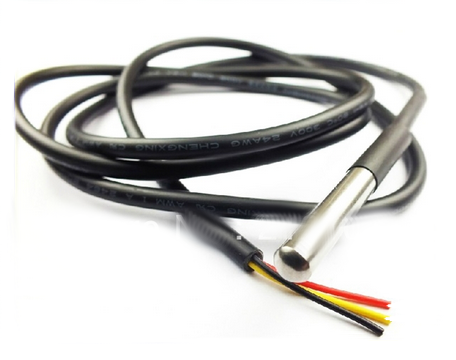
- Temperature and humidity sensors (*)
- Temperature Sensors on DS18B20 Chips
- via RS-485 ports (you can connect many devices in parallel)
- Various devices with Modbus RTU protocol, including our production
- Sensors of temperature, humidity, pressure, illumination
- Relay blocks

- Dimmers for LED strips and for incandescent lamps
- Blocks with additional dry contacts
- Electricity meters Mercury
- Blocks for sending IR signals to control the air conditioner (*)
- Via relay outputs
- Power load directly
- Managed Outlets
* - work in progress, so far without integration with the web interface
We maintain a list of tested models of devices and sensors on the wiki, many devices can be bought in our store along with the controller. Devices from other server monitoring systems are also supported.
Software
The software in the controller uses the same thing as in the version on the DIN rail - Wiren Board 4. We wrote about it on the hub
What is worth noting:
- As mentioned above, the controller is running Debian Linux. It uses the standard Debian repository and, in addition, our repository with our software. You can install any packages from the standard Debian repository, you can update ours - all this is done through the usual apt-get.
The distribution is used fully, no uClibc and other openwrt.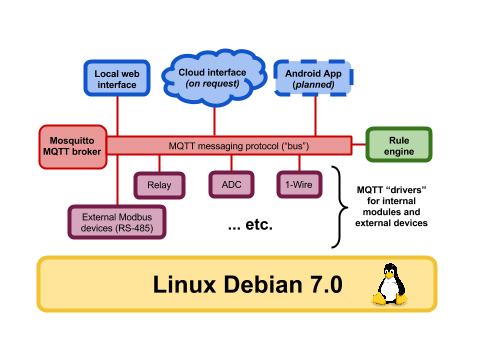
- There are “drivers” of devices. All external devices and integrated peripherals, as described above, have their own “drivers” on our controller. As a result, each device appears in a uniform way in our internal interface - the MQTT bus (for more details, see the documentation ).
This means that you can receive data (for example temperature) in any standard way from any device, regardless of the type and method of connection. The same applies to device management - the commands to turn on the relay are the same, whether it is a relay connected via radio, a built-in relay or a relay on an expansion module connected via RS-485.
It also means adding support for an arbitrary monitoring system, SCADA system, etc. very simple. To communicate with the MQTT bus, there are binders for almost all languages, including those that can be requested / sent using simple console commands. - There is a built-in web interface in which all physical devices and their channels are displayed. In the interface, you can create rooms, dashboards, widgets, etc.

- There is a system of rules that allows you to write arbitrary scripts in JavaScript. Scripts work with events coming from devices.
- There is a “cloud interface” that allows you to do everything the same as the local one. In testing, the ability to connect multiple controllers to a single interface.
- There is a ready integration with Zabbix - any parameter from the internal system can be requested from Zabbix.
Conclusion
The controller costs 14,000 rubles. as standard, you can buy in our store .
Wiren Board NetMon-1 - this is our first experience in server devices, although confirmed by the six months of operation of several hundred devices. Therefore, we will traditionally be happy to receive comments and suggestions both on software capabilities and peripheral device support, as well as on the iron part.