Qucs project news: preparations for release 0.0.19
Qucs is an open source electronic circuit simulator. My previous article on Habr tells about it .
Now our project is preparing for the next release 0.0.19, which will be released before September 1 of this year. Since the previous release (September 1, 2014), 6 developers made more than 700 commits. This note provides a brief overview of the expected innovations.
Download snapshots of the pre-release version here:
- Source code (all Linux, MacOS, Windows platforms):
sourceforge.net/projects/qucs/files/qucs/0.0.19-snapshots - Installer for Windows:
sourceforge.net/projects/qucs/files/qucs-binary/0.0.19-snapshots
Snapshots are not recommended for use in everyday work! This is a test version! To work, use the stable version 0.0.18.
Report bugs found in our bugtracker: github.com/Qucs/qucs/issues
Under cat, a brief overview of the changes.
Here is a short list of changes. After the release, there will be a detailed article describing all the innovations.
- A new tool for synthesizing active filters has been added. The low-pass filter, high-pass filter, band-pass and band-stop filters of Chebyshev, Butterworth, Cauer and filter with approximation of the frequency response specified by the user are supported. Circuitry is available for Sallen-Key links, with multi-loop OS and Cauer filter links. The filter scheme can be calculated, copied to the system clipboard and pasted into Qucs to perform a simulation.
This utility looks like this:
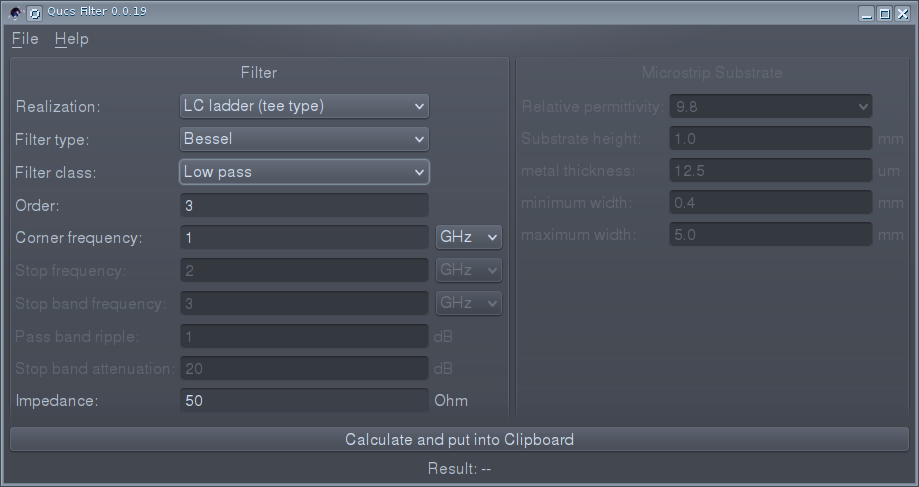
- Modified utility for the synthesis of passive filters. New link topologies have been added: microstrip filters with various link linking methods. The utility window now looks like this:
- A new component has been added: inductively coupled coils with a configurable number of coils. It can be used in circuits if 2 or 3 connected coils are not enough. The component looks like this:

- Slowly but surely we continue porting to Qt4
- The project is fully translated into C ++ 11
- Closed more than 50 bug reports
- Prepared to merge with the main branch subsystem Spice4Qucs . This is one of the most anticipated project innovations in recent years. This subsystem allows you to simulate Qucs schemes using external spice-compatible open-source simulators ngspice and Xyce. Xyce has a version for parallel computing through openMPI. No modification of the circuit is required for this. At the same time, compatibility with previous versions of Qucs will be fully preserved. Special components will be added, with which it will be possible to directly connect models of semiconductor components in the Spice format. Additional Ngpsice simulation types (Fourier, Distortion, and Noise) will also be available, which can be used in addition to the standard Qucs simulations. To process the results, you can connect the Ngnutmeg postprocessor. Here is an example of the scheme that Spice4Qucs allows to implement: Spice4Qucs

subsystem is not yet included in the main branch and therefore it is not in snapshots. To test Spice4Qucs, you need to independently build an unstable branch from the sources:github.com/Qucs/qucs/tree/spice4qucs . You can read more about the development of spice4qucs here: github.com/Qucs/qucs/issues/77