Import Substitution Part 2. Huawei OceanStor Family
Today, there is a slight mess in the Hauwei disk array market. This is due to the fact that in less than a year, Huawei announced as many as 2 new generations of storage systems, while leaving a number of solutions from previous lines on the market. Moreover, the difference between generations is quite significant.
Therefore, I decided to talk about the current offers of Huawei to clarify this issue.
So, now there are 3 different generations of Huawei OceanStor storage systems on the market.

From the first generation there was a budget array Entry level OceanStor S2200T V1.
The second generation is represented by the Low-end array OceanStor S2600T V2.
And the Mid-range begins with the third generation - an updated line of OceanStor 5300 V3 and higher.
Apart is the 18000 High-end line, which has not yet received an update in the third generation. However, the youngest of the High-end OceanStor 18500 V2 turned out to be equal to the new OceanStor 6800 V3 mid-range border array, which will gradually displace it from the Huawei lineup.
Let's see how it all began, and where it all came to.
The first generation OceanStor was a fairly balanced line of block arrays with a weak functional component: the
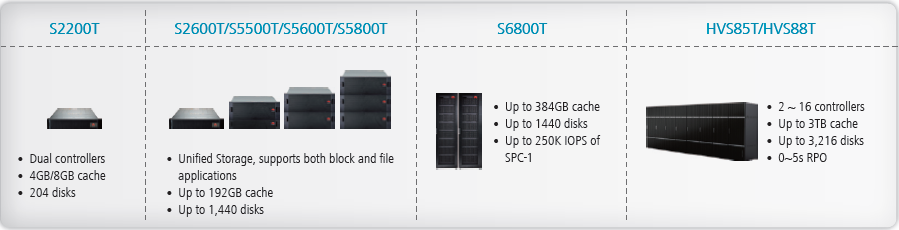
S2600T V1, S5500T V1, S5600T V1 and S5800T V1 models were unified, i.e. it was possible to configure them with file access. This was carried out according to the most common scheme - using a separate file head (File Engine). The file head was a fail-safe bunch of duplicated servers with a total height of 4U.
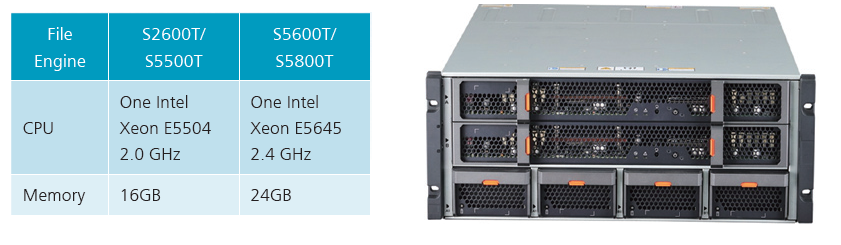
This approach to building unified arrays was superior in terms of performance compared to the “honest unifide” (for example, EMC VNXe3200, NetApp) due to scalability, however, it lost in terms of budgeting and banal saving of rack space.
From the point of view of functionality, the first generation lagged behind modern market leaders - there was no multi-level peering, partition, etc. Therefore, Hauwei decides to update the lineup, releasing the second generation of arrays.
In fact, the second generation differs from the first only in updated microcode. Having rewritten it from scratch, they significantly expanded the functionality of their storage systems, but made extremely illogical restrictions:
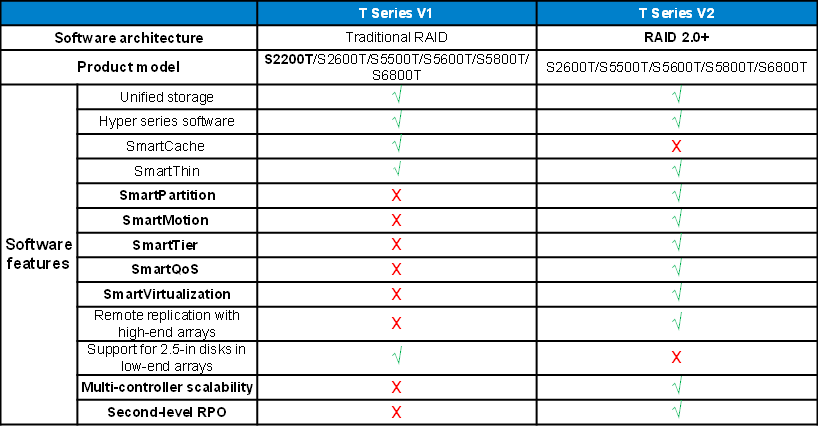
The main feature of the second generation was the updated approach to organizing disk spaces - RAID 2.0+ technology.
And do not let the name confuse you - this technology has nothing to do with RAID levels It has. In essence, this is the virtualization of system disks for organizing a single pool. In the future, this pool is divided into chunks, chunk groups and extents, from which classic LUNs are already assembled. HP uses a similar approach in its 3Par and Hitachi systems in HUS.

The obvious advantages of this approach include:
• Uniform load distribution between physical media.
• Acceleration of data recovery from checksums in case of media failure.
• Acceleration of expansion of pools and rebuilding of RAID groups in case new media is added to the system.
• Changing the type of partition (multi-level / single-level) "on the fly"
From the added functionality, you can select:
• SmartPartition - allocation of isolated pieces of cache memory for selected partitions.
• SmartTier - tiered data storage. Automatic "vertical" data migration between disks of different levels (7.2k, 10 / 15k, SSD) based on statistics of the frequency of access to them.
• SmartMotion - “horizontal” data migration between physical media and load balancing. In fact, without this license all the above advantages of RAID 2.0+ technology will not be available.
• SmartQoS - Quality of Service. Prioritizing your sections based on the criticality of hosted applications. Depending on the priority set, the system will guarantee the allocation of cache to this section or, conversely, limit the memory consumption of this section.
• SmartVirtualization - virtualization of arrays of third-party vendors according to the compatibility list.
Adding this functionality increased the load on computing resources, which remained the same from the first generation. Therefore, the OceanStor S2200T V1 Entry Array remained in the first generation, since it did not physically pull the updated microcode, and the S2600T V2 Array is now available for order only in a configuration with 16 Gb cache.
However, Huawei decided not to throw the S2200T V1 agonize. Instead, they updated the design by adding the ability to order a 24 * 2.5 "configuration with 8 * 8 Gbit / s FC to the existing 12 * 3.5" controller configuration with 12 * 1 GE iSCSI ports. The ability to order a controller with pre-installed FC ports brought this solution back to the market, making it competitive due to its low cost.
The flip side of the coin was the removal of SmartCache functionality (cache expansion due to SSD-drives) and the rejection of the use of 2.5 "SFF disks in the OceanStor S2600T V2 array. I did not find any reasonable reasons for this.
Using the" old "hardware and the lack of expandability cache - was a clear disadvantage of Huawei arrays. And, the lack of 2.5 "drives in the S2600T array generally kicked him out of the market.
Therefore, in December 2014, Huawei announced a new third generation of its unified storage systems OceanStor V3.
The third generation is a global update of the entire lineup. In addition to the new hardware and functionality, Huawei decided to change the approach to organizing unified access. They abandoned separate file nodes, organizing file access at the expense of the resources of the block controller.
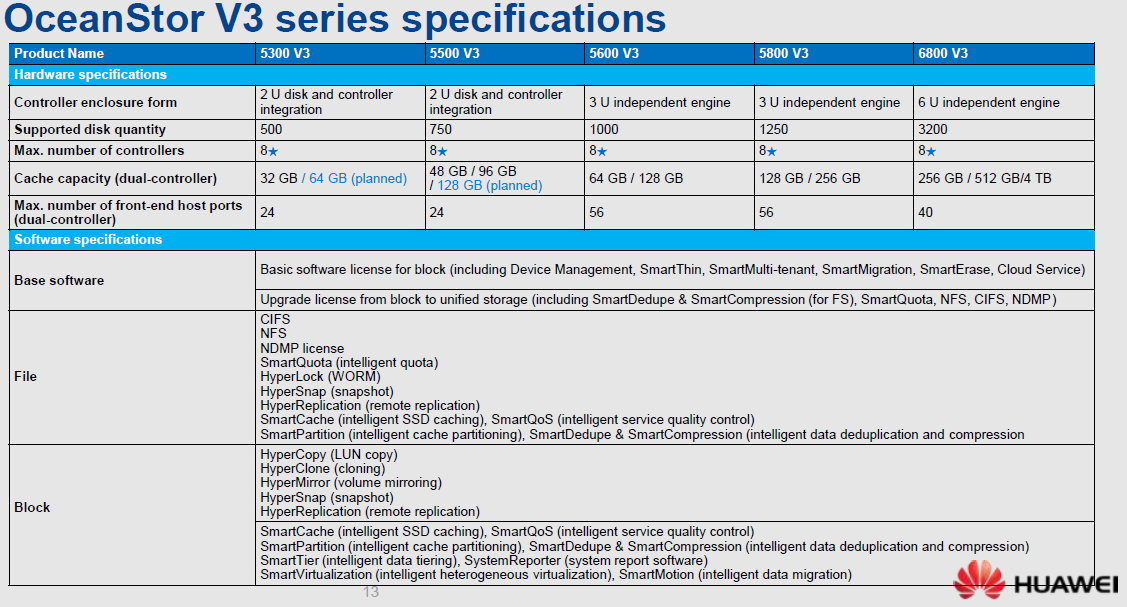
In addition to this global change, the functionality has also been updated:
• Deduplication implemented on the basis of ASICs.
• SmartErase function (“annihilation” of recorded data) to comply with safety procedures and regulations.
• SmartMigration function - one-time migration of all data from a legacy array to a newly acquired Huawei array.
The licensing model has also changed: the functionality of SmartThin, SmartMulti-tenant, SmartMigration, SmartErase are included in the database (purchased with the array).
With a license upgrade to a unified solution, file dedup and compression will be added to the basic functionality.
Software bundles appeared:
• Data Protection Software suit: includes HyperSnap, HyperCopy, HyperClone, HyperMirror.
• Storage efficieny Software suit: includes SmartCache and SmartTier.
When buying bundles, savings of about 30% are declared compared to the “piece-wise” acquisition of licenses.
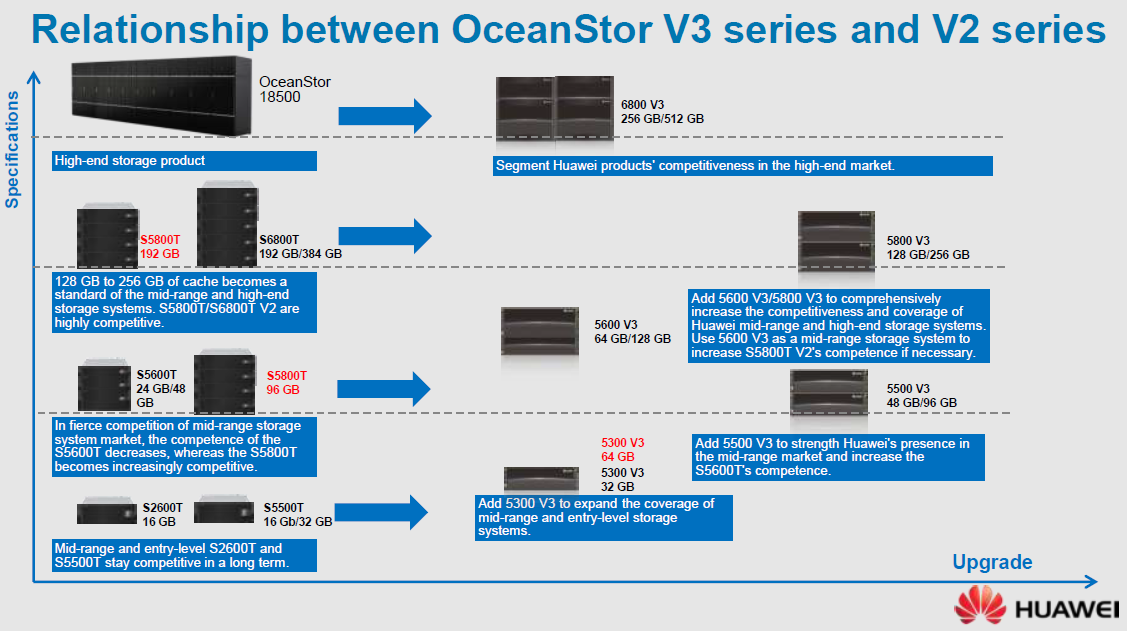
With the update of iron, the computing power of the models has changed, therefore, and market positioning has been slightly changed.
So, for example, OceanStor 6800 V3 became a full High-end, replacing OceanStor 18500 V2.
As already mentioned, deduplication and compression will appear in the third generation. They will be implemented by separate ASIC modules, which will take the burden of calculating fingerprints. However, the meta-data will still be stored in the controller’s cache, so when a large number of functions is activated, the cache will be a thin spot.
Updates touched and input / output ports. The interfaces appeared 16Gbit / s FC, 10 Gbit / s iWARP (scale-out LAN), as well as the back-end 12 Gbit / S SAS.
And, once again, Huawei did not listen to the market and did not release a 2U shelf for 3.5 "disks, the absence of which is a noticeably weak point of the entire OceanStor family. The currently existing 24 * 3.5" 4U shelf has just a terrible placement density (you need to place 5 3.5 "drives - buy a 4U shelf). This is especially surprising against the background of the release of the high density shelf: High density 75 * 3.5" 4U.
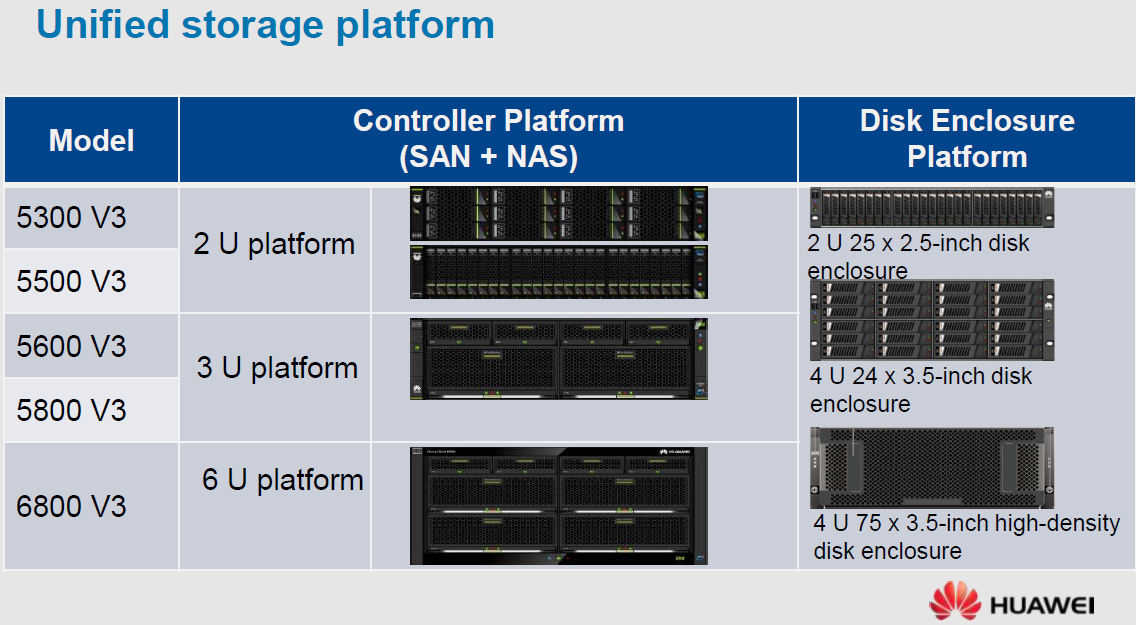
A very controversial update that is present in the third generation is the support of 8 controller configurations for all models, including the junior mid-range 5300 V3. It seems to me that this will be implemented as a connection of four 2 controller pairs through 10 GE.
And the most interesting, at the moment, OceanStor V3 arrays are already available for order, but so far with an incomplete list of updates:
• file access as such is completely absent;
• while deduplication and compression modules are not available for order;
• there is no 8-controller configuration (at the moment - only 2-controller configuration).
In this regard, Huawei has left the second generation OceanStor V2 available for order, so as not to limit its customers in the use of unified solutions. However, the release date for V2 is December 2015.
All unrealized, but declared functionality, Huawei promise to release gradually by the end of this year. And, as an addition - the re-release of the S2200T V1 and S2600T V2 based on the third generation is announced. What they will represent is not yet clear.
Summing up the available information, in terms of choosing a solution for specific projects, I can advise:
1. In cases where the fundamental factor in choosing a solution is the price for 1GB of stored data, and the functionality is not needed - it is worth using the S2200T V1 as the most budget solution.
2. S2600T hung in a market vacuum, not finding its niche.
3. If you need functionality and high performance with block access - you can safely consider the third generation of OceanStor.
4. If your tasks require file access “out of the box” - then you will have to turn to the second generation and their file nodes.
Therefore, I decided to talk about the current offers of Huawei to clarify this issue.
So, now there are 3 different generations of Huawei OceanStor storage systems on the market.
From the first generation there was a budget array Entry level OceanStor S2200T V1.
The second generation is represented by the Low-end array OceanStor S2600T V2.
And the Mid-range begins with the third generation - an updated line of OceanStor 5300 V3 and higher.
Apart is the 18000 High-end line, which has not yet received an update in the third generation. However, the youngest of the High-end OceanStor 18500 V2 turned out to be equal to the new OceanStor 6800 V3 mid-range border array, which will gradually displace it from the Huawei lineup.
Let's see how it all began, and where it all came to.
First generation
The first generation OceanStor was a fairly balanced line of block arrays with a weak functional component: the
S2600T V1, S5500T V1, S5600T V1 and S5800T V1 models were unified, i.e. it was possible to configure them with file access. This was carried out according to the most common scheme - using a separate file head (File Engine). The file head was a fail-safe bunch of duplicated servers with a total height of 4U.
This approach to building unified arrays was superior in terms of performance compared to the “honest unifide” (for example, EMC VNXe3200, NetApp) due to scalability, however, it lost in terms of budgeting and banal saving of rack space.
From the point of view of functionality, the first generation lagged behind modern market leaders - there was no multi-level peering, partition, etc. Therefore, Hauwei decides to update the lineup, releasing the second generation of arrays.
Second generation
In fact, the second generation differs from the first only in updated microcode. Having rewritten it from scratch, they significantly expanded the functionality of their storage systems, but made extremely illogical restrictions:
The main feature of the second generation was the updated approach to organizing disk spaces - RAID 2.0+ technology.
And do not let the name confuse you - this technology has nothing to do with RAID levels It has. In essence, this is the virtualization of system disks for organizing a single pool. In the future, this pool is divided into chunks, chunk groups and extents, from which classic LUNs are already assembled. HP uses a similar approach in its 3Par and Hitachi systems in HUS.
The obvious advantages of this approach include:
• Uniform load distribution between physical media.
• Acceleration of data recovery from checksums in case of media failure.
• Acceleration of expansion of pools and rebuilding of RAID groups in case new media is added to the system.
• Changing the type of partition (multi-level / single-level) "on the fly"
From the added functionality, you can select:
• SmartPartition - allocation of isolated pieces of cache memory for selected partitions.
• SmartTier - tiered data storage. Automatic "vertical" data migration between disks of different levels (7.2k, 10 / 15k, SSD) based on statistics of the frequency of access to them.
• SmartMotion - “horizontal” data migration between physical media and load balancing. In fact, without this license all the above advantages of RAID 2.0+ technology will not be available.
• SmartQoS - Quality of Service. Prioritizing your sections based on the criticality of hosted applications. Depending on the priority set, the system will guarantee the allocation of cache to this section or, conversely, limit the memory consumption of this section.
• SmartVirtualization - virtualization of arrays of third-party vendors according to the compatibility list.
Adding this functionality increased the load on computing resources, which remained the same from the first generation. Therefore, the OceanStor S2200T V1 Entry Array remained in the first generation, since it did not physically pull the updated microcode, and the S2600T V2 Array is now available for order only in a configuration with 16 Gb cache.
However, Huawei decided not to throw the S2200T V1 agonize. Instead, they updated the design by adding the ability to order a 24 * 2.5 "configuration with 8 * 8 Gbit / s FC to the existing 12 * 3.5" controller configuration with 12 * 1 GE iSCSI ports. The ability to order a controller with pre-installed FC ports brought this solution back to the market, making it competitive due to its low cost.
The flip side of the coin was the removal of SmartCache functionality (cache expansion due to SSD-drives) and the rejection of the use of 2.5 "SFF disks in the OceanStor S2600T V2 array. I did not find any reasonable reasons for this.
Using the" old "hardware and the lack of expandability cache - was a clear disadvantage of Huawei arrays. And, the lack of 2.5 "drives in the S2600T array generally kicked him out of the market.
Therefore, in December 2014, Huawei announced a new third generation of its unified storage systems OceanStor V3.
Third generation
The third generation is a global update of the entire lineup. In addition to the new hardware and functionality, Huawei decided to change the approach to organizing unified access. They abandoned separate file nodes, organizing file access at the expense of the resources of the block controller.
In addition to this global change, the functionality has also been updated:
• Deduplication implemented on the basis of ASICs.
• SmartErase function (“annihilation” of recorded data) to comply with safety procedures and regulations.
• SmartMigration function - one-time migration of all data from a legacy array to a newly acquired Huawei array.
The licensing model has also changed: the functionality of SmartThin, SmartMulti-tenant, SmartMigration, SmartErase are included in the database (purchased with the array).
With a license upgrade to a unified solution, file dedup and compression will be added to the basic functionality.
Software bundles appeared:
• Data Protection Software suit: includes HyperSnap, HyperCopy, HyperClone, HyperMirror.
• Storage efficieny Software suit: includes SmartCache and SmartTier.
When buying bundles, savings of about 30% are declared compared to the “piece-wise” acquisition of licenses.
With the update of iron, the computing power of the models has changed, therefore, and market positioning has been slightly changed.
So, for example, OceanStor 6800 V3 became a full High-end, replacing OceanStor 18500 V2.
As already mentioned, deduplication and compression will appear in the third generation. They will be implemented by separate ASIC modules, which will take the burden of calculating fingerprints. However, the meta-data will still be stored in the controller’s cache, so when a large number of functions is activated, the cache will be a thin spot.
Updates touched and input / output ports. The interfaces appeared 16Gbit / s FC, 10 Gbit / s iWARP (scale-out LAN), as well as the back-end 12 Gbit / S SAS.
And, once again, Huawei did not listen to the market and did not release a 2U shelf for 3.5 "disks, the absence of which is a noticeably weak point of the entire OceanStor family. The currently existing 24 * 3.5" 4U shelf has just a terrible placement density (you need to place 5 3.5 "drives - buy a 4U shelf). This is especially surprising against the background of the release of the high density shelf: High density 75 * 3.5" 4U.
A very controversial update that is present in the third generation is the support of 8 controller configurations for all models, including the junior mid-range 5300 V3. It seems to me that this will be implemented as a connection of four 2 controller pairs through 10 GE.
And the most interesting, at the moment, OceanStor V3 arrays are already available for order, but so far with an incomplete list of updates:
• file access as such is completely absent;
• while deduplication and compression modules are not available for order;
• there is no 8-controller configuration (at the moment - only 2-controller configuration).
In this regard, Huawei has left the second generation OceanStor V2 available for order, so as not to limit its customers in the use of unified solutions. However, the release date for V2 is December 2015.
All unrealized, but declared functionality, Huawei promise to release gradually by the end of this year. And, as an addition - the re-release of the S2200T V1 and S2600T V2 based on the third generation is announced. What they will represent is not yet clear.
In the dry residue
Summing up the available information, in terms of choosing a solution for specific projects, I can advise:
1. In cases where the fundamental factor in choosing a solution is the price for 1GB of stored data, and the functionality is not needed - it is worth using the S2200T V1 as the most budget solution.
2. S2600T hung in a market vacuum, not finding its niche.
3. If you need functionality and high performance with block access - you can safely consider the third generation of OceanStor.
4. If your tasks require file access “out of the box” - then you will have to turn to the second generation and their file nodes.