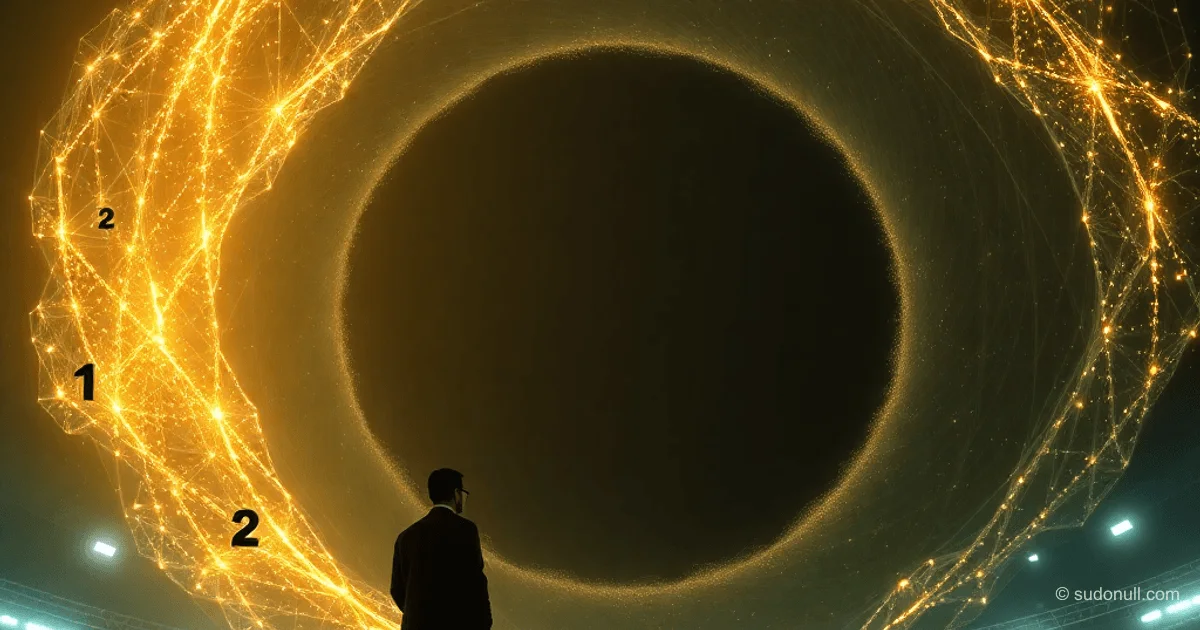
Prime Gases and Prime Numbers in Black Hole Singularities
Prime numbers, the fundamental building blocks of number theory, manifest in chaotic processes near black hole singularities. Research in 2025 revealed that the spectra of quantum systems near these points organize according to the logarithms of prime numbers, forming so-called prime gases. This discovery links the Riemann Hypothesis with quantum gravity, offering new mathematical tools for describing gravitational collapse.
Black hole singularities represent regions of infinite curvature, where general relativity predicts fractal chaos. Similar chaos is found in the fluctuations of the zeros of the Riemann zeta function, confirming a fundamental connection between number theory and high-energy physics.
The Riemann Hypothesis and Primon Particles
The Riemann Hypothesis, formulated in 1859, states that the non-trivial zeros of the zeta function lie on the critical line with a real part of 1/2. This function precisely estimates the distribution of prime numbers: ζ(s) = ∑ 1/n^s for Re(s) > 1, analytically continued across the entire complex plane.
In the 1980s, Bernard Julia proposed hypothetical primon particles with energy levels E_p = log p, where p is a prime number. The distribution function of a primon gas coincides with 1/ζ(s), modeling prime number statistics through a quantum system.
Researchers Yan Fedorov, Gait Hiyari, and John Keating proved in 2025 that the fractal chaos of zeta function zeros arises from quantum fluctuations similar to those predicted by general relativity near singularities.
Conformal Symmetry and the Primon Spectrum
In a February 2025 preprint, Sean Hartnoll and Ming Yang from Cambridge applied AdS/CFT duality to analyze spacetime near a singularity. In the conformal field theory on the boundary, they discovered scale invariance reminiscent of Escher fractals.
This symmetry leads to a quantum system with a spectrum organized by prime numbers—a conformal primon cloud. Mathematically, the spectrum is defined as discrete levels corresponding to log p_n.
- Key properties of the conformal primon gas:
- Energy levels: log p, where p is a prime number.
- The zeta function as a state distribution function.
- Fractal chaos from the zeros of ζ(s).
- Scale invariance near the singularity.
Five months later, the analysis was extended to five dimensions. The additional dimension introduced complex prime numbers—Gaussian primes in the ring Z[i]. These numbers of the form a + bi, where a and b are integers, are indivisible in the complex plane.
Complex Primon Gases in Higher Dimensions
In the five-dimensional model, the dynamics of the singularity require Gaussian primes to describe the spectrum. The authors introduced a complex primon gas, where levels E = log |π|, with π being a Gaussian prime.
Examples of Gaussian primes:
- 1 + i (norm 2).
- 2 + i (norm 5).
- 1 + 2i (norm 5).
Hartnoll notes an intriguing connection: the randomness in prime number distribution within singularities may point to deep structures of quantum gravity in higher dimensions.
Erik Perlmutter, in late 2025, generalized the zeta function to all real numbers, including irrational ones. This extension, the q-analogue ζ_q(s), enhances applicability to AdS/CFT and other approaches to quantum gravity.
John Keating emphasizes: reviewing from this new perspective opens pathways to solving problems that previously seemed insurmountable.
Key Takeaways
- Prime numbers organize the quantum spectrum near black hole singularities through primon gases.
- The Riemann Hypothesis manifests in the fractal chaos of general relativity.
- In five dimensions, Gaussian primes are introduced for a complex primon gas.
- Generalizing the zeta function to real numbers strengthens quantum gravity models.
- The link between number theory and physics offers a new language for fundamental laws.
— Editorial Team










No comments yet.