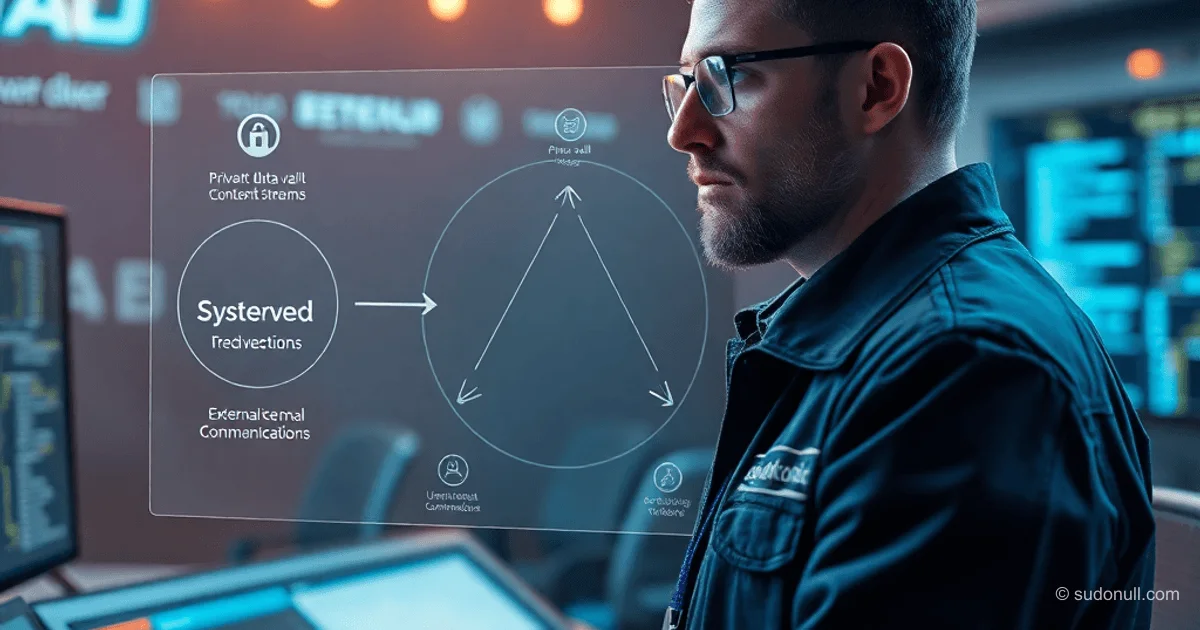
Securing Agentic Apps: OWASP Top 10 and the Lethal Trifecta Model
Agentic apps handle planning, tool calls, memory storage, and inter-agent communication with real-world side effects. Security demands strict trust boundaries, limited autonomy, and rigorous architecture checks. The OWASP Agentic Top 10 for 2026 spotlights key risks, while the Lethal Trifecta model uncovers catastrophic combos: private data + untrusted inputs + external outreach.
The Lethal Trifecta Model for Audits
The Trifecta is a simple checklist to spot risks: private data (databases, secrets), untrusted inputs (web content, emails), and outbound channels (HTTP, email). When all three align, indirect prompt injection can trigger leaks. Strategy: break at least one link or add ironclad controls.
- Private data: Just-in-time access, short-lived tokens, data minimization.
- External communication: Domain allowlists, DLP, human-in-the-loop for outbound.
- Untrusted content: Source tagging, data/control separation, policy gates.
- Persistent memory: TTLs, trust scoring, per-tenant namespaces.
Scan for Trifecta in every review: unrestricted access? Time to redesign.
OWASP Agentic Top 10: Risks and Mitigations
ASI01 Agent Goal Hijack. Attack: Indirect injection via tool outputs. Defense: Policy gates, high-impact approvals, goal-drift logging, source tagging.
ASI02 Tool Misuse. Attack: Malicious params in chains. Defense: Tool allowlists, blast radius limits, chain correlation.
ASI03 Identity Abuse. Attack: Token reuse, transitive privileges. Defense: JIT tokens, task-scoped perms, revalidation.
ASI04 Supply Chain. Attack: Descriptor compromise. Defense: Version pinning, artifact signing, source allowlists.
ASI05 Unexpected RCE. Attack: Eval injection. Defense: Execution isolation, no-net by default, generate/execute split.
Deep Dive: Memory and Communication Threats
ASI06 Memory Poisoning. Attack: RAG poisoning for lasting impact. Defense: Tenant segmentation, TTLs, quarantine rollback.
ASI07 Inter-Agent. Attack: Spoofing, replays. Defense: mTLS, message signing, nonce/timestamps.
ASI08 Cascading Failures. Attack: Error propagation. Defense: Planner/executor split, circuit breakers, lineage logs.
ASI09 Human Trust. Attack: Consent laundering. Defense: Diff approvals, multi-step confirms.
ASI10 Rogue Agents. Attack: Goal drift. Defense: Kill switches, behavioral baselines, periodic reviews.
Entry points: User input, RAG, tools. Planning sets goals, memory builds trust, inter-agent needs solid protocols.
Real-World Production Scenarios
Corporate Email/Document Agent (ASI01-03,09).
Risks: Emails as instructions, privilege creep, operator bias.
Mitigations:
- Split read from act.
- Explicit outbound approval.
- Action lineage tracking.
RAG Agent with Knowledge Base (ASI06,08).
Risks: Untrusted ingest, gradual poisoning.
Mitigations:
- Source-based trust scoring.
- TTLs and rollback.
- Tenant isolation.
Tool Orchestrator (ASI02,04,05,07,10).
Risks: Malicious tool calls, supply chain attacks, cascades.
Mitigations:
- Per-tool operation allowlists.
- Provenance checks.
- Quotas and policy gates.
Implementation Roadmap
Phase 1: Inventory (Trifecta audit), lock down egress, enable logging.
Phase 2: Policy gates, JIT tokens, high-impact approvals.
Phase 3: Memory segmentation, lineage tracing, incident response (kill switches).
This phased approach cuts risks without a full rewrite.
Key Takeaways
- Trifecta breaks deadly chains: minimize at least one factor.
- OWASP Top 10 targets data-to-instruction-to-action handoffs.
- Injection detectors are extras—architecture is king.
- Lineage monitoring and anomaly detection are musts for cascades.
- Behavioral baselines and kill switches handle rogue agents.
— Editorial Team










No comments yet.