Relational Physics Resolves Kant's Antinomies
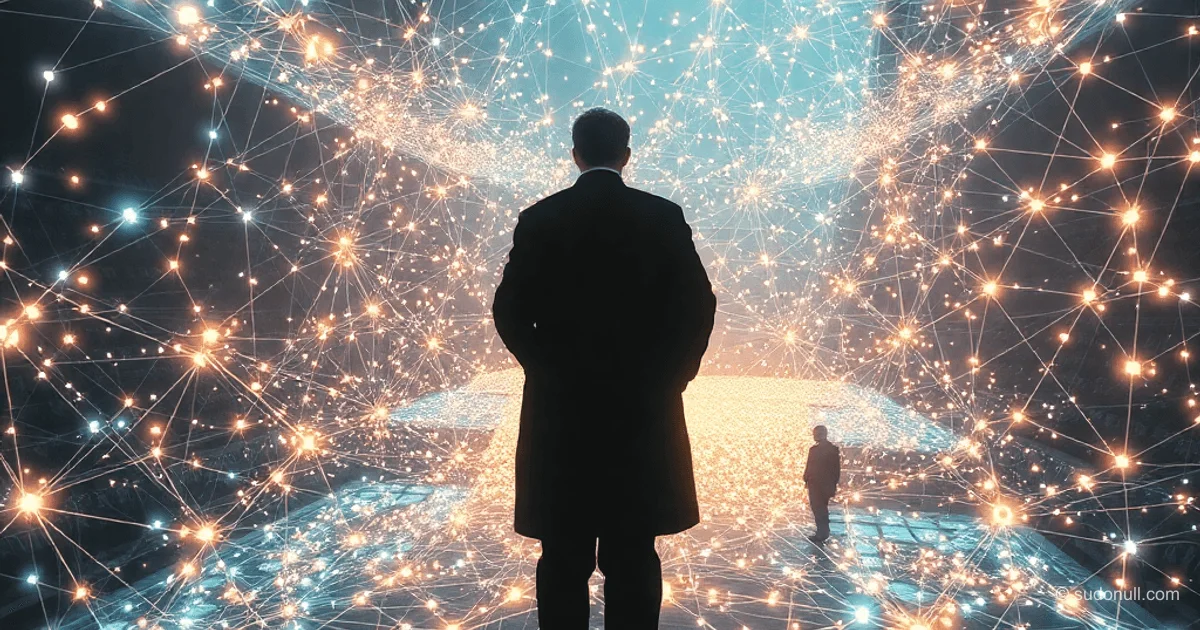
Physics is shifting from describing the world through independent substances to models of relational networks. This dissolves Kant's antinomies: finitude versus infinity, discreteness versus continuity. Space, time, and causality emerge from correlations among quantum systems, rather than existing as standalone containers.
Kant saw antinomies as the limits of reason bound to substantialist ontology. Hegel pointed out the flaws in such thinking: reality is a system of connections where parts gain meaning only in the context of the whole. Modern physics confirms this through relational quantum mechanics and loop quantum gravity.
Antinomies as Artifacts of the Substantialist Approach
Kant's questions—Is matter finite or infinite? Did time have a beginning or is it eternal?—arise when trying to measure relationships as things. There's no 'distance' between the numbers 1 and 1,000,000 that you can gauge with a ruler: there's only a ratio of multiplicity.
In the relational picture:
- Space emerges from the geometry of events, without an empty container.
- Time is a sequence of correlations, not an absolute line.
- Causality is the logical consistency of changes, like in a spreadsheet where updating one cell instantly affects linked ones.
This eliminates paradoxes: existence doesn't 'emerge' from non-existence but self-consistently aligns internally.
Causality and Dialectics in the Relational Model
Classical causality implies force transmission from cause to effect. The relational paradigm views it as the internal logic of structure. Hegel's dialectics—the unfolding of contradictions within a concept—finds a parallel here: development through connections, not external pushes.
In quantum information, causality shows up in entanglement: correlations are instantaneous, without local transmission. Loop quantum gravity models space as a network of spin connections, where geometry arises dynamically.
Free Will in a Multiverse Reality
The antinomy of freedom versus determinism resolves in the relational view. The many-worlds interpretation and M.B. Mensky's model describe reality as a field of potential trajectories.
Consciousness is the process of actualizing a trajectory from this field, not an external wave function collapse. Key aspects:
- Necessity—rigid correlations in the field's structure that set probabilities.
- Freedom—navigation within the structure, where reflection selects the actual path.
- Resolving the contradiction—freedom as conscious operation within the system of relations.
This preserves causal closure without sacrificing responsibility.
Applying the Relational Shift in Science
Relational ontology shapes practice:
- Quantum computing focuses on qubit correlations, not isolated states.
- Cosmology (Lambda-CDM) models evolution through changes in relational metrics.
- Neuroscience sees consciousness as patterns of connections in neural networks.
Hegelian logic—from identity to difference through contradiction—fits describing quantum entanglement and dynamic structures.
Key Takeaways
- Kant's antinomies are resolved by relational physics: substances replaced by networks of relations.
- Spacetime emerges from correlations, without a fundamental container.
- Causality is internal consistency, akin to Hegel's dialectics.
- Free will is actualizing trajectories in a multiverse field of reality.
- The approach applies to quantum computing, cosmology, and neuroscience.
Physics provides a language where contradictions integrate into a coherent whole. Matter, space, time are forms of relations, and freedom is reflective navigation through their structure.
— Editorial Team










No comments yet.