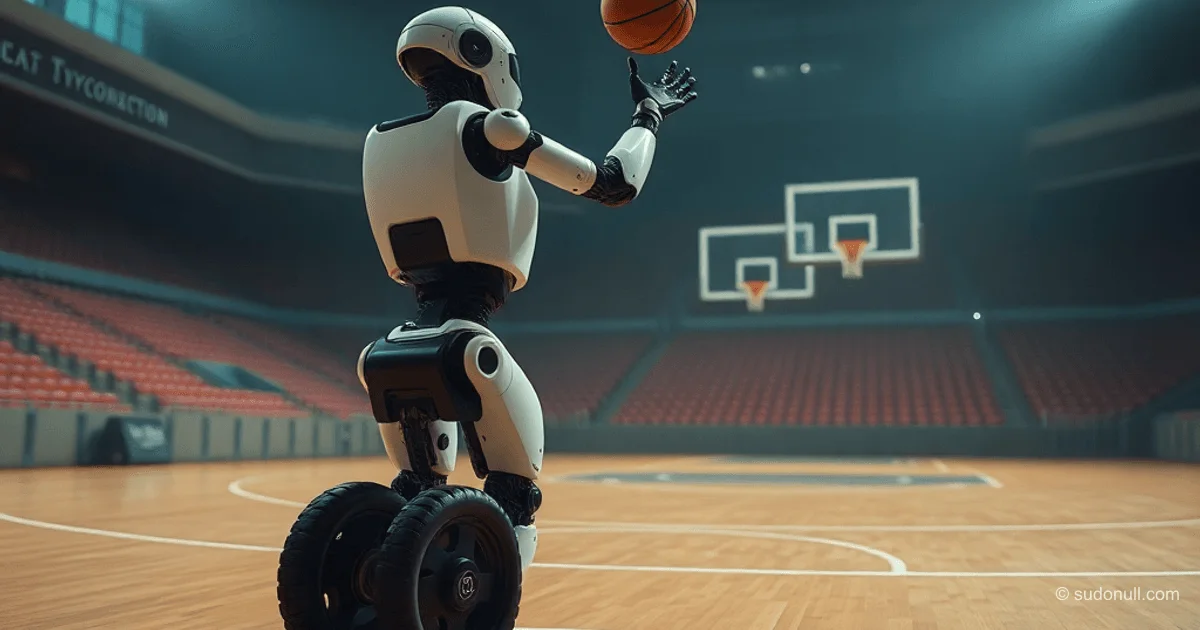
Toyota Enhances Physical AI with Basketball Robot CUE7
Quick Summary: Toyota unveiled an updated CUE7 robot capable of executing precise long-range basketball shots. The project demonstrates progress in computer vision, motion planning, and control systems applicable beyond the automotive sector.
Evolution of the CUE Platform: From Experiment to Research Tool
Development of basketball robots at Toyota began as an employee initiative and evolved into a key platform for testing AI. Initial models focused on basic shots, but each generation added autonomous functions: catching the ball, wheeled movement, rebounding, and dribbling. This allowed engineers to practice complex interaction scenarios in dynamic environments.
CUE7 represents a significant upgrade over its predecessors. Weight was reduced to 74 kg thanks to a new inverted two-wheel design. The robot integrates hybrid control, combining reinforcement learning with traditional control algorithms. These changes improve efficiency in repetitive tasks while minimizing energy consumption and errors.
Technical Innovations in Recognition and Control
The foundation of CUE7's success lies in cameras for target distance assessment and trajectory calculation algorithms. Before shooting, the robot fixes the hoop position, adjusts body and arm posture, then generates an optimal flight arc. Force dosing ensures high repeatability—the ball enters the basket with minimal rim contact.
- Machine Vision: Real-time image analysis for precise positioning.
- Motion Planning: Sequencing simulation for stable ball release.
- Force Control: Precision motor calibration for distances up to 24 meters.
- Autonomy: Independent action cycles without external intervention.
These elements address fundamental robotics challenges: synchronizing perception and execution in unstructured environments.
Achievements and Records in Series Development
The CUE project brought several achievements to Toyota. In 2019, the CUE3 model set a Guinness World Record by making 2,020 consecutive free throws. CUE6 surpassed the long-shot record in 2024 at 24.55 meters. CUE7 continues this lineage, emphasizing reliability in repeated series.
Basketball serves as an ideal test task: errors in vision or coordination are immediately visualized. This contrasts with laboratory simulations where real physical factors (gravity, bounce) are often overlooked.
Context and Significance for Robotics
Physical AI is an area where algorithms move from passive analysis to active actions in the physical world. Toyota uses CUE7 to validate technologies applicable in manufacturing, logistics, and service robots. Reduced weight and improved mobility open the path to compact systems for daily tasks.
Reasons for success: Combining reinforcement learning with model-based control compensates for environmental uncertainties. Consequences for the industry are significant—such platforms accelerate the transition from prototypes to commercial products. Globally, this strengthens Japan's position in robotics, where demand for autonomous systems grows by 15–20% annually.
The overall humanoid robot market is projected at $38 billion by 2035, with a focus on AI integration. Projects like CUE demonstrate how sports simulations model real scenarios, reducing development costs.
Key Takeaways
- CUE7 reduces weight by 38% and introduces a two-wheel scheme for better maneuverability.
- Hybrid control combines AI training with precise control for repeatability.
- Basketball serves as a benchmark for vision and coordination applicable in industry.
- Guinness records highlight reliability: from free throws to long shots.
- The project expands Toyota's expertise in physical AI beyond automotive engineering.
— Editorial Team










No comments yet.