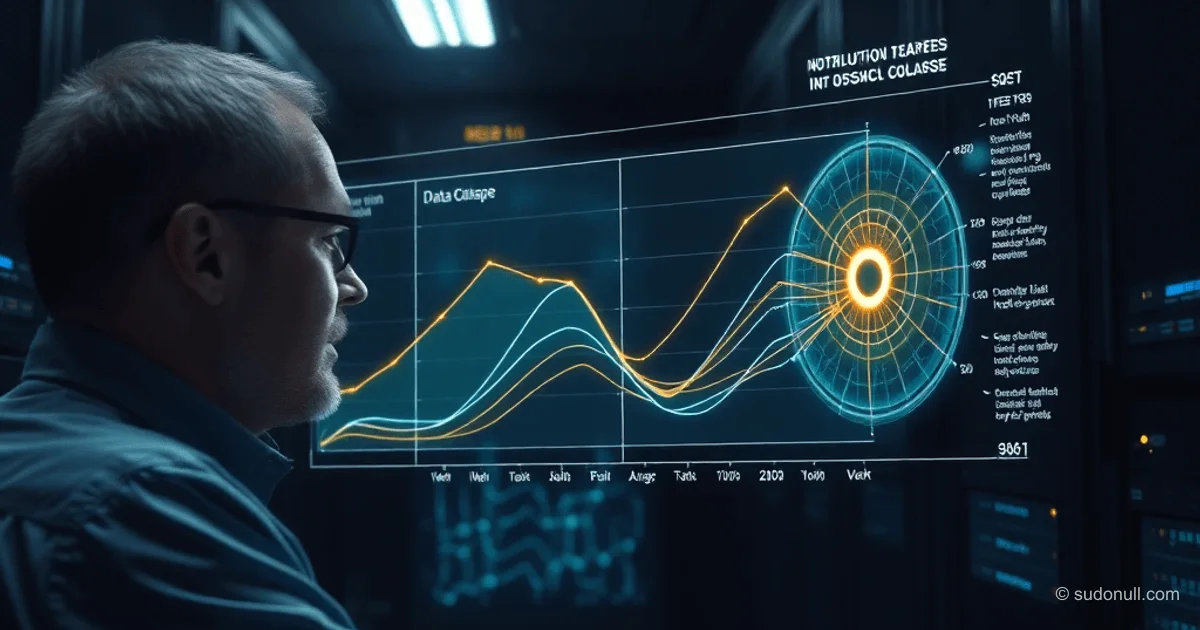
Self-Training on Synthetic Data: Mechanisms of Success and the Threshold of Model Collapse
Synthetic data is generated by models themselves for further training, addressing the shortage of real-world examples. Self-training works by formatting data into an optimal form, increasing the density of useful signals, and distilling skills from a teacher model to a student model. However, recursive use leads to model collapse—a narrowing of distribution and loss of rare events.
Synthetic data is created by algorithms: self-instruct for instructions, teacher-student distillation, generating tasks with solutions, and expanding datasets with similar examples. Unlike simulations, the focus is on generative models.
Advantages of synthetic data:
- Structured format: clear chain-of-thought, unified Q&A templates.
- High density: minimal noise, maximum diversity in phrasing a single concept.
- Pattern transfer: a strong model passes on solution logic, not just copying text.
The Risks of Recursion: How Model Collapse Occurs
In a closed loop of generation → training, the process repeats, mimicking the copying of degrading copies. Rare details are erased, errors accumulate, and the distribution narrows toward the mode.
Model collapse manifests gradually:
- Shrinking tails: rare cases disappear.
- Templatization: responses become homogeneous, losing nuance.
- False confidence: metrics on synthetic data improve, while those on real data decline.
Inflection Points: When Self-Training Spins Out of Control
Danger arises in three scenarios:
Scenario 1: Dominance of synthetic data. Real data must remain an anchor—at least 20–30% of the volume. If synthetic data exceeds 70%, the connection to reality breaks.
Scenario 2: Lack of verification. Without gold sets and hold-out data tests, the model optimizes for an illusion of quality.
Scenario 3: Non-verifiable tasks. Synthetic data is reliable for code (unit tests), mathematics (exact match), and logic (rules-based checks). In evaluative domains, there's a risk of self-confirmation.
| Task | Verifiability | Collapse Risk |
|--------|------------------|---------------|
| Code | High (tests) | Low |
| Mathematics | High | Low |
| Facts/judgments | Low | High |
Diagnosing Degradation in Production
Monitor symptoms on validation sets:
- Decrease in perplexity on the tails of long-tail distributions.
- Increase in templatization: cosine similarity of responses >0.8.
- Divergence of metrics: internal loss decreases, external benchmarks increase.
Use A/B tests: compare models with/without fresh synthetic data against a baseline on real tasks.
Practical Strategies for Safe Self-Training
Synthetic data is effective as a supplement. Key rules:
- Fixed real anchor: 30–50% real data in each batch, with rotation.
- Strict filtering:
- Perplexity filter < threshold.
- Deduplication (MinHash, Jaccard >0.9).
- Diversity sampling by embedding clusters.
- Targeted generation: focus on gaps—rare classes, edge cases, counterfactuals.
- Automatic verification:
- Code: lint + tests.
- Math: sympy/eval.
- Facts: internal RAG-check.
Check effectiveness via the triad:
- Utility: Δaccuracy on hold-out data.
- Robustness: tail loss < baseline.
- Cost: quality gain per GPU-hour.
Key Takeaways
- Synthetic data accelerates training but requires a real anchor for stability.
- Model collapse begins at >70% synthetic data without verification.
- Filtering and targeted generation reduce risks by 40–60% in benchmarks.
- Verifiable tasks (code, math) tolerate up to 90% synthetic data.
— Editorial Team










No comments yet.