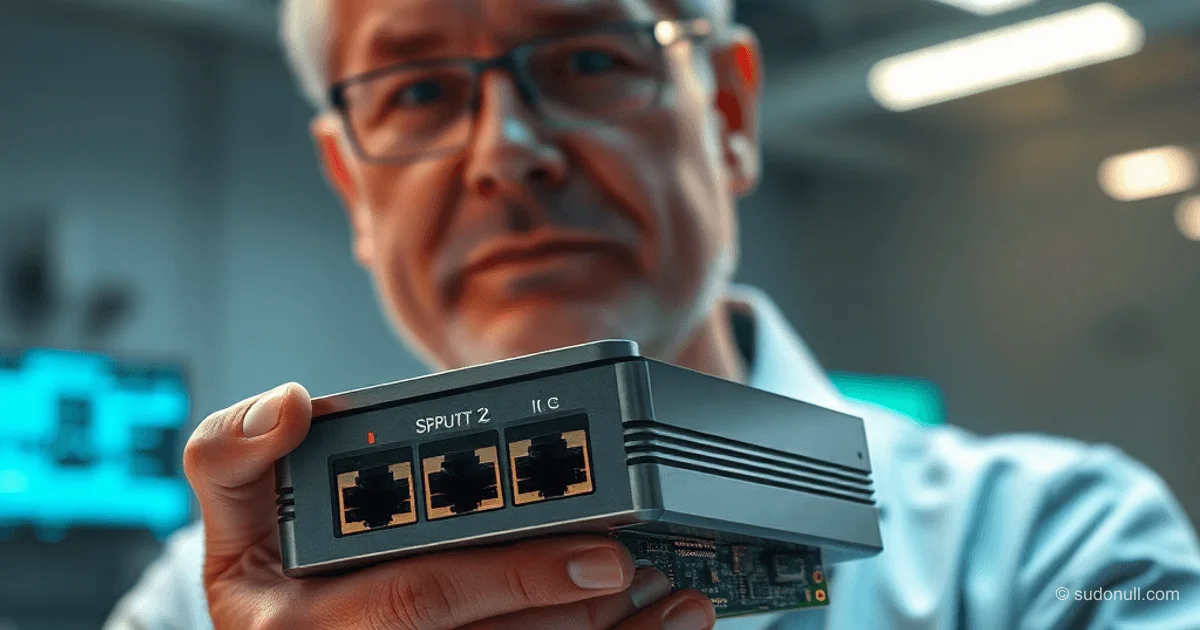
Sprut 2 Hardware Platform for Network Traffic Processing
Sprut 2 is a compact hardware platform for hardware-software information security systems. Roughly the size of two cigarette packs placed side-by-side, the device is housed in a metal casing with connectors and indicators on the ends. The main board tray slides out for installation into a rack or can operate standalone. Power requirements are 5V, up to 3A, with support for passive cooling via the casing's thermal conductivity.
The casing consists of a cover and an L-shaped tray. In a rack, multiple Sprut units can be combined both mechanically and via a blade connector for data exchange.
Main Board Components
The multilayer printed circuit board contains:
- A Cyclone IV FPGA for flexible logic.
- Five Realtek PHY chips for 10/100/1000 Base-T.
- An STM32 microcontroller with external FRAM memory.
Three gigabit LAN ports on the front panel connect via patch cables. A USB-C port provides access to the STM32 console with USB-UART emulation. An administrator hardware key is inserted inline into a cable, using a Challenge-Response protocol for authentication, blocking access if the token does not match.
Four multi-color LEDs and RJ-45 port indicators are programmable via software: by default, they mirror the PHY's Link-Activity status, but their behavior is configurable.
Hardware Bypass and Customization
A set of signal relays implements a bypass function: in the event of a power loss, the first and second LAN ports are galvanically connected, allowing the device to function as a simple patch cable. The relays are optional.
The platform is fully developed in-house: from schematics to FPGA firmware and CAD files. Custom modifications are possible, provided they are physically feasible. The product is listed in the Russian Ministry of Industry and Trade registry.
Functionality Expansion
A fourth LAN port, with connections to the FPGA and STM32, is available on pin headers for mezzanine boards. An example use case is a RISC-V processor with a 1 TOPS neural accelerator for remote management with cryptographic protection and anomaly detection.
A fifth LAN port is available on the blade connector for rack integration, providing LAN switching and dual-rail power.
| Component | Description | Purpose |
|-----------|-------------|---------|
| Cyclone IV | FPGA | Flexible traffic processing logic |
| Realtek PHY (x5) | 10/100/1000 Base-T | Network interfaces |
| STM32 + FRAM | Microcontroller | Management, console |
| Signal Relays | Hardware Bypass | Fail-safe mode |
| USB-C | Console | Diagnostics, administration |
Key Features
- Compactness and Cooling: Standalone operation without active cooling, powered by 5V/3A.
- Access Security: Challenge-Response key blocks console access without the physical token.
- Expandability: Mezzanine boards for FPGA/RISC-V, blade connector for racks.
- Optional Features: Bypass relays, customization for specific tasks.
- Integration: Listed in the Russian electronic products registry.
The platform is aimed at mid-level and senior information security developers. The Cyclone IV FPGA allows for implementing custom packet processing logic, while the Realtek PHYs ensure stable gigabit traffic. The STM32 manages peripherals, and the FRAM stores configuration without volatility. The bypass is critical for inline devices: traffic flow is not interrupted during a failure. Mezzanine boards add crypto/AI capabilities without a complete redesign.
— Editorial Team










No comments yet.