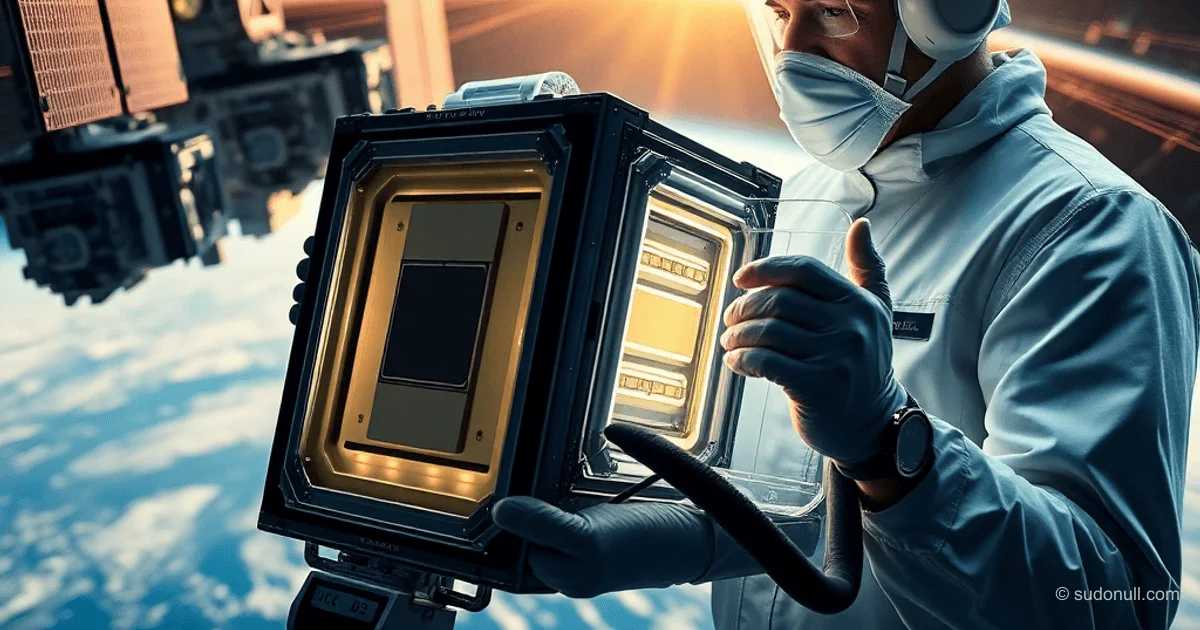
Foremay SSD InterStellar: Radiation Protection for Satellite Systems
Foremay has released the SSD InterStellar lineup, optimized for space operations. These drives withstand cosmic radiation impacts on low, medium, geostationary, and high orbits. Unlike standard industrial SSDs, which degrade within months, InterStellar delivers long-term reliability amid proton fluxes and cosmic rays.
The key feature is the Graded-Z shielding architecture based on proprietary technologies. It effectively slows protons and absorbs secondary neutrons, reducing radiation dose from 10,000 krad to 500 krad. This allows the drives to function during solar flares and galactic cosmic rays without critical failures.
AI-Driven Block Management for Risk Minimization
The IABM (Interstellar AI-Driven Block Management) technology uses machine learning for dynamic monitoring of radiation exposure. Algorithms in real time generate a risk zone map based on:
- Read/write error frequency;
- Built-in sensor readings;
- High-energy particle statistics.
The system proactively migrates critical data from damaged areas to protected flash memory blocks. This lowers the risk of irreversible data loss and extends MTBF under high-radiation conditions.
It supports a wide range of interfaces and form factors:
- SFF SATA and U.2 (NVMe);
- 1.8″ SATA;
- BGA NAND Disk-on-Chip;
- M.2 (2230/2242/2260/2280, NVMe);
- 3U VPX for military avionics.
The temperature range from −55 to +125 °C makes the drives versatile for satellite onboard systems, probes, and ground-based extreme installations.
Encryption and Integration with Onboard Systems
InterStellar integrates hardware data encryption that meets military and scientific mission requirements. Secure storage of telemetry, service logs, and scientific data prevents unauthorized access even if the device is physically captured.
Compared to competitors, Graded-Z shielding shows 20× less degradation than commercial SSDs without specialized protection. IABM adds adaptability by compensating for local damage without system downtime.
For onboard system developers, compatibility with NVMe over Fabrics in clustered satellite constellation configurations is crucial. Testing in radiation simulators confirms stability for missions lasting 5+ years.
Key Features
- Graded-Z shielding reduces radiation dose by 20 times, enabling operation at 500 krad;
- AI-based IABM migrates data from risk zones in real time;
- Temperature range −55…+125 °C and diverse form factors for easy integration;
- Hardware encryption to protect telemetry in military missions;
- Suitable for all orbit types, including GEO and HEO.
— Editorial Team










No comments yet.