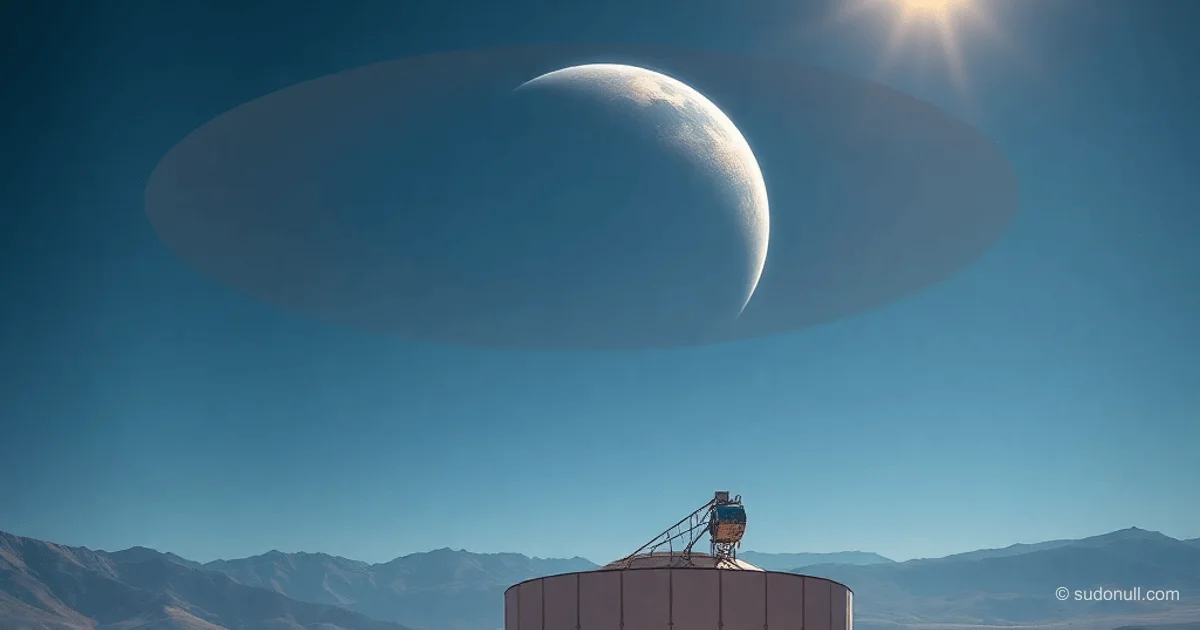
Hybrid Observatory with Starshade to Hunt Earth-Like Exoplanets
A 100-meter-diameter starshade in space blocks the light of a host star, enabling ground-based telescopes to directly image Earth-like exoplanets in habitable zones. This overcomes atmospheric turbulence and the low contrast limitations of traditional coronagraphs. A study in Nature Astronomy shows that this hybrid system, HOEE (Hybrid Observatory for Earth-like Exoplanets), can detect dozens of Earth-sized planets in minutes and biosignatures within hours, achieving an angular resolution of 0.058 milliarcseconds.
Lead author Dr. Ahmed Mohamed Soliman from NASA’s JPL emphasizes the advantage over purely space-based missions: ground telescopes have mirrors six times larger than those on HWO, delivering superior resolution for detecting planets in circumstellar dust.
Comparison with Existing Methods
Direct imaging accounts for only 1.5% of exoplanet discoveries due to stellar brightness and atmospheric turbulence. Traditional internal coronagraphs in space telescopes (JWST, Hubble) fail to achieve sufficient contrast for Earth-like planets at 1 AU from Sun-like stars.
The starshade works externally: positioned in orbit with milliarcsecond precision, it completely suppresses starlight. Advanced adaptive optics on the ELT compensate for turbulence even under moderate weather conditions.
| Method | Contrast | Resolution | Application |
|--------|----------|------------|-------------|
| Internal Coronagraph (JWST, Roman) | Low for Earth-like | Limited | General exoplanets |
| Ground Telescopes (VLT, Subaru) | Moderate | Low due to atmosphere | Jupiter-like |
| HOEE with Starshade | High | 6x better than HWO | Earth-like in habitable zone |
Integration with Ground-Based Telescopes
HOEE leverages:
- ELT and GMT in Chile’s Atacama Desert — mirror diameters up to 39 meters.
- TMT on Hawaii — 30-meter aperture.
These telescopes receive a clean signal from the starshade located at the Sun-Earth L2 point (like JWST). The shade masks the star at an angle of 0.1 arcsecond, revealing planets in the habitable zone.
Soliman notes: For Sun-like stars, Earth-like planets must be at 1 AU, where O₂ and H₂O could exist. The system scans entire planetary systems in minutes, identifying Earth-like candidates.
Advantages Over Future Missions
NASA’s Roman Space Telescope (launch 2026–2027) and HWO (2030s–2040s) rely on internal coronagraphs or smaller screens. HOEE outperforms them in speed and resolution:
- Detects planetary systems six times faster than HWO thanks to its large aperture.
- Operates effectively in dusty disks from comets and asteroids.
- Serves as a technological bridge to HWO.
HWO offers greater target flexibility, but HOEE saves days by analyzing biosignatures in just hours.
Technical Challenges and Next Steps
The 100-meter screen must be ultra-lightweight for launch and maneuvering between stars. Progress at JPL, Goddard, and Ames through NASA’s Starshade and NIAC programs has already prototyped foldable structures.
The Keck Institute for Space Studies coordinates the roadmap—from simulations to a mission aimed at finding the first Earth-like planet around a G-type star.
Astro2020 Decadal Survey prioritizes habitable worlds—HOEE fits perfectly.
Key Takeaways
- The starshade boosts contrast by over 100× compared to coronagraphs, unlocking Earth-like exoplanets.
- Ground-based giants (ELT, GMT, TMT) deliver 6× better resolution than space counterparts.
- Biosignatures detected in hours within the habitable zone (1 AU for Sun-like stars).
- HOEE acts as a stepping stone to HWO, accelerating the search for life.
- Adaptive optics minimize atmospheric turbulence effects.
— Editorial Team










No comments yet.