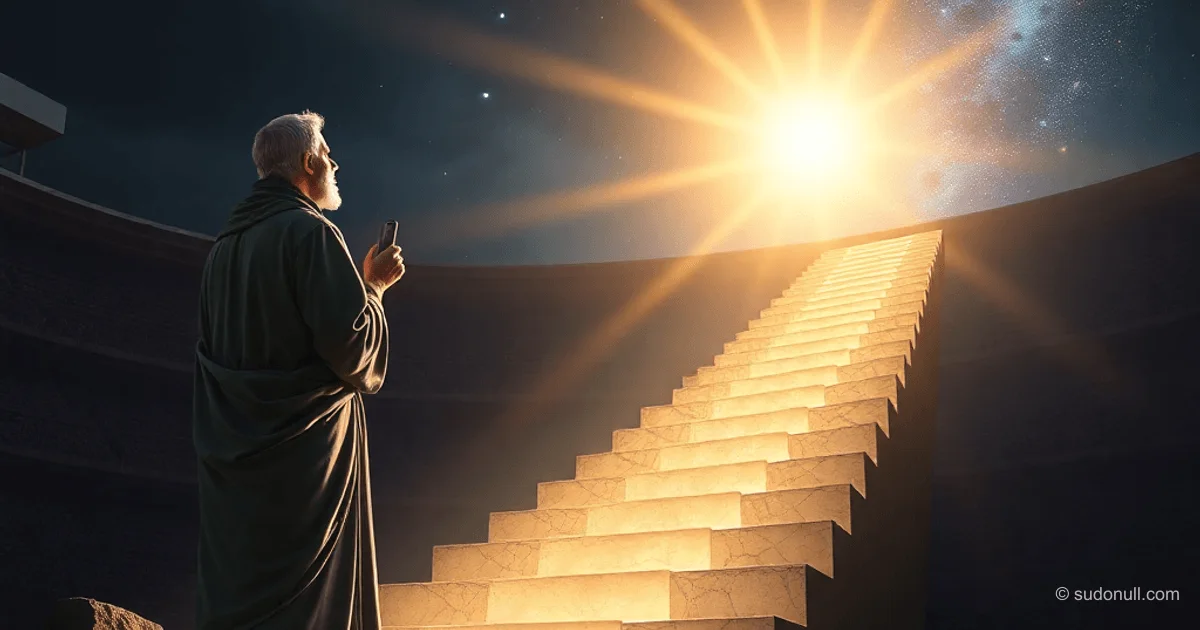
The Cosmic Distance Ladder: From Earth's Radius to the Scale of the Universe
Mathematician Terence Tao, in lectures with Grant Sanderson, unpacks the history of measuring cosmic distances. From proving Earth’s sphericity through lunar shadows to estimating the size of the Solar System—each discovery built on the last, using geometry and reference objects.
Proving Earth Is Spherical
Aristotle was the first to convincingly demonstrate that Earth is a sphere by observing lunar eclipses. The shadow Earth casts on the Moon is always circular, regardless of angle. This is a geometric argument: if a convex object’s projection is circular from any viewpoint, the object must be a sphere.
In 2D, such shapes exist—non-circular forms with fixed-length projections. But in 3D, perspective suffices: a consistently circular projection implies a sphere. The Moon serves as a natural reference point—no telescopes or space travel needed, just visual observation.
Composite images of eclipses also reveal the relative sizes of Earth and the Moon: the shadow’s size is proportional to the object casting it.
Eratosthenes Measures Earth’s Radius
Eratosthenes used the difference in the Sun’s position above the horizon between two cities. In Syene (modern-day Aswan), during summer solstice, sunlight reached the bottom of a well—Sun directly overhead. In Alexandria, 5,000 stadia north, a gnomon (sun dial) cast a shadow at about 7 degrees.
Assuming parallel sunlight rays (based on Aristarchus’s work), Eratosthenes applied spherical geometry:
- The angle between lines from Earth’s center to Syene and Alexandria equals the shadow angle—7° (1/50th of a full circle).
- Distance between cities (measured by caravans)—5,000 stadia.
- Full circumference of Earth: 50 × 5,000 = 250,000 stadia.
- Radius: ~40,000 km (modern value: 6,371 km—remarkable accuracy).
Sources clarify: Eratosthenes’ original text is lost; Cleomedes describes gnomons; Pliny mentions the well in Syene.
Spoiler: Parallel Sun Rays
Eratosthenes relied on Aristarchus, who estimated the Sun’s distance at 20 Earth radii (actual: ~23,500). Later astronomers (Hipparchus, Ptolemy, Aryabhata, Al-Battani) refined this.
The Distance Ladder: How It Works
Each measurement uses a reference object Y to estimate X. Direct observation isn’t possible—only indirect effects and geometry. From Earth to Moon, Sun, planets, galaxies.
- Earth → Moon: Parallax or eclipse shadow.
- Earth → Sun: Venus’s phases (transit).
- Solar System: Kepler’s laws, Mars parallax.
Tao emphasizes: math + data + technology.
Key Takeaways
- Earth’s sphericity was proven via lunar shadows without instruments.
- Eratosthenes calculated Earth’s radius with less than 2% error using 5,000 stadia and a 7° angle.
- The ladder is recursive: each distance calibrates the next.
- Geometry beats technology: parallel rays → trigonometry.
- Modern refinements still rely on ancient methods (parallax, transits).
Next Steps on the Ladder
Next rungs: Moon’s distance via parallax, Sun’s distance via Venus transit, stellar distances via annual parallax. Kepler deduced Earth’s elliptical orbit from Tycho Brahe’s observations, applying his harmonic law. This opened the door to trigonometric measurements.
Tao highlights the collaborative nature of discoveries—from Greeks to Kepler, Galileo, and modern observatories.
— Editorial Team










No comments yet.