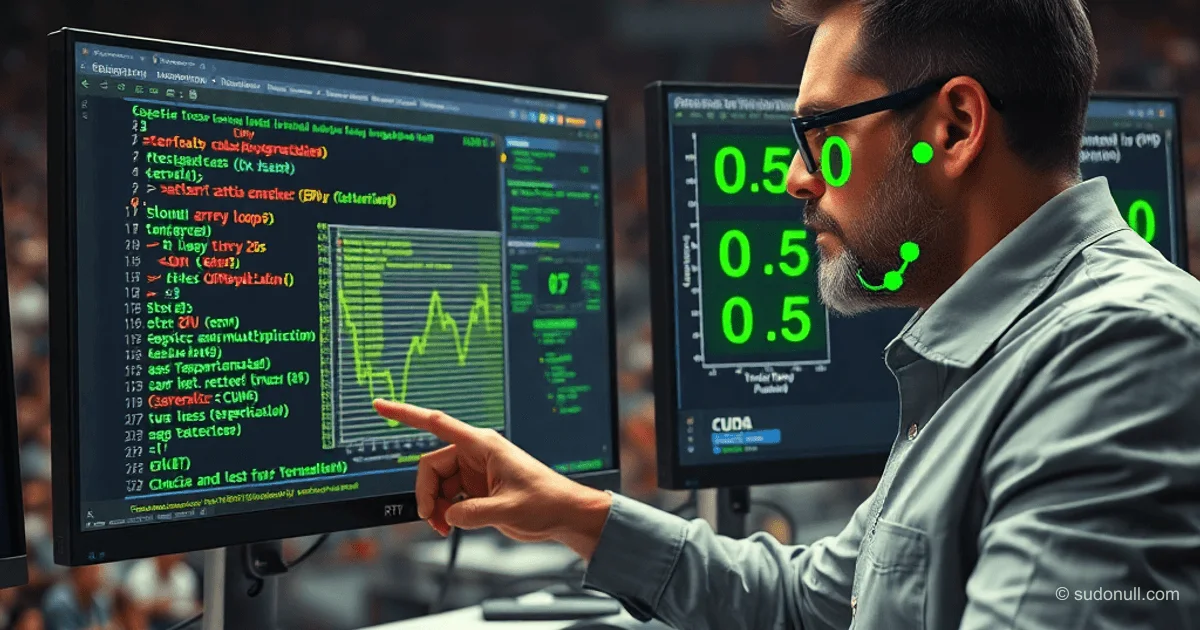
The Evolution of Tensor Computing in PHP: From Arrays to GPU Acceleration
PHP arrays are unsuitable for intensive matrix operations due to the overhead of zval structures, hash tables instead of contiguous memory, and lack of SIMD vectorization. Each element consumes extra memory, accesses disrupt CPU cache, and copy-on-write triggers unexpected allocations. Naive matrix multiplication implementations using triple loops work for prototypes but fail with data exceeding 10k elements.
Early ML libraries (PHP-ML, early RubixML) used pure PHP without extensions. Debugging simplicity and no compilation were advantages for experimentation, but performance degraded exponentially.
function matmul(array $a, array $b): array {
    $result = [];

    $rowsA = count($a);
    $colsA = count($a[0]);
    $colsB = count($b[0]);

    for ($i = 0; $i < $rowsA; $i++) {
        for ($j = 0; $j < $colsB; $j++) {
            $sum = 0.0;

            for ($k = 0; $k < $colsA; $k++) {
                $sum += $a[$i][$k] * $b[$k][$j];
            }

            $result[$i][$j] = $sum;
        }
    }

    return $result;
}
Similarly for dot product and neural layer forward pass:
function forward(array $inputs, array $weights, array $biases): array {
    $outputs = [];

    foreach ($weights as $i => $neuronWeights) {
        $sum = 0.0;

        foreach ($neuronWeights as $j => $weight) {
            $sum += $inputs[$j] * $weight;
        }

        $sum += $biases[$i];

        $outputs[$i] = 1 / (1 + exp(-$sum));
    }

    return $outputs;
}
Transition to Native Structures: Tensor and NDArray
The ecosystem evolved toward C/Rust backends. Tensor (RubixML/Tensor) implements contiguous memory and basic CPU vectorization. The API simplifies to method chains:
use Tensor\Matrix;

$a = Matrix::rand(500, 500);
$b = Matrix::rand(500, 500);

$c = $a->matmul($b);
NDArray adds multidimensional support with broadcasting. These structures bypass PHP overhead, minimizing zval copying and ensuring cache-friendly layout.
Key improvements:
- Contiguous storage: elements stored sequentially in memory
- Zero-copy views: slices without data duplication
- SIMD intrinsics: manual vectorization for hot paths
- Memory pooling: buffer reuse
Performance on matmul(500x500):
| Approach | Time |
|----------|------|
| PHP arrays | 10–20 s |
| Tensor (CPU) | 0.3–0.8 s |
| NumPower (GPU) | 0.05–0.2 s |
A difference of 2–3 orders of magnitude — the criterion for transitioning to GPU.
GPU Integration in RubixML: NumPower
RubixML via NumPower offloads computations to CUDA/OpenCL. Supports automatic offloading for arrays above a threshold (configurable).
$c = NumPower::multiply($a, $b);
// or operator notation
$c = $a * $b;
The backend automatically selects:
- CPU fallback for small tensors
- CUDA for NVIDIA GPU
- OpenCL for AMD/Intel
- Metal for Apple Silicon
Critical implementation aspects:
- Host-device synchronization minimized via lazy evaluation
- Unified memory (where available) simplifies data transfer
- Kernel fusion combines operations into a single GPU launch
- Fallback to CPU on OOM or driver errors
Benchmarks and Real-World Cases
On RTX 3060, matmul(1000x1000) accelerates 50–100x compared to Tensor CPU. Batch inference (32x1024x1024) shows gains even in edge cases.
Practical scenarios for PHP:
- Real-time recommendation in e-commerce
- Image preprocessing in CMS
- Anomaly detection in SaaS logs
- Embedding search in RAG systems
function batch_inference(array $batches, Tensor $model): array {
    $gpu_model = $model->to('cuda');

    return array_map(fn($batch) =>
        $gpu_model->forward(Tensor::fromArray($batch)),
        $batches
    );
}
Key Takeaways
- Scale determines the stack: PHP arrays → Tensor/NDArray → GPU for >100k elements
- 100x performance boost: GPU backends are essential for production ML
- API transparency: NumPower maintains PHP idioms without vendor lock-in
- Hybrid approach: CPU fallback + auto-offload for reliability
- Mature ecosystem: 140+ libraries in awesome-php-ml
— Editorial Team










No comments yet.