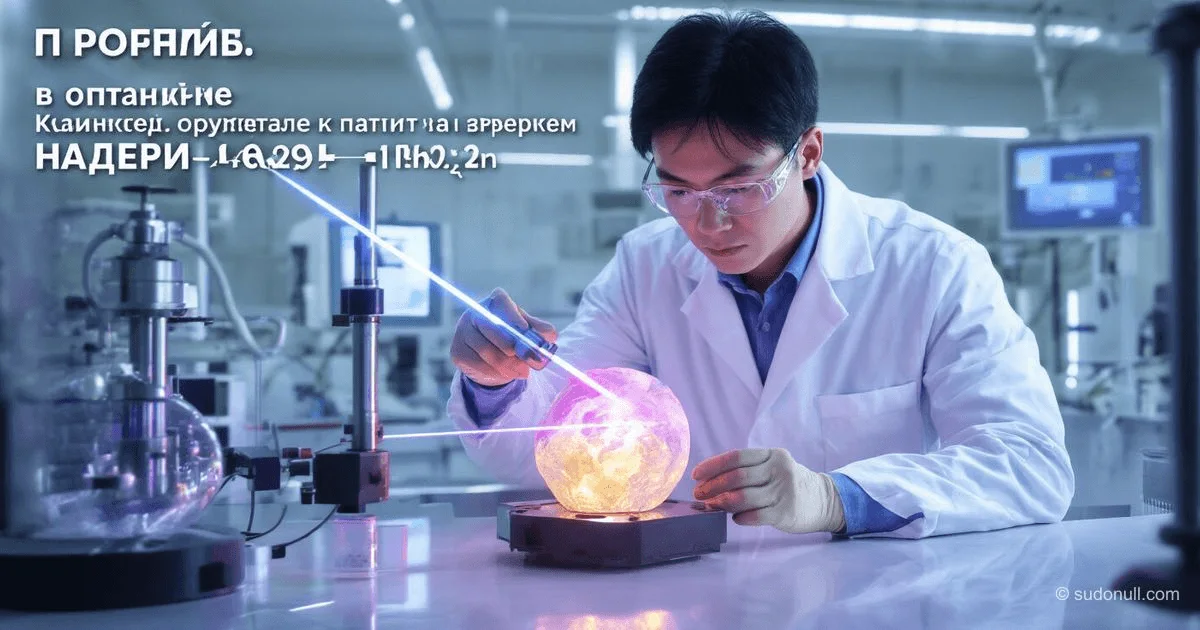
Optical Breakthrough: Chinese Crystal Paves Way for Ultra-Precise Nuclear Clocks
Chinese scientists have developed a crystal that generates ultraviolet light at a wavelength of 145.2 nm, bringing us closer to nuclear clocks based on thorium-229. This advancement could revolutionize navigation in environments without satellite signals.
The Technology Behind Nuclear Clocks
Nuclear clocks measure time using oscillations within atomic nuclei, offering stability 10 to 1,000 times greater than traditional atomic clocks. Electrons in atomic clocks are sensitive to external influences like temperature and magnetic fields, whereas atomic nuclei remain far more stable.
The key lies in the thorium-229 isotope, whose nucleus transitions between energy states at an exceptionally low level. Exciting this transition requires a laser with a wavelength of approximately 148.3 nm in the ultraviolet spectrum. Generating such light has long been a technical challenge due to limitations in available materials.
A new fluorinated borate crystal developed at Xinjiang University in China converts standard laser light into UV radiation at a record-breaking 145.2 nm—surpassing the previous benchmark of 150 nm. This leap forward lays the foundation for compact, high-precision timing devices.
Applications in Navigation Systems
Independence from GPS is crucial in scenarios where satellite signals are unavailable or jammed. Dead reckoning—a method of calculating position based on speed, direction, and elapsed time—relies on precise timekeeping and can be supported by celestial references such as stars, pulsars, or radio signals.
- Underwater operations: Extended deep-sea missions without surfacing for GPS correction.
- Space missions: Autonomous spacecraft navigation in deep space.
- Ballistic systems: Resilience against electronic interference.
- Terrestrial applications: Reliable positioning in tunnels or electromagnetically noisy environments.
Such clocks would greatly enhance system autonomy, reduce detection risks, and maintain meter-level accuracy over extended durations.
Development Context and Global Significance
Research into thorium-229 has been underway since the early 2000s in the U.S., China, and Europe. Past obstacles included unstable light sources and inefficient frequency conversion. The new crystal addresses several of these issues, moving portable nuclear clocks closer to real-world deployment.
Progress stems from advances in nonlinear optical materials capable of laser frequency conversion. For industry, this means a transformation in navigation tech—where time precision directly determines positional accuracy. Globally, it strengthens strategic independence from vulnerable satellite networks.
Broader context: While atomic clocks already serve telecommunications and metrology, nuclear clocks promise a tenfold leap in performance. Experts estimate full realization within the next 5–10 years, with major implications for defense, space exploration, and civilian navigation.
Key Takeaways
- The crystal emits UV light at 145.2 nm, very close to the 148.3 nm needed to excite thorium-229.
- Nuclear clocks are 10–1,000 times more accurate than atomic clocks and highly resistant to environmental disturbances.
- Dead reckoning enabled by these clocks allows GPS-free navigation in underwater, space, and signal-jammed environments.
- The breakthrough intensifies global competition in precision technologies.
- High potential for autonomous systems in both strategic and commercial sectors.
— Editorial Team










No comments yet.