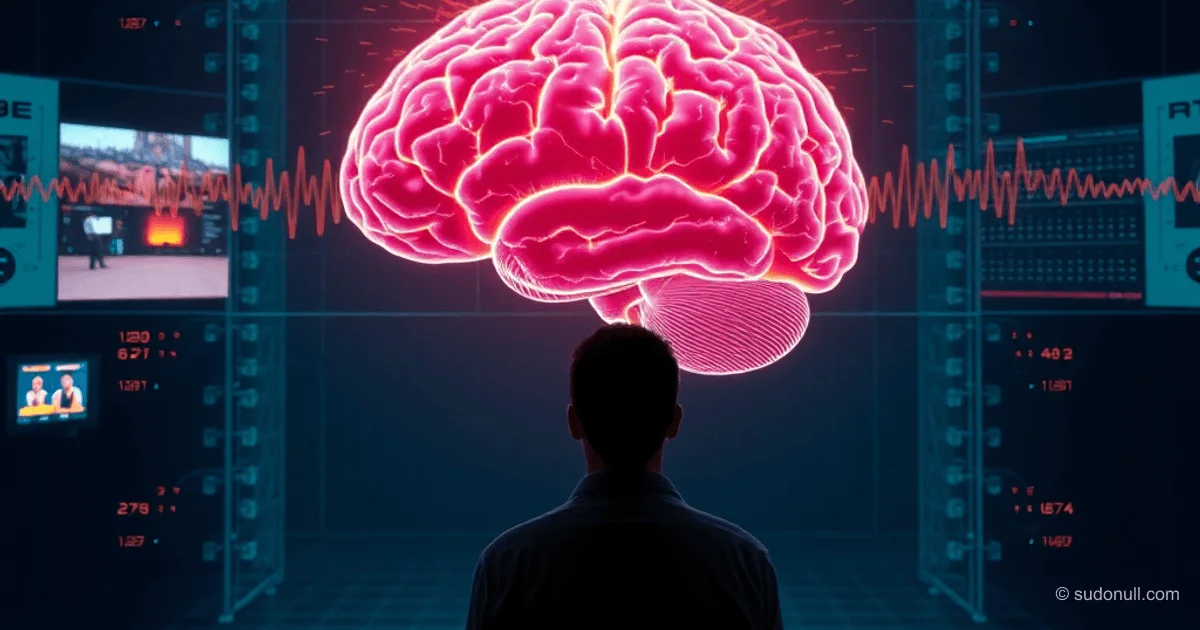
TRIBE: A Transformer-Based Foundation Model for In Silico Neural Activity Modeling
Meta’s FAIR team has introduced TRIBE — a foundational transformer model designed to predict neural responses to visual, auditory, and linguistic stimuli. Trained on large-scale fMRI data from volunteers watching movies and listening to podcasts, TRIBE achieves 70× higher spatial resolution than prior models. This leap enables rigorous in silico neurobiological experiments — eliminating the need for repeated scanning sessions.
The model constructs a digital twin of brain activity, synchronizing multimodal inputs across the ventral visual and auditory processing streams. Its transformer-based architecture — akin to large language models like GPT-4 — handles complex, real-world scenarios with unprecedented fidelity.
Advantages Over Traditional Approaches
Conventional AI models in neuroscience are narrow, trained on small, task-specific datasets — for example, classifying neuron types. As a foundation model, TRIBE generalizes across diverse stimuli:
- Multimodality: Simultaneous processing of vision, sound, and language.
- Zero-shot adaptation: Predicts neural responses to previously unseen languages — no fine-tuning required.
- High-fidelity resolution: 70× resolution gain enables precise modeling of neural patterns — from whispers to bursts, static scenes to fast-moving objects.
TRIBE outperforms predecessors in both speed and versatility, drastically reducing reliance on subject-specific data.
Applications in Virtual Experiments
TRIBE accelerates discovery by replacing physical fMRI sessions with thousands of high-fidelity simulations. Like CFD models in aerodynamics, neuroscientists now test hypotheses about brain responses to stimuli and pinpoint disruptions in signaling pathways.
Key use cases:
- Developing next-generation BCIs by predicting sensory processing dynamics.
- Analyzing neurological disorders — including aphasia and sensory integration deficits.
- Running large-scale hypothesis testing without ethical constraints or the cost and scarcity of fMRI resources.
This paves the way toward decoding the neural architecture of human thought.
Technical Specifications and Availability
The model is open-sourced: TRIBE v2 includes full code, pre-trained weights, and an interactive demo. Training on multimodal datasets ensures robustness across languages and individual subjects. The enhanced resolution reveals subtle neural patterns previously inaccessible.
Key highlights:
- 70× improvement in spatial resolution over state-of-the-art models.
- Zero-shot predictions for new languages and individuals — no fine-tuning needed.
- A scalable brain digital twin enabling thousands of virtual experiments per single fMRI scan.
- Transformer-driven synchronization of visual and auditory processing streams.
- Public release for the global research community — with strong emphasis on responsible, ethical deployment.
Future Directions
TRIBE marks a pivotal shift toward in silico neuroscience — where simulation replaces invasive or resource-intensive wet-lab experimentation. For BCI and neurotechnology developers, it serves as a hardware-agnostic prototyping platform. Future iterations will expand multimodality further — integrating proprioception and motor signals to build richer, embodied models of cognition.
— Editorial Team










No comments yet.