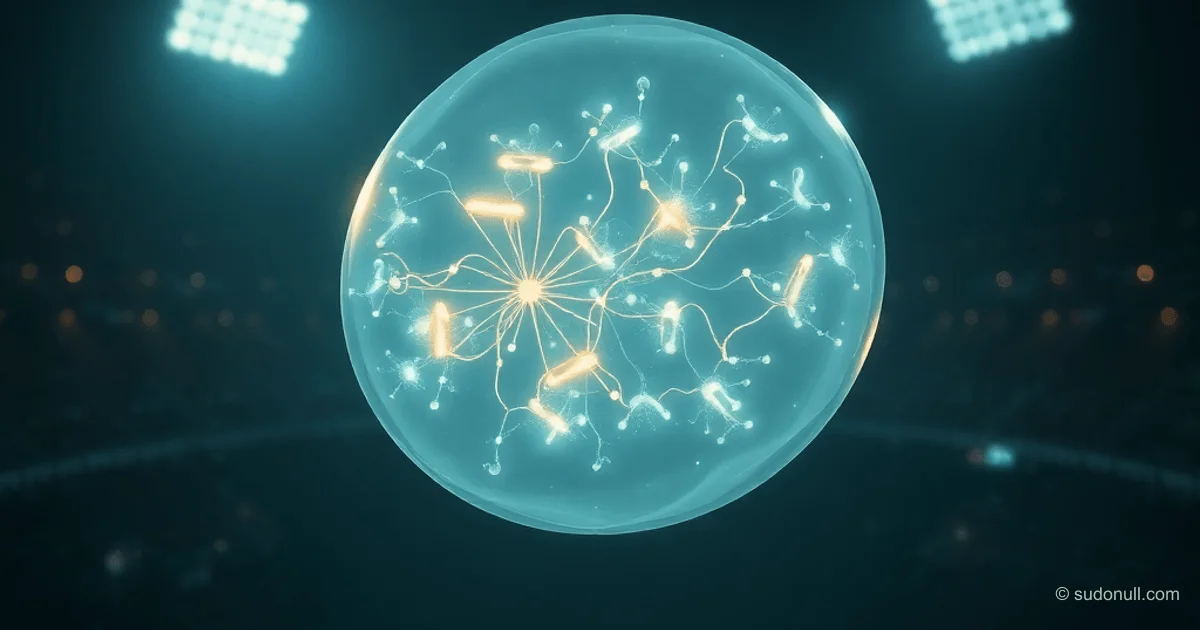
Virtual Cell: Where AI Meets Biomechanics
Creating a digital model of a living cell isn't science fiction—it's a complex engineering challenge at the intersection of systems biology, computational modeling, and machine learning. Today's efforts to combine deterministic mechanistic models with predictive AI systems are paving the way for in silico experiments that can replace costly lab procedures.
Why JCVI-syn3A Became the Gold Standard
The minimal synthetic bacterium JCVI-syn3A, with just 493 genes, became the first platform for a full mechanistic simulation of the cell cycle. The researchers included:
- All known biochemical reactions;
- Gene expression patterns;
- Spatial organization of molecules inside the cell;
- Stochastic elements reflecting natural variability between cells.
The result: 50 independent simulations visualizing chromosome replication and segregation. This isn't just animation: each model accounts for enzyme kinetics, metabolite concentrations, and time delays. However, scaling this approach to E. coli (with 4300 genes) or a human cell (20,000+) is impossible without a radical overhaul of the methodology.
AI as a "Bottom-Up" Alternative
While mechanistic models require manual description of every biochemical pathway, AI-based systems learn directly from multidimensional data:
- Transcriptomics — expression levels of thousands of genes simultaneously;
- Proteomics — quantitative protein profiles;
- High-throughput microscopy — spatial and temporal patterns;
- CRISPR screening data — cellular responses to genetic perturbations.
An example is the State model from Arc Institute, trained on 170 million cells and 100 million data points on perturbations. Such systems can predict transcriptional responses to drugs without knowing specific signaling cascades. But the downside is the "black box." If the model errs, you can't pinpoint which biochemical step was modeled incorrectly.
Where Virtual Cells Are Already in Use Today
Although a fully functional digital cell is still in the future, partial implementations are already delivering real benefits:
- Metabolic engineering: modeling optimal pathways for biofuel production in yeast before any genetic modifications;
- Pharmacology: predicting drug toxicity based on changes in metabolic networks;
- Precision medicine: simulating tumor cell behavior under combination therapy;
- CRISPR design: predicting off-target effects from multiple genetic edits.
The key limitation is the incompleteness of biological databases. For most enzymes, Michaelis-Menten constants are unknown, and regulatory interactions are only partially mapped. A 10% error in a reaction rate parameter can lead to a 300% discrepancy in target product yield.
Major Projects and Computational Challenges
In 2025–2026, global initiatives ramped up:
- Virtual Cells Platform (Chan Zuckerberg Initiative + NVIDIA) — a unified environment for collaborative model development with GPU acceleration support;
- Alpha Cell (SciLifeLab) — an AI model based on the human protein atlas and spatiotemporal data;
- Virtual Cell Challenge (Arc Institute) — a competition involving teams from 14 countries aimed at standardizing model quality metrics.
Computational complexity remains a barrier. The JCVI-syn3A mechanistic model requires hours of cluster computations even for one division cycle. Training AI models on hundreds of millions of cells is a job for distributed GPU farms. Additionally, stochasticity must be accounted for: two genetically identical cells in identical conditions can behave differently due to gene expression noise.
Integration, Not Replacement
The future belongs not to purely mechanistic or purely AI approaches, but to their hybridization. For example:
- Use AI to fill gaps in kinetic parameters where experimental data is lacking;
- Apply mechanistic models to verify AI predictions at key nodal points;
- Implement interpretable AI architectures (e.g., attention maps) to track which biological features influence the forecast.
The Human Cell Atlas project demonstrates that even incomplete maps of cell types have already transformed oncology and immunology. Similarly, partial virtual cell models will begin impacting biotechnology long before achieving a "complete" digital twin.
Key Takeaways:
- A full mechanistic cell model is only feasible for minimal organisms like JCVI-syn3A.
- AI models are scalable but suffer from lack of interpretability and require massive datasets.
- Practical applications already exist in metabolic engineering and drug screening.
- Hybrid approaches are the only realistic path to a universal virtual cell.
- Computational demands and incomplete biological data are the main hurdles for the next 5–10 years.
— Editorial Team










No comments yet.