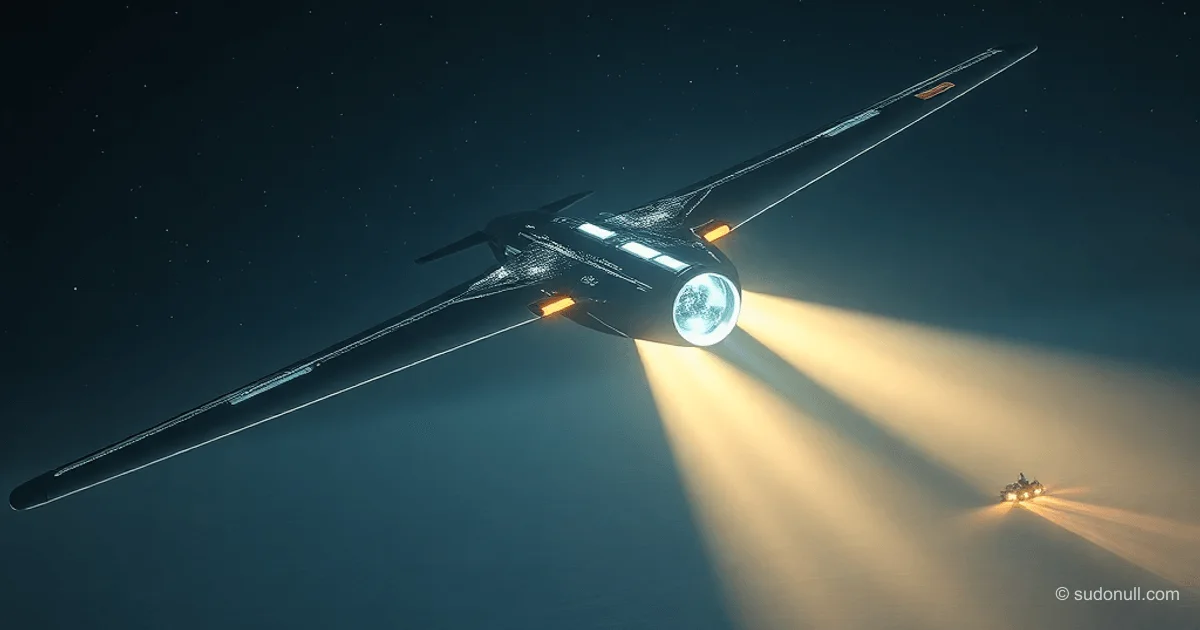
Hybrid Glider Watcher: Energy Recovery from Airflow for Extreme Endurance
The hybrid glider Watcher converts air resistance into electrical energy, enabling autonomous flight for up to 7 days in Arctic conditions without sunlight. The central vertical fin with a 280 mm diameter directs airflow through a microturbine, generating 150–500 W. This allows monitoring remote areas for climate research or search-and-rescue operations, where traditional drones are limited to 20–48 hours.
The system works like regenerative braking in aviation: altitude loss or excess airflow is converted into battery charging. AI manages the modes, balancing gliding and maneuvers.
Turbine Operation Principle and Energy Balance
The air intake at the wing root, with an area of 0.062 m², accelerates airflow from 110 km/h to 140–150 km/h in a narrowed 240 mm diameter channel. The dual microturbine with a 170 mm diameter generates power for electronics and batteries.
The turbine activates in three scenarios:
- Aerobraking during descent: at 1–3 km altitude at 110–150 km/h, generating 150–500 W by converting potential energy.
- Dynamic soaring: diving from strong winds (150–200 km/h) to recover excess speed.
- Station-keeping in wind: holding position in winds >20 m/s, like a kite.
In cruising mode at 110 km/h, 4.5 kW is required to overcome drag, covered by gliding. Generation (200–300 W average) powers the AI and systems, with surplus charging batteries for thermal climbs.
Design Solutions for Reliability
The 8 m long carbon fiber composite fin provides rigidity and houses the turbine. Wings with a 15–17 m span are optimized for L/D >18 based on CFD analysis, balancing glide performance and strength.
An inflatable valve made of siliconaramide composite weighing 4 kg replaces mechanical flaps (7 kg). It inflates in 2 seconds to break ice, with a lifespan of 15,000 cycles.
Landing: a 16 kg parachute system with a vertical descent rate of 10.8 m/s, with a final engine burst to level the craft. Launch: a ten-rotor tug lifts 260 kg to 200–600 m from a 20×20 m pad, with payback after 10 cycles.
Flight Modes and Autonomy
- Gliding: AI minimizes altitude loss, with the turbine charging during descent.
- Climbing: using external updrafts + stored energy.
- Maneuvers: auxiliary motor engaged, turbine off, air intake closed.
Overall autonomy of 3–7 days at 200 W generation. The system is self-sufficient in energy recovery, producing surplus for electronics without violating thermodynamics.
| Parameter | Value |
|-----------------|------------------------|
| Wingspan | 15–17 m |
| Fin diameter | 280 mm outer/240 mm inner |
| Turbine | 170 mm, 150–500 W |
| Mass | 260 kg |
| Flight | 3–7 days |
Key Points
- Energy recovery harnesses altitude loss or excess airflow to generate 150–500 W without external fuel.
- AI control separates modes: gliding, braking, and wind station-keeping.
- The inflatable valve is lighter and more resistant to icing, with 2.5x the lifespan of mechanical flaps.
- The tug simplifies launch without a runway, and the parachute enables landing on a 50×50 m area.
- Up to 7 days of autonomy in polar night outperforms Zephyr (solar) and ScanEagle (fuel).
— Editorial Team










No comments yet.