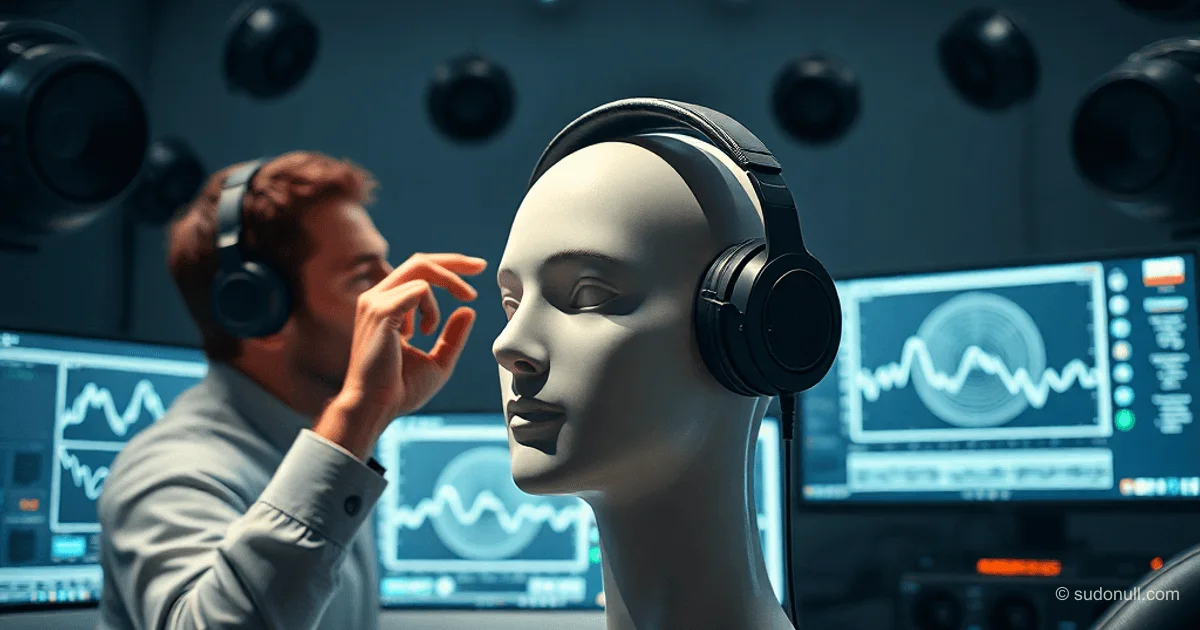
Sphere 3D Headphones: Compact Modeling of Multichannel Immersive Audio
The Sphere 3D driver system headphones emulate sound source positioning in surround sound and immersive audio formats. The system uses multiple drivers arranged in a spherical layout around the ear to deliver binaural ILD and ITD effects without digital processing. This enables direct playback of Dolby Digital, DTS 5.1/7.1, Atmos, and DTS:X content while preserving natural localization.
Principles of Binaural Perception in Spatial Audio
Spatial audio is shaped by three key factors: the propagation medium, wave direction, and binaural cues. Binaural hearing relies on:
- Interaural Level Differences (ILD): Spectral variations from diffraction around the head and ears.
- Interaural Time Differences (ITD): Timing delays between ears.
Localization occurs in horizontal, frontal, and vertical planes. Low-frequency response (>200 Hz) varies little by direction, while mid and high frequencies pinpoint position. The acoustic shadow boosts ILD for rear channels, where mids are attenuated.
HRTF (Head-Related Transfer Function) captures these effects. For multichannel systems, HRTF is measured in anechoic chambers using dummy head models like KEMAR or B1-E, with microphones at the ear canal entrance.
Multichannel Audio Formats
Multichannel speaker systems fall into two categories:
- Surround sound (Dolby Digital, DTS 5.1/7.1): Speakers in the horizontal plane—front stereo pair (0°/30°), center (0°), sides (90°/270°), rears (110°/250°), and subwoofer.
- Immersive audio (Dolby Atmos, DTS:X): Adds the upper hemisphere (elevation 30°–45°). Sphere extends this to the lower hemisphere for full coverage.
| Format | Channels | Hemispheres |
|--------|----------|-------------|
| 5.1 | 6 | Horizontal |
| 7.1 | 8 | Horizontal |
| Atmos | Up to 128| Upper + Horizontal |
| Sphere| 12+ | Full Sphere |
Digital HRTF Modeling for Conversion
To convert multichannel signals to binaural, phase-amplitude matrices and FIR/IIR filters model each channel's HRTF. Measurements occur in free-field setups: a monitor simulates the source, and a dummy head captures direct and shadowed frequency responses.
The Fletcher-Munson curve shows how perception varies with SPL levels, affecting HRTF at different volumes. Coefficients are loaded into a DSP processor. Sphere bypasses this by positioning physical drivers to mimic external speakers.
Sphere 3D Headphone Design
The system features acoustic chambers around the ear with open walls and felt damping to suppress resonances. Drivers (40–50 mm long-throw units) are arranged spherically:
- Front/center: 0°–30°.
- Sides: ±90°.
- Rears: ±110°–250°.
- Top/bottom: ±45° vertical.
Silicone earpads fully immerse the ear in the chamber. For immersive formats, the chamber expands while maintaining comfort. The prototype uses JBL Quantum 100 drivers, optimized for ear distance.
Chamber diagram for surround (7.1):

Diagram for immersive:

Multi-Driver Headphones vs. Stereo
Stereo headphones create an "inside-the-head" effect due to missing ILD/ITD. Sphere's multi-drivers:
- Provide physical wave diffraction off ear geometry.
- Support native multichannel streams without decoding.
- Enhance localization across all planes.
Prototype frequency response tests show a flat curve without peaks, rivaling external speakers.
Key Takeaways
- Sphere emulates a full sphere of drivers, including the lower hemisphere, for true 3D audio.
- No DSP dependency: Sound is shaped acoustically, minimizing latency.
- Compatible with 5.1/7.1/Atmos without re-encoding.
- HRTF varies with SPL, requiring volume-specific calibration.
- Prototype leverages standard 40 mm drivers for high scalability.
— Editorial Team










No comments yet.