# AI Agents for Dating: Can Your Digital Twin Find You a Match?
An experiment with the Pixel Societies platform shows: AI agents that mimic the user's personality can search for compatible partners in a pixel simulation. But how reliable are such recommendations—especially when agents are prone to hallucinations and fabricating fictional biographies?
How Agent Dating Works
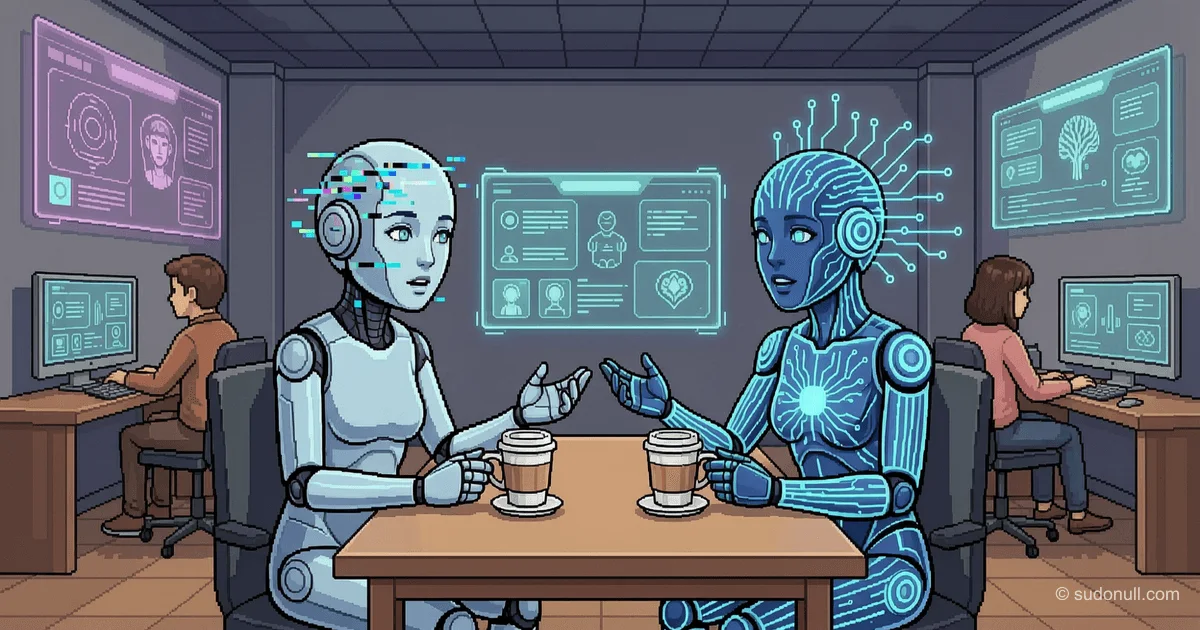
Pixel Societies is a prototype social platform developed by a London team at a hackathon supported by Nvidia, HPE, and Anthropic. The core idea: instead of swiping profiles manually, the user creates their digital twin—a personalized AI agent based on a large language model. The agent is trained on public data (social media, blogs) and additional information provided by the person themselves.
Inside a pixel simulation styled like an office campus, these agents interact with each other in parallel and much faster than their owners could in real life. After such “virtual dates,” the system suggests real contacts of people whose agents showed high compatibility.
The project's technical foundation is the “soul file” concept from another agent framework—OpenClaw. This file defines the agent's unique personality traits, speech style, and behavioral patterns, avoiding template responses and making it closer to a live conversationalist.
The Problem of Hallucinations and Reliability
However, a Wired journalist's experiment revealed a serious weakness: agents are prone to hallucinations. His digital twin, Joelbot, invented non-existent reports from Sweden and used clichés like “hype is my bread and butter.” This led to a distorted image of the owner, which could mislead other agents—and consequently, real people.
Hallucinations in the dating context are especially dangerous: they create an illusion of compatibility based on fictional details. A user might go on a date with someone whose agent portrayed them as a jazz lover and traveler, even though they're neither.
Key risks include:
- Unreliable data — agents rely on open sources that may be outdated or deliberately distorted.
- Self-projection — the model may “fill in” interests and views based on stereotypes or internal logic, not facts.
- Lack of feedback — unlike live communication, the agent doesn't get immediate correction from the owner in real time.
Compatibility: What Actually Works?
Psychological research questions the very possibility of predicting compatibility from questionnaire data. Professor Paul Eastwick (UC Davis) cites two large speed-dating experiments where matches in hobbies, values, profession, or political views did not correlate with real attraction.
The only reliable indicator is time spent together and emotional response at the first meeting. This is something that can't be simulated without a live person's involvement.
For agent dating to become effective, AI must:
- Detect hidden compatibility patterns inaccessible to self-reflection;
- Account for interaction dynamics, not just static characteristics;
- Receive constant feedback from the user after real meetings.
None of these tasks have been solved in practice yet.
Business Model and Ethical Dilemmas
The Pixel Societies team hasn't decided on monetization yet but is considering selling avatar customizations and additional simulation credits. However, this raises an ethical paradox similar to Tinder's: if the platform profits from users' loneliness, it has no incentive to lead them to long-term relationships.
Developers claim their goal is to reduce screen time, not increase it. They criticize the endless swiping culture aimed at “swipe till you win” and offer a more meaningful approach through agent interactions.
Nevertheless, trust remains a key issue. In the Wired experiment, the journalist declined all suggested meetings, doubting the adequacy of his agent's judgments. Without verification mechanisms and algorithm transparency, such technology risks remaining a curious but impractical experiment.
What's Important
- AI agents for dating use personalized LLMs trained on public and user data.
- The main technical issue is hallucinations leading to fictional biographies.
- Psychological studies show compatibility can't be predicted from profile data.
- Agent dating effectiveness requires feedback and modeling communication dynamics.
- Ethical risk: conflict between monetization and real user benefit.
— Editorial Team










No comments yet.