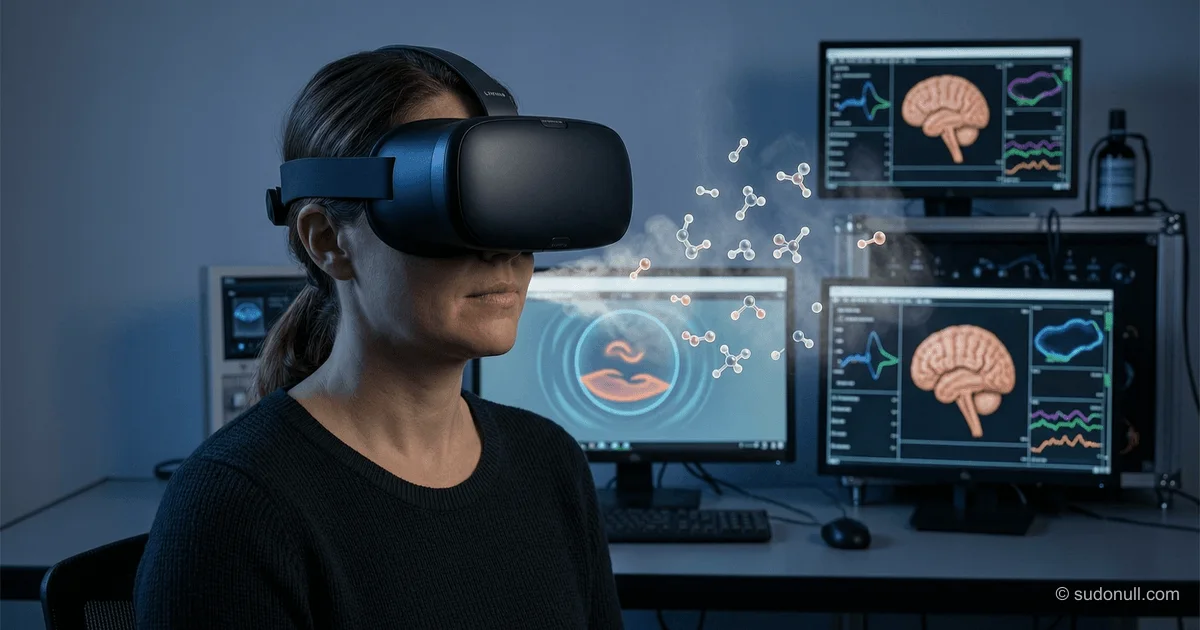
# Ultrasound Instead of Cartridges: Evoking Scents in VR Without Chemicals
Researchers have developed a method to stimulate the olfactory bulb using focused ultrasound, bypassing traditional chemical scent sources. This paves the way for fully multisensory virtual reality without the need for consumables.
The Problem with Chemical Solutions for VR Olfaction
Previous attempts to integrate smells into VR systems relied on physically releasing aromatic substances—most often through cartridges with liquids or gels. This approach had several fundamental drawbacks:
- Legal restrictions related to classifying devices as electronic cigarette analogs;
- The need for constant replacement of consumables, making the system expensive and inconvenient;
- Slow degradation of scents leading to "cross-contamination" of sensations;
- Limited set of available smells due to the physical nature of the carriers.
These factors made chemical solutions impractical for mass adoption, especially in the context of commercial VR platforms.
Ultrasound Stimulation of the Olfactory Bulb
The new approach, proposed by a group of researchers (Lev Chizhov, Albert Jan-Huan, Thomas Ribeiro, and Aayush Gupta), is based on non-invasive neuromodulation. The device generates a focused ultrasound beam that passes through the skull's bone tissue and directly impacts the olfactory bulb—a brain structure responsible for primary processing of olfactory signals.
The emitter is placed on the user's forehead, between the eyebrows, using a dense gel pad to ensure acoustic contact and comfort. The current prototype requires manual fixation, but its size suggests potential integration into existing VR headsets in the future.
Difference Between "Smell" and "Sensation"
During experiments, participants reported two types of perception:
- Smell — a clearly localized, intense sensation that you can "sniff" like from a physical source. It occurs mainly during active inhalation.
- Sensation — a diffuse, slowly building impression, often accompanied by tactile effects (for example, slight tingling on the face), likely due to cross-activation of somatosensory pathways.
Among the successfully reproduced scents:
- Fresh air with elevated oxygen content;
- Smell of decomposing organic waste (described as like fruit peel left for several days);
- Ozone, characteristic of air ionizers;
- Campfire smoke.
Interestingly, some participants experienced a strong emotional reaction: one of the researchers, upon smelling garbage, instantly opened their eyes, mistaking it for a real signal (garbage truck arriving).
Advantages of the Ultrasound Method
Key technical and user advantages of the new approach:
- No consumables;
- Instant on/off of scents without residual effects;
- Ability to programmatically modulate ultrasound parameters to create a wide spectrum of olfactory sensations;
- Potential compatibility with existing HMD (head-mounted displays) after miniaturizing components.
Additionally, the method doesn't require introducing chemicals into the airways, reducing risks of allergic reactions and simplifying regulatory approval.
Comparison with Other Technologies
Previously, engineers from the Tokyo Institute of Science presented an olfactory display based on micro-dispensers and surface acoustic waves (SAW). Their system can mix up to eight base scents in real time with precise intensity control. However, it still depends on physical carriers and faces the same limitations as other chemical solutions.
The ultrasound method is fundamentally different: it doesn't generate smell molecules but directly stimulates the neural circuits responsible for their perception. This makes the technology akin to TMS (transcranial magnetic stimulation), but with higher spatial precision and less invasiveness.
Key Points
- Ultrasound enables olfactory sensations without chemicals.
- Stimulation targets the olfactory bulb through the frontal bone.
- Users distinguish "smells" (localized) from "sensations" (diffuse).
- The technology is potentially integrable into commercial VR headsets.
- No consumables or residual effects—a key advantage over alternatives.
— Editorial Team










No comments yet.