# Tungsten and Graphene Memristor Withstands 700°C: Breakthrough for Electronics in Extreme Conditions
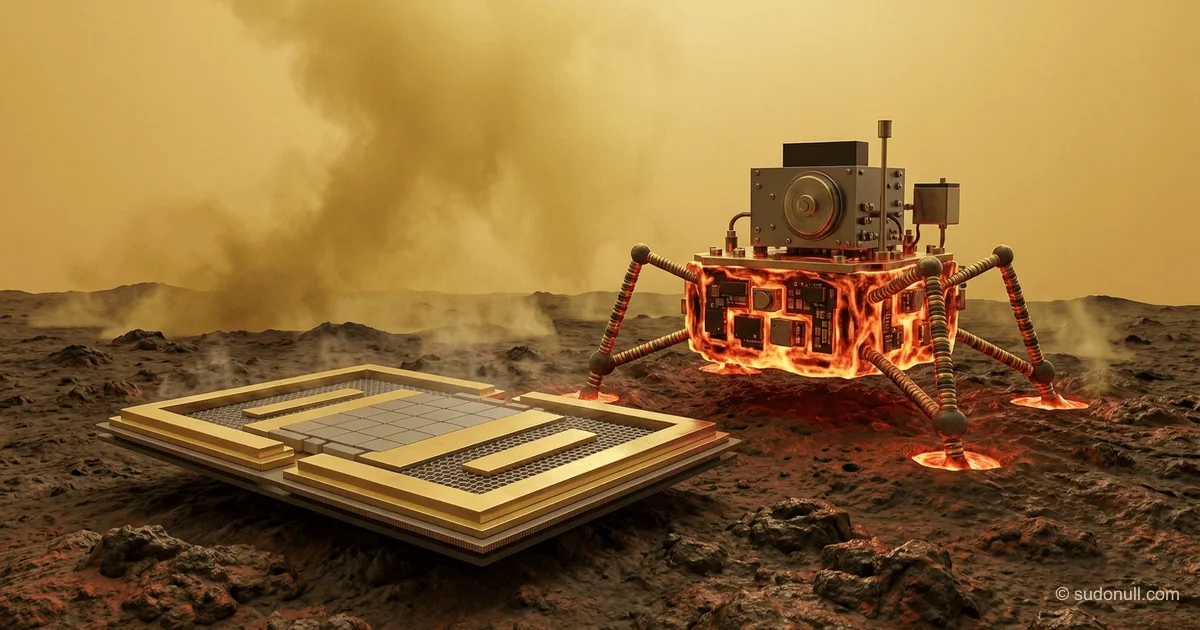
Engineers from the University of Southern California have developed a memristor capable of stable operation at temperatures up to 700°C — significantly higher than conditions on Venus's surface. This achievement overcomes the decade-long limitation of traditional electronics, which lose functionality at just 200°C. The new device paves the way for creating systems resilient to extreme thermal loads in space, geothermal energy, and nuclear installations.
Design That Withstands Molten Lava
The heart of the development is a memristor with a unique multilayer architecture. Its core is a "sandwich" of two electrodes and a hafnium oxide (HfO₂) dielectric layer. The outer electrodes are made of tungsten — a metal with a record melting point (3422°C). At the bottom of the structure is a monolayer of graphene, which plays a key role in preventing device degradation.
At high temperatures, in classical memristors, atoms from the metal electrodes begin to diffuse through the dielectric. This process, known as electromigration, eventually leads to the formation of a conductive channel between the electrodes and irreversible short-circuiting. The graphene layer blocks this mechanism at the atomic level, ensuring long-term stability even at 700°C.
Applications Beyond the Lab
The technology has direct relevance for several high-tech industries:
- Space missions to Venus: All landers, including Soviet Venera probes, failed within hours due to electronics overheating. New chips could keep scientific instruments running for weeks or months.
- Deep geothermal drilling: Sensors placed in wells deeper than 10 km face temperatures over 500°C. Current solutions require active cooling or frequent replacement.
- Nuclear and fusion energy: Control and measurement systems near reactors need components resistant to radiation and heat without extra shielding.
Technical Features and Limitations
The memristor retains its functional properties thanks to a combination of highly heat-resistant materials and controlled ion migration. Hafnium oxide was chosen deliberately: it delivers stable resistive switching even at extreme temperatures, which is critical for memory and logic elements.
However, the technology is still at the lab-testing stage. Integrating these components into full computing systems will require tackling these challenges:
- Developing compatible lithography methods for multilayer structures with graphene.
- Ensuring reliable interconnections between heat-resistant and conventional components.
- Scaling production while maintaining atomic-layer precision.
Key Takeaways
- Tungsten, hafnium oxide, and graphene memristor operates stably at 700°C — higher than Venus's surface temperature (about 465°C).
- Graphene prevents electromigration of metal atoms, eliminating the main cause of electronics failure from overheating.
- Technology applicable in space missions, geothermal extraction, and nuclear energy.
- Device has no internal cooling and doesn't require a sealed capsule.
- Tests pushed the furnace to its limits — the real reliability threshold may be even higher.
This development signals a shift from passive electronics protection (thermal containers, cooling) to active components designed from the ground up for extreme conditions. It's especially relevant for autonomous systems where weight and power consumption are critical.
— Editorial Team










No comments yet.