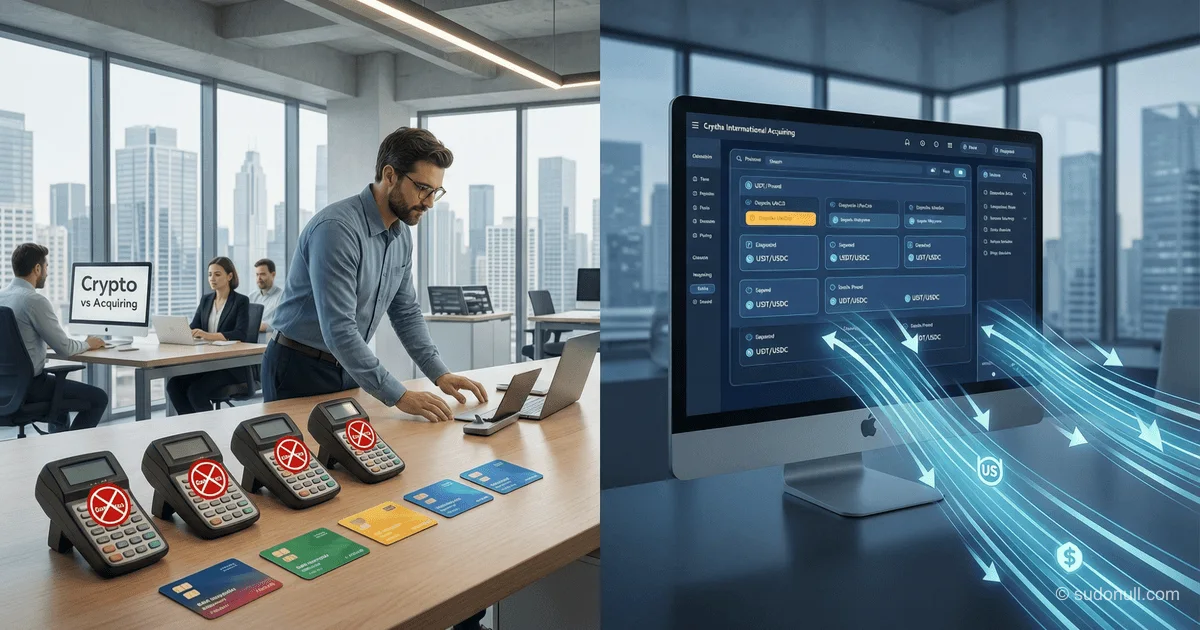
# Crypto Acquiring vs. International Acquiring: The Choice for Global Business in 2026
Amid tightening international sanctions, blocks, and growing regulatory pressures on traditional payment systems, crypto acquiring has evolved from a niche solution into a viable alternative for businesses with a global audience. This is especially relevant for companies in jurisdictions facing restrictions on access to SWIFT and Western processing systems. In 2025–2026, changes in U.S. legislation and the surge in stablecoin transaction volumes have dramatically reshaped the landscape of digital payments.
Evolution of Payment Infrastructures: From Fiat to Regulated Crypto
International internet acquiring has traditionally relied on banking infrastructure supporting card payments and local methods. However, its key drawbacks—high fees (up to 10% including conversion and chargebacks), lengthy KYC/KYB checks, geographic restrictions, and the risk of sudden account blocks—make it an unpredictable tool for businesses outside the "white list" countries.
Meanwhile, crypto acquiring, once seen as an experiment, received a major boost from the adoption in the U.S. in 2025 of two key laws:
- GENIUS Act—allows licensed banks and non-bank organizations to issue stablecoins under strict reserve, capital, and monthly certification requirements.
- STABLE Act—legally defines payment stablecoins, prohibits interest accrual on them, and sets liquidity standards.
These laws have legitimized stablecoins as part of the financial infrastructure, accelerating their integration into commercial payment flows. According to TRM Labs, stablecoin transaction volumes in the first half of 2025 exceeded $4 trillion—an 83% increase compared to the same period in 2024.
Comparative Analysis: Technical and Operational Parameters
When choosing between fiat and cryptocurrency acquiring, it's important to evaluate not just cost, but also operational resilience, integration speed, and scalability.
International Acquiring
- Setup: Requires an overseas company, corporate bank account, and KYB/KYC verification. The process takes days to weeks.
- Fees: 2.9% + fixed fee per transaction, plus up to 5–7% for conversion and chargebacks.
- Restrictions: Geographic blocks, bans on high-risk niches (gadgets, software, digital services), turnover limits.
- Reliability: High for low-risk businesses, but vulnerable to political and regulatory risks.
Crypto Acquiring
- Setup: Just a domain and basic verification. Supports sole proprietors and small projects without offshore structures. Integration in hours.
- Fees: From 0.4% to 1%, no hidden fees for conversion or chargebacks (technically impossible).
- Restrictions: Minimal—no country ties, high-risk sectors allowed.
- Reliability: Depends on the provider, but immune to blocks from banks or payment systems.
Market Leaders: Overview of Solutions for Developers
Fiat Providers
- Stripe: API-first approach, ideal for SaaS and marketplaces. Does not serve CIS directly.
- PayPal: Maximum brand recognition, but high risk of account freezes with growing volumes.
- Square: Focused on offline + online mix, limited by geography (USA, Canada, EU).
Crypto Providers
- CryptoCloud: Supports stablecoins (USDT, USDC), volatility protection, fees from 0.4%, fast payouts in fiat or crypto.
- Coinbase Commerce: Reliable infrastructure, but limited availability and 1% fee.
- NOWPayments: Over 200 assets, automatic conversion, plugins for WooCommerce, Shopify, simple integration via REST API.
Example NOWPayments integration via API:
import requests

API_KEY = "your_api_key"
url = "https://api.nowpayments.io/v1/invoice"
headers = {
    "x-api-key": API_KEY,
    "Content-Type": "application/json"
}
payload = {
    "price_amount": 100,
    "price_currency": "usd",
    "pay_currency": "usdt",
    "order_id": "#12345",
    "order_description": "Premium subscription",
    "ipn_callback_url": "https://yourdomain.com/webhook"
}

response = requests.post(url, json=payload, headers=headers)
print(response.json())
How to Choose: Three Key Criteria
- Customer Geography: If the audience is concentrated in the EU/USA and pays by card—fiat acquiring offers higher conversion. For global reach including countries with unstable banking systems—crypto is preferable.
- Business Risk Profile: High-risk (SaaS, digital goods, subscriptions) often get rejected by Stripe/PayPal. Crypto acquiring is the only viable option here.
- Speed and Autonomy Requirements: If instant payments without compliance check delays and block risks are key—crypto infrastructure ensures operational independence.
Key Takeaways
- Crypto acquiring is no longer just an alternative—it's a full-fledged tool for global settlements thanks to U.S. stablecoin regulation.
- Crypto acquiring fees are 3–10 times lower than international fiat systems when accounting for all charges.
- No chargebacks improve financial predictability, but require a clear refund policy to maintain trust.
- Crypto acquiring integration is technically simpler and faster, especially for IT products with API-first architecture.
- Provider selection should be based on support for needed assets (most often USDT/USDC), payout speed, and automatic conversion availability.
— Editorial Team










No comments yet.