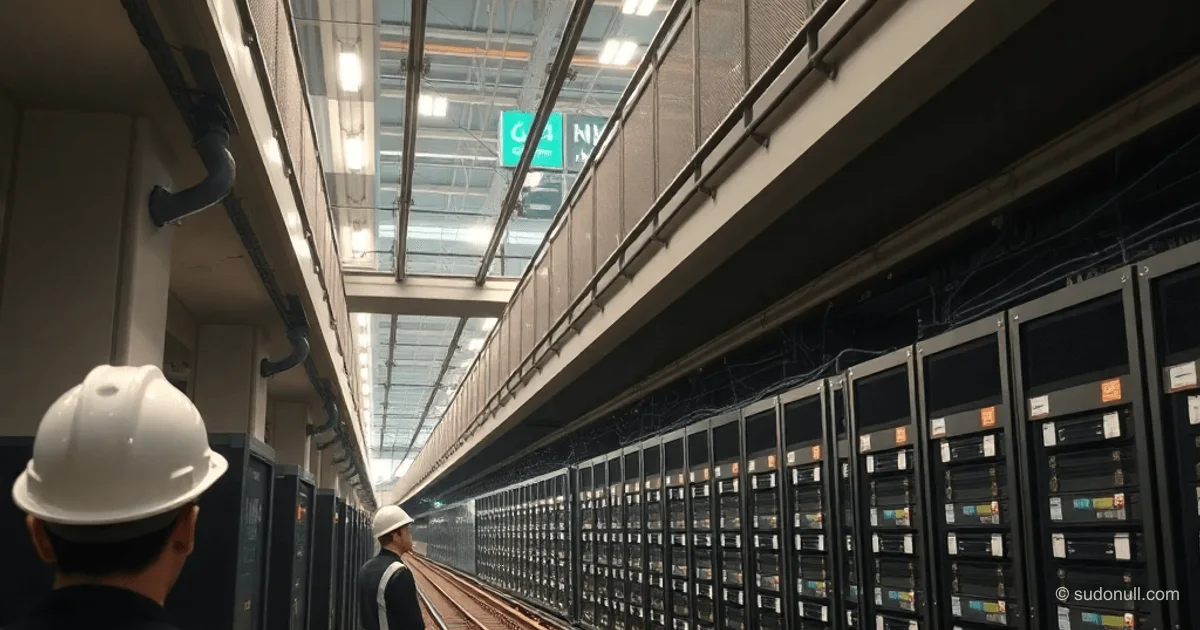
Modular Data Centers Under Railway Viaducts: The Tokyu Experiment
Japanese conglomerate Tokyu, which operates railway lines, is launching a demonstration project to install a modular data center under the Oimachi Line viaduct. Starting in June 2026, Tokyu, Tokyu Electric Railway, iTSCOM, and Tokyu Construction will test a small modular data center in an urban infrastructure setting. The Oimachi Line connects Oimachi in Tokyo's Shinagawa district with Mizonokuchi in Kawasaki (Kanagawa Prefecture).
Testing will focus on specific factors of the railway environment: vibrations, noise, and server cooling efficiency. The data obtained will determine the feasibility of deploying similar facilities in comparable locations. A key advantage will be leveraging the existing high-bandwidth fiber optic cable network along the tracks.
Technical Aspects of Testing
In the experiment, they will measure:
- Sound and vibration isolation of server equipment.
- Cooling system efficiency under viaduct conditions.
- Operational stability under transport loads.
The modular data center design will allow quick deployment of the test environment and data collection for scaling. The Oimachi Line infrastructure will provide low-latency fiber optic connectivity, minimizing data transmission delays.
Tokyu owns a network of railways and bus operators in the Greater Tokyo Area, opening potential for integrating data centers into the existing transport ecosystem. In the future, the company plans similar projects along the Shibuya Line to create digital urban infrastructure.
Alternative Approaches: Data Centers on Barges
Parallel innovations are developing in other regions. Singapore's Bridge Data Centres and China's Concord New Energy are preparing to place hydrogen generators on barges to power data centers. This configuration offers:
- Deployment in coastal zones without occupying land areas.
- Separation of hydrogen infrastructure from core data center operations.
- Flexibility in hydrogen transportation and storage thanks to Singapore's maritime logistics.
Compared to land-based solutions, it shows advantages in scalability and safety: barges isolate hydrogen-related risks from computing power.
What’s Important
- Oimachi viaduct testing from June 2026: focus on vibration isolation, noise, and cooling for modular data centers.
- Fiber optic utilization along railway lines for high-speed connectivity.
- Expansion plans to the Shibuya Line and Greater Tokyo digital infrastructure.
- Hydrogen-powered barge data centers in Singapore: advantages in flexibility and safety.
- Overall trend: integrating computing power into transport and coastal infrastructure to optimize resources.
Prospects for IT Infrastructure
Tokyu's project demonstrates an approach to utilizing underutilized spaces in megacities. For mid/senior-level data center specialists, key metrics will be PUE (Power Usage Effectiveness) results in vibrational conditions and latency using railway fiber optics. Modular data centers simplify A/B testing of cooling and isolation configurations.
Barge solutions add a dimension of resilience: hydrogen generators on floating platforms minimize carbon footprint through green fuel, with the ability to quickly relocate power capacities. Engineers must consider marine corrosion, wave-induced vibrations, and integration with shore-based networks.
This experiment highlights the shift toward edge and urban computing, where city infrastructure becomes the foundation for distributed computing. Developers will be able to optimize applications for low-latency connections via railway trunk lines.
— Editorial Team










No comments yet.