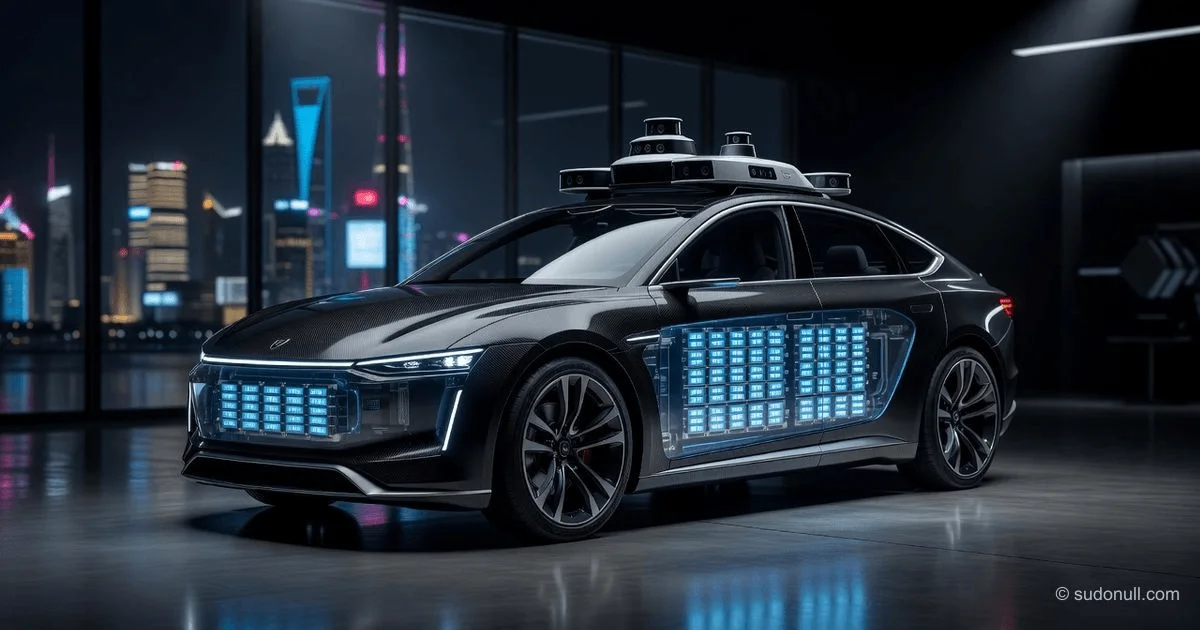
Chinese startup DeepWay announces robotaxi with 1000 km range without recharging
Autonomous electric vehicle uses solid-state batteries and new AI control architecture, launch in Shanghai scheduled for July.
DeepWay and the solid-state revolution: what lies behind the Chinese robotaxi with 1000 km range
Earlier this week, news came from Shanghai that seemingly fits the familiar narrative of China's electric vehicle surge: startup DeepWay announced a robotaxi with a 1000 km range without recharging, using solid-state batteries and a new AI control architecture. Launch is promised as early as July 2026. At first glance, another loud number aimed at stealing attention from Tesla and Waymo. But if you look closer, this news is like an iceberg: the visible part is "1000 km," while underwater lies a complete transformation of the economy, geopolitics, and production chains in the automotive industry.
[The Essence]: what is really happening
China's automotive industry has moved from a "catching-up" phase to a "standard-setting" phase. But not through marketing, but through total vertical integration and state planning at a level that Western corporations simply cannot afford by definition. DeepWay is not just another startup. It is a project backed by one of China's largest auto giants, and its announcement is not a technical experiment but a signal to the market that solid-state batteries are no longer a laboratory curiosity.
Why is this fundamentally important? Because the claimed 1000 km is not some theoretical figure. It is the result of Chinese manufacturers already launching experimental production lines for solid-state batteries and preparing for mass production in 2026–2027. GAC, Dongfeng, Chery—all have announced models with solid-state batteries for 2026 with energy densities from 350 to 600 Wh/kg. That is two to three times higher than current lithium-ion batteries. And this changes the entire math of the electric vehicle.
The robotaxi market, according to Counterpoint Research, will reach $168 billion by 2035, with the fleet growing to 3.6 million units. Chinese companies already occupy three of the top five spots in the global robotaxi ranking, surpassing Tesla and Zoox in real commercialization. Baidu Apollo Go, Pony.ai, and WeRide are not some "Chinese Teslas" but companies that actually make money from autonomous rides and are scaling beyond China. DeepWay in this lineup is a new but well-armed player.
Timeline and context
To understand the depth of the shift, let's look at the timeline and compare key metrics of different approaches:
| Parameter | DeepWay Robotaxi (2026) | Tesla CyberCab (2026) | Waymo Gen 6 (2026) | XPeng Robotaxi (2026) |
|---|---|---|---|---|
| Range (km) | 1000+ (solid-state battery) | ~550 (estimated) | ~500 (estimated) | 600+ |
| Production cost | Estimated < $40,000 | Estimated < $30,000 | ~$80,000–$100,000 | < $28,000 |
| Sensor system | Multimodal | Pure Vision | Lidar + radar + cameras | Pure Vision |
| Paid service availability | No (launch in July) | Limited (3 cities) | 250,000 rides/week, 11 cities | Yes (from 2026) |
Notice the key gap: Waymo is the technology leader in quality, but their cars cost three to four times more than Chinese counterparts. Tesla is trying to replicate the Chinese pure vision strategy but lags in scale. The Chinese, meanwhile, are catching up in quality and have already surpassed in cost. That is where the main story lies.
Who wins and who loses
China wins overall. Thanks to solid-state batteries already leaving laboratories and undergoing pilot production, Chinese automakers gain a commercial advantage that cannot be quickly copied. This is not software that can be rewritten in a year. It is chemistry, materials science, and production lines built over the last five years. By 2027, Dongfeng promises a second generation of solid-state batteries with a density of 500 Wh/kg based on sulfides. If that happens, the gap in range and cost will become insurmountable for Western competitors.
Chinese taxi platforms win. Unlike the US and Europe, where robotaxis face regulatory barriers and unions, China is a single market with a huge population where the state is both customer and regulator. DeepWay can scale domestically faster than anyone from outside.
Waymo and Tesla lose. Waymo is stuck in a high-cost model. Their fifth generation on Jaguar I-PACE cost over $100,000 per car, and even the sixth generation is estimated to cost $0.99–$1.08 per mile, still higher than Chinese competitors. Tesla is a separate story. Their CyberCab essentially tries to do what the Chinese have been doing for the last three years, but they do not control the battery supply chain, and regulatory restrictions in the US prevent them from scaling. In Texas, Tesla has only 69 registered robotaxis. Waymo has 250,000 rides per week. Different leagues.
European and Japanese manufacturers lose. They are traditionally strong in mechanics but weak in software and chemistry. Toyota promised solid-state batteries back in 2020, yet still no production model. Europe has essentially dropped out of the race—they have neither their own solid-state batteries nor large-scale robotaxi operators. As Axios writes, even European officials admit they risk "missing this wave."
What the media isn't saying
Now—the main insight that is not obvious and that I see as someone tracking production logistics.
Problem #1: 1000 km is most likely the Chinese CLTC cycle.
No one in the press releases specifies which standard the range was measured under. And the difference is enormous: CLTC is about 30–35% more optimistic than the European WLTP, and 35–40% more than the American EPA. So the real range in a mixed cycle will likely be around 650–700 km. That is still good, but not "1000 km" in the sense that Western consumers understand. It is a marketing advantage, not a physical one.
Problem #2: Charging infrastructure is the bottleneck.
DeepWay's solid-state batteries support ultra-fast charging—Dongfeng is already showing a 1200 V platform with 2 MW power. But who will build these charging stations? In China, the state, and it will be done quickly. In the US, private companies, and it will take years. In Europe, it is unclear. So "1000 km" in China is a reality, but in Europe or the US it is just a nice number that cannot be used in practice because there is nowhere to charge.
Problem #3: Entering international markets will take much longer than promised.
DeepWay talks about launching in Shanghai in July. That is realistic. But entering Europe, the Middle East, or the US will take years. The experience of WeRide and Pony.ai shows that even with local government support, adapting to new regulations, road conditions, and partnerships takes years. In London, for example, robotaxis must learn to drive on narrow streets where carriages once rode and yield to cyclists. That is not solved in one quarter.
Problem #4: Production cost is not the whole economics.
DeepWay and XPeng claim car costs around $28,000–$40,000, which is 3–4 times cheaper than Waymo. That sounds like a win. But in reality, operating expenses for robotaxis include not only vehicle depreciation but also insurance, maintenance, remote monitoring, sensor cleaning, etc. So far, none of the Chinese operators have published full per-mile economics. And there is suspicion that the gap in total cost of ownership is not as dramatic as the gap in hardware cost.
Forecast: next 30 days and 90 days
Next 30 days: Expect a wave of contracts between DeepWay and Chinese taxi platforms—Didi, Amap, and others. This will not be a technical announcement but commercial agreements locking in initial orders for thousands of cars. Also, partnerships with Uber or Lyft for tests outside China will likely be announced, probably in the Middle East, where the regulatory environment is most favorable. But these will be tests, not commercial launches.
Next 90 days: The key will be the actual launch in Shanghai in July. If it happens without scandals and with real passengers, it will trigger a revaluation of the entire sector. Shares of Chinese battery manufacturers (CATL, BYD) and automakers will rise, and Western analysts will start revising their market share forecasts for Tesla and Waymo.
The second important point is the reaction of regulators in the US and Europe. If they speed up permits for local players, it will be a sign that they take the Chinese challenge seriously. If not, bureaucracy will trump competition, and the Chinese will gain a 2–3 year head start.
Bottom line: behind DeepWay's announcement is not just another car, but a systemic shift in how autonomous transport is produced, sold, and operated. Solid-state batteries are the key, but the lock is scale. And China is already unlocking that lock. The rest either catch up or change the rules of the game. There is no third option.
— Editorial Team










No comments yet.