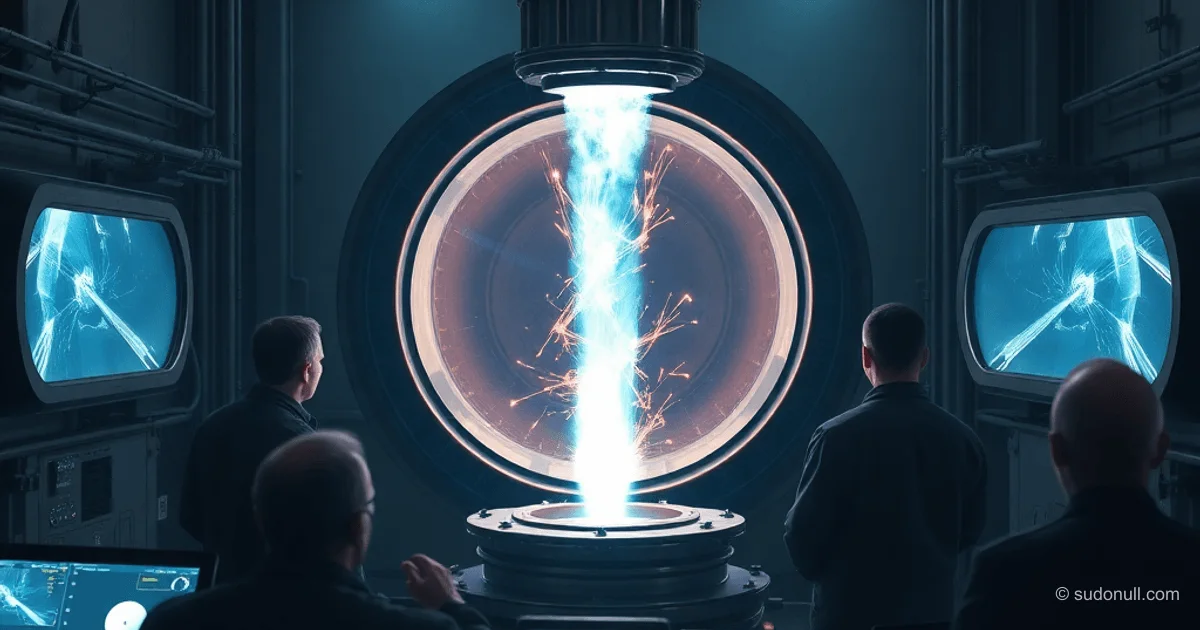
# Pulsar Fusion Ignites Plasma in Prototype Fusion Rocket Engine
British startup Pulsar Fusion has achieved a breakthrough: for the first time, plasma has been ignited in the Sunbird fusion exhaust system prototype using electric and magnetic fields. The testing took place at the company's headquarters in Bletchley, UK, and was streamed live at the Amazon MARS conference. This demonstrates the potential of fusion engines for accelerating interplanetary flights.
Technological Basis of the Experiment
The Sunbird fusion prototype is an early model of a fusion-powered rocket engine. The team used electric and magnetic fields to ionize gas and generate plasma at extreme temperatures. Stabilizing plasma in Earth-based lab conditions is challenging due to heat losses, but the low ambient temperatures in the vacuum of space make the task much easier.
The process replicates the reactions that power stars: the fusion of light atomic nuclei (deuterium, tritium), releasing energy according to Einstein's equation E=mc². In the engine, magnetic fields accelerate the plasma, creating a high-velocity exhaust.
Advantages of Fusion Propulsion
Fusion engines promise a radical increase in efficiency compared to chemical and ion systems:
- Thrust: up to 1,000 times higher than orbital engines (e.g., Hall thrusters).
- Speed: up to 800,000 km/h (0.66% speed of light), compared to 40–50 km/s for current systems.
- Energy output: specific impulse (Isp) in tens of thousands of seconds vs. 450 s for LH2/LOX.
- Fuel: deuterium from water, with supplies lasting centuries.
- Scalability: modular configurations for ships of various classes.
These parameters could cut Mars flight times from 6–9 months to 1–3 weeks, minimizing exposure to cosmic radiation and microgravity.
Challenges and Future Improvements
Key challenges for fusion systems:
- Plasma stabilization: turbulence causes energy losses (MHD instabilities).
- Materials: need for superconductors to generate fields >10 T.
- Reaction ignition: achieving the Lawson criterion (nτE > 10²¹ m⁻³·s·keV).
Pulsar Fusion is focusing on high-field superconducting magnets for better confinement. Upcoming tests will verify plasma stability and measure thrust in a vacuum chamber.
Key Takeaways
- The first successful plasma ignition in a fusion rocket prototype paves the way for direct trajectories to Mars.
- Potential speeds of 800,000 km/h will revolutionize Solar System logistics.
- The space vacuum is ideal for fusion, reducing cryogenic requirements.
- Magnet improvements will boost confinement efficiency by 20–50%.
- Shorter missions reduce crew risks: radiation, osteoporosis, muscle atrophy.
— Editorial Team










No comments yet.